
Diaper Price Comparison by Unit Cost: Rank Brands by Statistical Unit Price

Key Takeaways
- Cost per diaper, not the sticker price on the pack, is what tells you the real value. A $50 box of 200 beats a $25 box of 80.
- A useful comparison table needs five columns: brand, pack quantity, price per pack, cost per diaper, and discounted cost per diaper.
- Store brands consistently win on raw cost per diaper. A size 3 store pack lands around $0.15 each.
- Premium eco and subscription brands sit at the top, often double a warehouse pack at roughly $0.36 per diaper.
- Subscribe-and-save discounts can reshuffle the whole ranking, dropping a subscription-only brand from $0.30 to $0.24 per diaper.
- A 198-count bulk warehouse pack at $42.99 works out to about $0.22 per diaper, with no subscription discount available.
- Real per-brand breakdowns exist, including a JennyBlogs test comparing 66 diapers and Diaper Dabbler's cheapest-options ranking.
Quick Summary
Diaper costs come down to one number: cost per diaper. Not the sticker price on the pack. Quantity relative to total price is where the real value hides, which is why we tell shoppers to ignore the pack price and sort by per-unit cost. Same logic behind comparison tools like DiaperPricer.
What a real diaper comparison table looks like
A useful comparison needs at least five columns: brand, pack quantity, regular price per pack, cost per diaper, and the discounted cost per diaper after subscriptions or coupons. That last column matters because subscribe-and-save can swing the ranking entirely.
The Diapers Analysis Template from FamilyConsumerSciences.com tracks exactly these fields. Here's an illustrative layout:
| Brand / Product | Pack Qty | Price/Pack | Cost/Diaper | Cost/Diaper (Subscription) |
|---|---|---|---|---|
| Store brand (size 3) | 168 | $24.99 | $0.15 | $0.13 |
| Mid-tier name brand | 120 | $27.99 | $0.23 | $0.20 |
| Premium eco brand | 96 | $34.99 | $0.36 | $0.31 |
| Bulk warehouse pack | 198 | $42.99 | $0.22 | $0.22 |
| Subscription-only brand | 140 | $42.00 | $0.30 | $0.24 |
Numbers shift by size and region, so treat this as a structure to copy, not fixed pricing.
Which brands are cheapest, and which are robbery?
Store brands almost always win on raw cost per diaper. Premium eco and subscription brands sit at the top, often double the price of a warehouse pack. For real per-brand breakdowns, JennyBlogs ran 66 diapers side by side and Diaper Dabbler ranked the cheapest options.
One catch we see constantly: shrinkflation. A pack quietly drops from 92 to 84 diapers while the price holds. A Reddit user in r/Target, after tracking sizes for a while, called it "honestly infuriating" how often counts shrink without notice. So recalculate cost per diaper every few months. Not once.
How long does manual comparison actually take?
Doing this by hand is the hard part. You're opening five retailer sites, dividing prices by counts that aren't always listed, and re-checking after each restock or coupon cycle. Budget 30 to 60 minutes per full comparison if you go manual.
The math is trivial. The grind is the data collection across stores that hide unit price or bury it in fine print. That's the entire reason unit-price tools exist.
Skip the manual route if you only buy one box a month from one store. The savings won't beat the time spent. Run the full comparison when you're buying in bulk, switching sizes, or testing a new brand. That's where cost per diaper actually moves your monthly budget.
How the brand ranking works
Ranking diaper brands fairly means stripping out the marketing and reducing every option to comparable numbers. Two metrics do the heavy lifting: average cost per diaper and price per pound of absorbent material. Both let you line up unequal packs side by side and rank them honestly.
The two numbers that decide the ranking
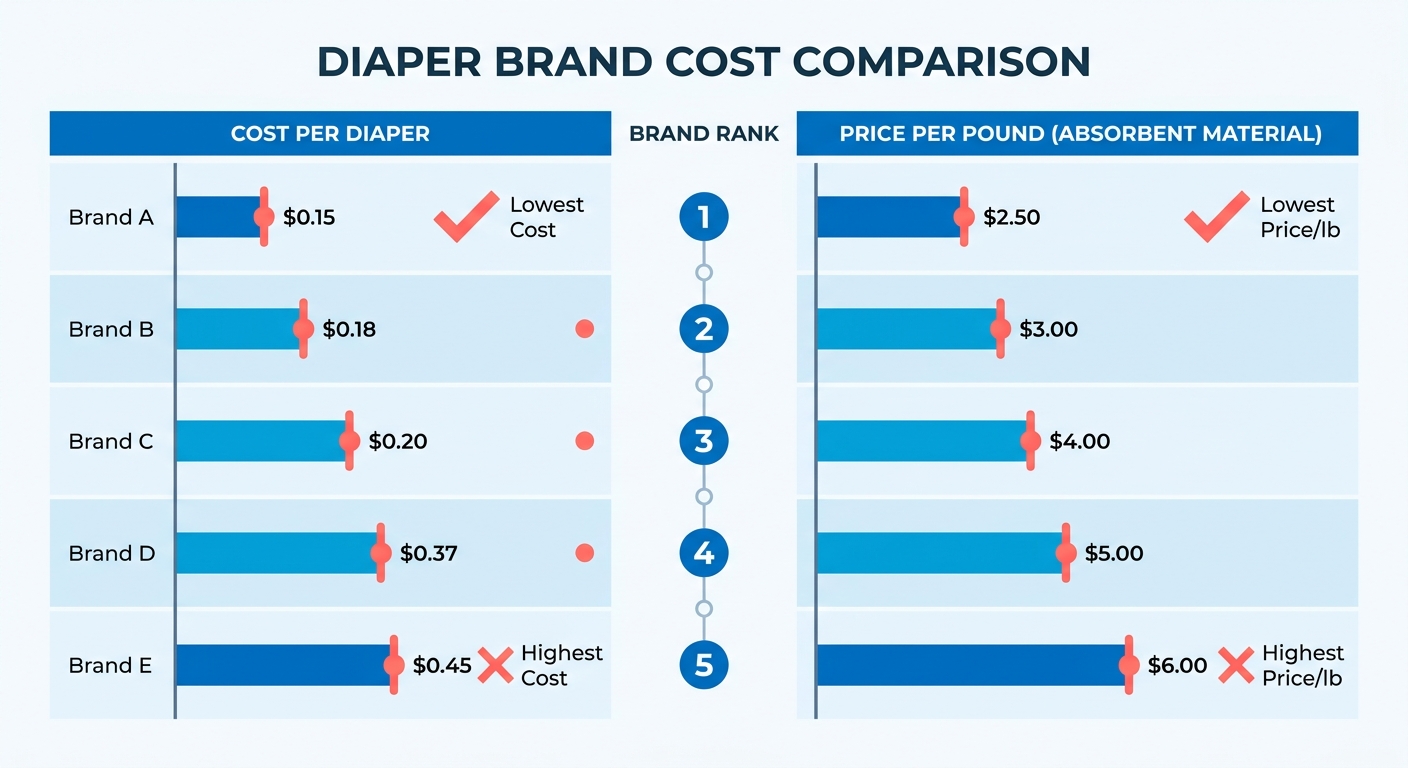
Cost per diaper divides the pack price by the count. Price per pound accounts for size and absorbency differences across the same brand line.
Price per pound matters because diapers grow with the child. A size 6 holds far more material than a size 1, so comparing raw per-diaper cost across sizes misleads you. Normalize by weight or absorbency and the comparison stays apples-to-apples.
Track regular pricing alongside post-discount figures and you can see how promotions move the baseline. That keeps a temporary sale from skewing your long-term read on a brand.
How the data gets collected
The ranking pulls live prices across brands and pack sizes, then converts each to a per-unit figure. Scraping tools speed this up by aggregating retail listings, so you can sort by true unit cost instead of shelf price.
The statistical step is simple division applied consistently. Calculate cost per diaper for every pack, then average across pack sizes within a brand to get a representative figure. Larger packs almost always win on per-unit cost, which is why bulk boxes dominate the top of most rankings.
Cross-referencing price data with physical product testing helps verify the findings. Hands-on reviews assess whether material thickness tracks with price, while curated cheapest-diaper lists help sanity-check pricing baselines across regional markets.
Where unit-cost ranking falls apart
Unit-cost ranking has real blind spots. The biggest: it measures price, not performance. A cheaper diaper that leaks costs you more in changes, laundry, and ruined clothes than the per-unit number suggests.
Pricing is a moving target. Retailers adjust packaging constantly, so a spreadsheet from six months ago may not match current inventory. Because manufacturers tweak package volumes instead of shelf prices, historical unit-cost databases need constant updates to stay reliable.
Sample bias creeps in too. Most public comparisons skew toward major retail brands and online availability. Store-brand and regional options get undercounted, and a deal in one zip code may not exist in another.
Why you should rank on the discounted price
The post-discount column is where most decisions actually flip. A brand that looks expensive at shelf price can drop below a cheaper rival once subscription pricing applies. So rank on the discounted figure, not the sticker.
Watch how percentage discounts scale with pack size. A 15% subscription cut on a 144-count box saves far more per change than the same percentage on a 24-count travel pack, even though both advertise identical savings. That's why bulk buyers see the steepest real per-diaper drop, and why the discount column reorders rankings more than the regular-price column ever does.
Reading the price chart by brand
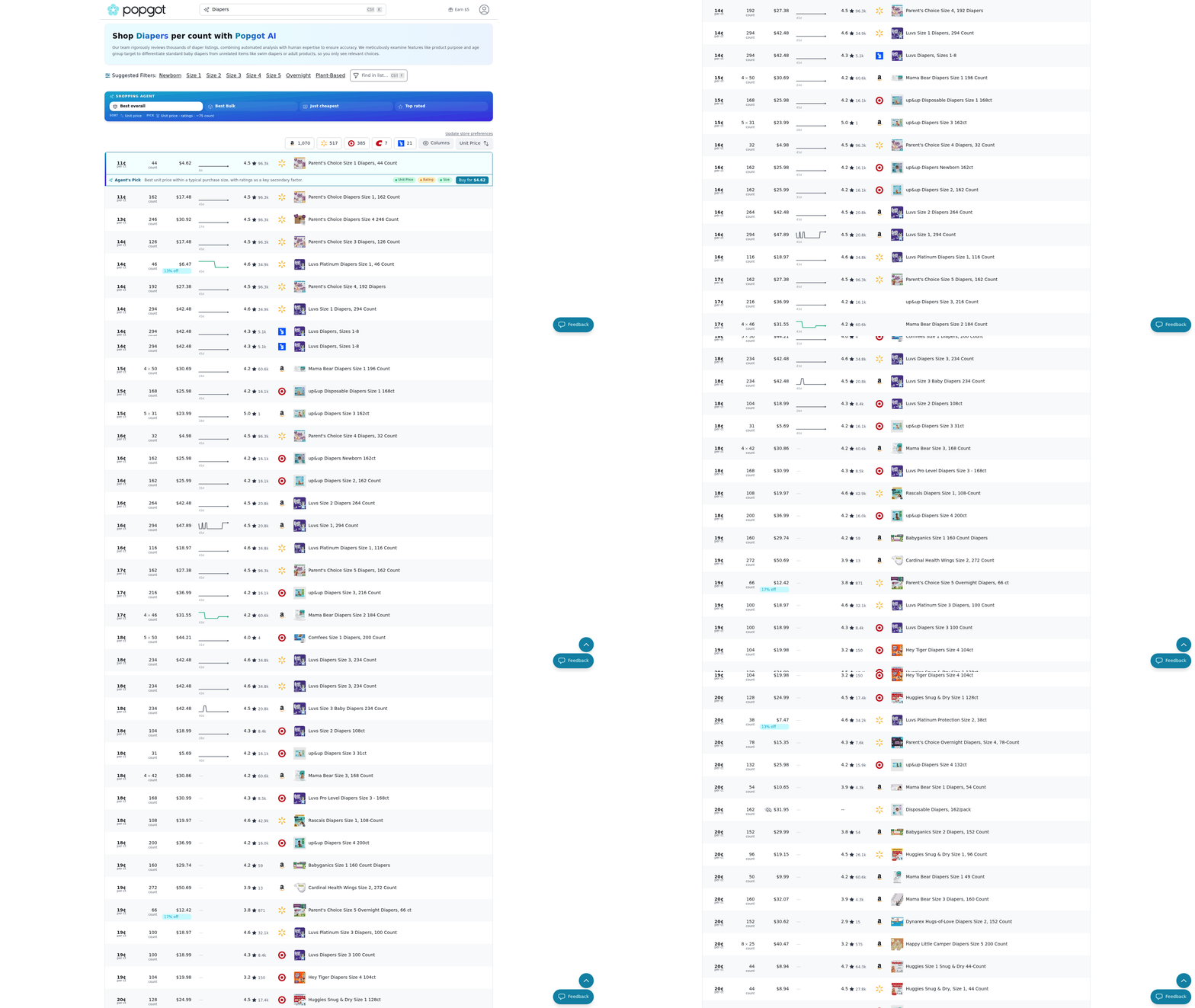
A comparative price chart turns a confusing wall of pack prices into one ranked list you can scan in seconds. Plot every brand on a single axis (cost per diaper) and the cheapest and priciest options jump out immediately.
How to read it
A good chart ranks brands low to high by cost per diaper, then layers in the discounted price as a second bar. Read it like a leaderboard: bottom of the list is your best value, top is what you're overpaying for. The second bar matters because subscribe-and-save can flip the order entirely.
Plot the baseline unit cost next to the promotional unit cost for each brand. A simple dual-bar format lets you see both pricing tiers at once, which makes it easy to spot the brands with the most aggressive loyalty incentives.
What the chart actually reveals
The chart exposes gaps that pack prices hide. Two brands can sit ten cents apart on the shelf yet land twenty cents apart per diaper once you account for count. Store brands and warehouse-club options usually cluster at the cheap end, while heavily-marketed name brands sit higher.
Watch for the discount bar that leapfrogs a brand from mid-pack to cheapest. A premium brand with an aggressive subscription can undercut a store brand that has no deal. That's the single most useful thing a chart shows you, and it's invisible if you only look at sticker prices.
One caveat: a chart is only as honest as its inputs. Compare different sizes side by side and the cheapest "brand" might just be the smallest diaper. Normalize by size before you trust the ranking.
How it helps you decide
It collapses a half-hour of mental math into a glance. Say you're choosing between four brands for a size 4. Three look similar on the shelf, but the chart shows one is eight cents per diaper cheaper after its subscription discount. At roughly 240 diapers a month, that's a real cut to your monthly spend.
The chart also catches packaging changes you'd otherwise miss. When a manufacturer drops a box count while holding the retail price, the bar visibly shifts upward. Compare an old chart against a current one and those quiet adjustments become obvious.
Adjusting diaper prices for inflation
Inflation hits diaper budgets harder than most baby costs because you buy them constantly for years. Adjusting for inflation means converting old prices into today's dollars so you can compare what you actually paid then versus now. The tool for that is the Consumer Price Index (CPI), which tracks how much a basket of goods costs over time.
How to do the inflation math
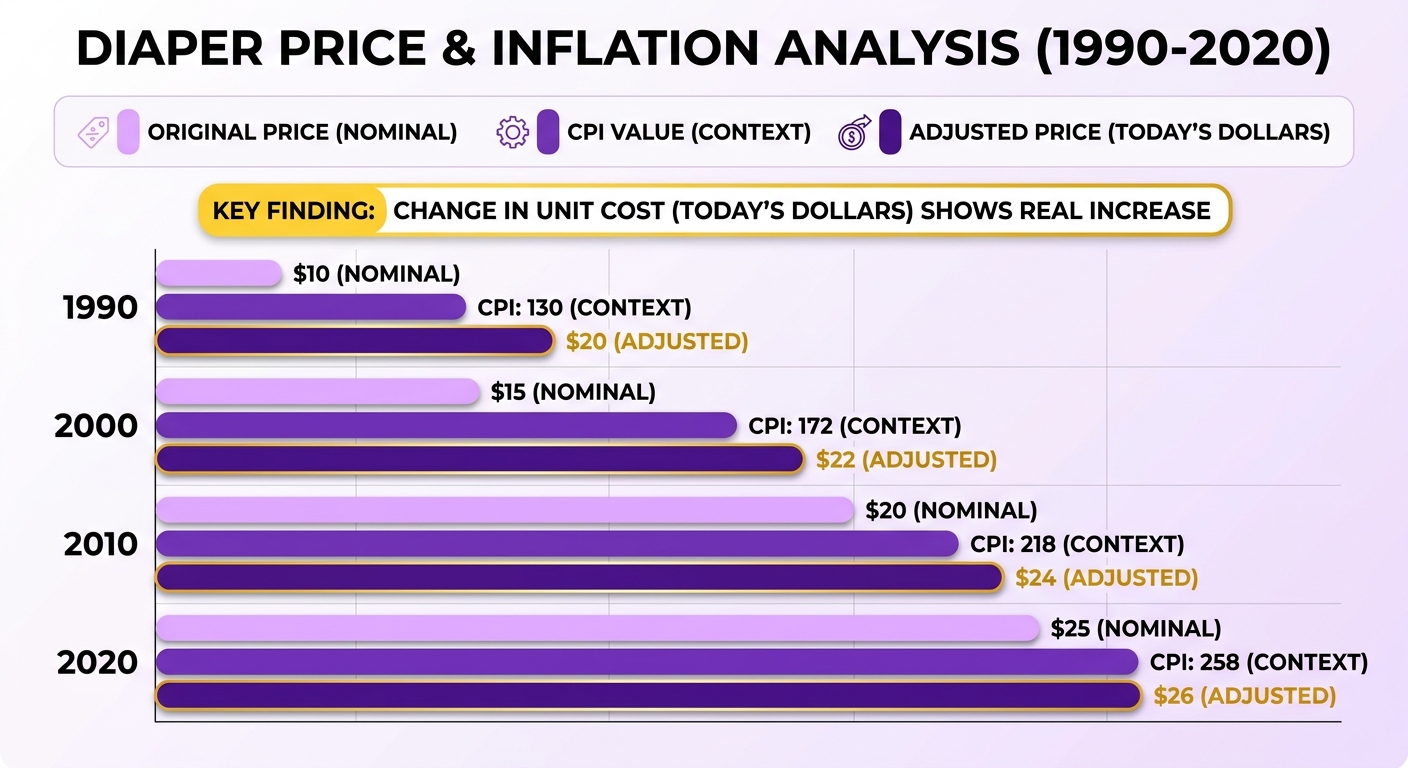
You need three numbers: the old price, the CPI value from when you paid it, and the current CPI value. Multiply the old price by today's CPI divided by the old CPI. That gives you what the old price would equal in current dollars.
A simple example. Say a jumbo pack cost $18 three years ago. If prices have climbed 9% since then, that same pack in today's dollars is worth about $19.60. If you're paying $23 now, your real cost went up, not just your nominal cost.
This matters because shrinkflation muddies the water. A box might hold the same sticker price but fewer diapers. Tracking cost per diaper in inflation-adjusted terms catches both the price hike and the quiet count reduction. One r/Target user summed up the frustration after using a size-change tracker:
"It's actually been going on pretty consistently, over the last 10 years. It seemed to start with food commodities like cereal and now it's everything." - r/Target user mxtrekkie
Why inflation-adjusted comparison beats sticker price
Inflation-adjusted comparison shows whether a brand is genuinely cheaper or just looks that way on the shelf. Convert each brand's per-diaper cost into the same base year, then rank them. A brand that held its price flat over three years is winning even if its sticker looks unchanged.
Run this across retailers too. Two stores selling the same brand at the same price today may have very different trajectories. The one that resisted recent price creep is the better long-term bet.
Keep a running log of your own purchases with dates. Over a year of diapering, that history tells you which brands quietly outpaced inflation and which stayed honest.
How to calculate unit cost for diapers
Unit cost comes down to one formula: divide the pack price by the number of diapers inside. That gives you cost per diaper, the number that matters. A second metric, price per pound of absorbent material, lets you compare across sizes fairly.
Cost per diaper, step by step
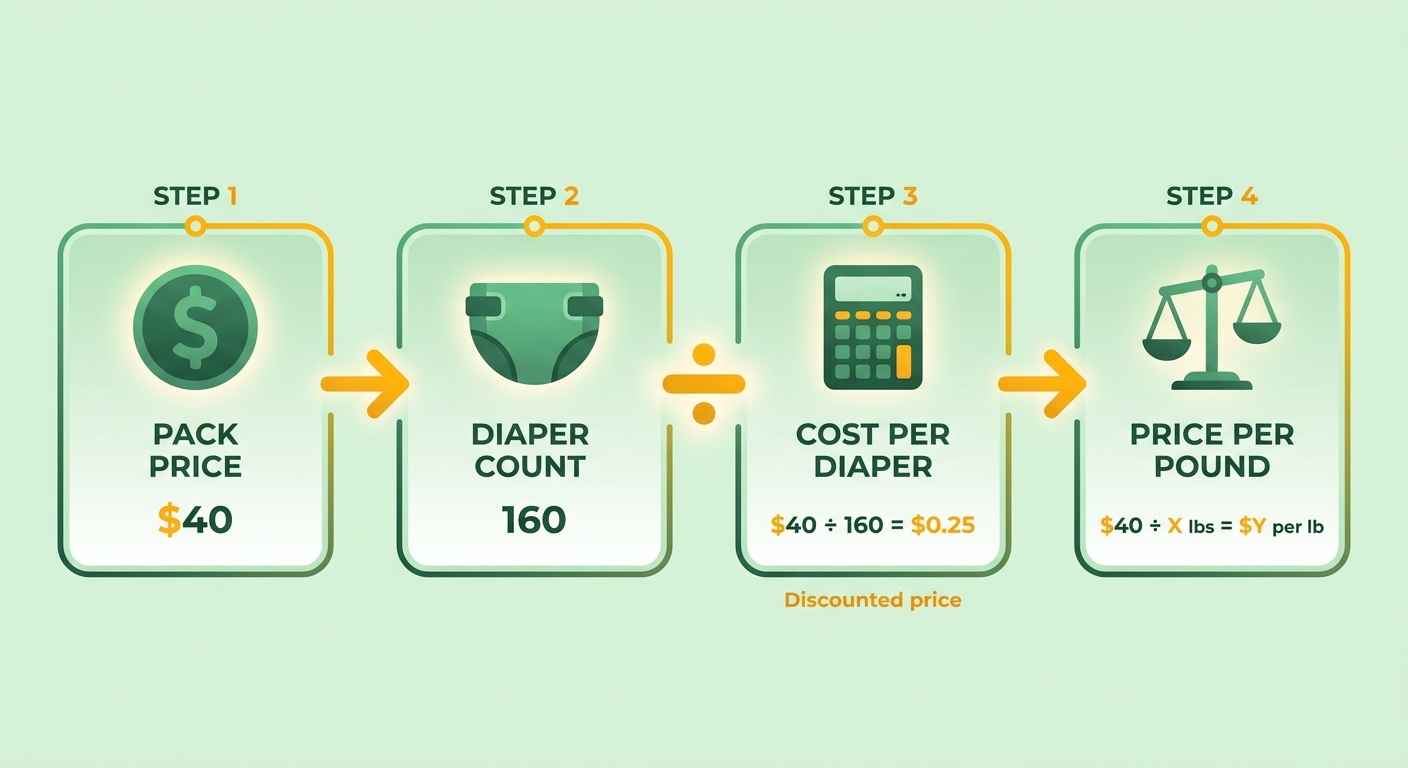
Cost per diaper is the pack price divided by the count. A $40 box of 160 diapers costs $0.25 each. A $52 box of 200 works out to $0.26 each. The bigger box looks like the obvious bulk win until you run the math and see the gap is razor-thin.
Fold in promo codes and loyalty rewards while you're at it. Factoring those in means your comparison reflects actual out-of-pocket cost, not an artificial baseline.
Price per pound works the same way but accounts for absorbency. Weigh the absorbent capacity, divide the price by it, and you can line up a size 1 against a size 5 without the size difference skewing the result.
What counts as a statistical unit
A statistical unit defines what you're measuring so comparisons stay honest. For diapers, two attributes set the unit: size and type. Size ranges from newborn through size 6 and beyond. Type covers disposable, training pants, and overnight variants. Mix units and you wreck the comparison.
Compare size 3 disposables against size 3 disposables. Don't pit an overnight against a daytime diaper and call it a fair fight. Overnights hold more material, so their higher per-unit cost reflects more product, not worse value.
Isolate specific sizes and styles into distinct categories and you can evaluate competing brands without performance differences distorting the financial picture.
Where the unit cost data comes from
Reliable data comes from aggregating live prices across retailers, since a single store's price changes weekly. Comparison tools pull pack prices and counts from multiple sellers, then compute the per-diaper figure for you. That saves you from doing the math on every listing.
A price comparison tool scans multiple retail platforms automatically and compiles those scattered listings into one interface, so you can find the lowest unit cost without visiting a dozen websites.
This is especially valuable when the market gets volatile. When manufacturers shrink package volumes while holding retail prices flat, manual tracking gets deceptive fast. Calculating exact cost per unit exposes those hidden adjustments, so you notice when a box count drops even if the shelf price doesn't budge.
For deeper brand-by-brand breakdowns, parent-run reviews like The Big Diaper Comparison walk through per-diaper costs across popular lines. Pair that hands-on testing with a live price aggregator and you get both the quality signal and the lowest unit cost at once.
What diaper spending actually tells you
Diaper spending sits among the most relentless recurring costs of early parenthood. A single child runs through thousands of diapers before potty training, so even a few cents of difference per unit compounds into hundreds of dollars. Tracking that spending tells you where your money actually goes, and where you can claw some back.
What spending patterns reveal
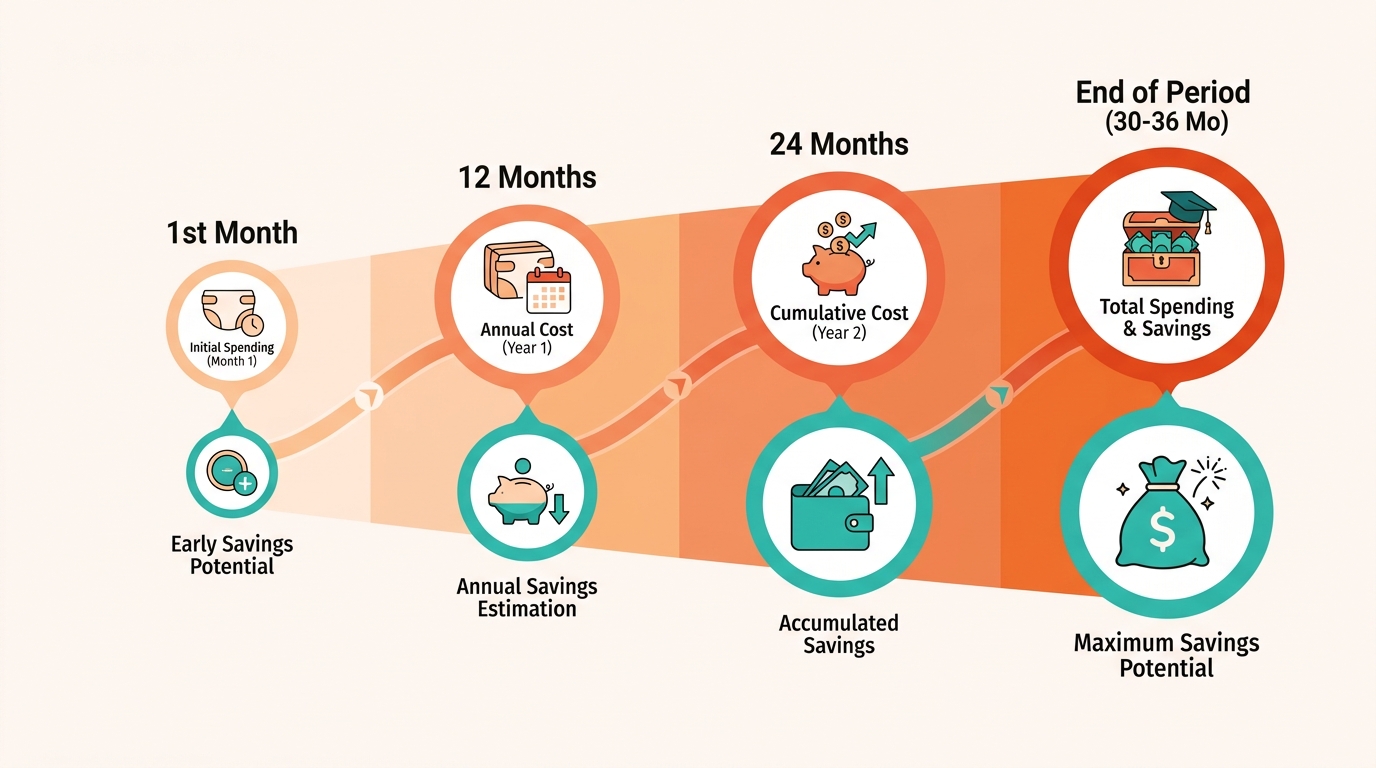
The real cost driver is volume over time, not the price of any single pack. Because the purchases are recurring, minor differences in unit cost pile up over several years.
Two patterns matter most. First, bulk packs almost always lower your per-diaper cost, but only if you finish them before your baby sizes up. Second, size inflation quietly raises spending: as your child grows, each size holds fewer diapers per pack at a similar price.
Packaging changes play into long-term spend too. When manufacturers cut the count in a standard box, the real cost of diapering rises silently. Watch for it, and your budget reflects actual usage instead of outdated packaging assumptions.
How diaper spending compares to other household costs
Diapers behave like groceries: frequent, non-negotiable, and sensitive to per-unit pricing. You can't skip them and you can't easily delay the purchase. That puts them in the same budgeting bucket as food staples, where unit-price comparison delivers the biggest payoff.
For households, the most effective playbook is straightforward: sort purchases by unit cost, go for larger packs once your child's growth stabilizes, and verify package counts every time you restock. Those habits turn raw spending data into real savings.
References
[1] DiaperPricer: Diaper Price Comparison | Home - https://www.diaperpricer.com/
[2] [XLS] Diapers Analysis Template - FamilyConsumerSciences.com - https://familyconsumersciences.com/wp-content/uploads/Diapers-Analysis-Template.xlsx
Frequently Asked Questions
1. How many diapers will my baby use before potty training?
Most children use between 6,000 and 9,000 diapers from birth until potty training, typically around age 2.5 to 3. Newborns need 8-12 changes daily, dropping to 5-6 by toddlerhood. This volume is why even a $0.05 per-diaper difference compounds into hundreds of dollars in total spending.
2. Are cloth diapers cheaper than disposables when calculated by unit cost?
Cloth diapers carry higher upfront costs ($300-$800 for a full set) but no per-use price, making them cheaper over multiple years or children. Disposables average $0.15-$0.36 per change with zero startup cost. Factor in water, detergent, and your time for an accurate cloth comparison.
3. Does buying a bigger diaper size change my cost per diaper?
Larger sizes hold fewer diapers per pack at similar retail prices, which increases the unit cost as your child grows. To manage this transition, calculate the price difference before moving up, and avoid buying excessive bulk quantities of a smaller size when your child is near a growth milestone.
4. How do I spot shrinkflation before it inflates my diaper budget?
Compare the printed count on your current packaging against your historical purchase records or receipts. Manufacturers often reduce the quantity per box while maintaining the same retail price. Regularly checking these counts ensures your budget calculations remain accurate over time.
5. Is it worth using a price comparison tool if I only shop at one store?
If you purchase only one box per month from a single retailer, the time required to track prices manually may outweigh the immediate savings. Digital comparison tools offer the greatest benefit when managing bulk orders, transitioning between sizes, or evaluating alternative brands where unit cost variances are more pronounced.
6. Should I prioritize the cheapest diaper or factor in performance?
Focusing solely on the lowest unit price can be counterproductive if the product fails to perform. A lower-priced option that requires more frequent changes or causes leaks ultimately increases your overall consumption rate. Evaluating absorbency and fit alongside price ensures you achieve the best overall value.
7. How do subscription discounts change which brand is actually cheapest?
Recurring delivery incentives can significantly alter the competitive landscape of diaper pricing. Because these percentage-based markdowns apply to the total cost, they yield much larger absolute savings on high-volume bulk packages than on smaller convenience packs, often making premium options more cost-effective than standard retail brands.