
Find This Item in Minutes: Compare Unit Prices Across Major Retailers

Key Takeaways
- Unit pricing tells you what a product costs per ounce, pound, or piece, so you can compare different-sized items and see which one is actually cheaper.
- Retail prices can legally sit the same size or larger than the unit price, pushing the more useful number into the background.
- Unit prices make shoppers more price-sensitive, even when two products are the exact same size.
- That effect gets stronger under time pressure — the more rushed you are, the more unit pricing steers you toward the better deal.
- Stores vary wildly in how prominently they display unit prices. Some barely show them.
- Consistent unit pricing across retailers fixes the shelf-label inconsistency that researchers keep documenting.
Why unit pricing is the only number worth trusting
Unit pricing tells you what a product costs per ounce, pound, or piece. It's the cleanest way to compare two products of different sizes and see which one actually gives you more for your money. Price it by unit and you stop guessing, as NIST puts it.
The catch is that unit prices aren't always easy to read on the shelf. A Rutgers guide points out that the retail price can legally appear the same size or larger than the unit price, which shoves the number you actually need into the background. Research on shelf labels found considerable variation in how prominently stores show unit prices — or whether they show them at all. Accurate, consistent unit pricing fixes that.
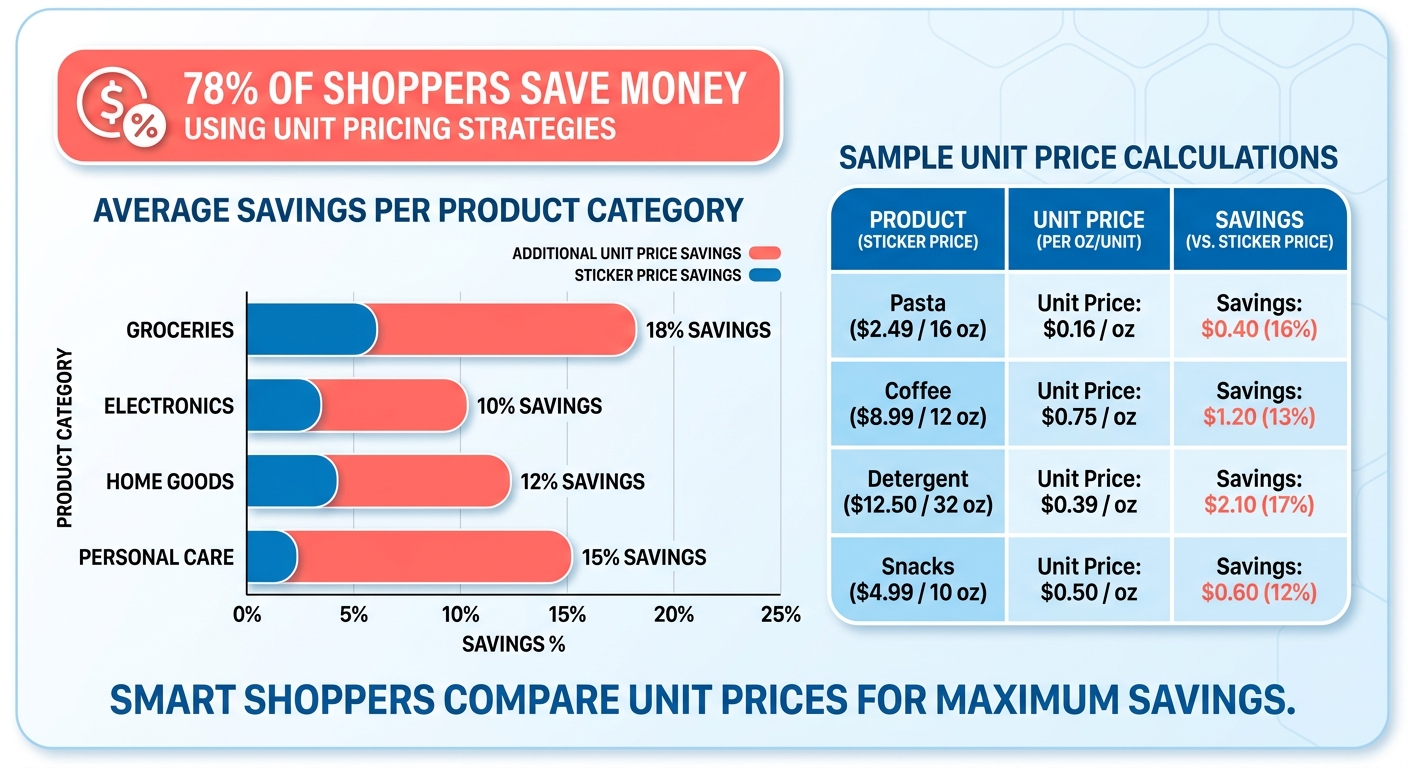
Why the unit price changes what you buy
Put the price in plain view and people notice it. That noticing shifts choices toward better value. Studies show unit prices increase price sensitivity even when two products are the exact same size. The number sitting there changes how you decide.
The effect gets stronger when you're rushed. One study found unit pricing matters more under time pressure, pushing shoppers toward the lower unit-priced option and making the whole task feel easier. Fewer errors. Less second-guessing.
Take carrots. Iowa State's guide uses the classic example: full-sized versus baby carrots. Same vegetable, wildly different price per pound. Without the unit price, you'd never know which bag actually costs less.
How long manual comparison really takes
Comparing unit prices by hand means dividing price by quantity for every option. wikiHow lays out the math: divide cost by amount, then repeat for each competing product. Do that across three brands and two sizes and you're running six calculations before you can decide anything.
Shelf tags help when they exist. They don't compare across stores. NDSU's tips tell you to check the tag, know how to do the math yourself, and compare sizes and brands. That's real work, repeated for every product on your list.
Here's how the two approaches stack up:
| Task | Manual Comparison | Automated Unit Pricing |
|---|---|---|
| Find price per unit | Divide cost by quantity yourself | Shown instantly |
| Compare across brands | Recalculate for each brand | Side-by-side |
| Compare across stores | Visit or check each retailer | One screen |
| Difficulty | High | Low |
| Time per product | Several minutes | Under a minute |
What retailers are finally doing about it
Major retailers now list unit prices online, not just on shelves. New York's attorney general announced that Costco, CVS, FreshDirect, Wal-Mart and Walgreen agreed to post unit prices on their sites. Costco and Wal-Mart confirmed they'd add unit pricing across their US sites and mobile stores.
Progress. But each retailer still shows its own prices in its own format. To compare one product across five stores, you're opening five tabs and doing the mental math yourself. Pulling accurate unit prices into one view is what turns a ten-minute chore into a quick check.
Spotting dynamic pricing and pricing errors
Prices change fast. The same product can carry one price at 9 a.m. and another by dinner, and shelf labels don't always keep up. So check the unit price every time, not just the sticker staring back at you.
Dynamic pricing means the number moves based on demand, time, or location. Pricing errors mean the number is simply wrong. Both hide the true cost per unit, and both get worse when the unit price sits in the background instead of front and center. Federal guidance on unit pricing best practices exists precisely because accuracy and readability fall apart without clear standards.
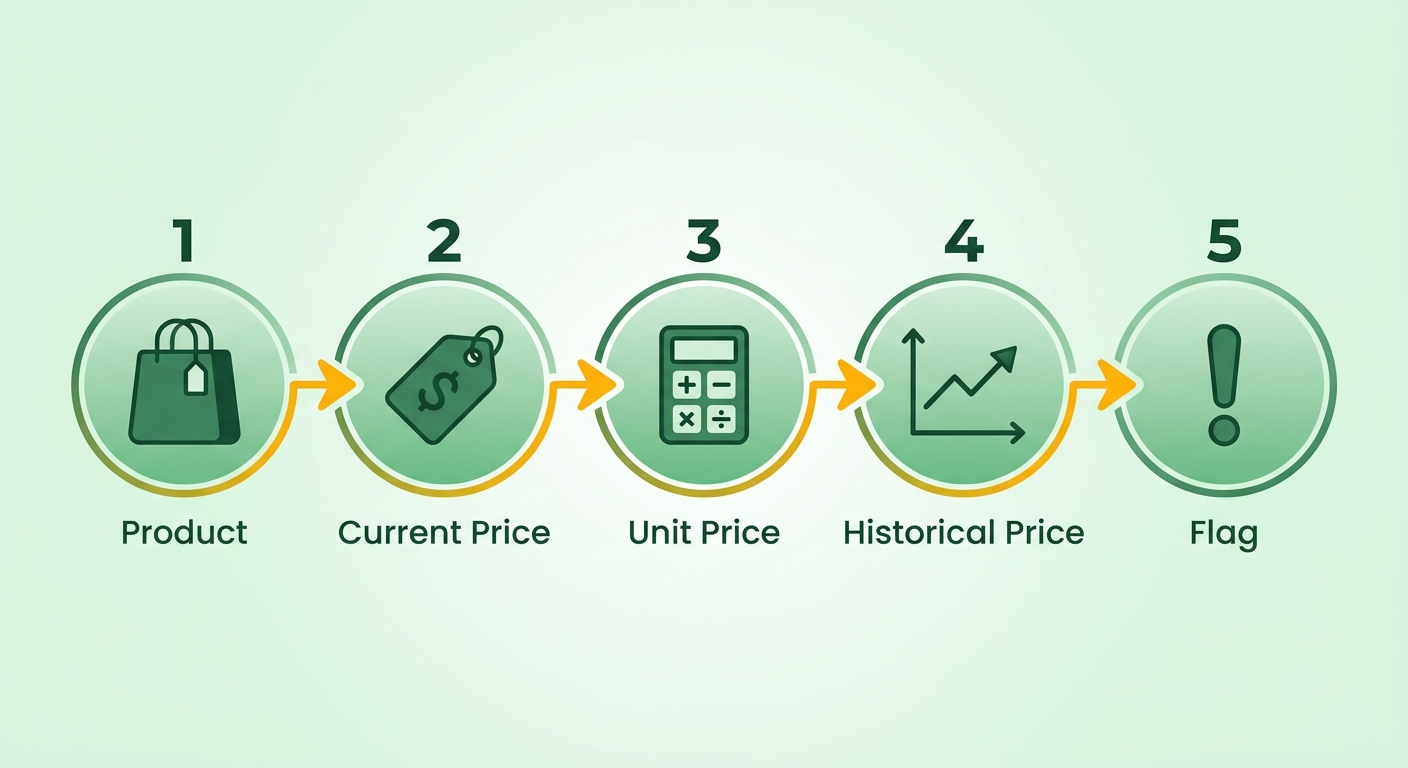
How retailers use dynamic pricing
Dynamic pricing: retailers adjust prices in real time based on demand, competitor moves, inventory, or shopper behavior. The retail price shifts, but the unit price often lags behind or gets buried.
Think about a family-size cereal box that goes on "sale" while the price per ounce quietly climbs past the smaller box. The big number looks like a deal. The unit price tells the real story.
Which is why label prominence matters so much. When a price moves and the unit figure is faint, you've lost your only reliable comparison point.
Why pricing errors slip through
Pricing errors happen when the shelf tag, the checkout system, and the actual math disagree. A promotion ends but the sign stays up. A unit price gets calculated on the wrong quantity. The bigger package prints a per-unit figure that doesn't match its size.
The federal best practice guide targets these exact failures. It pushes for consistent measures and accurate calculation, so the per-unit number you read is the per-unit number you pay.
The practical fix: recalculate the unit price yourself before you buy. Divide total price by quantity. If the shelf number and your math don't line up, trust your math and flag the tag.
What to do when a price looks off
Compare the per-unit cost, not the sticker. That one habit protects you from both moving prices and plain mistakes.
- Check the measure: confirm both products use the same unit, like price per ounce, before comparing.
- Redo the math: total price divided by quantity gives you the real per-unit cost.
- Watch mismatched units: one item priced per ounce and another per pound is a red flag for buried true cost.
- Question big "deals": a larger box isn't automatically cheaper per unit during a promotion.
An AI-driven tool earns its keep here by pulling the current price, recalculating unit cost across retailers, and surfacing mismatches you'd otherwise miss. Prices move. Errors happen. Consistent per-unit comparison is how you stay ahead of both.
Finding the best deal on everyday essentials
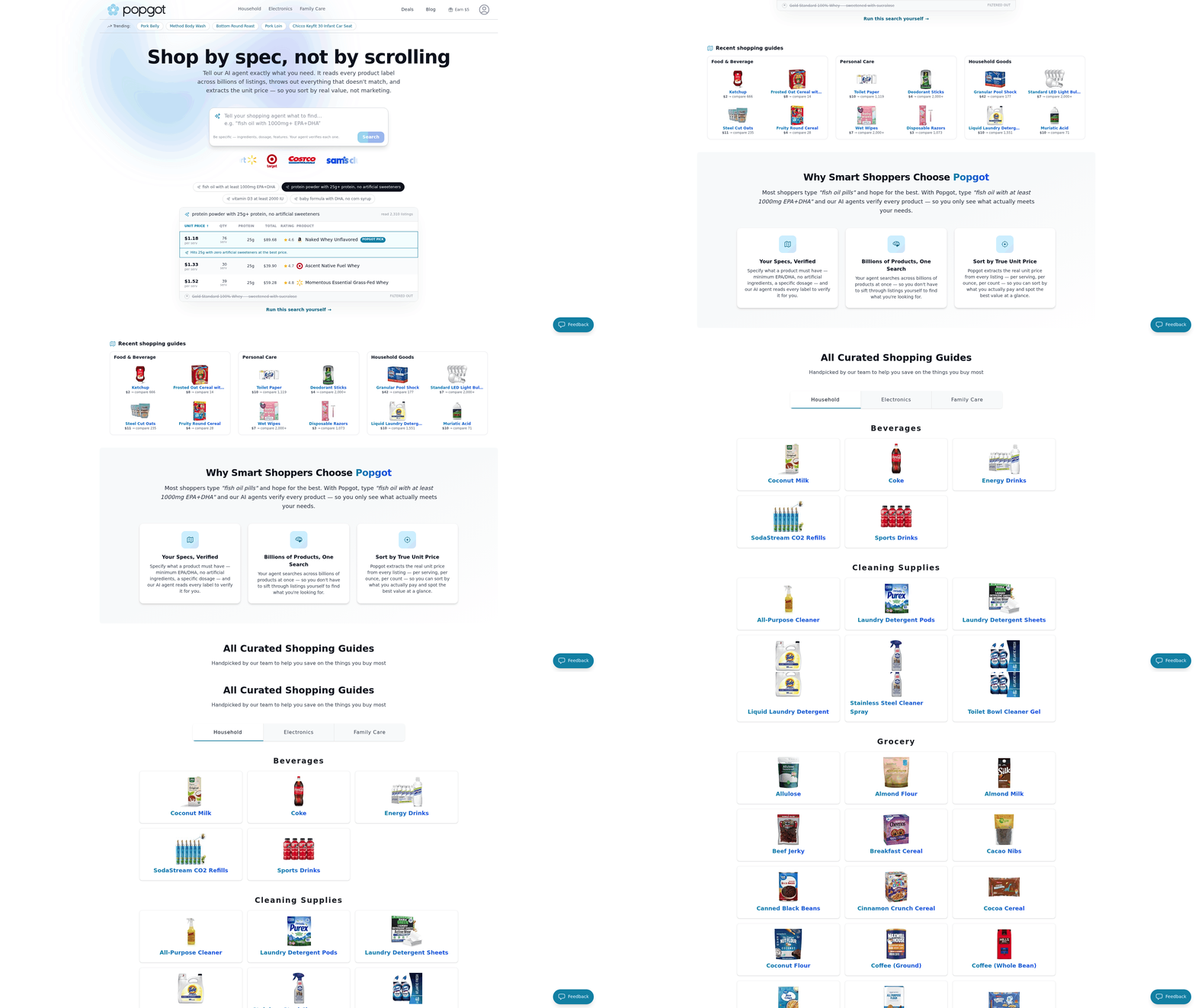
The fastest way to find the best deal on everyday essentials is to compare unit prices across retailers before you buy. Price gaps on the exact same product can be large, and the sticker alone won't tell you where the value is. Price it per ounce in more than one store and the cheaper option becomes obvious.
That comparison used to mean walking aisles with a calculator. Now that major retailers post unit prices online, you can line products up side by side from your couch. Cross-store comparison is finally practical for pantry staples and personal care items alike.
Which essentials show the biggest price gaps
Products sold in many sizes and forms show the widest gaps. Pantry staples like rice, oil, and canned goods swing hard.
Same logic in personal care. A bar of soap and a bottle of body wash serve similar needs, but cost per ounce can be worlds apart across retailers. Bulk multi-packs often beat single units. Not always. That's why you check the number instead of trusting the label.
How to find the best deal, step by step
Follow a simple sequence to lock in the lowest cost per unit. Each step takes seconds once you know the number to look for.
-
Check the unit price, not the shelf price. Unit pricing tells you the cost per ounce, pound, or piece, which is what you actually pay for, as Utah State University notes. Start here every time.
-
Calculate it yourself when the tag is missing. Divide total cost by quantity. A $6 box holding 24 ounces costs $0.25 per ounce. Do this once and comparison gets easy.
-
Compare that number across stores. Most shelf labels post the price per ounce so you can line up options without a calculator, per the University of Minnesota. Shoppers do actively check price differences between retailers, research on store price image found.
Check the specs before you trust the price
Always confirm you're comparing the same product before you judge the price. A concentrated formula and a standard one can carry different per-ounce numbers for good reason. The cheaper unit price isn't a deal if the products aren't equivalent.
Check the form, the concentration, and the count. Read the specs first, then let the unit price decide. That habit turns unit pricing into a reliable filter. You stop overpaying on staples and personal care without guessing.
Making the whole thing faster with Popgot
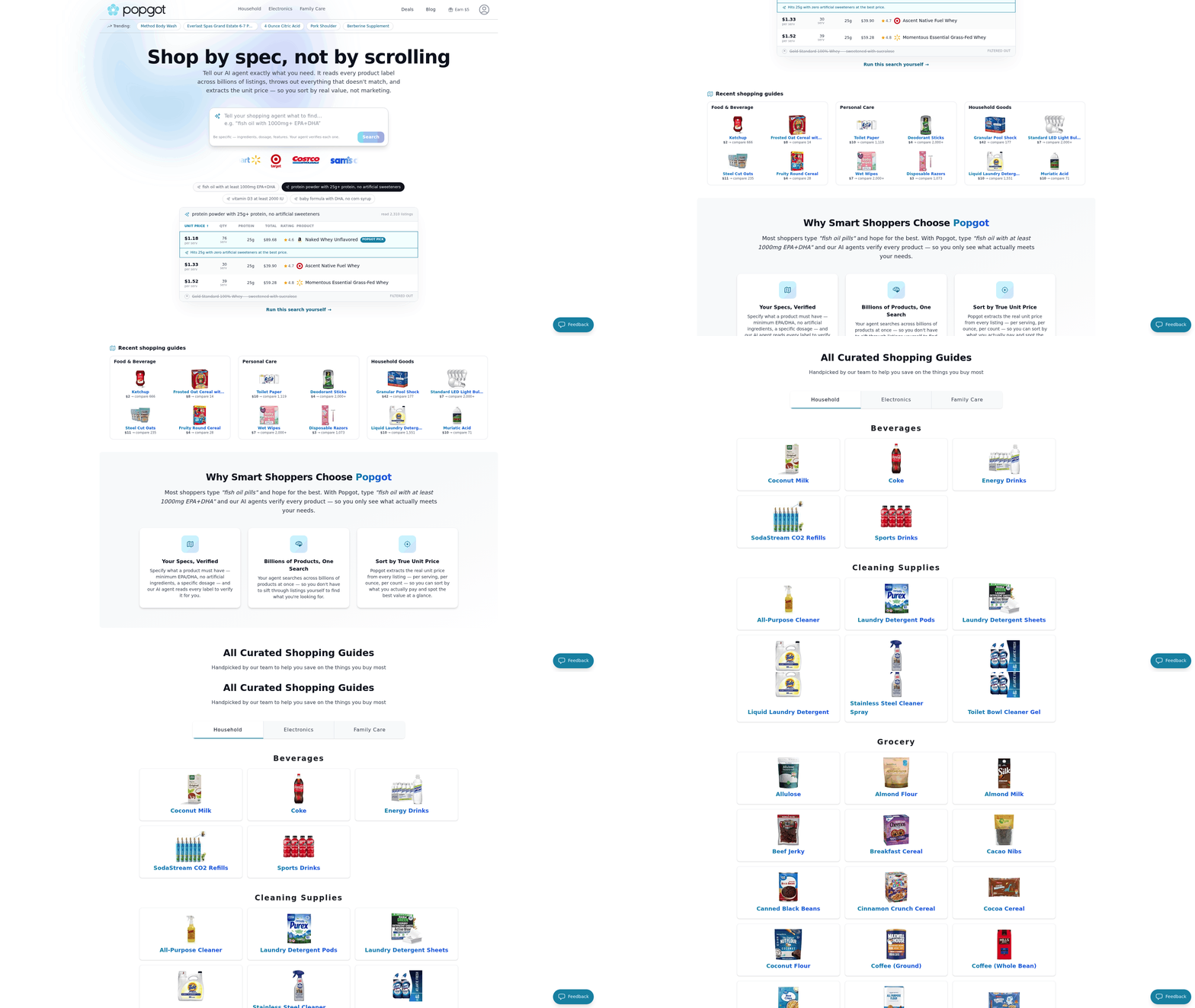
Smart shopping filters cut your search time by putting the number that matters, the unit price, right where you can see it. Instead of scanning shelves with a calculator, you set your filter once and let the tool sort products by cost per ounce, pound, or piece. True value in seconds.
Time pressure is exactly when this help matters most. When you're rushed, clear unit-price sorting keeps you from overpaying.
How customizable filters save you money
Customizable filters: settings that sort and narrow results by the criteria you care about, like unit price, brand, or size. You pick the rules once, and every search follows them.
The payoff is speed plus accuracy. The filter does the comparison work for you. Say you need olive oil. One view shows a 16-ounce bottle and a 33.8-ounce bottle side by side, already priced per ounce. The bigger bottle isn't always cheaper per unit, and the filter makes that obvious without any math.
How curated guides cut your time
Curated guides group everyday essentials so you compare like with like, fast. Instead of hunting product by product, you open a guide for a category and see the strongest per-unit values already lined up.
The tag reading and the calculation are handled before you add anything to your cart. Stocking a pantry with rice, pasta, and canned beans? A staples guide shows each product's cost per pound across sizes and brands. What used to take three trips down three aisles now takes one screen.
When personalization is actually worth it
Personalization pays off because it removes friction at the exact moment you decide to buy. When the lower unit price is front and center, the choice gets easier and faster.
The honest limit: if you only buy one item once a year, filters won't save you much. But for regular grocery runs and stocked pantries, the per-ounce savings stack up week after week.
Set your filters, open the guide for what you need, and let the unit price lead.
Comparing unit prices across retailers
Comparing unit prices across retailers means checking the cost per ounce, pound, or piece for the same product in more than one store, then buying where that number is lowest. The idea is simple. The math takes seconds once you know the formula.
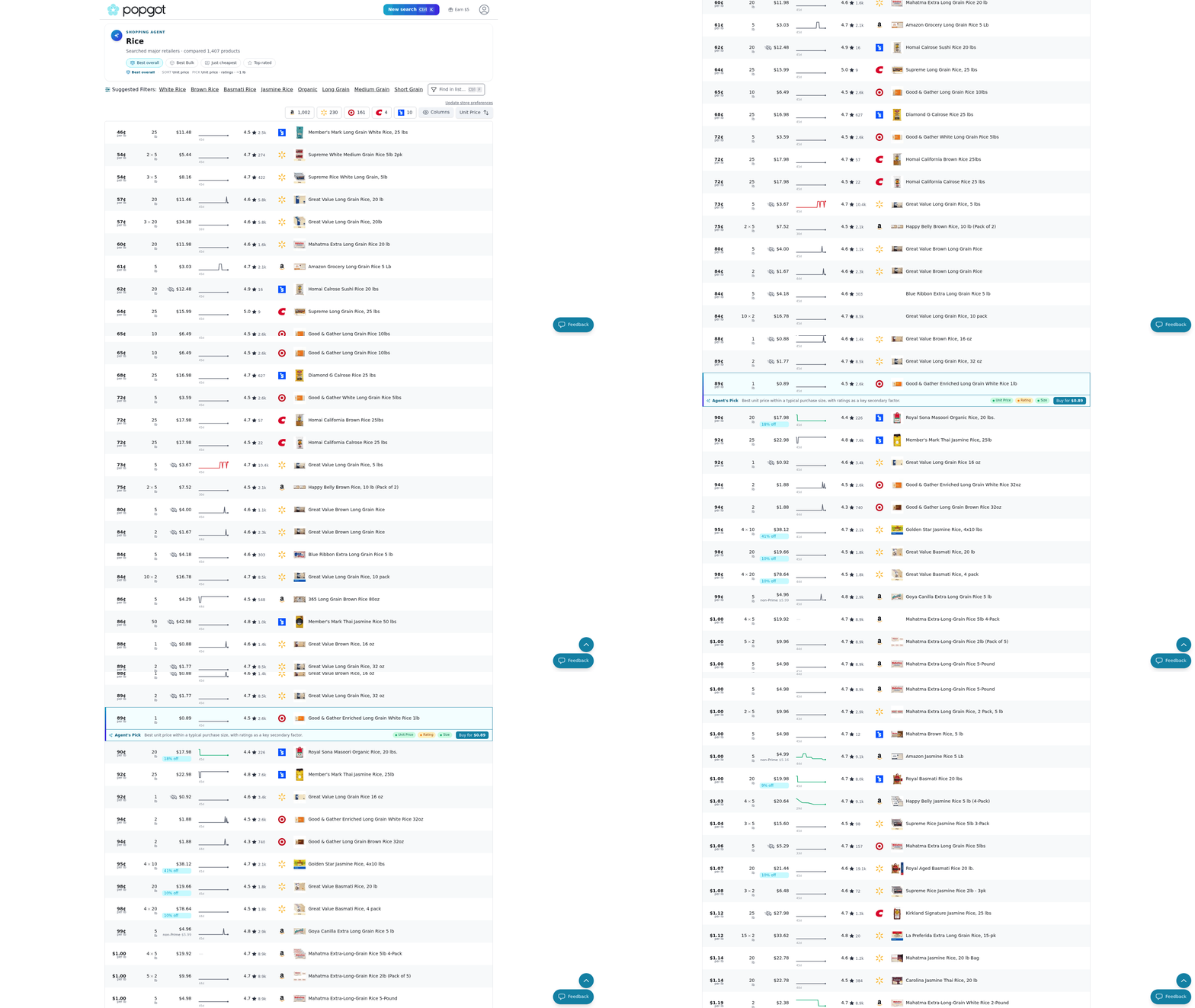
To calculate a unit price manually, divide total cost by quantity. A $4.00 box holding 32 ounces costs 12.5 cents per ounce. Run that same math at a second store, and the better value is obvious.
The five-step manual routine
You can run this in any aisle or browser tab. Start with the shelf tag, verify the math, then compare across forms, sizes, and brands before deciding.
- Check the shelf tag first. The unit price is often already printed. If it's there, you skip the math entirely.
- Calculate it yourself when the tag is missing. Divide price by quantity. Keep the unit consistent — ounces or pounds, never both.
- Compare different forms. Processing differences can change the per-unit cost of similar items.
- Compare sizes and brands. A bigger package isn't always cheaper per unit. Store brands often beat name brands on cost per piece.
- Repeat across retailers. Run the same number in a second store to see where the real gap sits.
Why the specs matter so much
Two listings can show the same price per ounce yet differ in concentration, count, or drained weight. If the specs don't match, the unit price lies to you.
This is where careful verification pays off. Unit pricing only helps when you compare truly similar products. A concentrated detergent priced per ounce beats a diluted one even at a higher number, because you use less per load.
How retailers present unit prices varies widely, research on product choice found. That inconsistency is exactly why matching specs before you trust a number matters.
What online unit pricing changes
Online unit pricing lets you compare retailers without leaving home. That takes the calculator out of the equation. An AI shopping agent can pull listings, confirm the specs match, and sort by true cost per unit — the comparison already done, with the verification baked in.
When the unit price sits front and center and the specs line up, you buy the cheaper option with confidence every time.
Getting past the common snags
Comparing unit prices sounds simple, but three things trip shoppers up: labels that hide the number, products sold in different forms, and prices that don't line up across stores. Clear these and you find real value in seconds, not minutes.
Every one of these has a fix. Some you handle at the shelf. Others get solved the moment you compare across retailers instead of trusting one sticker.
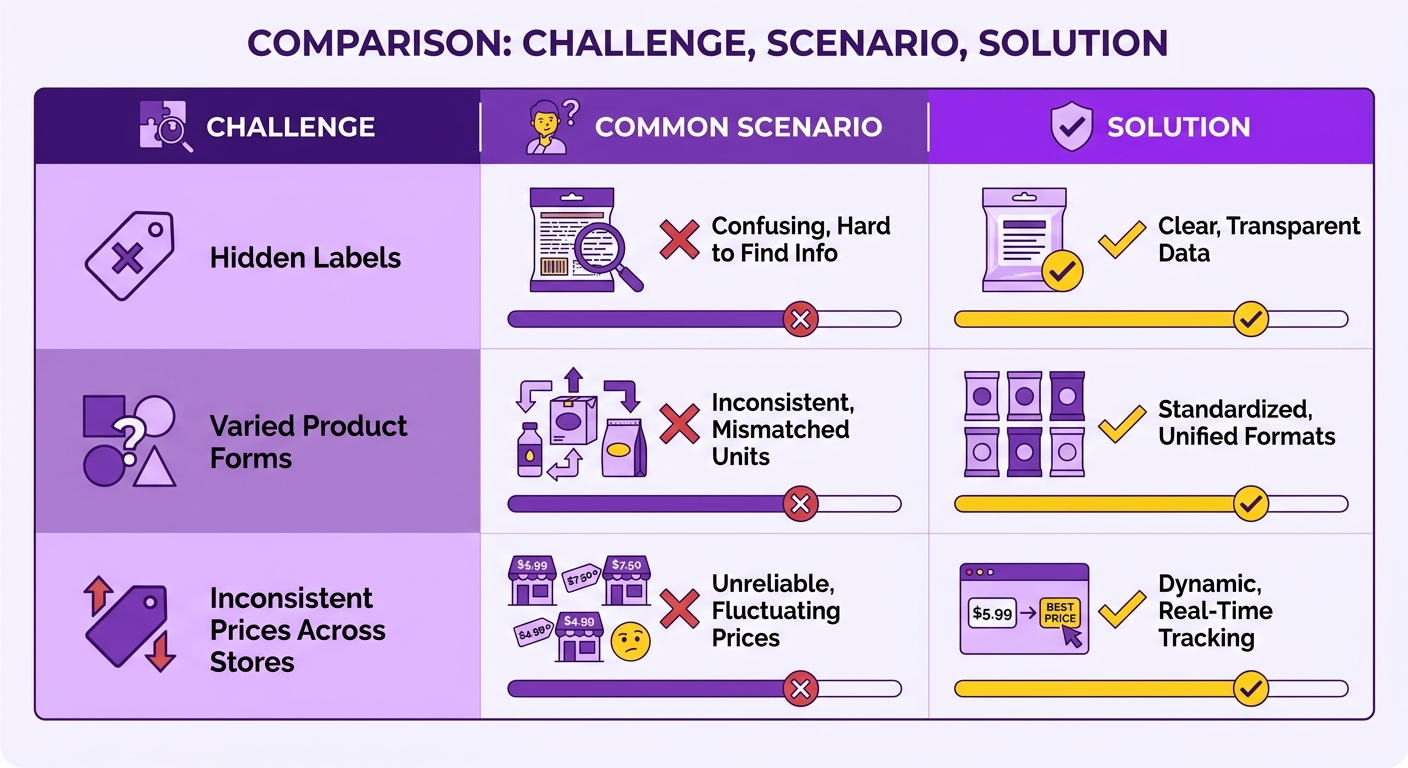
Why the labels are so hard to read
The unit price often gets buried because the retail price can legally appear the same size or larger. The space for both should be equal, but stores can shrink the number you actually need. Not a small design quirk.
The fix: train your eye to skip the big number and hunt for the small "price per ounce" line. Most shelf tags post it, so you can compare without a calculator once you know where to look.
Comparing products sold in different forms
The same food comes in shapes that resist easy comparison. Unit price is the equalizer. It reduces both to cost per ounce, so a fancier package can't disguise a worse deal.
Watch for measurement units that don't match, too. One brand of rice might list price per pound while its neighbor lists price per ounce. Shredded cheese often gets tagged by weight while a block beside it uses a different base. When a tag is missing or the units clash, convert both to the same measure so the cheaper option stops hiding behind mismatched labels.
Prices that don't match across stores
Unit prices differ store to store, and shoppers who care about value actively check that spread.
My honest carve-out: if you only buy one product at one store, cross-retailer checking isn't worth your time. The payoff shows up when you buy staples repeatedly. That's where a tool that extracts and sorts unit prices across stores saves real money, and where doing it by hand stops being practical.
The pattern across all three snags is the same. The number you need exists. Getting it front and center, in a form you can actually compare, is the whole job.
References
[2] Unit Pricing - Spend Smart Eat Smart - Iowa State University - https://spendsmart.extension.iastate.edu/shop/compare-unit-prices-best-buy/
[3] [PDF] how to get the best product for your money at the store - https://extension.usu.edu/fscreate/files/store_brand_unit_pricing.pdf
[4] How to Calculate and Compare Unit Prices at the Store - wikiHow - https://www.wikihow.com/Calculate-and-Compare-Unit-Prices-at-the-Store
[5] Major retailers agree to list unit prices online - Washington Examiner - https://www.washingtonexaminer.com/news/815218/major-retailers-agree-to-list-unit-prices-online/
[6] The Unit Price is Right | NIST - https://www.nist.gov/blogs/taking-measure/unit-price-right
[7] FS138: Unit Pricing: What It is and How to Use It (Rutgers NJAES) - https://njaes.rutgers.edu/fs138/
[8] Unit pricing | Real Life, Good Food - https://reallifegoodfood.umn.edu/shop-smart/unit-pricing
[9] 6 Tips to Save Money With Unit Pricing | NDSU Agriculture - https://www.ndsu.edu/agriculture/extension/publications/pinchin-pennie-kitchen-6-tips-save-money-unit-pricing
[10] [PDF] a best practice approach to unit pricing - GovInfo - https://www.govinfo.gov/content/pkg/GOVPUB-C13-4851a46324cc86af742242cfc5a93d9a/pdf/GOVPUB-C13-4851a46324cc86af742242cfc5a93d9a.pdf
[11] Unit prices on retail shelf labels: An assessment of information ... - https://www.researchgate.net/publication/222626710_Unit_prices_on_retail_shelf_labels_An_assessment_of_information_prominence
[12] Does unit pricing influence store price image dimensions and ... - https://www.researchgate.net/publication/317155591_Does_unit_pricing_influence_store_price_image_dimensions_and_shopping_intentions_for_retail_stores
[13] Unit Price Measures in Retailing: Consistency Effects on Product ... - https://www.researchgate.net/publication/341400867_Unit_Price_Measures_in_Retailing_Consistency_Effects_on_Product_Choice_and_Store_Evaluations
[14] Unit Pricing Increases Price Sensitivity Even When Products are of ... - https://www.researchgate.net/publication/282249263_Unit_Pricing_Increases_Price_Sensitivity_Even_When_Products_are_of_Identical_Size
[15] Unit pricing matters more when consumers are under time pressure - https://www.researchgate.net/publication/304607541_Unit_pricing_matters_more_when_consumers_are_under_time_pressure
Frequently Asked Questions
1. Does unit pricing account for sales tax or is it always the pre-tax cost?
Unit prices reflect the pre-tax shelf or listed cost, not the final checkout total including tax. When comparing across states or retailers, remember that tax varies by location and product category. For accurate budgeting, treat the unit price as a comparison tool for base value, then add applicable local tax at checkout.
2. Is a lower unit price always the best financial choice for my household?
A lower unit price isn't always the smartest buy if the larger quantity leads to waste. Perishables like produce or dairy can spoil before you finish them, erasing bulk savings. Consider your consumption rate, storage space, and expiration dates alongside the per-unit cost to determine genuine value for your situation.
3. Can I compare unit prices between a physical store and an online retailer?
Comparing in-store and online unit prices works, but factor in shipping fees, membership costs, and delivery minimums that online listings may not show upfront. A lower online per-ounce price can vanish once shipping applies. Tools like Popgot pull listings into one view, helping you spot true cross-channel value before committing.
4. What unit of measurement should I use when items list different bases like fluid ounces versus weight ounces?
Always convert both items to the same measurement type before comparing, and never mix weight ounces with fluid ounces. Liquids typically use fluid ounces or milliliters, while solids use weight ounces or grams. Mismatched bases produce misleading comparisons, so confirm the unit type on each label first, then recalculate if needed.
5. How often do retailers actually update online unit prices?
Online unit prices can lag behind real-time price changes, especially during dynamic pricing shifts driven by demand or time of day. A displayed per-ounce figure may not reflect the current sticker price. An AI-driven platform that pulls current listings and recalculates helps catch these mismatches before you purchase.
6. Should I trust store-brand unit prices over name brands?
Store brands frequently beat name brands on cost per unit while offering comparable quality for pantry staples and personal care items. However, verify the specifications match, including concentration, count, and drained weight. A cheaper store-brand unit price only saves money when the product is genuinely equivalent to the name-brand alternative you're replacing.
7. What can I do if I spot a pricing error on a shelf tag at checkout?
Recalculate the unit price yourself by dividing total price by quantity, and if your math disagrees with the tag, flag it to store staff. Promotions that expired but left signs up, or per-unit figures calculated on wrong quantities, are common errors. Many stores honor the lower posted price when errors are reported.