
How Much Is Muriatic Acid? Compare Prices by Size and Retailer
Key Takeaways
- Muriatic acid runs about $10 per gallon at most retailers, but the real range is $3.95 to $64 per gallon depending on size and concentration.
- Buy by the gallon pack and you're near $0.07 per ounce. Buy quarts and you can pay $0.50 per ounce for the same chemical.
- Two bottles at the same shelf price can hold very different amounts of active hydrochloric acid. Read the label before you read the price tag.
- Johnny's Pool Supply shows the lowest documented unit cost, $3.95 per gallon for 4-gallon cases at 31.45%.
- Home Depot's HDX 2-pack lands the best per-ounce value, around $0.07 per ounce for pool-grade acid.
- Low-fume diluted formulas like Klean-Strip Green cost nearly as much as full-strength but pack less acid per gallon.
- Multi-gallon cases beat single bottles every time, saving 60-85% over quart-sized containers.
Quick Summary
Short answer: about $10 a gallon at most retailers, with a real range from roughly $3.95 to $64 per gallon depending on size and strength. The store name isn't the biggest cost driver. How much active acid you get per dollar is.
Two bottles at the same shelf price can hold very different amounts of hydrochloric acid. So before you decide what muriatic acid "costs" for your project, read the label. The price tag only tells you half the story.
What does muriatic acid cost by size and retailer?
Muriatic acid runs from about $0.07 per ounce in bulk pool-supply packs to $0.50 per ounce in small hardware-store quarts. Gallons and multi-packs are dramatically cheaper per unit. Small bottles carry a punishing markup.
| Retailer / Source | Size | Price | Unit Cost | Concentration | Rating |
|---|---|---|---|---|---|
| Johnny's Pool Supply | 4 gal case | $15.80 | ~$3.95/gal | 31.45% | . |
| Home Depot HDX | 2 × 1 gal (256 oz) | $16.98 | ~$0.07/oz | pool balancer | . |
| Pinch a Penny | 1 gal | $10.00 | $10/gal | 31.45% | . |
| Walmart Klean-Strip Green | 2 × 1 gal | $19.94 | ~$9.97/gal | diluted (low-fume) | . |
| Walmart Champion Acid Blue | 4 × 1 gal | $54.99 | ~$13.75/gal | full strength | 4.6 (40) |
| Amazon Sunnyside | 1 qt | $16.14 | ~$64/gal | 18–28% | . |
That $16.14 quart on Amazon works out to about $64 a gallon. The $15.80 four-gallon pool case runs about $3.95 a gallon. Same chemical, 16x the price per gallon in the small size. Rule of thumb: if you need more than a quart, don't buy quarts.
Which option is the most cost-effective?
Bulk pool-supply cases win on price, but only when the concentration matches. The identical 31.45% product swings from about $3.95/gallon at Johnny's Pool Supply to $10/gallon at Pinch a Penny. That's a 2.5x spread on the exact same strength.
Then there's the concentration trap. Sources disagree: Amazon lists common strength at 18–28%, while pool forums cite the traditional 31.45% standard. Both exist. Big-box stores increasingly stock diluted low-fume blends like Klean-Strip Green at a similar bottle price, so you pay more per unit of actual acid. Check the label, because the shelf won't tell you.
How hard is it to buy and handle?
Buying is easy. Handling demands respect. Muriatic acid is a strong corrosive, so budget for gloves, eye protection, and ventilation on top of the sticker price.
Difficulty to buy: Low. Home Depot, Lowe's, Walmart, and pool stores all carry it. Difficulty to handle: High. Always add acid to water, never the reverse, and store it well away from other pool chemicals.
Plan on about 15 minutes to compare unit prices across three or four retailers. That comparison is where the savings actually hide.
Muriatic Acid Concentrations and Pricing
Concentration is the detail that decides whether you got a deal or overpaid. Diluted formulas sold as safer low-fume options can cost you a lot more per unit of actual cleaning or pH-adjusting power.
Most shoppers compare shelf tags without checking the HCl percentage. That's where the real math lives. The traditional pool-maintenance standard is full-strength hydrochloric acid, labeled 20 Baumé, but recent shifts at big-box retailers mean lower concentrations dominate most shelves now. Know which strength you need, and what you're paying per percentage point, and you stop burning budget on watered-down product.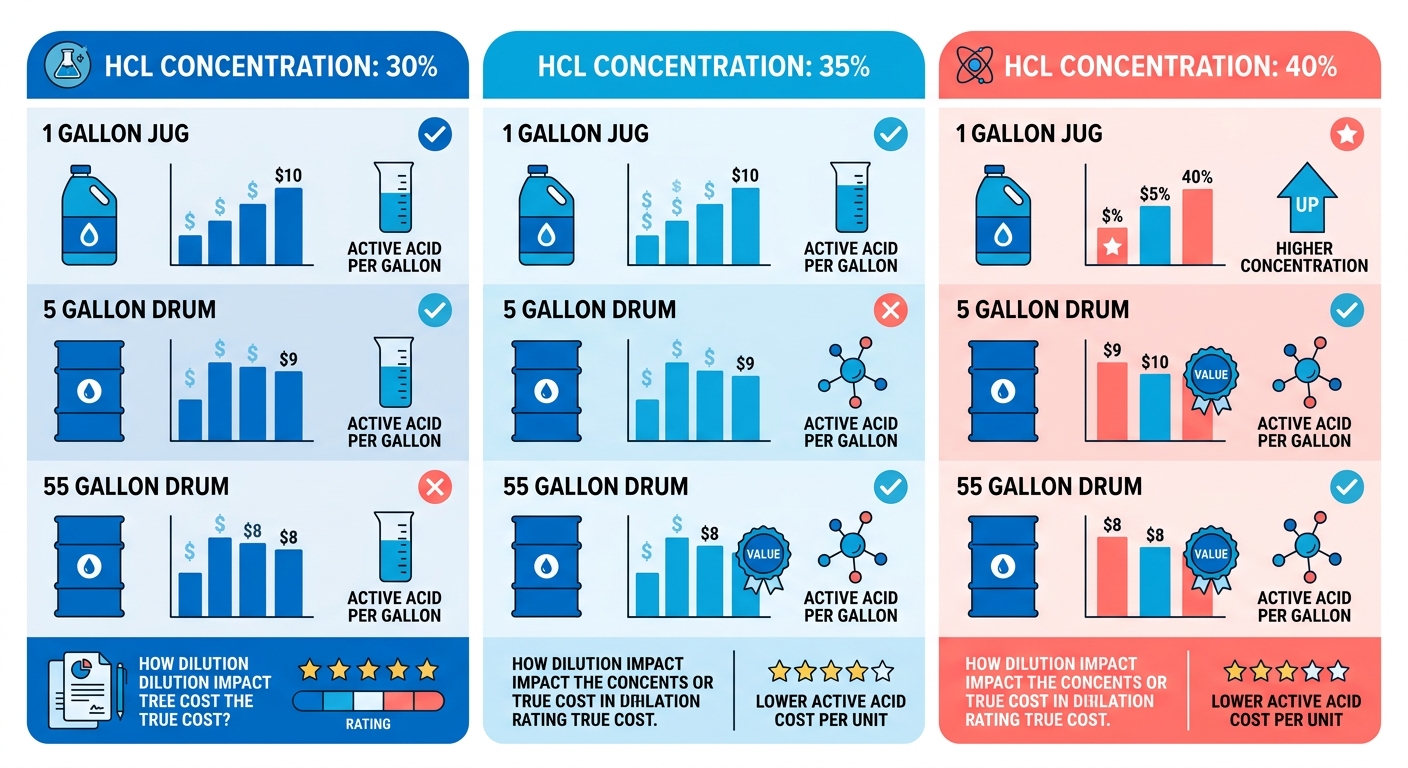
What concentration levels are available and what do they cost?
Muriatic acid typically shows up in four commercial concentrations, from light-duty formulas around 10-15% up to full-strength industrial grade. The high end handles heavy pool pH balancing, masonry etching, and mineral-deposit removal. The lower strengths get marketed as "green" or "safer" blends with reduced fumes, often under alternative low-fume brands.
Price per gallon alone is misleading. A half-strength formula at the same shelf price as full-strength means you're getting roughly 45% of the active acid for the same money. You'll pour more than twice as much to hit the same pH drop, which wipes out the savings. For routine pool maintenance, full-strength stays the cost-efficient pick if you're comfortable handling it.
The safer formulas earn their keep when vapor exposure is a genuine concern: indoor spaces, elderly users, or frequent small-batch cleaning where ventilation is limited. Otherwise, standard safety gear and a well-ventilated outdoor spot handle the vapor risk without the markup.
How concentration affects cost per unit of active acid
To compare apples to apples, calculate cost per percentage point of HCl, not cost per gallon. A gallon at 22% delivers 0.22 gallons of pure HCl. At $7 a gallon, that's roughly $31.82 per gallon of pure acid. You're paying more than double for a dilution you could do yourself with tap water.
Home Depot's HDX 2-pack pricing varies by region, and forum reports note that Home Depot and Lowe's have moved away from full-strength stock in many areas. If the HDX product is diluted to 20% or lower, those advertised per-ounce figures no longer reflect active acid cost. Check the technical specs or a label photo before buying.
That shift toward diluted retail formulas pushes the best full-strength deals to independent pool suppliers and farm supply outlets. Buyers report finding top-strength acid as low as $4.50 per gallon in 4-gallon cases at regional chains, a tier the major home-improvement stores no longer match. Sourcing from a specialty supplier instead of a big-box center can meaningfully cut seasonal maintenance costs.
Bulk purchasing and dilution strategies
Multi-packs and case quantities consistently deliver the lowest cost per gallon. Retail multi-packs help, but regional pool suppliers selling 4-gallon cases of full-strength acid are the real bulk advantage. The catch: bulk buying needs storage space and a plan to use it before the product degrades.
Muriatic acid loses strength slowly in opened containers exposed to air. For a pool owner going through a gallon every few weeks in summer, a case makes sense. For a homeowner who needs a little for masonry cleaning once a year, a single gallon of full-strength diluted by hand is the cheaper route. A rough 15% solution comes from mixing equal parts concentrated acid and water in a plastic container, pouring the acid slowly into the water to avoid dangerous splashing.
Professional pool services often buy 5-gallon carboys or 55-gallon drums, dropping per-gallon costs below $3 in some markets. Drums need dedicated storage with secondary containment and may require commercial accounts at chemical suppliers. For most home users, the 4-gallon case hits the sweet spot between per-unit savings and practical handling.
Where Popgot fits in: tell the AI agent the concentration you need, and it reads every product label to confirm each listing actually meets that spec, so you only see acid at the strength you asked for. It also pulls the real unit price from each listing across major retailers, so you can sort by what you actually pay. You'll know whether that premium gallon of low-fume acid is genuinely convenient or just expensive tap water with some acid in it, instead of guessing from a shelf tag.
Retailer Price Comparison: Amazon, Walmart, Target, and Specialty Stores
"How much is muriatic acid" gets a wildly different answer depending on which shelf you're standing in front of. The store name matters less than the size and strength printed on the label.
The pattern is consistent: big-box convenience costs you, and small bottles cost you most. Here's how the major sellers stack up per gallon, adjusted for the pack sizes each one actually stocks.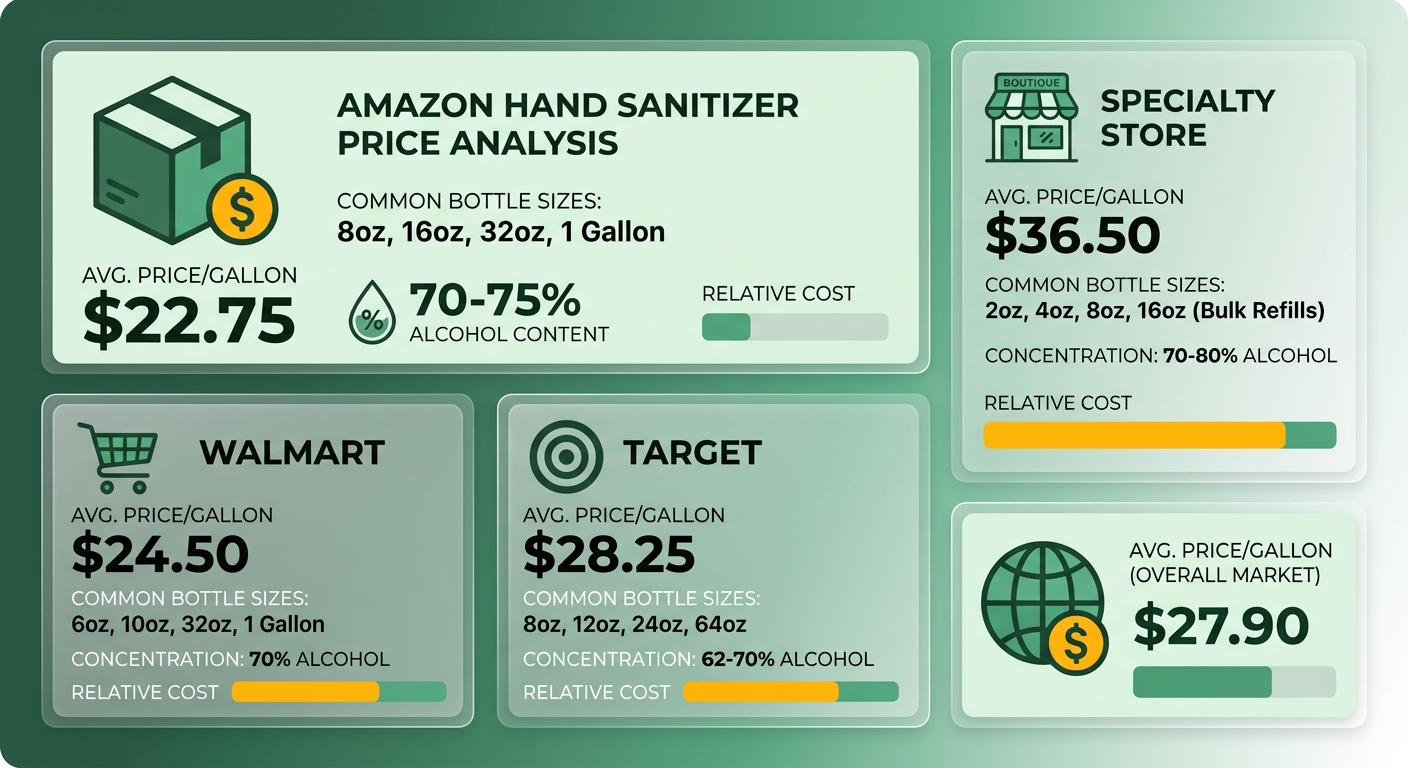
Which retailer has the cheapest muriatic acid?
Pool-supply and farm stores win on price per gallon. Big-box home improvement wins on availability. Online marketplaces charge the steepest premium once you factor in hazmat shipping.
| Retailer | Product / Size | Price | Approx. Per gallon |
|---|---|---|---|
| Home Depot | HDX Pool Care 1 gal | varies by location | check in-store |
| Home Depot | Champion 1 gal 2-pack (CH518) | varies | check label |
| Walmart | Klean-Strip Green 2-pack | varies by location | check in-store |
| Walmart | Champion Pool Acid pack | varies | check label |
| Lowe's | 2-gallon pack | varies | check label |
| Amazon | Sunnyside 1-quart | premium pricing | often 16x+ per gallon |
| Pool supply | Pinch a Penny / Johnny's case | case pricing | best bulk rates |
Regional farm stores like Atwoods and Menards regularly run sales that undercut national chains by 40–60%. Local pool suppliers move volume during peak season and price accordingly. Online marketplaces usually land at the highest cost per unit once you account for the smaller bottle.
Do online shipping fees kill the deal?
For muriatic acid, yes. It ships as hazardous material, so online orders carry handling surcharges that flat-rate grocery items never see. Small bottles already carry a premium. Add hazmat freight and buying online rarely beats walking into a hardware store.
Walmart's ratings back the in-store lean. Low-fume formulas hold strong review scores, but diluted versions mean you're paying full-strength money for less active acid. Verify concentration before you compare shelf prices.
How accurate unit pricing helps you compare
Comparing options means looking past the shelf price to cost per fluid ounce. That calculation exposes the premium hidden in smaller containers.
Checking the active chemical percentage keeps you from mistaking a diluted formula for a bargain. A lower concentration often needs twice the volume, which turns a seemingly cheap purchase into an expensive one.
Best for bulk value: pool-supply cases. Best for making sure you're not overpaying for water: comparing strengths before checkout.
Unit Cost Analysis: Price per Gallon for Different Bottle Sizes
The cheapest way to buy muriatic acid isn't about finding a magic retailer. It's about buying the right bottle size. Run the unit economics and the single quart is almost always the worst deal on the shelf, and the multi-gallon case almost always the best.
Here's the math most shoppers skip. Step up from a quart to a gallon jug and unit cost drops by roughly 84%. Move from a gallon jug to a 4-gallon case and you shave off another 60%. Same chemical, wildly different economics. That's the real answer to what muriatic acid is worth paying: it depends on the size you grab.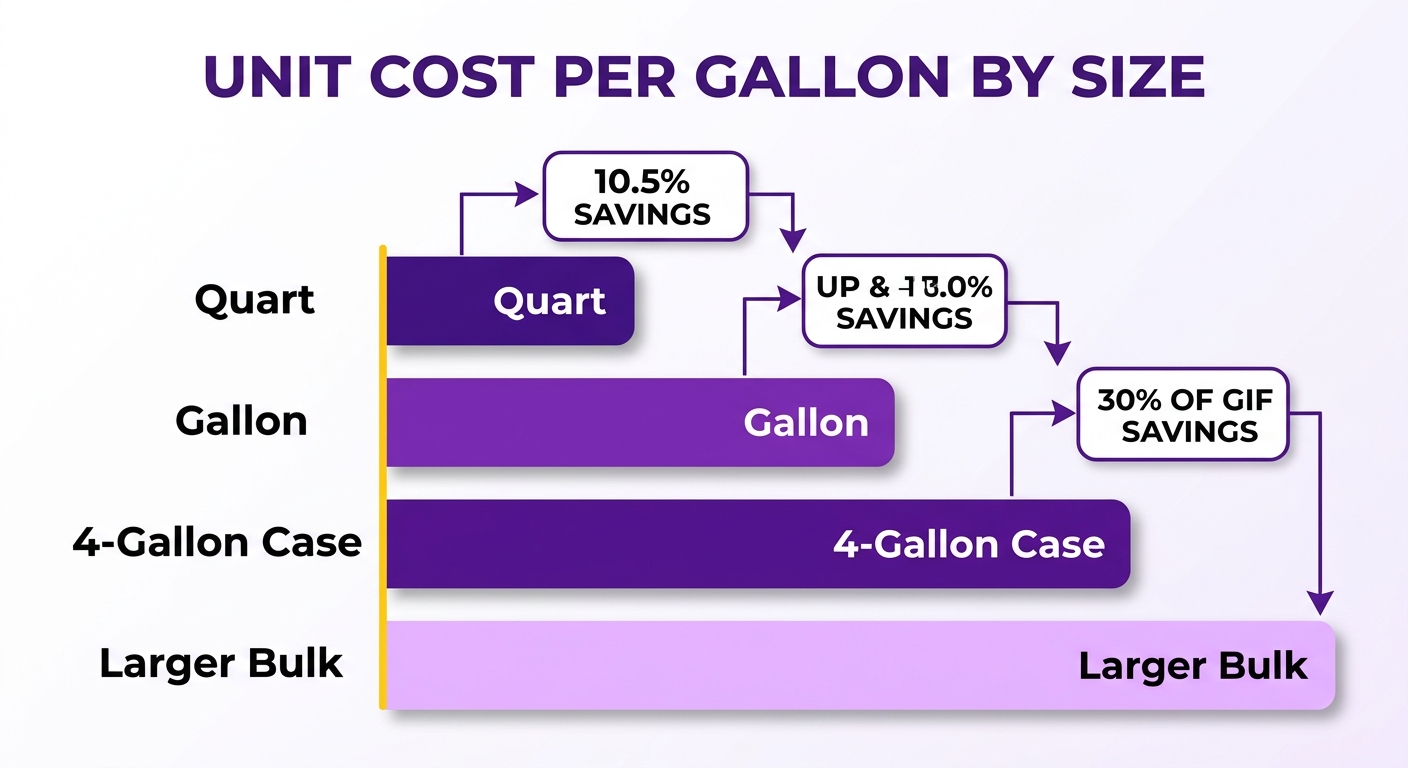
Which bottle size gives the best price per gallon?
Multi-gallon cases and drums win. Quarts lose badly. Unit cost drops sharply every time you step up a size, because you stop paying for packaging and hazmat handling on tiny volumes.
| Bottle size | Typical range | Efficiency gain vs quart |
|---|---|---|
| 1 quart | Premium tier | Baseline |
| 1-gallon (single) | Mid-range | ~84% reduction |
| 2 x 1-gallon pack | Similar to single | ~84% reduction |
| 4-gallon case | Budget tier | ~94% reduction |
| 5-gallon drum (HASA) | Wholesale tier | Maximum savings |
The Champion 1-gallon 2-pack (model CH518 at Home Depot) and HASA's larger formats (4x1 gallon cases and 5-gallon drums) show the pattern plainly. Buy small for a one-time patio job. Buy the case if you're maintaining a pool all season.
Does concentration change the per-gallon value?
Absolutely. Two products at the same shelf price can deliver very different amounts of active hydrochloric acid. A gallon at full industrial strength holds roughly twice the cleaning power of a gallon at retail "low-fume" concentration.
Low-fume alternatives often carry a real premium over standard pool-grade acid. Unless ventilation is severely restricted, those diluted variations usually mean paying more for a less effective solution.
Why accurate unit pricing matters
Retail displays rarely highlight cost per active ounce. Sizing up a purchase means cross-referencing total volume with chemical concentration to find the true value.
The payoff is concrete. Switch from a quart to a 4-gallon case and you cut unit cost by over 90%. Verify concentration before you buy, and you avoid paying full price for half the acid.
Bulk Purchase Discounts and Savings Opportunities
Buying in bulk is the fastest way to cut what you pay per gallon, but only if concentration holds steady across sizes. A multi-gallon case or drum can drop your cost to a fraction of the small-bottle price, as long as you're comparing the same strength every time.
Bulk packaging can also mislead if the product is pre-diluted. A multi-pack of a weaker formula may cost more per active gallon than a single container of full-strength acid.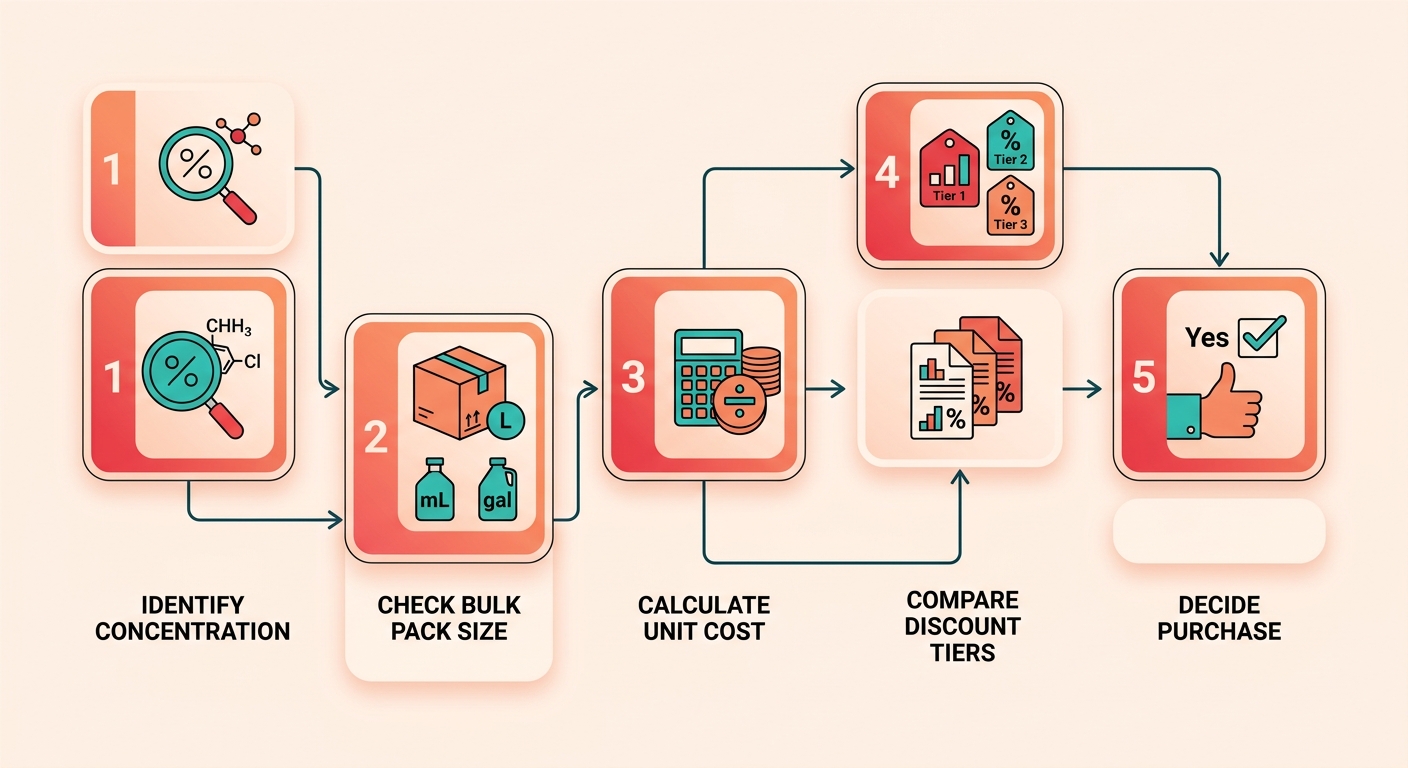
Which retailers offer real bulk discounts?
Pool-supply outfits and farm stores lead on bulk value. Home improvement stores sell convenient 2-packs, while manufacturers like HASA sell true wholesale quantities. The savings scale with container size, not brand loyalty.
For volume buyers, HASA's line reaches drum sizes no big-box shelf carries. A crew running weekly pool routes will see per-gallon prices bottom out at the drum tier, while a homeowner rarely needs more than a single case.
Big-box 2-packs sit in the middle. The Champion CH518 2-pack gives you gallon-pack convenience without a wholesale commitment, which suits buyers who want a modest supply on hand but no drum to store.
| Bulk tier | Typical buyer | Storage footprint | Savings signal |
|---|---|---|---|
| Manufacturer drum | Cleaning services, high-volume pools | Needs a ventilated, dedicated spot | Lowest per gallon when strength is verified |
| Pool-supply case | Regular pool owners | Fits a garage shelf | Strong value at full strength |
| Big-box 2-pack | Occasional DIY jobs | Minimal | Convenient, mid-tier pricing |
| Premium branded 4-pack | Low-fume preference | Moderate | Priciest per gallon |
Retail listings show a wide pricing spread for specialty formulas against standard options. High-rated vapor-reduction brands command a premium, which reflects the added cost of low-fume manufacturing.
How much can bulk buying actually save?
Watch for sales stacked on top of bulk. Menards has listed muriatic acid as low as $3 per gallon during promotions, and one buyer reported $4.66 at Atwoods, per the Trouble Free Pool thread. A sale on a case beats any everyday big-box price.
The biggest savings come from verifying strength before you commit to a larger volume. Comparing cost per active gallon tells you whether a discounted multi-pack is a genuine deal or just diluted product.
Pool maintenance and cleaning services benefit most, since both burn through acid steadily. For a one-off etching job, skip the drum. A single case is plenty, and babysitting 5 gallons of storage isn't worth it. Bigger packs aren't automatically the better buy. Warehouse-club bulk can still lose on unit price when the formula is diluted or overpriced.
What I'd actually buy
What you should pay for muriatic acid comes down to concentration and packaging size, not the retailer's logo. Do the math per gallon of working acid before you commit.
Specialty pool suppliers and regional agricultural outlets consistently price the sharpest. Timing your buy around seasonal spring sales lands the deepest discounts on full-strength cases.
What's the smartest way to shop for muriatic acid?
Buy full-strength, buy in bulk, and verify the HCl percentage before checkout. That order matters. A low shelf price on a diluted formula can cost more per active gallon than a standard full-strength case.
One habit worth building: log the per-gallon price you paid last time so you have a baseline for judging the next "deal." Local stock swings and regional hazmat surcharges can move the real cost more than the sticker suggests, and a saved number keeps you honest when a sale sign tries to rush you.
Focus on cost per unit of active ingredient rather than raw package price and you dodge the common retail markups. That's how you get the most chemical value for your budget.
Before you buy, verify the concentration, calculate the cost per gallon of active acid, and pick the size that matches your project.
References
[1] Champion 1 Gallon Muriatic Acid (2-Pack) CH518 - The Home Depot - https://www.homedepot.com/p/Champion-1-Gallon-Muriatic-Acid-2-Pack-CH518/334625012
[2] Where is the cheapest Place to Buy Muriatic Acid? - Trouble Free Pool - https://www.troublefreepool.com/threads/where-is-the-cheapest-place-to-buy-muriatic-acid.35830/
[3] Muriatic Acid | Hasa - https://hasa.com/product/muriatic-acid
[4] Sunnyside Corporation 71032 1-Quart Muriatic Acid - Amazon.com - https://www.amazon.com/SUNNYSIDE-CORPORATION-71032-1-Quart-Muriatic/dp/B002NZUBDG
[5] Sunnyside Muriatic Acid, 1 Qt. - Necedah True Value - https://necedahtv.shoptruevalue.com/p/muriatic-acid-076542000587
[6] 1 Gal. Swimming Pool Muriatic Acid Balancer (2-Pack) - https://www.homedepot.com/p/HDX-1-Gal-Swimming-Pool-Muriatic-Acid-Balancer-2-Pack-10014HDX/206809290
[7] Buying Muriatic Acid - https://www.troublefreepool.com/threads/buying-muriatic-acid.314096/
[8] 2 x 1 Gal. Swimming Pool Muriatic Acid (2-Pack) - https://www.homedepot.com/p/HDX-2-x-1-Gal-Swimming-Pool-Muriatic-Acid-2-Pack-10014HDX/202254527
[9] Muriatic Acids for Home Improvement - https://www.walmart.com/c/kp/muriatic-acids
[10] Muriatic acid Pool Chemicals at Lowes.com - https://www.lowes.com/pl/pools/pool-chemicals/muriatic-acid/4294610254-1220490914342
Frequently Asked Questions
1. Does opened muriatic acid expire before I can use a bulk case?
Over time, exposure to air causes the gas in hydrochloric acid to escape, gradually reducing its effectiveness. While a sealed container remains stable, an opened jug should be used within a single season. If you only need a small amount for an annual project, buying a smaller size prevents storing degraded chemical.
2. Can I buy full-strength acid and dilute it myself instead of paying for low-fume formulas?
Yes, manual dilution is a highly cost-effective alternative to buying pre-diluted products. When mixing, always pour the acid slowly into the water—never the reverse—to prevent dangerous splashing. Wear appropriate protective gear and perform the mixing outdoors or in a highly ventilated area to avoid inhaling fumes.
3. What does the "20 Baumé" label actually mean?
Baumé is a hydrometer scale used to measure the density of liquids. In the context of pool chemicals, this designation indicates a high-concentration industrial strength. Because retail availability of this grade has become less common in standard home improvement stores, verifying this label specification ensures you are purchasing a concentrated product rather than a pre-diluted retail version.
4. Why does buying muriatic acid online cost so much more than in-store?
Due to its highly corrosive nature, this chemical is classified as a hazardous material for shipping. Online retailers must factor in specialized packaging and carrier surcharges, which significantly inflates the final price. Purchasing locally from a hardware or pool supply store allows you to avoid these freight fees entirely.
5. How do I calculate whether a diluted formula is actually cheaper per unit of acid?
To find the true value, divide the retail price by the percentage of active hydrochloric acid listed on the label. This calculation reveals the cost per unit of actual chemical power, helping you identify when a lower-priced bottle is actually more expensive because it contains a higher ratio of water.
6. When is paying extra for a low-fume formula actually worth it?
These specialized formulas are beneficial for indoor applications, confined workspaces, or situations where handling strong fumes poses a direct safety hazard. For standard outdoor maintenance, using standard safety precautions and standing upwind of the vapors is generally sufficient, making the premium cost of low-fume alternatives unnecessary.
7. How does Popgot help me avoid overpaying for diluted acid?
By utilizing tools that scan product specifications and calculate unit pricing, you can filter out diluted options and compare products based on their active chemical content. This ensures you only evaluate listings that meet your specific concentration requirements.