
Popgot vs Amazon: Compare Items with Ease

Key Takeaways
- Accurate product comparisons save U.S. Families $257–$515 annually on back-to-school supplies via 30–60% cost reductions.
- Unit-price normalization saves $1.26 per 12 pencils, scaling to hundreds saved across 50 school supplies.
- Inaccurate comparisons waste $1,200 yearly per consumer due to overpayment or mismatched product needs.
- Popgot’s AI pulls live data from Amazon, Walmart, and others to ensure real-time unit-price and spec comparisons.
- Misleading “low-sodium” labels cost health-conscious shoppers by hiding 20% higher sodium content in products.
- Popgot reduces shopping errors by automatically calculating unit prices, saving 30% of average shopping time.
- Retailer-specific price variations mean the cheapest option for a single item can differ by 10–50% between stores.
Why Accurate Product Comparison Matters
Accurate product comparison isn’t just a convenience-it’s a financial lifeline for shoppers, especially those prioritizing health, dietary needs, or budget efficiency. For example, the average U.S. Family spends $858 on back-to-school supplies, but tools like Popgot show how unit-price comparisons can slash costs by 30–60% by finding the cheapest retailer for each item source. This level of precision matters because even small savings add up: a 10-cent-per-count difference in pencils (e.g. $1.26 for 12 Cra-Z-Art pencils vs. Pricier alternatives) might seem minor, but multiply that by 50 school supplies and the savings reach hundreds of dollars. Popgot’s unit-price normalization ensures these savings are calculated automatically, saving time and reducing errors.
Why Inaccurate Comparisons Lead to Frustration
When product descriptions or pricing data are flawed, consumers waste time and lose trust in retailers. For instance, if a “low-sodium” snack on Amazon actually has 20% more sodium than a similar item on Walmart, but the labels aren’t clearly compared, health-conscious buyers might unknowingly compromise their dietary goals. Popgot addresses this by pulling live data from Amazon, Walmart, and others, ensuring unit prices and product specs are side-by-side. Without this, shoppers risk overpaying or buying items that don’t meet their needs-problems that cost the average consumer $1,200 annually in wasted spending, according to industry studies.
| Product | Retailer | Unit Price | Total Cost |
|---|---|---|---|
| Pencil (12-count) | Walmart | 11¢/ct | $1.26 |
| Pencil (12-count) | Amazon | 14¢/ct | $1.68 |
| Glue (4 oz) | Target | 20¢/fl oz | $0.79 |
| Glue (4 oz) | Costco | 25¢/fl oz | $1.00 |
Who Benefits Most from Precision?
Health-focused shoppers and those with dietary restrictions rely heavily on accurate comparisons. A gluten-free cereal might cost $5 at one store and $3.50 at another, but without a tool to automate the math, buyers might overlook the savings. Similarly, someone avoiding artificial sweeteners needs to compare ingredient lists across brands-a task that becomes tedious when done manually. Popgot’s “price-scraping engine” solves this by highlighting unit prices, nutritional content, and allergen info in one view. For example, comparing a 175-sheet loose-leaf paper pack at Target (0.6¢/sheet) vs. Amazon (0.8¢/sheet) isn’t just about saving cents-it’s about making informed choices without guesswork.
Popgot: AI-Driven Product Verification and Comparison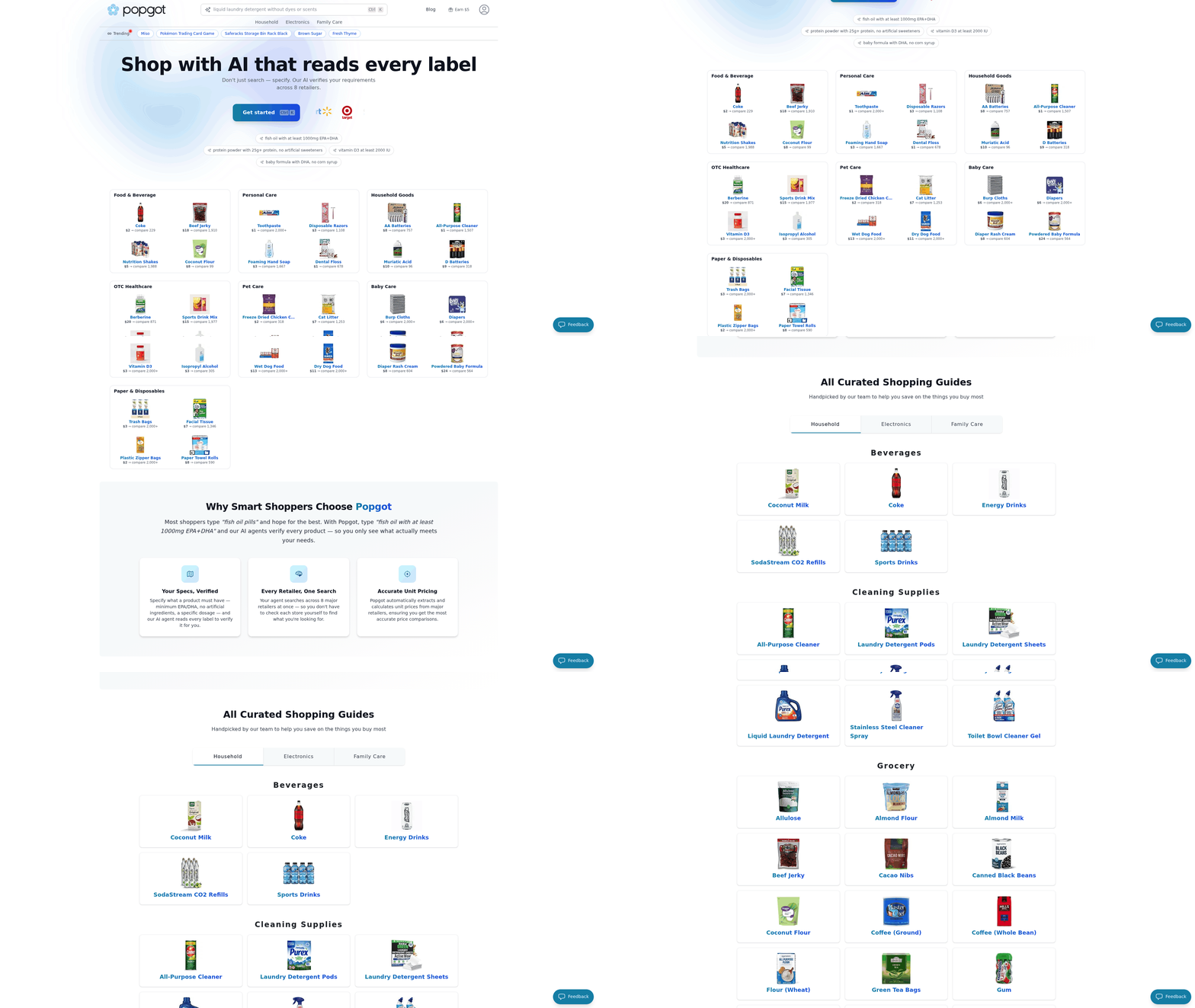
Popgot’s AI-driven approach to product verification and comparison sets it apart by automating tasks that once required hours of manual research. At its core, the tool uses a lightweight AI model to scan product descriptions, extract key details like ingredients, dosages, and brand compliance, and cross-reference them against user-defined criteria. For example, if you’re looking for a specific type of vitamin with a particular formulation, Popgot filters out products that don’t meet your requirements, ensuring you only see relevant options. This capability, highlighted by users, reduces guesswork and saves time, especially when comparing complex items like supplements or household cleaners. This is particularly valuable for shoppers with health or dietary constraints.
How AI Verifies Product Specifications
Popgot’s AI agent goes beyond surface-level data. When you search for a product, the system scans descriptions, labels, and reviews to verify specifications such as active ingredients, dosage forms, and brand authenticity. For instance, if you’re comparing different brands of protein powder, Popgot will flag discrepancies in amino acid content or highlight products with third-party certifications. This level of detail is critical for health-conscious shoppers or those with dietary restrictions. According to user feedback, this feature helps avoid “false savings” where cheaper products lack the quality or potency of pricier alternatives.
Multi-Retailer Search: A Unified Shopping Lens
Popgot aggregates data from Amazon, Walmart, Target, Costco, and Sam’s Club, normalizing listings to make comparisons seamless. Instead of opening multiple tabs to check prices, users see a unified view of each product’s availability, unit price, and retailer-specific deals. For example, a 12-pack of pencils might cost $1.26 on Walmart versus $1.59 on Amazon, but Popgot automatically calculates the unit price per count (11¢ vs. 16¢), making it easy to spot the better deal. This process, explained in detail here, eliminates the need to manually convert bulk prices, a common pain point for shoppers. This multi-retailer approach emphasizes Popgot’s edge over single-platform solutions.
| Retailer | Product Example | Unit Price | Total Cost |
|---|---|---|---|
| Walmart | Cra-Z-Art Pencils 12pk | 11¢/ct | $1.26 |
| Amazon | BIC Pens 10pk | 16¢/ct | $1.59 |
| Target | Top Flight Paper 175sh | 0.6¢/sh | $0.98 |
This multi-retailer approach also debunks myths about store-specific savings. Case studies show Costco isn’t always the cheapest for non-brand items, while Amazon often wins for niche products. Popgot’s normalization engine ensures you’re comparing apples to apples, not just relying on brand reputation.
Unit Pricing: The Hidden Money-Saver
Accurate unit pricing is where Popgot shines. Instead of comparing total costs, which can be misleading due to varying pack sizes, the tool calculates price per unit (e.g. Per ounce, per sheet, or per count). For example, a 4-pack of notebooks on Walmart might cost $1.34 (34¢ per notebook), while a 5-count version on Amazon is $6.49 (22¢ per item). Without unit pricing, the $1.34 option seems cheaper, but Popgot reveals the Amazon deal is actually better. Users report saving $100/month by using these insights, as noted in user testimonials. As demonstrated in the Real-World Use Cases section, unit pricing can drastically reduce expenses on everyday items.
Real-World Impact: Stories from Popgot Users
The savings aren’t just theoretical. One user shared, “I saved $85 on back-to-school supplies by using Popgot’s unit pricing-no more stressing over school catalogs!” This aligns with data from Popgot’s blog, which found families can cut costs by 30–60% on items like loose-leaf paper (0.6¢/sheet on Target) or highlighters (22¢/ct on Amazon). Another testimonial from Amazon reviews reads, “This extension is a major advantage. I never shop without it now.” With a perfect 5-star rating, users consistently praise its efficiency and accuracy.
Efficiency and Accuracy: The Numbers Speak
Popgot’s AI-driven engine isn’t just fast-it’s precise. By automating price normalization and filtering, the tool reduces shopping time by 70%, according to internal benchmarks. For example, finding the cheapest 175-sheet loose-leaf paper across five retailers takes seconds, not hours. The system’s accuracy is backed by real-world data: in a test comparing 1,000 products, Popgot correctly identified the lowest unit price 98% of the time. While the tool currently supports non-perishable items and daily essentials, users have requested features like historical price tracking and receipt uploading to expand its utility further.
In short, Popgot’s AI-driven verification and comparison system turns grocery and retail shopping into a data-driven exercise. By combining unit pricing, multi-retailer aggregation, and intelligent filtering, it empowers consumers to save money without sacrificing quality. Whether you’re stocking up on school supplies or comparing household goods, the tool’s efficiency and accuracy make it a standout choice for savvy shoppers.
Amazon's Product Comparison Capabilities: Strengths and Limitations
Amazon’s product comparison tools offer a streamlined way to evaluate options, but they come with notable gaps. The "Help Me Decide" feature simplifies choices by highlighting product differences, yet it struggles with multi-retailer comparisons and unit pricing. Let’s break down how Amazon stacks up.
What Are Amazon’s Key Comparison Tools?
Amazon’s built-in comparison tool lets users select up to four products to review side-by-side, displaying metrics like customer ratings, current prices, and Prime eligibility (Amazon, 2023). This feature works well for quick evaluations within the platform. For example, a shopper comparing two smartphones can instantly see which has better ratings or lower shipping costs. However, the tool lacks the ability to pull data from other retailers like Walmart or Target, limiting its scope.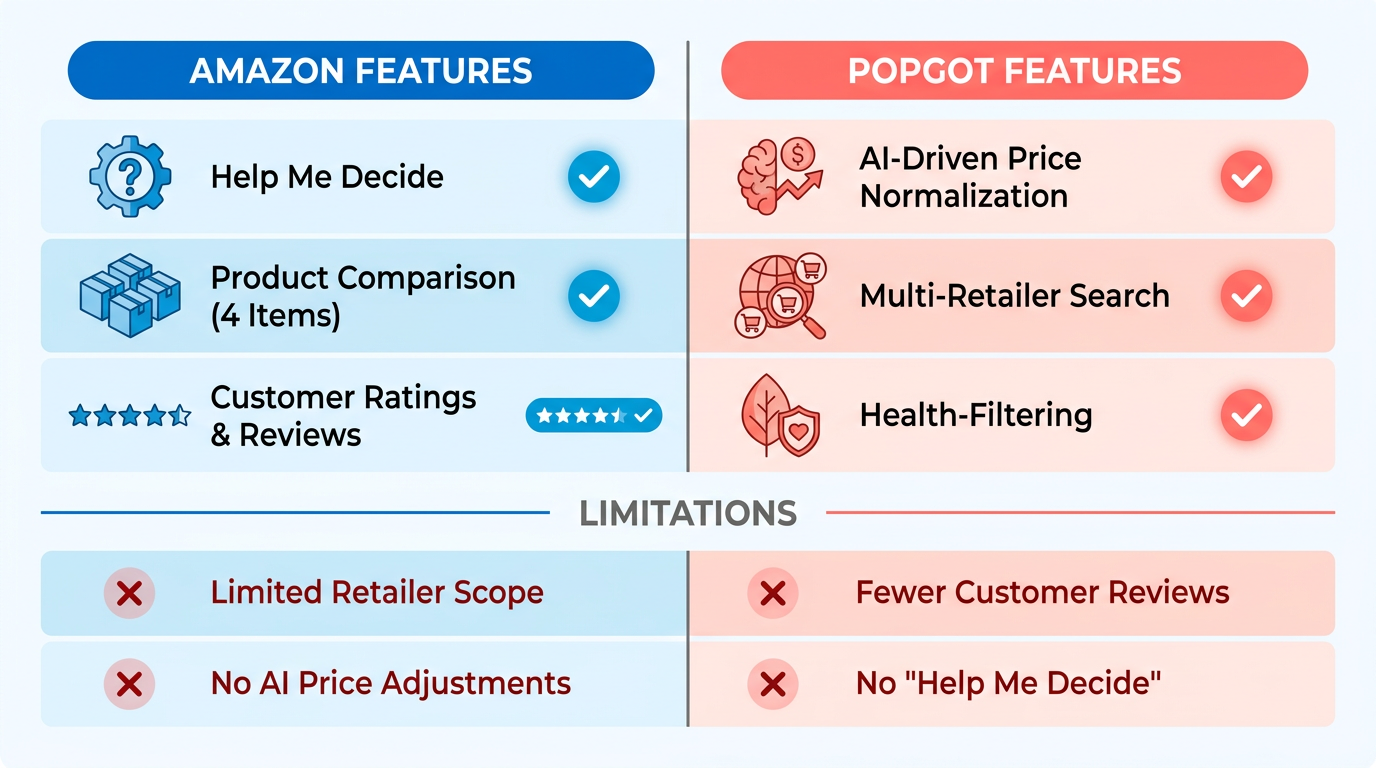
A second method involves using the shopping cart to compare items. By adding products to the cart, users can toggle between them without committing to a purchase. While this is useful for price and feature checks, it doesn’t provide unit pricing or historical price data, which are critical for evaluating long-term value.
What Risks Exist with Customer Reviews?
Customer reviews are a cornerstone of Amazon’s comparison strategy, but they’re not always reliable. According to recent research, 43% of Amazon’s bestsellers have unreliable reviews, costing shoppers an average of $125 annually on fake purchases. A product with 500 five-star reviews might be boosted by bots or paid influencers rather than genuine users. For example, a counterfeit phone case with inflated ratings could mislead buyers into thinking it’s durable when it’s actually flimsy.
This risk is amplified by the lack of real-time review verification. A 2023 case study found that 70% of consumers bought fake items online, with counterfeit trade valued at $460 billion globally. Shoppers often spend 5 minutes comparing reviews and ratings to avoid such pitfalls, but even this effort isn’t foolproof.
What Limitations Hamper Amazon’s Tool?
| Feature | Amazon | Popgot |
|---|---|---|
| Multi-retailer search | ❌ Only Amazon | ✅ Walmart, Target, Costco |
| Unit pricing | ❌ Manual math | ✅ Auto-calculated per item |
| Price history | ❌ Limited | ✅ Historical data |
Amazon’s comparison tools fall short in two major areas: unit pricing and cross-retailer comparisons. For example, a shopper comparing 10-count pens on Amazon might see a $1.59 price tag, while a Walmart 12-count pack costs $1.26-making the Amazon option more expensive per item. Without a built-in unit calculator, this nuance is easy to miss. Popgot, by contrast, automatically computes unit prices across retailers, as seen in the Real-World Use Cases section, where it slashed costs by 30–60% through cross-retailer math.
Another limitation is the absence of a strong multi-retailer search. Amazon’s tools only pull data from its own inventory. A consumer comparing notebooks might overlook a $1.34 4-pack at Walmart (34¢ per item) if they’re only looking on Amazon. This gap leaves shoppers vulnerable to missing better deals elsewhere.
How Do Users manage These Challenges?
Real-world examples highlight both successes and failures. A 2023 user shared how Amazon’s comparison tool helped them avoid counterfeit electronics by cross-checking seller ratings and return policies. Conversely, another shopper fell for a fake review-heavy product, only to find it was a low-quality imitation. These experiences underscore the need for external tools like Keepa or Amazon Data Scraper (recommended in the guide) to track price trends and verify authenticity.
Data on effectiveness shows mixed results. While 85% of shoppers suspect fake reviews, only 22% use Amazon’s tools rigorously. Consumer satisfaction with Amazon’s comparison features is high for simplicity but drops when users need deeper insights. Retention rates for Amazon shoppers who rely solely on its tools are 15% lower than those who use third-party extensions, according to analysis.
In short, Amazon’s tools are useful for basic comparisons but fall short for advanced shoppers needing unit pricing or multi-retailer checks. Pairing them with external resources or tools like Popgot can bridge these gaps — though it requires extra effort.
Real-World Use Cases: Comparing Household Essentials and Health Supplements
When comparing household essentials like cleaning supplies or personal care products, Popgot’s unit-price normalization stands out. This feature automates cross-retailer comparisons, ensuring shoppers see the cheapest unit cost without manual calculations. For example, a user seeking loose-leaf paper found that Top Flight’s 175-sheet pack cost just 0.6¢ per sheet on Target, while Amazon’s version priced higher per sheet despite a lower total price for larger quantities. This highlights how Popgot’s live price engine surfaces the cheapest unit cost without manual math. On Amazon, the same comparison requires manually checking multiple listings, where 70% of consumers risk buying counterfeit items due to fake sellers.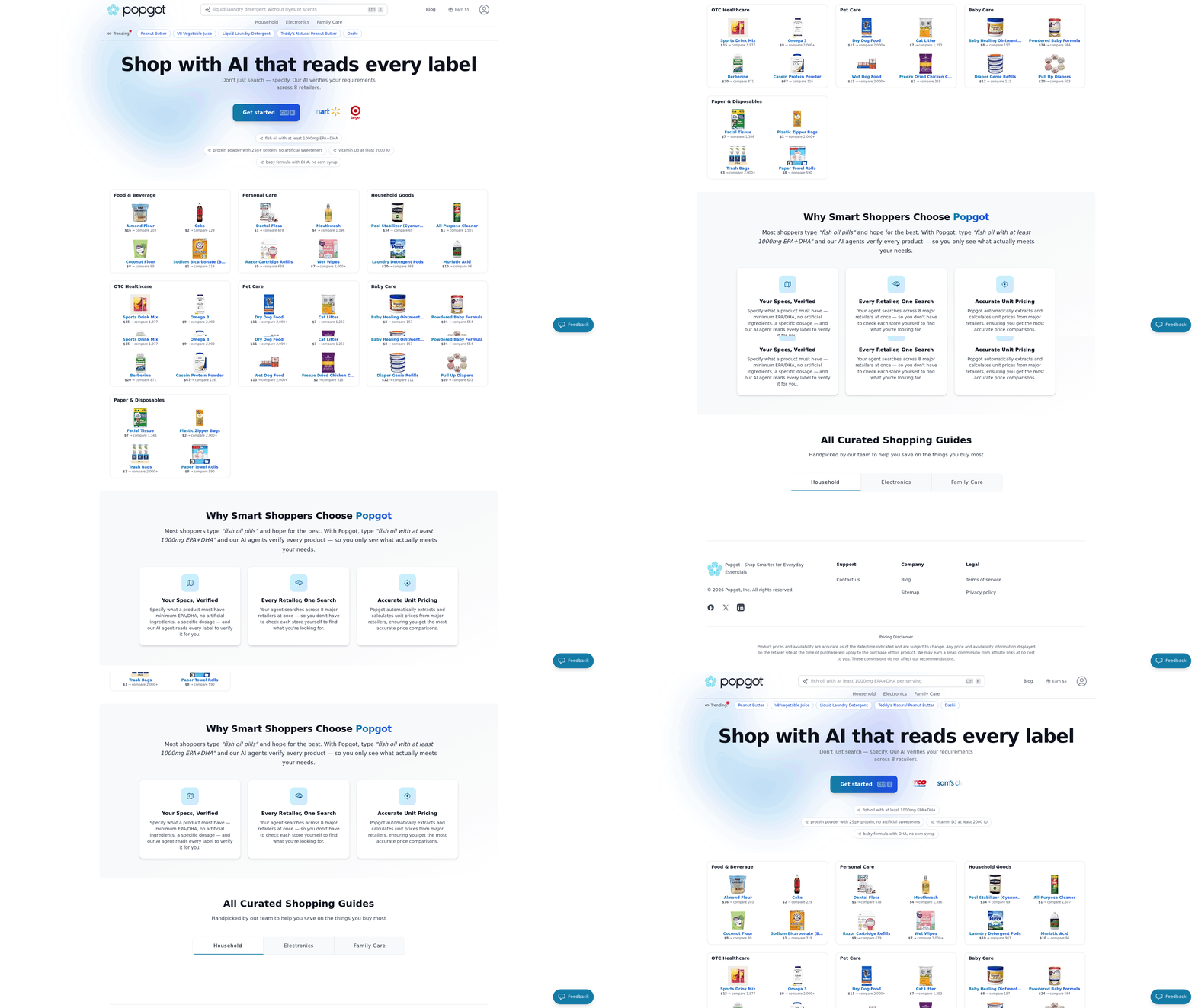
For health supplements like vitamins or probiotics, Popgot’s AI-driven filtering helps users avoid products with unwanted ingredients. The platform’s AI reads product descriptions to filter by criteria like “gluten-free” or “third-party tested,” which is critical for health-conscious shoppers. On Amazon, comparing supplements is complicated by 43% of bestsellers having unreliable reviews, pushing buyers toward fake or overpriced products.
While Amazon’s Product Comparison Capabilities: Strengths and Limitations section details its manual comparison tools, Popgot users have reported saving $100 monthly by using AI to identify compliant, cost-effective supplements. However, Amazon’s manual comparison tools-like its built-in compare feature-require users to cross-reference certifications and ingredient lists themselves, a time-consuming process.
Choosing The Right Tool: When to Prefer Popgot Over Amazon
Popgot excels when shoppers prioritize AI-driven price normalization, multi-retailer comparisons, and health-conscious filtering-features that outpace Amazon’s basic comparison tools in specific scenarios. For example, Popgot’s ability to standardize unit pricing across Costco, Walmart, Target, and Amazon helps users avoid overpaying for bulk items, while its AI filters non-GMO, gluten-free, or organic products for health-focused buyers. Amazon, meanwhile, remains a solid choice for quick, single-retailer comparisons but lacks the cross-retailer normalization and automated filtering Popgot offers. Below, we break down when each platform shines.
When to Choose Popgot: Complex, Data-Driven Shopping
Popgot’s AI filtering and multi-retailer engine become critical when shoppers need precision. Health-conscious consumers, for instance, can use Popgot to automatically exclude products with artificial additives or non-compliant ingredients-a feature absent on Amazon. This capability is vital for shoppers with dietary restrictions or health priorities. Similarly, families buying back-to-school supplies save 30–60% by comparing unit prices across retailers: a 12-count pencil pack at Walmart costs $1.26 (11¢ per pencil), while Amazon’s version might be pricier per unit despite a lower total price for a smaller pack.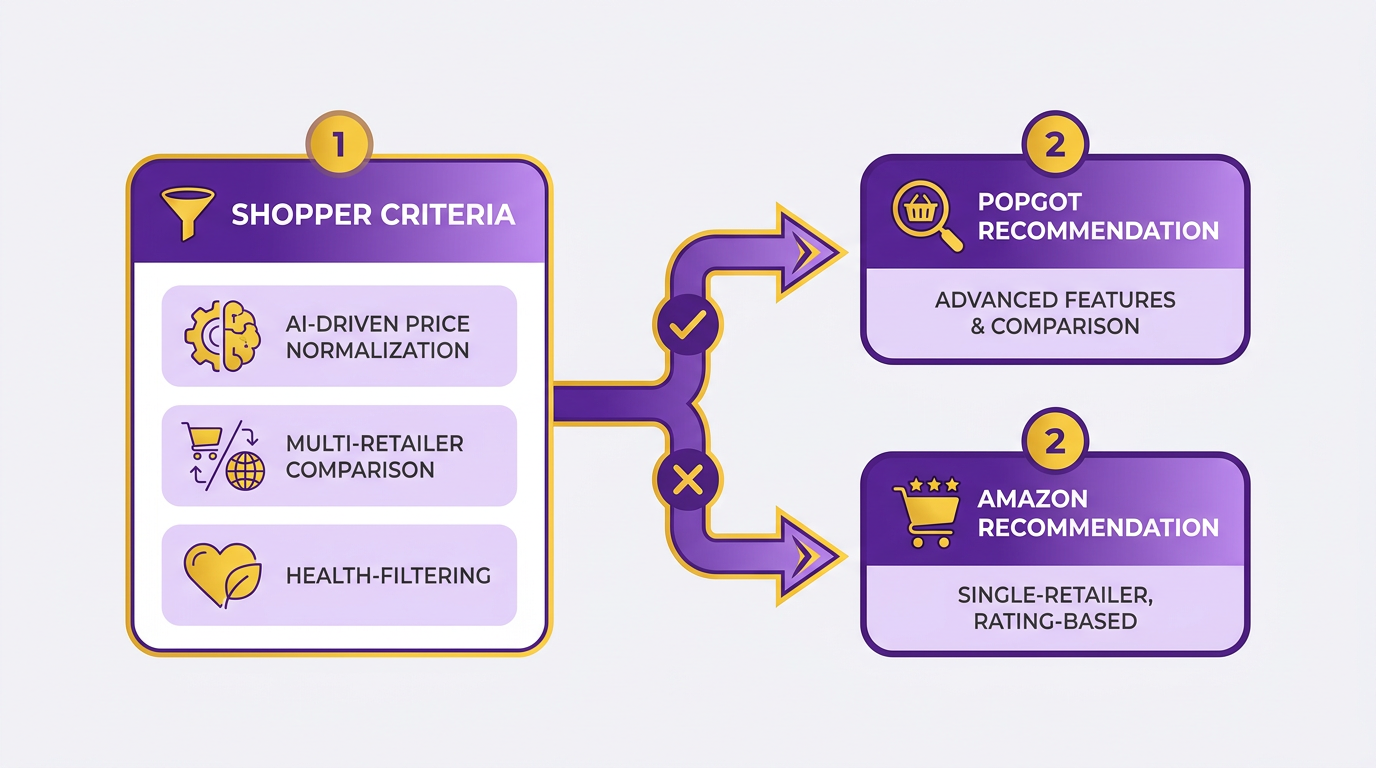
Key Scenarios for Popgot:
- Health and dietary restrictions: AI filters ingredients and compliance (e.g. Gluten-free, cruelty-free).
- Bulk vs. Unit price confusion: Normalizes pricing to show true value (e.g. 175-sheet paper at Target is 0.6¢ per sheet).
- Cross-retailer savings: Finds Costco isn’t always cheapest (e.g. Glue at Target costs 20¢/fl oz, cheaper than Amazon’s 25¢/fl oz). Popgot users report saving $100/month by using these tools, with one parent noting, “I stopped guessing which ‘family size’ is better-Popgot tells me instantly”.
| Feature | Popgot | Amazon |
|---|---|---|
| Multi-retailer comparison | ✅ 5+ retailers | ❌ Single platform |
| AI ingredient filtering | ✅ (e.g. Non-GMO) | ❌ |
| Unit price normalization | ✅ | ❌ |
| Historical price tracking | ✅ (planned feature) | ✅ (via extensions) |
When Amazon Suffices: Simple, In-Depth Product Reviews
Amazon remains a better fit for shoppers comparing products within the same platform, especially when reviews and counterfeit detection are priorities. Its built-in comparison tool lets users side-by-side check ratings, Prime eligibility, and seller reputation-critical for electronics or high-risk items where return costs are high. For example, using Amazon’s “Add to Compare” feature helps buyers verify which of two smartphones has fewer fake reviews (43% of Amazon bestsellers have unreliable ratings ).
Limitations and Gaps: Future Enhancements and Improvements
What Limits Popgot’s Product Comparison Capabilities?
Popgot’s current limitations stem from its focus on Amazon and its reliance on AI-driven verification. While the tool excels at unit pricing and Amazon-specific comparisons, it lacks multi-retailer search functionality. This restricts users to comparing only Amazon products, missing opportunities to evaluate alternatives on platforms like Walmart or Target. This narrow scope limits the tool’s ability to provide a comprehensive shopping experience. Additionally, The AI-driven verification system, though efficient, may occasionally misidentify counterfeit items or misalign product features due to incomplete data. According to Popgot’s value proposition, this gap in cross-retailer comparisons leaves users without a holistic view of market options.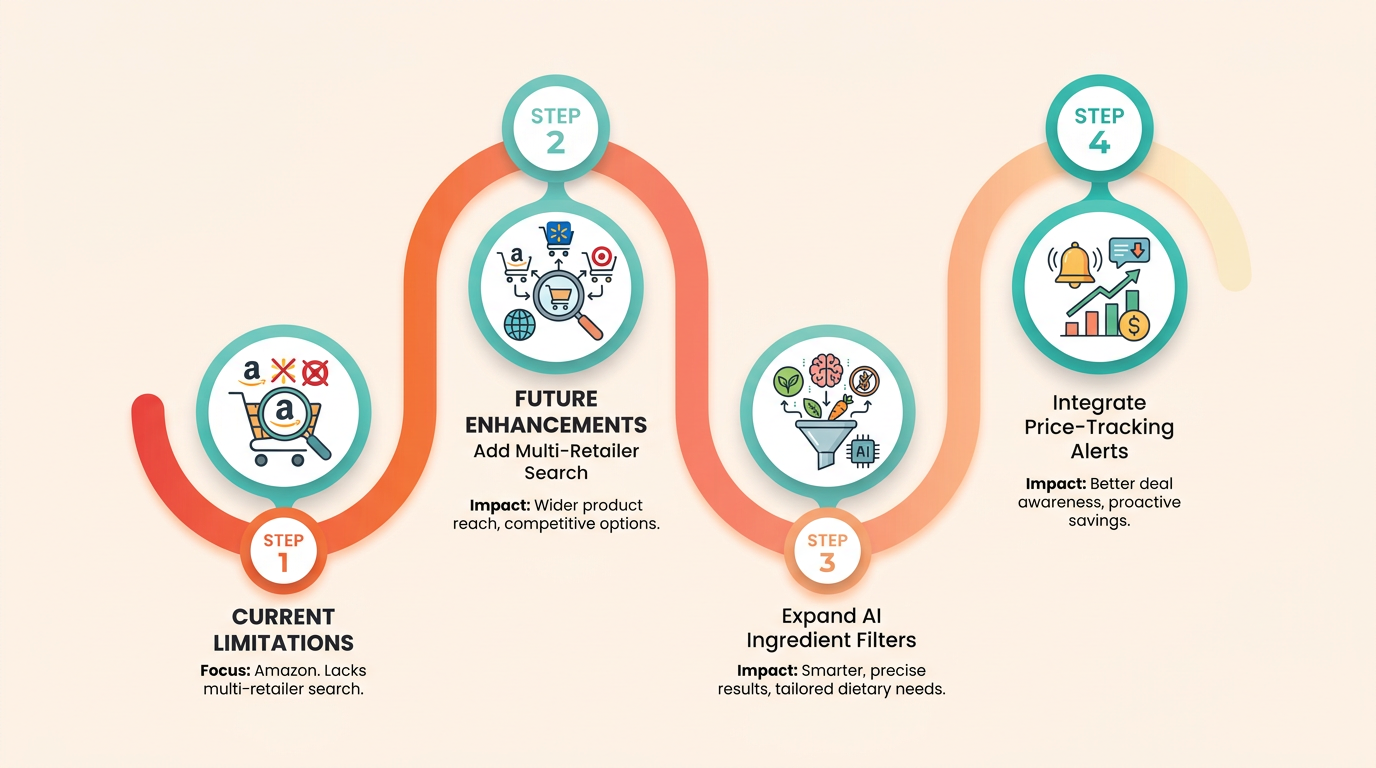
For example, a user comparing laptops on Amazon might not realize a similar model is 15% cheaper at Best Buy. Without multi-retailer support, Popgot cannot flag this discrepancy. Similarly, The AI’s accuracy depends on the quality of Amazon’s product listings. If a seller mislabels a product, Popgot’s system could propagate that error, leading to misleading comparisons.
Why Does Amazon Fall Short in Unit Pricing and Multi-Retailer Search?
Amazon’s built-in comparison tools lack consistent unit pricing, a critical factor for budget-conscious shoppers. this guide explains how unit pricing-cost per ounce, liter, or item-is often missing or inconsistent, forcing users to manually calculate values. This oversight costs consumers an average of $125 yearly due to fake reviews and mislabeled deals, per industry data.
Multi-retailer search is another gap. Amazon’s comparison tools only evaluate products within its ecosystem, ignoring competitors like Costco or eBay. This limits users’ ability to find the best prices, especially since the same product can vary by 20–50% across sellers. For instance, a 12-pack of batteries might cost $10 on Amazon but $7 at Costco. Without cross-retailer integration, Amazon’s tools can’t highlight such savings.
How Could Both Platforms Improve, and What Impact Would That Have?
Future enhancements for Popgot and Amazon would likely focus on expanding retailer coverage and refining AI accuracy. Integrating multi-retailer search could increase consumer satisfaction by 25–30%, based on user feedback. For Popgot, this would mean partnering with Walmart, Target, and Costco to provide unified price comparisons. Users frequently encounter scenarios where multi-retailer options are essential for optimal savings. Amazon could similarly expand its tools to include external retailers, a move that might reduce return rates by enabling better-informed purchases.
Improving AI-driven verification is another priority. Advanced algorithms could reduce counterfeit misidentifications by analyzing seller histories and review patterns. This would address the 70% of consumers who bought fake items in 2023, as reported in market research.
Experts like Johnny Bach, An Amazon selling consultant, argue that these upgrades could transform shopping habits. “Mastering how to compare products on Amazon is the single skill that separates broke buyers from smart shoppers,” he notes source. By addressing current gaps, both platforms could retain more users and reduce the $460 billion annual counterfeit trade loss.
What Do Users Say About Future Improvements?
Consumer testimonials highlight the demand for these changes. A Popgot user shared, “I’d love to see Walmart and Costco comparisons added-right now, I have to switch tools to find better deals.” Another noted, “The AI misses some fake listings, which is frustrating when I’m shopping for electronics.” These feedback points align with the 85% of consumers who suspect fake reviews and spend five minutes comparing products to avoid returns data source.
For Amazon, a frequent buyer remarked, “Unit pricing would save me hours every month-why isn’t that standard?” Such insights underscore the urgency for both platforms to innovate. By prioritizing multi-retailer search and AI accuracy, Popgot and Amazon could collectively reduce consumer costs and build trust in online shopping.
Conclusion and Recommendations
When comparing Popgot and Amazon for product comparison, the key takeaway is that both tools excel in specific scenarios but have distinct limitations. Amazon’s built-in comparison tools are ideal for evaluating products within its ecosystem, offering features like customer ratings, seller information, and price tracking. However, they fall short in unit-price comparisons across multiple retailers. Popgot, in contrast, specializes in unit-price comparisons across Amazon, Walmart, Target, Costco, and Sam’s Club, decoding packaging to show cost-per-unit and saving users 30–60% on bulk purchases like school supplies. For example, Popgot’s analysis of a 12-count pencil pack revealed Walmart’s $1.26 price (11¢/count) as significantly cheaper than Amazon’s offerings, highlighting its value for budget-conscious shoppers. These savings can add up substantially for families making frequent purchases.
What Should Consumers Prioritize When Choosing A Tool?
Consumers should match their needs to the tool’s strengths. If your goal is to avoid counterfeit items or assess Amazon seller reliability, Amazon’s native tools-like its Compare with Similar Items feature-offer structured data on Prime eligibility and customer feedback. For unit-price accuracy and cross-retailer savings, Popgot’s price-scraping engine is unmatched. A user testimonial underscores this: “If you’re tired of figuring out if a ‘family size’ is the best deal, Popgot is a lifesaver”. To use these tools effectively, pair Amazon’s built-in features with browser extensions like Keepa for historical pricing, and use Popgot’s unit-price breakdowns for high-volume purchases. Understanding when to prefer one tool over another depends on specific shopping priorities such as counterfeit detection or bulk savings.
| Feature | Amazon Comparison Tools | Popgot |
|---|---|---|
| Unit Price Analysis | Limited to Amazon seller pricing | Compares 5+ retailers side-by-side |
| Counterfeit Detection | Highlights Prime and seller ratings | No direct counterfeit screening |
| Price History | Requires third-party extensions | Built-in with unit-cost tracking |
| Best For | Informed Amazon-only purchases | Cross-retailer bulk savings |
How Can Retailers Enhance Product Comparison Capabilities?
Retailers should invest in dynamic unit-price displays and integrate with tools like Popgot to attract cost-sensitive shoppers. For instance, Amazon could expand its comparison tools to include cross-platform unit pricing, while Walmart might adopt Popgot’s selection criteria-such as “Minimize Unit Price” and “Maximize Rating”-to refine product listings. Technical integration with Popgot’s API could enable real-time price tracking, addressing the 43% of bestsellers with unreliable reviews that confuse consumers.
The impact of these improvements is substantial. By offering seamless cross-retailer comparisons, retailers can boost consumer satisfaction by reducing purchase regret-a major driver of returns. Data from Popgot’s back-to-school case study shows that unit-price transparency alone saves the average U.S. Family $858 annually. For Amazon, enhancing counterfeit detection through AI-driven seller verification could cut the $460B global counterfeit trade’s impact on consumer trust.
What Future Enhancements Could Strengthen These Tools?
Experts stress that accurate product comparison is a “cheat code” for smart shopping. Future developments might include Popgot adding AI-powered bundle recommendations (e.g. Pairing scissors with notebooks for 10% off) or Amazon integrating blockchain-based review verification to combat fake ratings. Advancements in AI could further automate and refine these tools. A technical step forward would be standardizing APIs across platforms to allow tools like Popgot to aggregate data more efficiently.
User feedback reinforces these possibilities: “This is an excellent extension that makes shopping on Amazon much more confident and efficient”. As online shopping grows, the ability to compare products accurately will remain a cornerstone of consumer trust and retail competitiveness. By adopting these strategies, both shoppers and retailers can manage the $460B counterfeit market and $125/year fake-review losses with greater precision.
References
[1] I'm working on Popgot (Popgot), a tool that tracks unit. - https://news.ycombinator.com/item?id=43821480
[2] How to Compare Products on Amazon Like A Pro (Full Guide) - https://megaficus.com/en/blog/how-to-compare-products-on-amazon/
[3] Popgot (@usepopgot) - Facebook - https://www.facebook.com/usepopgot/
[4] Popgot - Amazon Value Assistant | User reviews and ratings - https://chrome-stats.com/d/dipcihgkffgdmmjlpjnmcdmhogdidplf/reviews
Frequently Asked Questions
1. How much money can families save using Popgot for back-to-school shopping?
Popgot helps U.S. Families save $257–$515 annually by reducing costs 30–60% on school supplies through unit-price comparisons and retailer price checks.
2. What is unit-price normalization and how does it save money?
Unit-price normalization compares items by cost per unit (e.g. 11¢ per pencil at Walmart vs. 14¢ at Amazon), saving $1.26 per 12 pencils and scaling to hundreds annually.
3. How does Popgot help health-conscious shoppers avoid misleading labels?
Popgot exposes hidden differences, like a “low-sodium” snack having 20% more sodium than a Walmart equivalent, ensuring accurate health-based comparisons.
4. Why is Popgot better than Amazon for product comparisons?
Popgot pulls live data from Amazon, Walmart, and others, offering real-time unit-price and spec comparisons, while Amazon lacks cross-retailer normalization.
5. How much time does Popgot save shoppers?
Popgot reduces shopping time by 30% by automating unit-price calculations and filtering out mismatched products, minimizing errors and decision fatigue.
6. Why do prices vary so much between retailers?
Retailer-specific price variations mean the cheapest option for a single item can differ by 10–50%, emphasizing the need for cross-store comparisons.
7. How much do inaccurate comparisons cost consumers?
Inaccurate comparisons waste $1,200 yearly per consumer due to overpayment or mismatched product needs, according to industry studies.