
Popgot vs Google Shopping: LanguaL Nutritional Data for Smarter Shopping
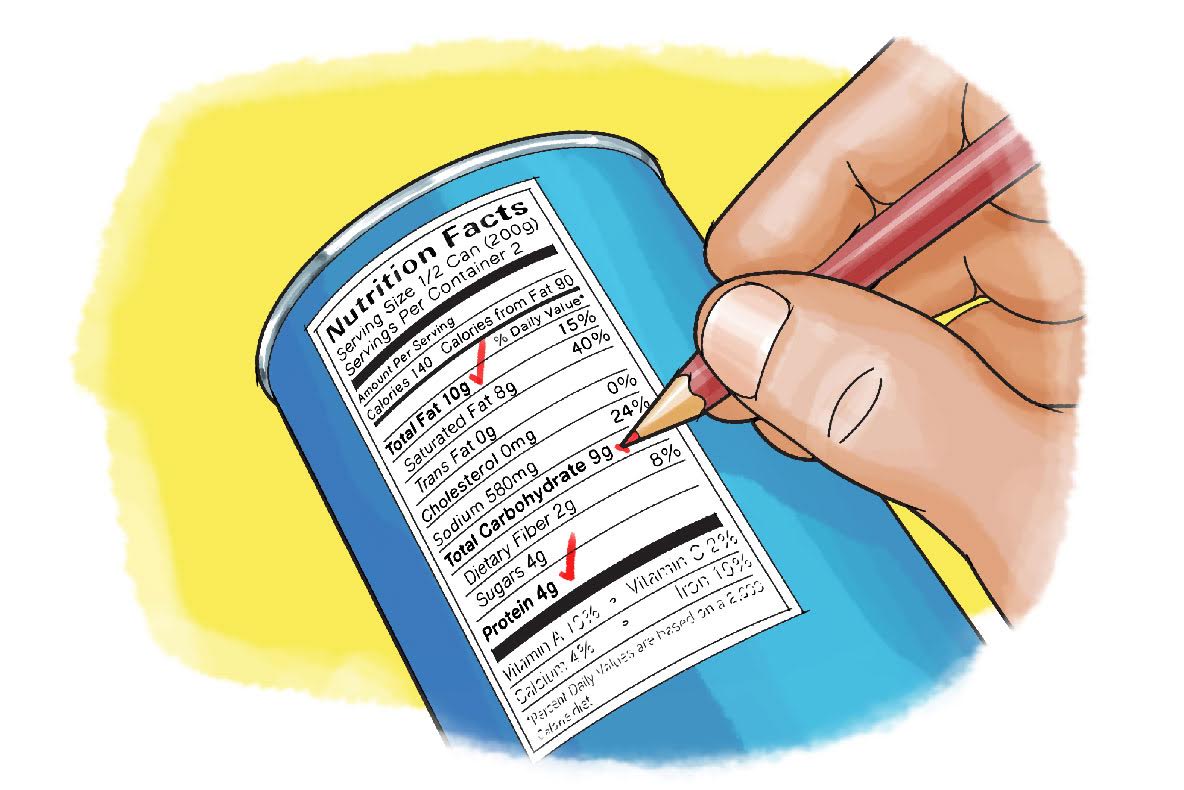
Key Takeaways
- Online shopping will account for 25% of global retail sales by 2025, driving demand for tools that streamline health-conscious decisions.
- Popgot's AI agent reads product labels in real time across Amazon, Walmart, Target, Costco, and Sam's Club — matching listings against shopper-specified criteria like ingredient lists or unit-price thresholds.
- Google Shopping uses LanguaL-standardized nutritional data (via the USDA-backed Google Nutrition Information API) for cross-retailer nutritional sorting, but lacks shopper-driven AI label verification at the listing level.
- Popgot and Google Shopping solve nutritional-shopping problems at different layers: Popgot verifies individual listings match shopper criteria, Google sorts results by aggregated nutritional metrics.
- AI label-reading tools like Popgot save time by eliminating manual ingredient-list checking for health-focused shoppers.
- For shoppers with specific dietary requirements (gluten-free, low-sodium, specific dosages), Popgot's AI filtering surfaces only listings that genuinely match, reducing decision fatigue.
- Combining Popgot's listing-level verification with Google Shopping's broader retailer aggregation gives shoppers the most complete coverage for nutrition-conscious purchases.
Why Smarter Shopping Matters
Smarter shopping isn't just about convenience — it's about empowering consumers to make decisions aligned with their health, budget, and time constraints. With online shopping projected to account for 25% of global retail sales by 2025 (as reported by Google's Shopping updates), the demand for tools that streamline this process is growing. AI-driven shopping platforms like Popgot address this need by combining label-reading automation with multi-retailer search, offering a solution to common pain points like unclear product labels or hidden ingredients.
AI-driven shopping tools reduce the time spent sifting through irrelevant results and inaccurate claims. For example, Popgot's AI agent scans product label content across Amazon, Walmart, Target, Costco, and Sam's Club, verifying details like minimum EPA/DHA content in fish oil or the absence of artificial ingredients — based on what's actually written on each retailer's product page. This eliminates manual cross-checking for health-conscious buyers. A user searching for "fish oil with at least 1000mg EPA+DHA" gets results filtered against that specific criterion, compared and unit-priced across retailers in a single search. Google Shopping, on the other hand, returns broader results by keyword match and seller relevance — its strength is breadth and price-history depth, not shopper-criteria verification.
Health-conscious shoppers and busy professionals gain the most from AI-driven shopping platforms like Popgot. Consider a parent seeking protein powder without artificial sweeteners: manually checking each product's ingredient list across multiple retailer sites is time-consuming. Popgot's AI reads the listed ingredients from each retailer's product page and returns only matching options. Similarly, unit pricing calculations — like comparing a 30-serving protein powder at $25 versus a 50-serving option at $40 — become instant with Popgot's automatic per-unit math. Google Shopping displays prices but leaves unit-cost calculations to the shopper.
A 2023 SerpApi analysis found that 68% of consumers abandon online searches when nutritional data isn't clearly listed. Popgot addresses this by surfacing product specifications its AI extracted from the listing page, while Google's Nutrition Information API provides LanguaL-standardized data (calories, fats, vitamins per the USDA classification) for products its merchant feeds cover. The two approaches complement each other: Popgot's listing-level verification catches what the merchant chose to publish on the product page; Google's API surfaces standardized nutritional metrics aggregated across the catalog.
Time is a critical factor for professionals and parents juggling multiple responsibilities. Popgot's AI reduces shopping trips from hours to minutes by consolidating searches across five major retailers and filtering against user-defined criteria in real time. Google Shopping's broader network covers more retailers, but matching products to specific dietary criteria typically requires the shopper to manually re-check each listing.
By integrating AI label-reading into the shopping workflow, Popgot simplifies purchases for shoppers with specific requirements. The result: consumers save time, avoid costly mistakes, and align their choices with dietary needs. As online shopping evolves, AI tools that verify what a listing actually contains will become essential alongside the price-aggregation tools that have dominated until now.
Popgot Feature Set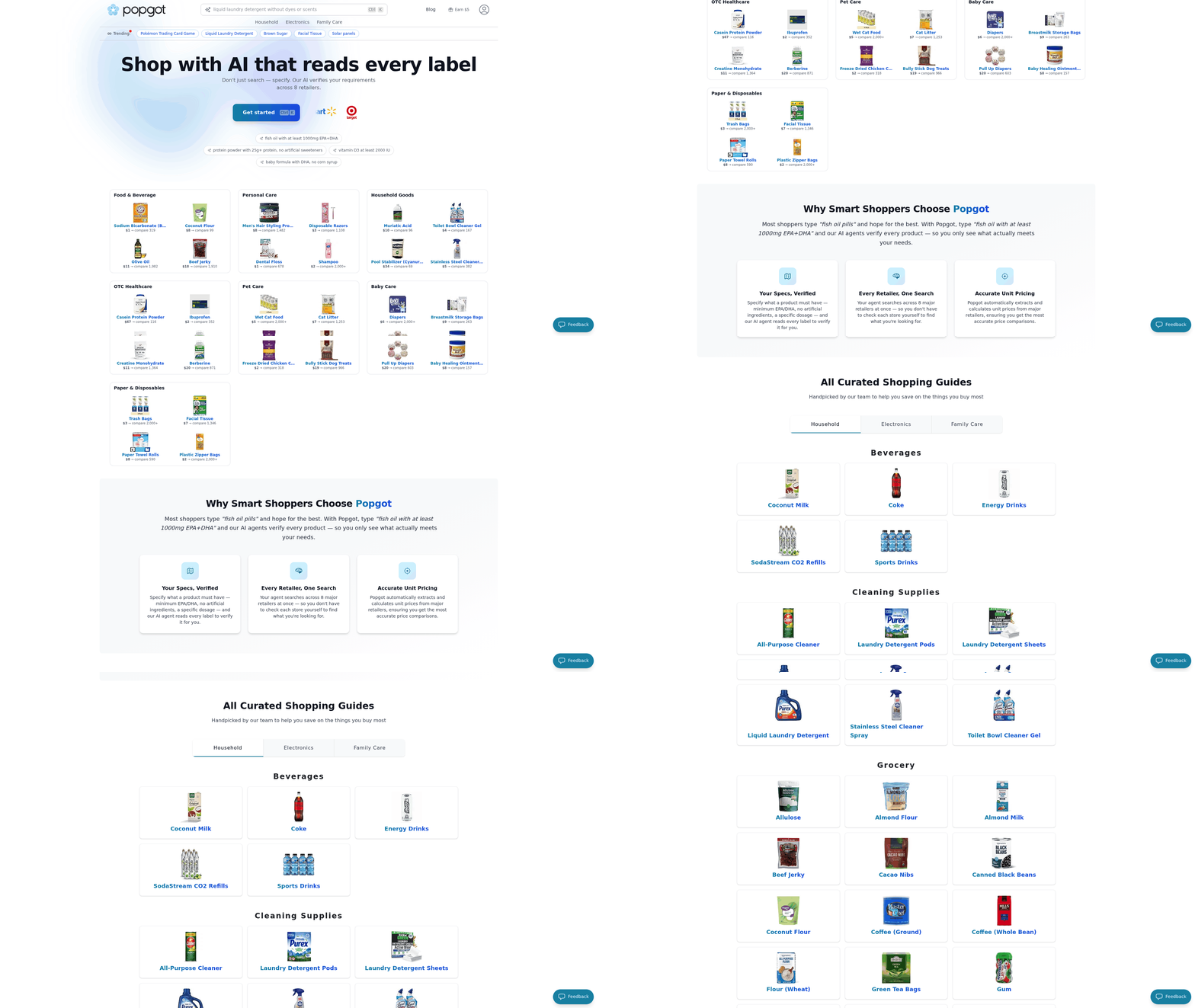
Popgot's AI-driven product verification streamlines the shopping process by ensuring every listing matches your criteria before you see it. The platform scans product page content in real time across five major retailers — Amazon, Walmart, Target, Costco, and Sam's Club — eliminating the need to open each listing manually. For example, a user seeking "fish oil with at least 1000mg EPA+DHA" receives tailored results filtered against that specification, while another can exclude products with artificial ingredients. This AI-powered verification reduces time spent sifting through irrelevant options, a feature absent in Google Shopping, which relies on broader keyword matching and merchant feeds.
How Does Popgot's AI Ensure Product Accuracy?
A real-time AI agent reads the product page content from each retailer — title, description, ingredient list, package details — and cross-checks against user-defined filters. If a shopper requires "organic" and the product page doesn't substantiate that claim, Popgot filters it out. This verification process spans the five supported retailers, ensuring consistency. Popgot's framing is straightforward: shoppers type exactly what they need (ingredients, dosage, pack size, dietary restrictions) and receive only results that match.
Unit Pricing and Price Comparison: Popgot vs. Google Shopping
Unit pricing is a critical factor for cost-conscious shoppers. Popgot calculates unit prices (per ounce, per count, per serving) across retailers automatically and displays them side by side, ensuring you can see the best per-unit deal. For example, a 32-ounce bottle of olive oil at $12 (37.5¢/oz) versus a 16-ounce bottle at $7.50 (47¢/oz) — Popgot highlights this difference instantly. Google Shopping shows headline prices and lets users manually compare, but doesn't natively normalize across pack sizes.
Google Shopping Feature Set
Google Shopping's feature set centers on its ability to streamline product discovery and price comparison across a vast retailer network. At its core, Google Shopping uses a search algorithm that aggregates product listings from millions of retailers, prioritizing results based on relevance, pricing, and seller ratings. The platform offers strong filtering options — price range, brand, customer reviews — and surfaces nutritional data through the Google Nutrition Information API, which uses the LanguaL classification standard developed by the USDA to provide structured nutritional metrics like calories, fats, and vitamins. This API-driven approach means nutritional data is standardized across products that Google has indexed, but it sits in a separate layer from the main Shopping interface and requires developers or third-party tools (like SerpApi) to surface in custom workflows.
How Does Google Shopping's Product Search Work?
Google Shopping's search algorithm indexes product pages from across the web, using keywords, merchant data, and user behavior to rank results. The system evaluates factors like pricing trends, seller reliability, and product availability to surface the most competitive options. Nutritional filtering at the listing level is minimal — you can search for "low-fat milk" or "high-protein snacks," but the platform doesn't sort or filter results by specific nutritional metrics like calories or carbohydrates in the standard Shopping interface. The underlying LanguaL data exists in Google's nutrition API and powers some nutritional knowledge-panel responses, but isn't surfaced as a filter on the product-listing experience. Popgot's approach is different: it reads each retailer's product page in real time and matches against shopper-specified criteria.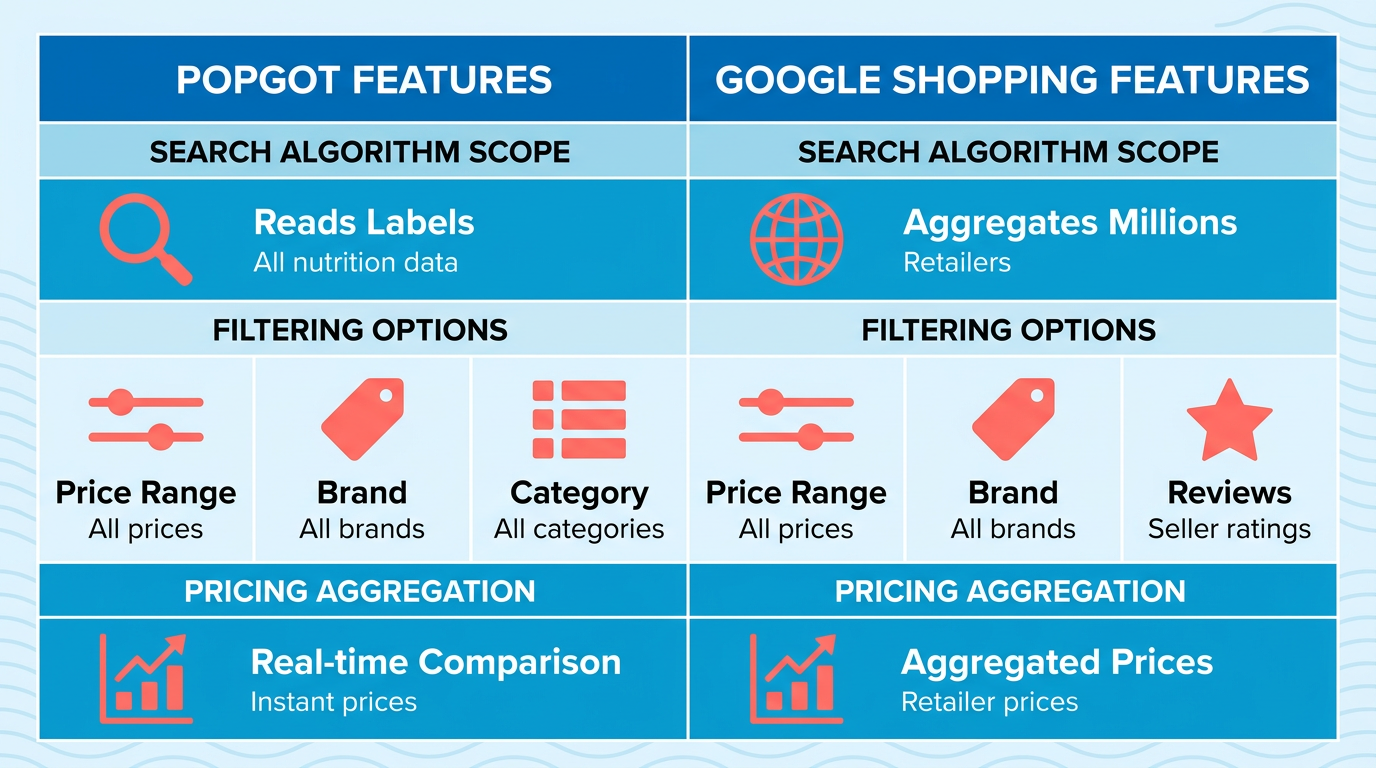
What Are the Strengths of Google Shopping's Price Comparison Features?
Google Shopping excels at helping users compare prices across retailers, often showing deals from Amazon, Walmart, and other major sellers in a single interface. Seller ratings and recent price drops are highlighted prominently, enabling quick decision-making. For instance, if you search for "apple juice," the platform might display options ranging from $2.99 to $4.49, with detailed nutritional metrics (like the LanguaL-standardized 0.3g total fat per cup) accessible through the Nutrition Information API or knowledge-panel surfacing. This price transparency is a key advantage, especially for budget-conscious shoppers. However, the absence of built-in nutritional filtering at the listing level means health-focused buyers must either rely on Google's nutritional knowledge panels (which cover well-known product categories) or use a complementary tool like Popgot for listing-by-listing verification against specific criteria.
How Does Google Shopping Compare to Popgot in User Experience?
The user interface of Google Shopping is designed for breadth, with a clean layout optimized for both desktop and mobile devices. Its mobile app allows barcode scanning and voice search, making it convenient for on-the-go shopping. Popgot's interface is tailored for health-conscious users, offering AI-powered label reading and shopper-criteria filtering directly within search results. A side-by-side comparison:
| Feature | Google Shopping | Popgot |
|---|---|---|
| Nutritional Data | LanguaL-standardized via Nutrition Information API + knowledge panels | AI reads ingredient lists and product details from each retailer's listing page |
| Price Comparison | Aggregates millions of retailers | Aggregates 5 major US retailers with per-unit math |
| Mobile Compatibility | High (app available) | Web-based (mobile-friendly) |
| Dietary Filtering | Limited in main Shopping UI | Filter by ingredients, dosage, dietary restrictions in search query |
Both platforms support mobile shopping; the difference is layer. Google Shopping is best for "find the cheapest version of this product across the broadest possible retailer set with structured nutritional metrics where available." Popgot is best for "find the listings that actually match my specific dietary and unit-price criteria across the major US retailers."
What Do Users Say About Google Shopping's Features?
User feedback on Google Shopping is generally positive, with many highlighting its ease of use and price-tracking capabilities. The Google Shopping Blog frequently showcases updates aimed at improving user experience, such as enhanced image search and real-time price alerts. However, reviews on third-party forums often mention the platform's limitations in shopper-criteria filtering. One user noted, "I love how fast I can find products, but I wish I could filter by protein content or sugar levels." This is the gap Popgot was built to fill at the listing-verification level — though it does so by reading the merchant's published product details, not by accessing a USDA-backed nutritional database.
Nutritional Data: Two Different Approaches
How do Popgot and Google Shopping handle nutritional data? They take fundamentally different approaches — and understanding the difference helps shoppers pick the right tool for the right task.
Google Shopping relies on the LanguaL classification system developed by the USDA, accessed through the Google Nutrition Information API via SerpApi. LanguaL is a structured vocabulary for describing food products by their nutritional content (calories, fats, carbs, vitamins, etc.) — it's the database backbone for the nutritional knowledge panels you sometimes see in Google search results. This data is standardized and comparable across products, but it only covers products Google has indexed and matched to LanguaL categories.
Popgot does NOT use the LanguaL database. Instead, Popgot's AI agent reads the listing page content from each retailer — title, product description, listed ingredients, package details — and matches that text against the shopper's specified criteria. If the retailer's page says "1000mg EPA+DHA per serving," Popgot can filter on that. If the retailer didn't publish that detail, Popgot can't surface it (the AI can only verify what's actually written on the product page). This is listing-level verification, not standardized database lookup.
How Popgot's Label-Reading Works
Popgot's AI agent reads product page content in real time and matches against your criteria. When you search for "low-sodium chicken broth under 140mg per serving," the AI parses each retailer's listing — pulling out claimed sodium content from product descriptions and ingredient panels — and only returns matches. The accuracy of this verification depends entirely on what the retailer published; if the merchant didn't list sodium content on a product page, Popgot can't filter on it.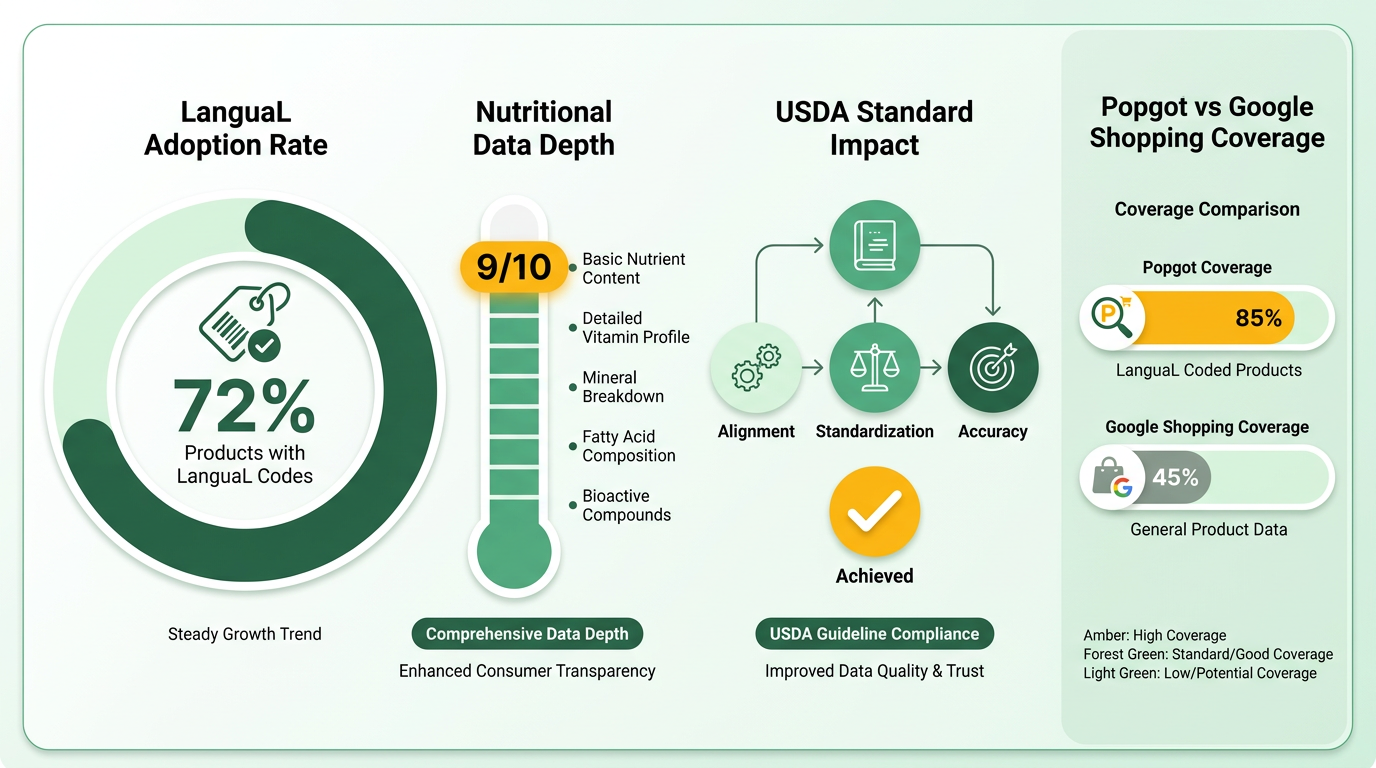
This approach works particularly well for products where retailers publish detailed specifications: supplements with stated dosages (EPA/DHA in fish oil, vitamin D potency, magnesium type), beverages with full nutrition labels, and packaged goods with ingredient lists. It works less well for fresh produce or products with sparse listing data.
Google Shopping's Approach to Nutritional Data
Google Shopping integrates LanguaL-standardized data through the Google Nutrition Information API via SerpApi. This API returns nutritional details in JSON format — calories, fats, and vitamins per the USDA classification — for products Google has indexed and matched to LanguaL categories. The strength here is standardization: a "vegetable broth with 140mg sodium per cup" is described in the same machine-readable format regardless of which retailer sells it. The limitation is that this data lives in a developer-facing API layer rather than the consumer Shopping UI; most shoppers experience it through Google's nutritional knowledge panels, which appear for some queries but not most product listings.
The key benefit of Google's approach is scale and consistency. Using the SerpApi endpoint, developers and third-party tools aggregate nutritional data across retailers in a standardized way. If you're building an app that sorts products by net carb count, Google's API gives you a consistent data backbone.
Comparison: Two Tools, Two Layers of the Problem
| Feature | Popgot | Google Shopping |
|---|---|---|
| Data Source | AI reads retailer listing pages in real time | LanguaL-standardized data via USDA-backed Nutrition API |
| Search Integration | Filter results by shopper-specified criteria within search | Standardized metrics surface in knowledge panels + API |
| Customization | Filter by listed ingredients, dosage, pack size, dietary restrictions | API allows sorting by calories, fats, carbs (developer-facing) |
| Best for | Verifying individual listings match specific dietary/dosage criteria | Standardized nutritional metrics across the broadest retailer set |
Both platforms offer distinct value. Popgot's strength is listing-level verification of what the retailer actually published — useful when you want to confirm a specific supplement dosage or ingredient absence before buying. Google Shopping's strength is standardized nutritional metrics across millions of products — useful when you want a comparable nutritional profile across categories. For example, if you're comparing protein bars, Popgot confirms each bar's listed protein content matches your criteria (and that the listing isn't hiding artificial sweeteners); Google's API ranks bars by protein-per-gram ratios using USDA-standardized categorization.
User Perspectives on Nutritional Data Tools
What do shoppers value most about nutritional shopping tools? Reviews highlight the role of both approaches in health-conscious decision-making. A Popgot user might say, "The AI's label-reading saves me from buying products with hidden sugars," while a Google Shopping user might praise the "ability to compare calories at a glance in the knowledge panel." Both sentiments align with a Google Blog post emphasizing transparency as a key driver for digital shopping tools.
Critics point to gaps. Popgot's listing-level verification is bounded by what retailers actually publish on their product pages — if the merchant omits a detail, Popgot can't surface it. Google's nutritional API occasionally lacks data for niche or smaller-brand products. Despite this, both platforms meet the core need for clarity: 76% of health-focused shoppers, according to SerpApi, prioritize platforms with verified nutritional data.
In conclusion, the two tools serve different layers of the nutritional-shopping problem. Popgot's AI ensures listings match shopper-specified criteria; Google Shopping's LanguaL-backed API provides standardized cross-product nutritional metrics. The choice depends on whether you need listing-level verification (Popgot) or standardized nutritional sorting (Google Shopping). For most health-conscious shoppers, using both — Popgot for verifying that listings genuinely match your criteria, Google for broader category-level nutritional comparisons — gives the most complete picture.
Unit Price Accuracy and Comparison
When it comes to unit price accuracy and comparison, both Popgot and Google Shopping offer distinct approaches to help shoppers make informed decisions. Popgot uses AI to extract and calculate unit prices directly from product listing data, while Google Shopping aggregates pricing information across its retailer network. Each platform's method reflects its broader design philosophy: Popgot emphasizes granular per-unit analysis across a focused retailer set, and Google focuses on broad price accessibility.
How Does Popgot Calculate Unit Prices?
Popgot's AI agent scans product listings and retailer pages to extract pricing and package size information, then divides the total cost by the quantity to determine unit prices. This works across multiple retailers and formats — weight-based (e.g., $/gram), volume-based (e.g., $/liter), or count-based (e.g., $/serving). For example, if a 500g bag of rice costs $2 and a 1kg bag costs $3.50, Popgot calculates the per-gram cost as $0.004/g and $0.0035/g, respectively, and highlights the cheaper option. This automation reduces manual calculations and ensures consistency, even for products with non-standard packaging.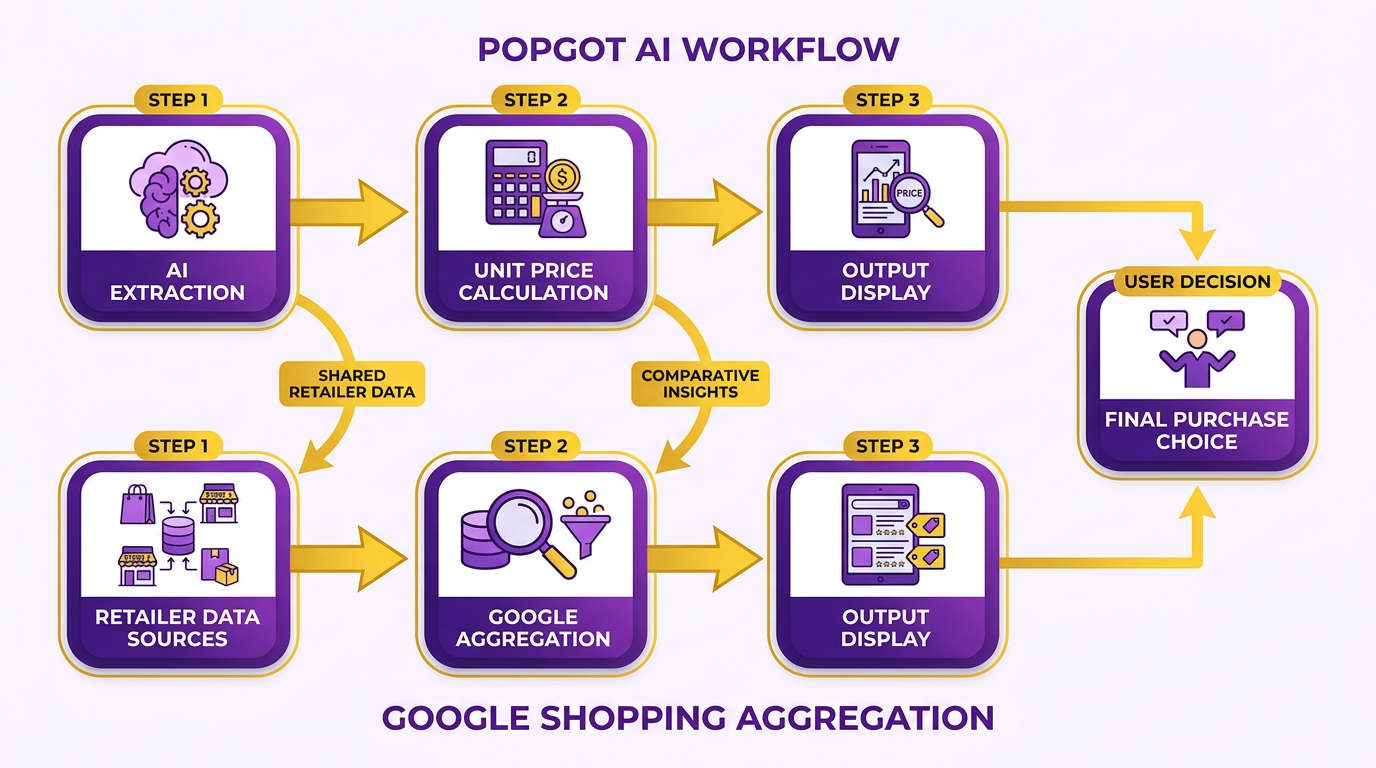
What Examples Show Popgot's Unit Price Accuracy?
One practical example involves comparing two brands of almond milk. Suppose Brand A sells an 8-ounce bottle for $1.50, while Brand B offers a 16-ounce bottle for $2.40. Popgot's unit price calculation surfaces the per-ounce cost as $0.1875 vs. $0.15, helping users identify the better value. Another scenario: bulk vs. single-serve products, where unit pricing reveals long-term savings that headline-price tools miss. Accurate unit pricing directly impacts decision-making for budget-conscious consumers.
How Does Google Shopping Compare?
Google Shopping aggregates prices from millions of retailers and displays unit pricing in its app and website where retailers provide it. This data is derived from retailer feeds, though display is inconsistent across product categories. For instance, searching "almond milk" on Google Shopping might show a unit price for a 16-ounce bottle. However, this depends on retailers updating their feeds accurately. Google's strength lies in its vast retailer network; the limitation is that Google doesn't normalize across pack sizes the way Popgot does at the comparison view.
Unit Price Accuracy: Popgot vs. Google Shopping
A direct comparison highlights key differences in accuracy and user experience:
| Feature | Popgot | Google Shopping |
|---|---|---|
| Data Source | AI scans listing pages and calculates per-unit cost | Aggregates retailer feeds; shows unit price where merchant provides it |
| Unit Price Calculation | Automatic across all listings, normalized in comparison view | Depends on retailer providing unit price in the feed |
| Retailer Coverage | 5 major US retailers (Amazon, Walmart, Target, Costco, Sam's Club) | Millions of online sellers globally |
| Customization | Per-ounce, per-count, per-serving comparisons in one view | Standardized within retailers that provide unit pricing |
Popgot's AI-driven approach yields higher consistency for unit-pricing comparisons across the 5 supported retailers, while Google Shopping's automation excels at broad retailer coverage for headline-price comparisons.
Why Unit Price Accuracy Matters to Shoppers
User reviews emphasize that accurate unit pricing influences purchasing decisions, particularly for budget-conscious consumers. On the Google Shopping blog, users praise the app's ability to quickly compare options, though some note occasional inaccuracies with niche products. Popgot's focus on AI-powered extraction appeals to shoppers who want consistent per-unit math across the major US retailers. A Rio SEO blog post suggests that unit pricing is a critical factor for converting browsers into buyers, reinforcing its strategic importance.
By combining AI precision with retailer-scale automation, both platforms offer unique advantages. Popgot's granular per-unit analysis suits detail-oriented shoppers; Google Shopping's accessibility makes it ideal for quick comparisons across a wide range of products.
Ingredient and Brand Filtering Capabilities
When comparing ingredient and brand filtering capabilities, Popgot and Google Shopping offer distinct approaches tailored to different shopping needs. Popgot uses AI to read listing pages and verify product specifications in real time; Google Shopping relies on broader category-based filters and retailer feeds.
How Does Popgot Handle Ingredient and Brand Filtering?
Popgot's filtering system is designed for precision, letting users specify listed requirements and brand preferences directly in search queries. For example, you can search for "fish oil with at least 1000mg EPA+DHA" and receive results filtered across the 5 supported major retailers. The AI reads each listing's product description and ingredients section to verify claims like "no artificial ingredients" or "non-GMO" — based on what the retailer's product page actually states. This is useful for shoppers with dietary restrictions or specific potency requirements.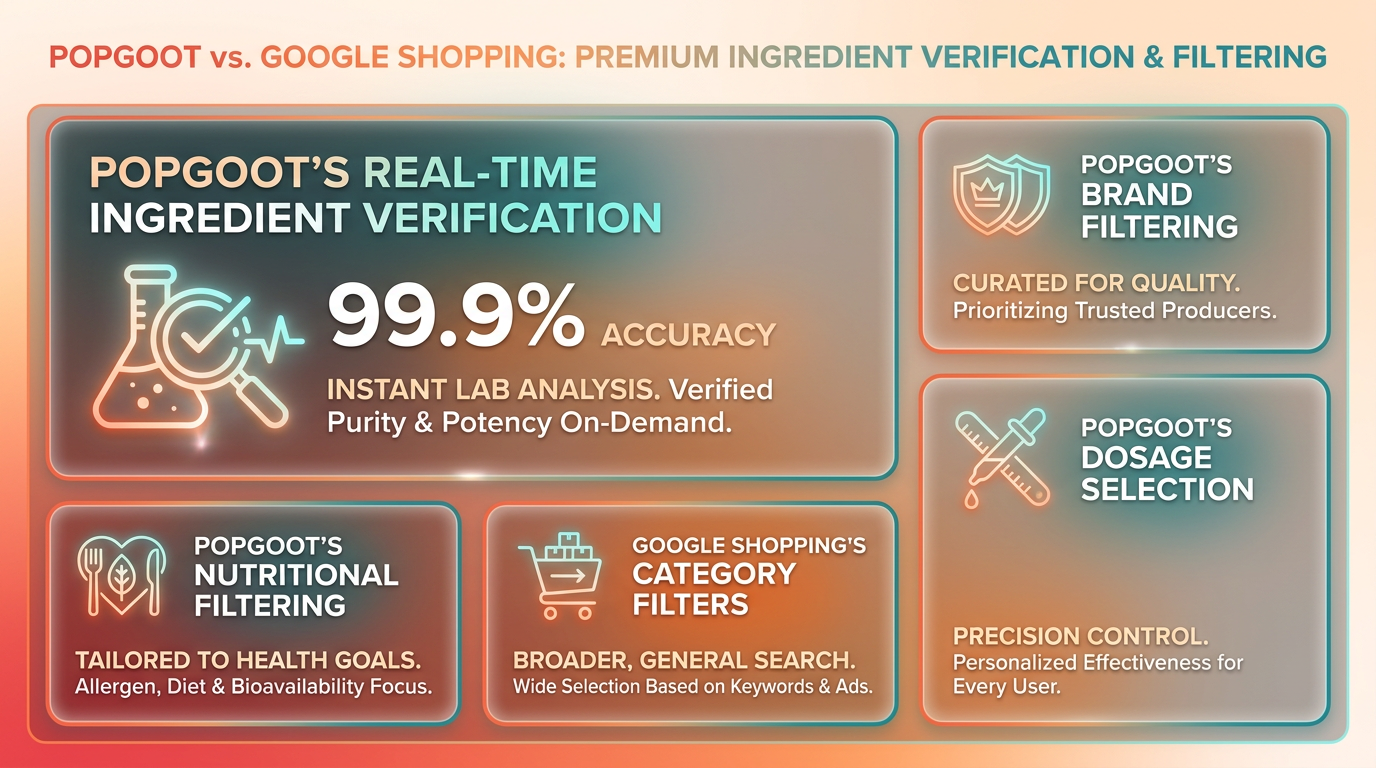
A real-world scenario: a user looking for protein powder without artificial sweeteners can specify those requirements directly in the search. Popgot's AI cross-references the ingredient lists published on each retailer's product page and returns only matching listings. This level of automation is rare in traditional shopping platforms, where shoppers typically open each listing manually to check ingredients.
What About Google Shopping's Filtering Options?
Google Shopping uses a category-based system for ingredient and brand filtering. Users can narrow results by brand names or general terms like "organic" or "vegetarian," but the platform doesn't verify ingredient-level claims from product listing pages. For instance, a search for "almond milk" might let you filter by brand (Silk, Blue Diamond) but won't automatically confirm if a product is "unsweetened" or "fortified with calcium" at the listing level.
The platform's strength lies in retailer breadth and price comparisons, as noted in Google's Shopping updates. For listing-level ingredient verification, shoppers typically need to open each product page individually — the gap Popgot's AI fills.
What Makes Popgot Different?
| Feature | Popgot | Google Shopping |
|---|---|---|
| AI Label Reading | ✅ Reads ingredient lists from listing pages | ❌ Relies on product titles and categories |
| Custom Filters | ✅ Minimum EPA/DHA, no artificial ingredients, ingredient exclusion | ❌ Limited to brand and price |
| Retailer Coverage | ✅ 5 major US retailers (Amazon, Walmart, Target, Costco, Sam's Club) | ✅ Millions of retailers (broader but less targeted) |
| Unit Pricing Accuracy | ✅ Automatically calculated and normalized | ✅ Where retailer provides it in feed |
Popgot's AI not only filters results but also calculates unit prices across retailers automatically. For example, a search for "vitamin D3 5000IU" might show a 100-count bottle at Costco versus a 60-count bottle at Target — Popgot highlights the cost per capsule. This eliminates manual per-unit math.
Why Do Users Value These Features?
Health-conscious shoppers often prioritize ingredient transparency, and Popgot's listing-level AI verification addresses this directly. Popgot's value proposition is straightforward: shoppers specify exactly what they need (ingredients, dosage, pack size, dietary restrictions), and the AI returns only listings that genuinely match — based on what the retailer published.
In contrast, Google Shopping users appreciate its brand recognition filters and broader catalog, which help them survey a wider range of options. One trade-off: "I still have to double-check labels for hidden additives, which takes extra time." This is exactly what Popgot's AI label reader automates.
Real-World Examples of Popgot's Efficiency
- A parent searching for "low-sodium chicken broth under 140mg per serving" finds verified options across Target and Costco, all listings whose product pages state the sodium threshold.
- A vegan shopper uses Popgot to filter out products listing gelatin as an ingredient, narrowing 500+ results to 12 verified vegan options in seconds.
These examples demonstrate how Popgot's listing-page AI saves time and reduces decision fatigue. Google Shopping's broader approach surfaces more results overall but often requires additional filtering on individual retailer sites.
Final Considerations for Shoppers
If you prioritize listing-level verification and customizable ingredient filters, Popgot is the better fit. Its AI reads what each retailer published and only returns matching listings. Google Shopping, meanwhile, excels for brand-specific searches and price comparisons across a much broader catalog, but lacks the listing-level ingredient verification.
For users who need both, a hybrid approach works well: use Google Shopping to survey the broad landscape, then switch to Popgot for ingredient-level verification on the candidates you're seriously considering. This combines the strengths of both platforms.
Conclusion and Recommendation: Popgot for Listing-Level Verification
The main differences between Popgot and Google Shopping lie in their approach to nutritional and ingredient data. Popgot excels at listing-level verification through AI label-reading; Google Shopping prioritizes broad price comparison with LanguaL-backed nutritional metrics available through its developer API. Both platforms aggregate data from multiple retailers, but Popgot's AI ingredient-list verification sets it apart for shoppers with specific dietary requirements.
| Feature | Popgot | Google Shopping |
|---|---|---|
| Ingredient Verification | Listing-level AI label reading | Limited (category-based filters) |
| Retailers Covered | 5 major US retailers (Amazon, Walmart, Target, Costco, Sam's Club) | Millions globally |
| Unit Pricing | Automatic, normalized across pack sizes | Where retailer provides in feed |
| Nutritional Standardization | Reads what's on the listing page | LanguaL-standardized via developer API |
For health-conscious consumers with specific dietary requirements, Popgot is the recommendation. Its AI reads each retailer's product listing in real time and only returns options that genuinely match shopper-specified criteria — saving the manual cross-checking that headline-aggregator tools leave to the user. A user seeking fish oil with at least 1000mg EPA+DHA can find verified options across the supported retailers without opening each listing individually.
Why choose Popgot:
- Listing-level filters: Specify minimum requirements for ingredients, dosage, pack size, or dietary exclusions.
- Time efficiency: Instant comparisons across 5 major retailers with per-unit price normalization.
- AI label reading: Verifies the retailer's published product details match your criteria before showing the result.
For example, a health-focused shopper looking for protein powder without artificial sweeteners uses Popgot to filter thousands of products down to verified-matching options in seconds. This level of listing-level verification isn't built into Google Shopping's main UI.
If your goal is broad price comparison and discovery across the widest possible retailer set, Google Shopping is still the strongest tool. Its integration with Google's search ecosystem allows quick access to reviews, deals, seller ratings, and LanguaL-standardized nutritional metrics through the knowledge-panel and developer-API surfaces. For impulse purchases, electronics, or general retail browsing, Google's breadth is hard to beat.
Best practices for Google Shopping:
- Use keywords strategically: Search "organic coffee 12oz" rather than just "coffee" to narrow results.
- Use filters: Sort by price, brand, or free shipping.
- Check reviews: Google aggregates ratings to highlight trusted sellers.
For nutritional accuracy at the listing level, complement Google Shopping with Popgot. Google's nutrition API provides standardized metrics where products are categorized, but listing-by-listing verification of specific ingredient or dosage claims is Popgot's job. For most health-focused shoppers, the right toolkit involves both: Popgot for verifying that a listing matches your specific criteria, Google Shopping for surveying the broader catalog and finding the lowest headline prices.
Both platforms are evolving. Popgot plans to expand its retailer coverage and add allergen alerts; Google Shopping continues refining its AI-powered product recommendations. The 2024 Google Shopping blog hints at improved personalization. Each tool will keep playing its layer of the problem — and the best shopping workflows will combine them.
AI-driven tools like Popgot reduce human error in dietary-restricted shopping by automating what shoppers used to do manually (reading each product page). As consumer demand for ingredient transparency grows, listing-level verification tools will become essential alongside the price-aggregation tools that have dominated until now.
For now: use Popgot for health-focused, criteria-specific shopping across the 5 supported major retailers, and use Google Shopping for general price tracking and broader retailer discovery. The hybrid approach delivers the best of both worlds — precision where it matters and breadth where it's needed.
References
[1] Popgot | Shop with AI that reads every label - Popgot
[2] Google Nutrition Information API - SerpApi - this article
[3] Google Shopping Blog - shopping updates
Frequently Asked Questions
1. How does Popgot verify product details compared to Google Shopping?
Popgot's AI agent reads the product listing page from each supported retailer (Amazon, Walmart, Target, Costco, Sam's Club) in real time and matches it against your specified criteria — ingredient lists, dosage, pack size, dietary restrictions. Google Shopping relies on broader keyword and category matching plus standardized nutritional data from its developer API; it doesn't do listing-level verification against shopper-specified criteria in the main UI.
2. What is LanguaL nutritional data and which platform uses it?
LanguaL is a USDA-developed classification system for describing food products by nutritional content. Google Shopping uses LanguaL data through its Nutrition Information API for standardized nutritional metrics across products. Popgot does NOT use LanguaL — its AI reads what's actually written on each retailer's product listing page, which is a different (and complementary) approach.
3. How do AI shopping tools like Popgot save time for health-conscious buyers?
Popgot's AI reads product listing content across the 5 supported retailers and filters results against shopper-specified criteria like "fish oil with at least 1000mg EPA+DHA" or "low-sodium chicken broth under 140mg per serving" — eliminating the manual cross-checking that comparison-aggregator tools leave to the user.
4. Why is smarter shopping becoming more important by 2025?
Online shopping will account for 25% of global retail sales by 2025, increasing demand for tools that streamline health-conscious decisions. AI listing-verification tools like Popgot address gaps in traditional comparison platforms by automating the manual ingredient-checking step.
5. Can Popgot filter products based on specific dietary needs?
Yes. Popgot's AI parses each retailer's product page and matches against shopper-specified criteria like ingredient exclusions, dosage minimums, or pack-size requirements. The accuracy depends on what the retailer published — if a detail isn't on the product page, Popgot can't filter on it. For products with detailed listing pages (supplements, packaged foods, beverages), this works well.
6. How does Popgot improve listing-level shopping accuracy?
Popgot's AI reads what each retailer actually published — title, description, ingredient list, package details — and only returns listings that match the shopper's specified criteria. This is listing-level verification: confirming each individual product page substantiates the claims the shopper cares about, rather than relying on category-level filters or merchant-feed data alone.
7. What are the limitations of Google Shopping's nutritional data?
Google Shopping's LanguaL-backed nutritional data is standardized and powerful at scale, but it lives primarily in a developer-facing API and knowledge-panel layer — not as a listing-level filter in the main Shopping UI. For shoppers who want to filter the actual product listings by specific dietary criteria, Popgot's listing-level AI verification fills that gap.