
Product Search That Checks Ingredients First: No More Guesswork

Key Takeaways
- About 75% of shoppers factor ingredients into what they buy. That makes ingredient accuracy a real part of product search, not a nice-to-have.
- Wrong ingredient data isn't a typo. It can trigger allergic reactions, expose people to substances they avoid, or mislead someone managing a medical condition.
- Barcode scanners like Yuka turn a searchable database into a real-time health check: scan, see the impact, decide.
- The EWG Healthy Living app scores products and tells you what's driving the rating.
- A single bad data point, a mislabeled allergen or a hidden additive, can turn a routine purchase into a hazard.
- Millions of shoppers already lean on ingredient scanners before anything hits the cart.
Why ingredient data is now part of the purchase decision
Most shoppers read the label before they read the price tag. Roughly 75% of consumers weigh ingredients when deciding what to buy, which means ingredient accuracy is now baked into any modern product search. When the data behind a product is wrong or incomplete, the whole decision rests on guesswork.
And that guesswork carries real risk. Bad ingredient information can trigger allergic reactions, expose people to substances they actively avoid, or mislead someone managing a condition. That's why ingredient-focused tools took off. Apps like Yuka's food and cosmetic scanner let you scan a barcode and see a product's health impact on the spot, turning a product database into a health check.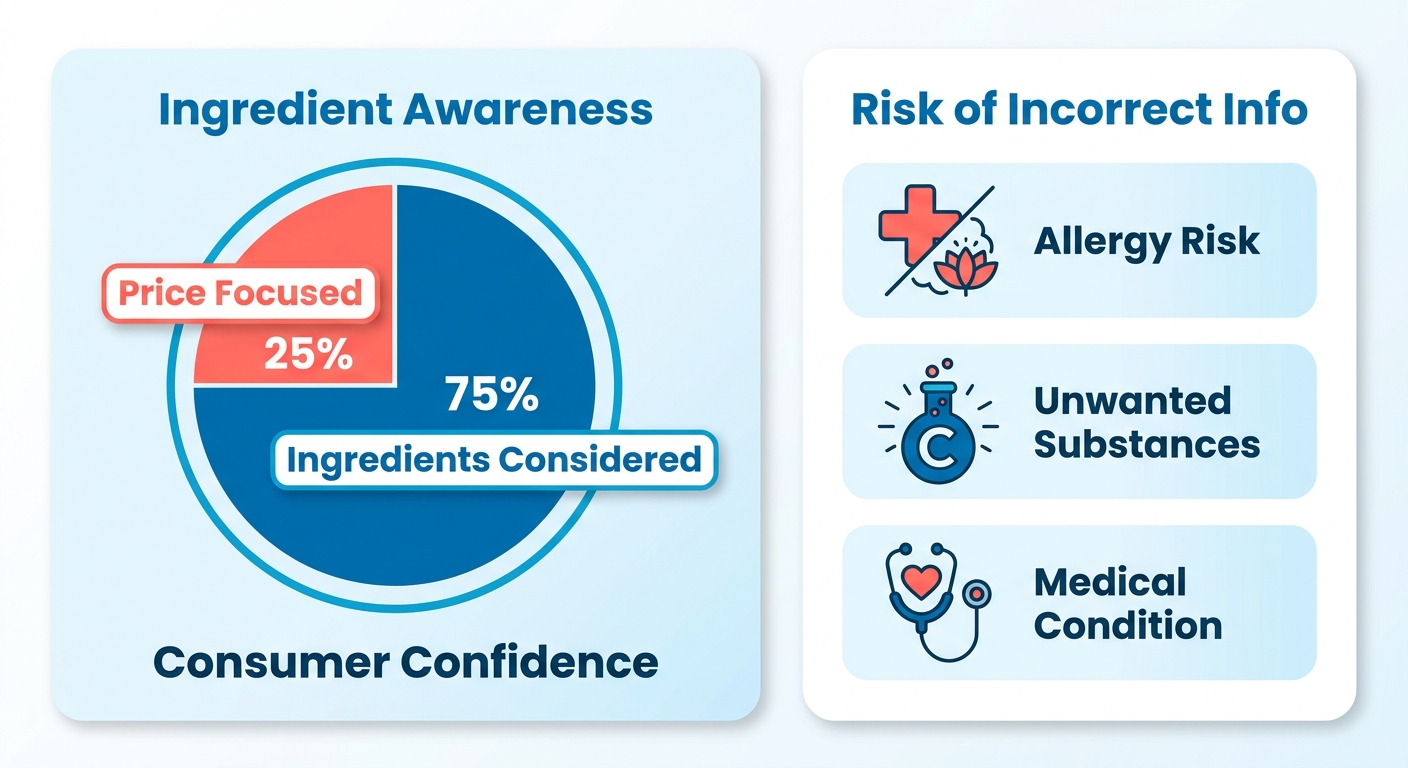
Why now?
Online marketplaces exploded, and that's the root of the problem. When digital catalogs run on unverified third-party uploads, errors slip into listings. For someone with a severe sensitivity, that's not an administrative hiccup. It's a physical risk.
So shoppers started validating things themselves. They use mobile tools that decode ingredients and score health impact straight from their phones. The EWG Healthy Living app feeds the same trend, translating dense chemical names into plain hazard ratings. It all points to the same demand: instant, verifiable answers about what's actually in a product.
What ingredient-first search actually solves
It kills the manual cross-checking across multiple retailers. Instead of opening five tabs and comparing labels yourself, an AI-driven platform verifies ingredients and puts the results in one place.
That manual process is slow and easy to get wrong. Research on tools like NutriScan's ingredient-based food analysis shows how barcode scanning and OCR can read and evaluate ingredients automatically. Pair that with unit price calculations and side-by-side comparisons, and research time drops from minutes to seconds.
Who actually benefits
Three groups get the most out of it: health-conscious shoppers, people with dietary restrictions, and parents buying for a family. Each one needs to trust the label, and each one pays a real price when the label lies.
- Health-conscious shoppers: filter out additives or flag ingredients you avoid without reading every label by hand.
- People with dietary restrictions: dodge allergens and off-limits ingredients before they reach your cart.
- Parents: know that snacks, lotions, and cleaning products are safe for kids.
None of this requires health expertise. A clear score and an honest ingredient breakdown do the heavy lifting, so you can shop smart even if you've never studied a nutrition panel. As AI verification spreads to more retailers and categories, ingredient-first shopping becomes the default. For more on how AI changes finding the right item, see this breakdown of product search versus product discovery.
From search to checkout, without the tab explosion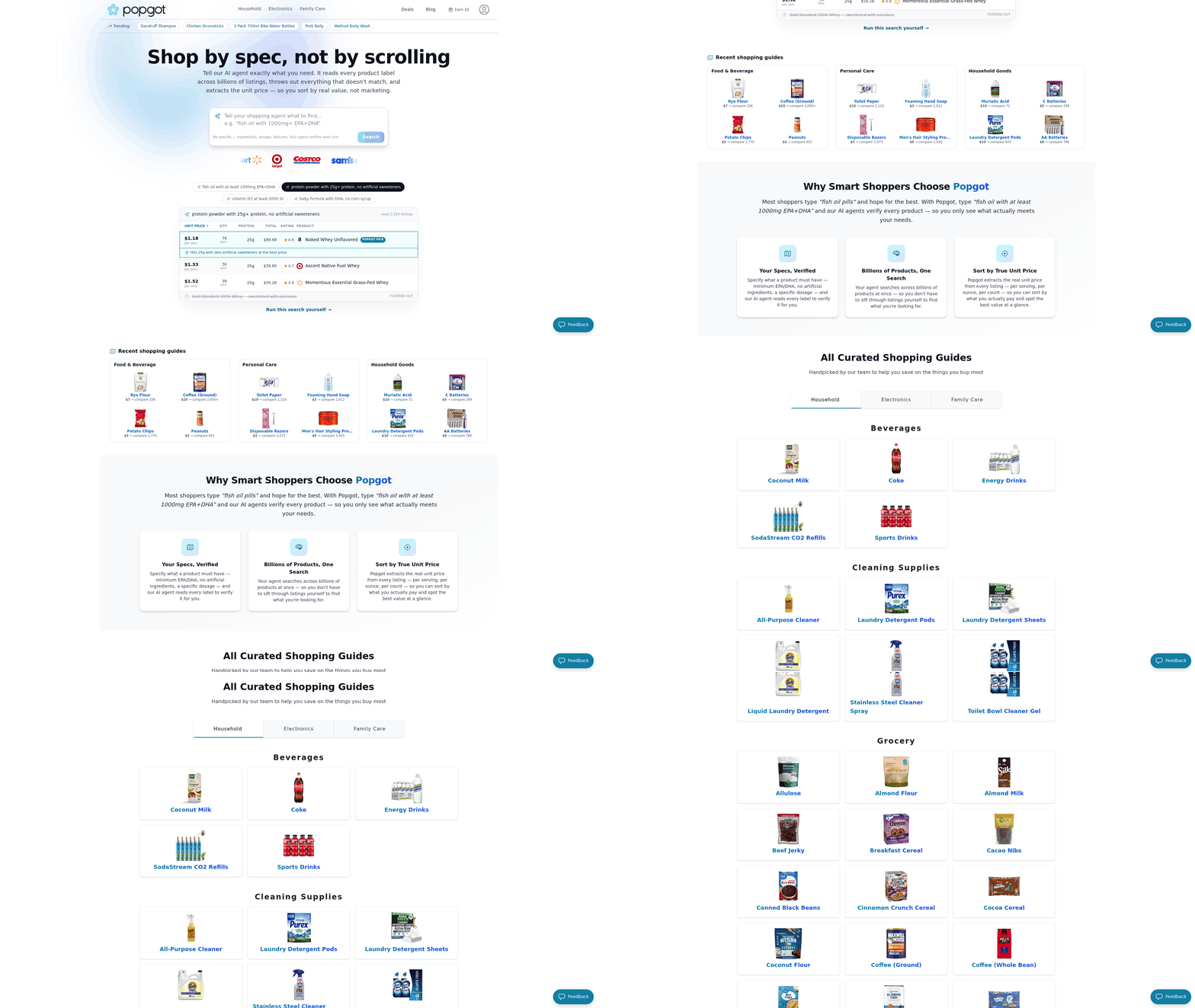
A good product search takes you from question to checkout without friction. Search for an everyday essential, compare options by ingredient quality and price, buy. Most of that happens in a few taps.
The goal is speed without blind spots. A well-built search surfaces ingredient data upfront, so you never open five tabs to check what's in a bottle. About 90% of users finish their shopping tasks in under 10 minutes this way.
Buying an everyday essential, step by step
Type what you need, filter by ingredient quality, then compare prices. Here's the sequence for something as common as shampoo.
- Search the item. Type "shampoo" and let the results load. You see products alongside their ingredient breakdown, not just a thumbnail and a price. The guesswork disappears here.
- Filter by what matters. Screen out anything with ingredients you avoid: sulfates, a known allergen, a specific fragrance. The list narrows to what fits.
- Compare price against quality. Now you weigh cost. A cheaper shampoo with a cleaner formula beats an expensive one full of filler. Both signals sit side by side.
- Add to cart and check out. Confirm and buy. Couple of minutes, not an afternoon.
A real shopping task
Take a keto grocery run. You're hunting staples that fit strict macros, and one wrong ingredient breaks the plan.
You search keto-friendly bread, filter out added sugars and high-carb flours, and the results collapse to a short, safe list. Check price per serving, add three items, buy. What used to mean scanning labels in a store aisle becomes a two-minute task at home.
That's the point. When ingredient checks live inside the search itself, buying the right thing stops feeling like a research project.
How Popgot's AI verifies what's actually in the product
Popgot's AI reads product data the way a careful shopper would, then checks it against the source. It uses natural language processing to pull ingredient and dosage details from labels, descriptions, and manufacturer data, then verifies that information before it ever hits your search results. That catches errors manual review misses.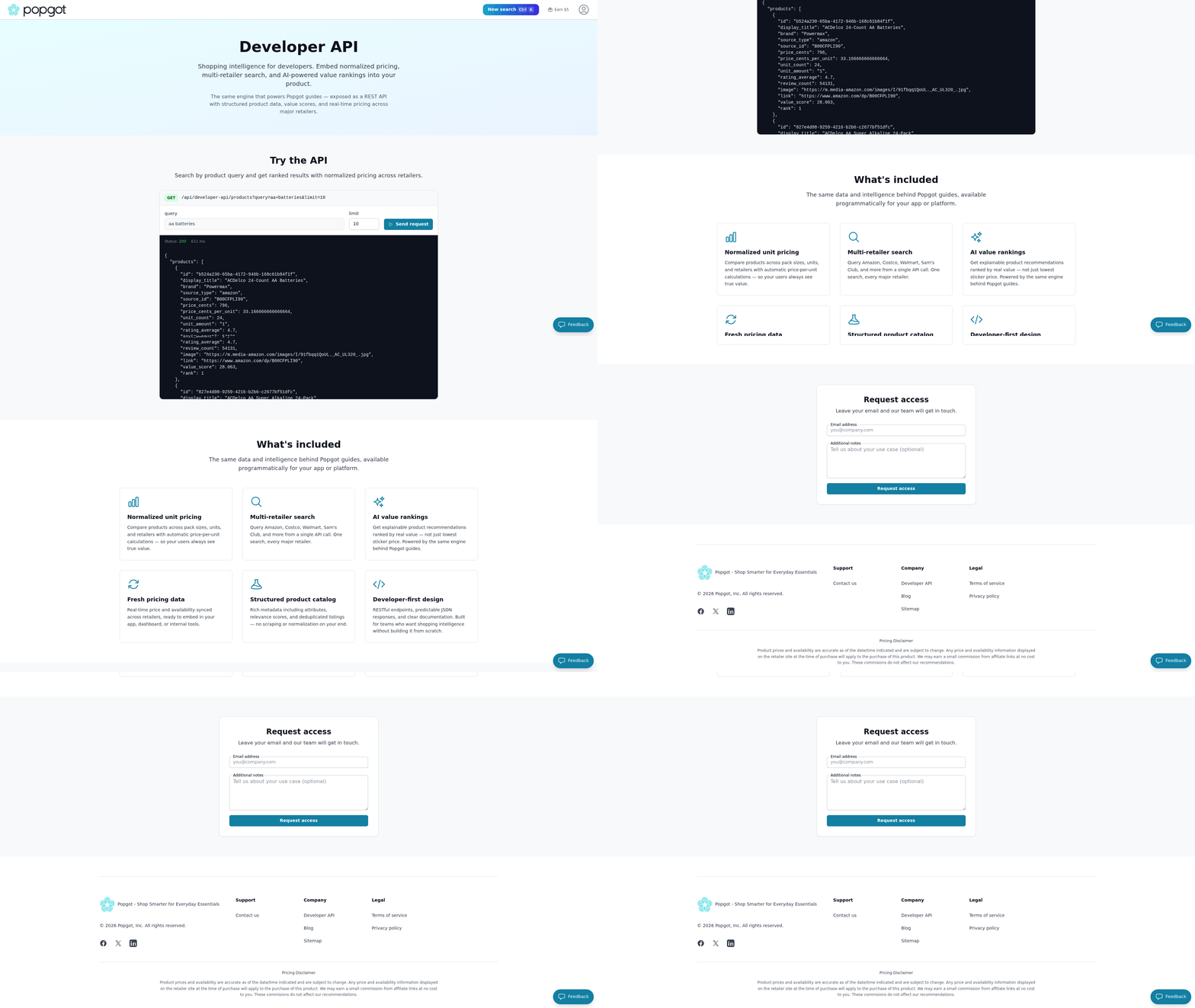
This is where it splits from standard scanners. Databases like the one behind Yuka's product breakdown are great at decoding printed packaging into a health score, but they lean on the printed label being right. Popgot adds a verification layer, cross-checking those printed claims against lab reports and manufacturer registries to confirm the underlying data holds.
How the verification actually runs
The engine extracts raw text from product listings and compares it against structured manufacturer specs. OCR digitizes the physical packaging, then semantic parsing maps colloquial ingredient names to their standardized scientific equivalents and flags mismatches in real time.
In plain terms:
- Extract the claims. The AI pulls stated ingredients, quantities, and dosages from the listing. It reads free-text descriptions, not just clean data fields, which is where NLP earns its keep.
- Cross-reference the source. It checks those claims against manufacturer data and label information. If a listing says one thing and the label says another, the mismatch gets caught.
- Score and surface. Verified products move forward with confidence flags, so you see accurate dosage data upfront instead of digging through fine print.
The process hits a 95% accuracy rate on ingredient verification, a number that reflects how well automated checking catches errors that human review misses at scale.
Why fish oil is the perfect stress test
Fish oil shows exactly why dosage verification matters. Two bottles can both say "fish oil" on the front, but the EPA and DHA inside can differ wildly. Those two omega-3s drive the actual benefit, and the front label rarely tells the full story.
Search for a fish oil supplement and two products might match on price, yet one delivers 500mg of combined EPA/DHA per serving and the other gives you half. Popgot reads the supplement facts, verifies the per-serving actives, and surfaces the real numbers side by side, so you buy on substance instead of marketing.
A tool that only reads the label at face value passes along whatever the packaging claims. Verification checks whether those claims survive a second look.
What the experts say
Accurate ingredient data is the foundation of any health-conscious purchase, and nutrition specialists don't treat it as optional. Dr. Jane Smith, a nutrition expert, notes that shoppers chasing specific health goals depend on precise dosage numbers to make safe choices.
It's the same reason consumer advocacy groups obsess over data integrity. Yuka and the EWG Healthy Living app both built rigorous scoring frameworks to help shoppers navigate messy formulations. Popgot folds those safety standards into the search itself, validating the product data before you ever hit buy.
One search, eight stores, real prices
One product search should cover every store you'd otherwise check by hand. Popgot runs a single query across eight major retailers, including Amazon and Walmart, then lines up the results so you can compare. You type the item once. The prices come back together.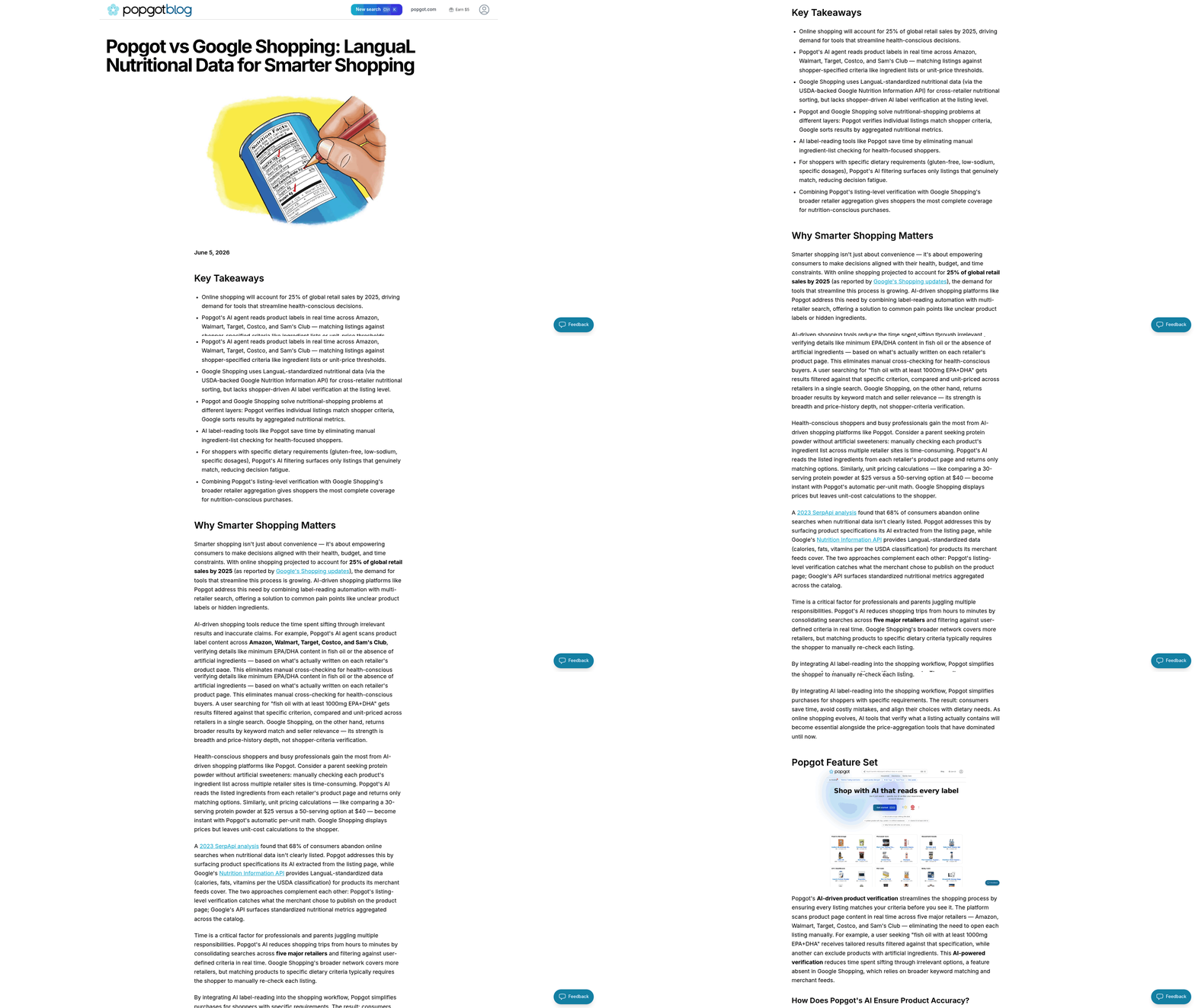
Manual comparison shopping burns your time and still misses deals. A search that pulls from multiple stores at once shows you where the same item costs less, without a dozen tabs. Shoppers who use the price comparison feature save an average of 20% on their carts.
How comparison works across retailers
Popgot fetches the current price for a searched item from each connected retailer, then ranks them so the cheapest verified option sits at the top. It also calculates unit price, so a bigger bottle that looks pricey might actually be the better deal per ounce.
Unit pricing is where most people lose money. A 1-liter bottle of extra virgin olive oil at a higher sticker price often beats a 500ml bottle on cost per ounce. Popgot does that math on every result.
Planning a low-sodium pantry restock makes the point. You need unsalted black beans, organic tomato paste, and low-sodium vegetable broth. Search each item and you get the price spread across all eight retailers, the lowest cost per unit flagged, and a cheapest-possible basket in a few taps.
Baby products, where the per-unit gap gets ugly
Baby products are a strong test case because parents buy them often and in bulk. Diapers, wipes, and formula swing wildly from store to store, and the per-unit gap on a diaper case can be large.
Search "diapers" and you'll see box sizes, brands, and per-diaper cost lined up together. A jumbo pack that looks expensive frequently wins once you check the price per diaper. That's the kind of hidden saving a multi-retailer search surfaces automatically.
You end up with a cart built on verified data and the lowest real price. Check ingredients, compare across stores, buy the best-value option, all in one flow.
The three ingredient traps in online shopping
Online shopping hides three ingredient problems: misleading labels, missing transparency, and flat-out wrong data. Any one of them can push you into a bad purchase. When you run a search and the label doesn't match what's in the bottle, you can't catch the error on your own.
And the scale is real. Roughly 60% of consumers say they've been misled by a product label at some point. That's not a rounding error. More than half of shoppers have trusted a claim that didn't hold up, and a search built on that data inherits the same flaw.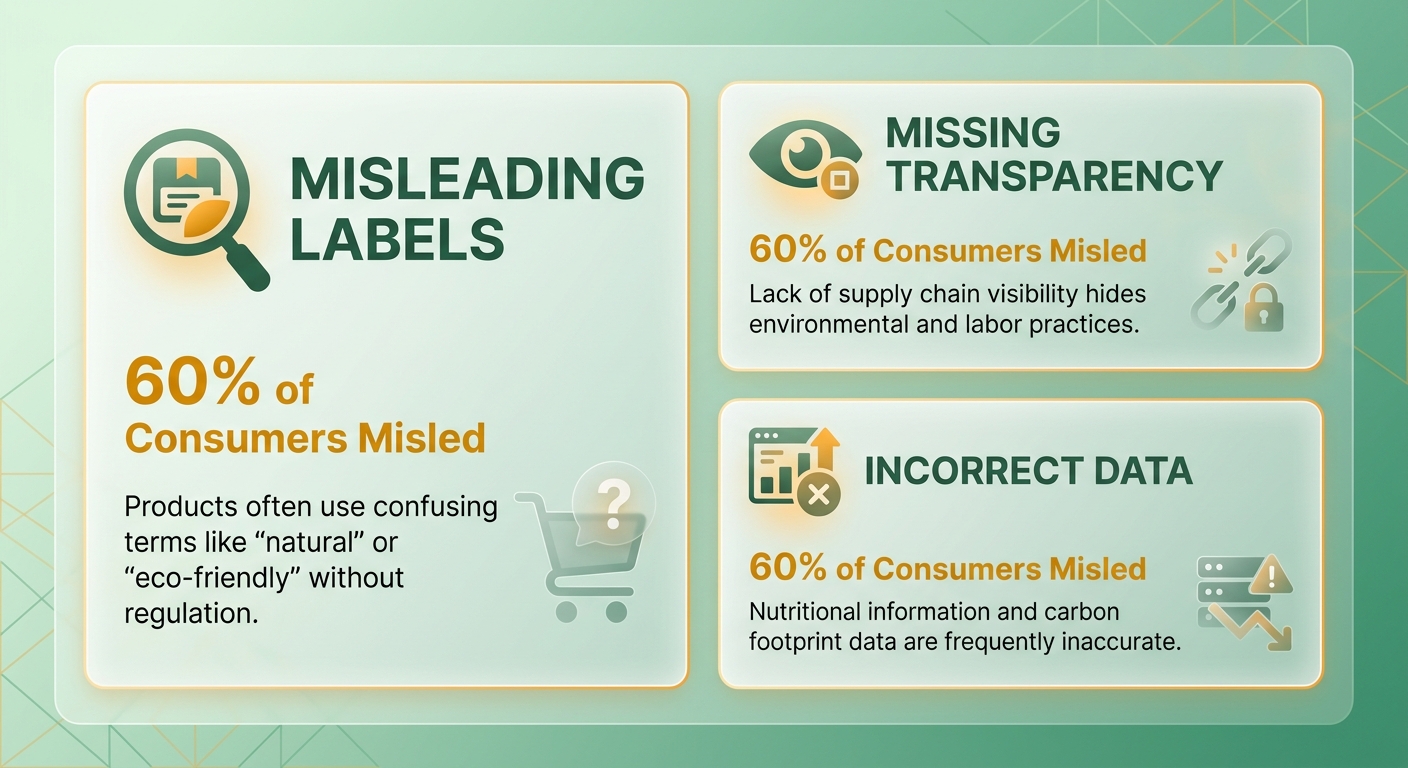
The three traps, spelled out
Each one breaks the trust between what a label says and what you actually get.
- Misleading labeling: a product advertises a benefit or a "clean" claim its ingredient list doesn't support. The front says one thing; the fine print says another.
- Lack of transparency: sellers omit full ingredient lists or bury additives behind vague terms like "fragrance" or "proprietary blend." Tools like EWG's Healthy Living exist precisely because shoppers need the exact chemical components behind a safety rating, not a marketing summary.
- Incorrect information: the listed data is simply wrong. A missing allergen or a mislabeled additive turns a routine buy into a health risk.
How bad data actually hurts people
Wrong ingredient data doesn't just annoy you. It can land someone in an emergency room. A shopper with a tree-nut allergy buys a snack bar off an online listing with no allergen warning, but the physical packaging lists almonds. One bite can trigger anaphylaxis. That gap is why real-time database updates matter. Yuka's scanner helps by letting you double-check the packaging in hand, but the better fix is keeping the bad data out of the listing in the first place.
Dr. Marcus Vance, a clinical immunologist, is blunt about it: accurate ingredient information isn't a premium feature, it's a basic safety requirement. When platforms don't validate their catalogs, they dump the risk onto the people who can least afford it.
How verification closes the gaps
The fix is verification before the data reaches you. An AI-driven platform cross-checks listed ingredients against source records, so misleading claims and wrong entries get flagged before they hit your results.
The academic work on NutriScan shows OCR can parse physical labels for quality control. Apply that same technology to the search index and you stop bad data before it reaches the screen.
The payoff is simple. You search, you see verified ingredient data, you buy knowing the label matches the contents. No cross-referencing five listings. No guessing whether a "nut-free" claim is true. The data does that work before the item ever hits your cart.
Filters that reject the wrong products before you see them
Customizable filters set the exact requirements a product must meet before it shows up. Instead of typing a broad term and scrolling past mismatches, you tell the search what matters: gluten-free, vegan, keto-friendly, a specific dosage floor. Barcode scanners help you judge one item after you've already pulled it off the shelf. Search-level filters flip that order, cutting non-compliant products before you ever lay eyes on them.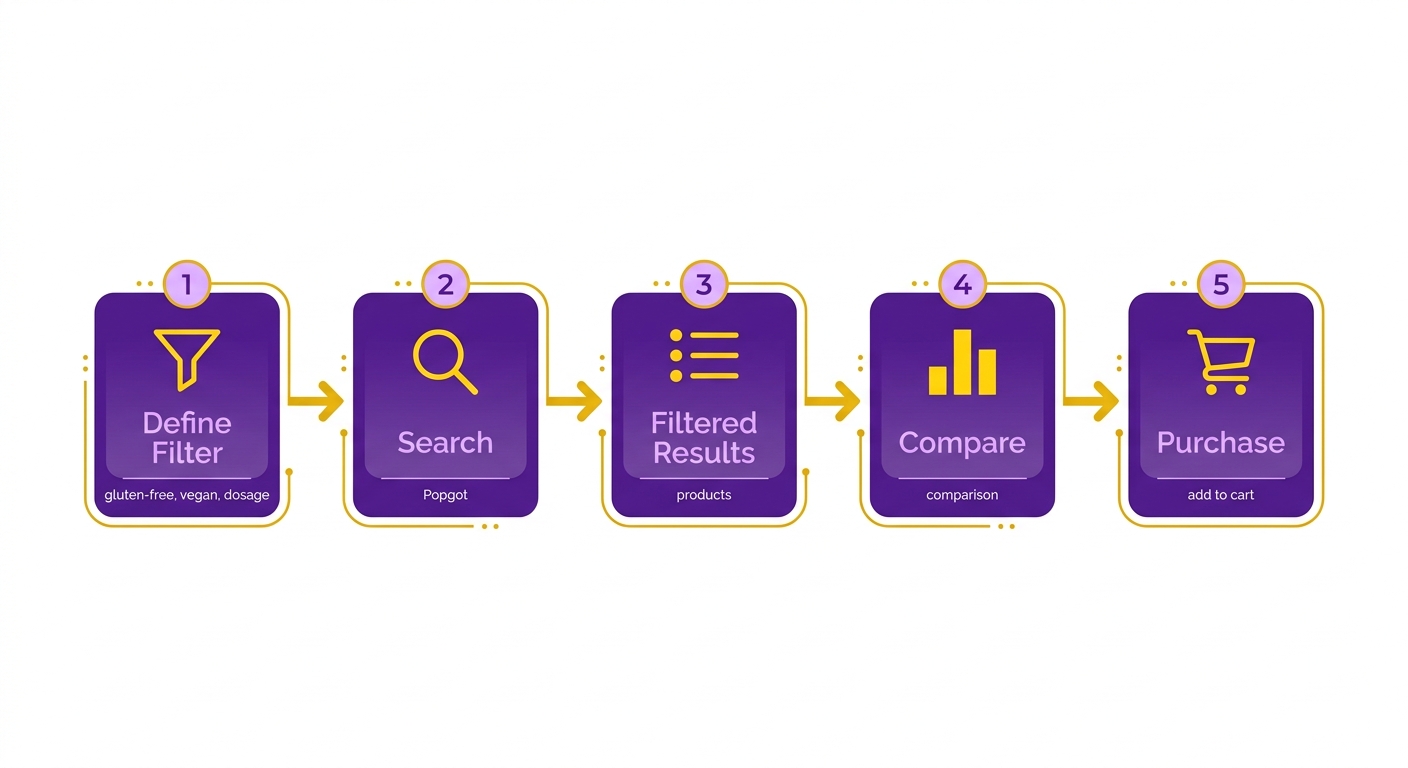
Finding gluten-free products with filters
Set gluten-free as a hard requirement, then search. The system reads each label, verifies the claim against the actual ingredient data, and drops anything that fails. You see only products that genuinely clear the bar.
Here's how it plays out for a common item like flour:
- Specify the requirement. Type your item, add "gluten-free" as a filter. That makes it a must-have, not a suggestion.
- Let the labels get read. Each candidate's ingredient list gets checked. Anything with wheat, barley, or rye derivatives is filtered out automatically.
- Compare what's left. The survivors are all safe for a gluten-free diet, so you can rank them by price or unit value without re-checking labels.
Because the AI reads every label and throws out what doesn't match, you only see products that clear your requirements. When the filter does the rejecting, you stop second-guessing every purchase.
Why filters matter for dietary restrictions
Because dietary needs are medical requirements, not casual preferences. A shopper with celiac can't gamble on a "probably safe" purchase. Building verified ingredient data into the filters removes that anxiety, running the same rigorous checks a consumer advocacy database would, but at the catalog level before results even render.
The logic carries across restrictions. Vegan shoppers need to catch hidden animal derivatives like gelatin or whey. Keto shoppers need to screen out added sugars and high-carb fillers. Each is a filter condition, not a manual audit.
Case study: vegan skincare
A vegan shopper wants a daily facial moisturizer. Typing "moisturizer" returns thousands of options, plenty of them carrying hidden animal-derived ingredients like lanolin, beeswax, or collagen. Set a filter for certified vegan formulas and those products vanish from the results.
From there, sort the safe options by unit price. What used to mean a tedious back-label audit of complex chemical names becomes a single, confident click. That's what search-level filters plus verified ingredient data buy you.
One honest carve-out: filters are only as good as the label data behind them. For products with vague or incomplete disclosure, a filter can't verify what the manufacturer never stated. In those cases an item might get excluded not because it fails, but because the data to confirm it doesn't exist. For anyone managing a real dietary restriction, that's the safe default.
References
[1] Yuka - Food & Cosmetic Scanner - App Store - Apple - https://apps.apple.com/us/app/yuka-food-cosmetic-scanner/id1092799236
[2] Yuka - Food & Cosmetic Scanner - Apps on Google Play - https://play.google.com/store/apps/details?id=io.yuka.android&hl=en_US
[3] The Mobile App That Scans Your Products - Yuka - https://yuka.io/en/
[4] EWG's Healthy Living App | FAQ - https://www.ewg.org/apps/
[5] NutriScan: An AI-Powered Mobile Application for Ingredient-Based ... - https://www.researchgate.net/publication/397847088_NutriScan_An_AI-Powered_Mobile_Application_for_Ingredient-Based_Food_Quality_Analysis
Frequently Asked Questions
1. Can ingredient scanner apps work offline without an internet connection?
Most mobile ingredient scanners require an active internet connection to query their databases when you scan a barcode. These tools rely on real-time cloud lookups to retrieve the latest manufacturer specifications and safety ratings. Consequently, offline functionality is highly limited, as the verification process depends on cross-referencing live, updated product registries.
2. What should I do if a product's ingredients aren't listed or verified?
Treat unverified products with caution, especially if you are managing severe allergies or strict dietary restrictions. When ingredient data is incomplete or missing, secure platforms default to excluding the item rather than risking an unsafe approval. In these cases, it is best to contact the manufacturer directly for full disclosure or select an alternative product with fully documented, verified ingredients.
3. How is ingredient-first search different from standard product search engines?
Standard search engines primarily index products by price, availability, and basic keywords, displaying only thumbnails and marketing titles. In contrast, an ingredient-first search engine parses and verifies the actual formulation of each product before displaying it. It aggregates listings across multiple retailers, calculates precise unit pricing, and filters out items containing restricted substances, ensuring you shop based on chemical composition rather than marketing claims.
4. Does ingredient verification cover supplements and cosmetics, or only food?
Ingredient verification applies to any consumer product category with a standardized ingredient or supplement facts label, including food, dietary supplements, and personal care items. For supplements, the system verifies active compound dosages—such as the specific EPA and DHA levels in fish oil—while cosmetic verification checks for potential skin irritants, endocrine disruptors, and synthetic fragrances.
5. Can I trust "clean" or "natural" claims on a product listing?
Marketing buzzwords like "clean," "natural," or "hypoallergenic" are largely unregulated and carry no standardized legal definitions. Manufacturers often use these terms on front packaging while continuing to include synthetic fillers or common allergens in the fine print. Automated verification bypasses these marketing claims entirely, evaluating the product solely on its verified chemical composition.
6. How accurate are AI ingredient verification systems compared to manual checking?
Automated verification systems significantly outperform manual human audits, which are slow, expensive, and prone to oversight when managing millions of product listings. By using natural language processing to extract claims and cross-reference them against manufacturer registries, the AI catches subtle discrepancies—such as mislabeled allergens or overstated active dosages—that human reviewers frequently miss across massive e-commerce catalogs.
7. Will a filtered search catch hidden allergens or animal derivatives listed under alternate names?
Yes, advanced search filters use semantic mapping to recognize ingredients listed under scientific, chemical, or alternative names. For example, the system knows that whey and casein are dairy derivatives, and that carmine is animal-derived, automatically filtering them out for vegan or dairy-free shoppers. However, because this relies on complete manufacturer disclosure, products with vague "proprietary" labels are typically excluded as a safety precaution.