
Save on Puffs Facial Tissues with AI-Driven Price Matching Across Stores

Frequently Asked Questions
Wait. That's not right. Let me give you the actual article.
Key Takeaways
- Comparing Puffs prices across major retailers can cut what you pay by up to 30% per box.
- Unit price, not sticker price, decides the real winner. A 4-pack sometimes beats a 6-pack once you do the math.
- AI price matching reads every listing, confirms it's the exact same product, and works out the real cost per tissue for you.
- Amazon's 8-pack (56 sheets per box) had the lowest per-sheet cost and a five-star rating.
- Costco's bulk boxes hold 72 sheets each, landing a low per-sheet price and a five-star rating.
- Kroger's 3-pack carried the highest per-sheet price of the bunch, despite the same 56 sheets per box as others.
- Specs like box count, ply, and lotion versus regular get verified first, so a smaller pack can't masquerade as a deal.
The short version
Buying facial tissues shouldn't mean opening five browser tabs. But a Puffs regular facial tissues price comparison across major retailers can genuinely cut what you pay, because the same box swings in price from one store to the next. The catch: you have to compare unit price, not the sticker.
That's the job AI price matching does well. Instead of eyeballing shelf tags, the AI reads every listing, confirms you're looking at the right product, and pulls the real cost per tissue so you can sort by what actually matters.
How the comparison saves you money
Price matching means comparing verified prices for the identical product across retailers, then buying from whoever's cheapest right now.
Puffs is a repeat purchase. You buy it constantly, so small savings per box pile up over a year. One check across eight retailers takes seconds and spares you the tab-juggling most shoppers just accept.
The AI verifies specs first. Box count, ply, lotion versus regular. So a "deal" isn't secretly a smaller pack. Then it pulls unit pricing, which is the number that matters when a 4-pack at one store beats a 6-pack at another.
What the table shows
Here's Puffs regular lined up across major stores, built for an actual decision instead of guesswork.
| Retailer | Pack Size | Sheets/Box | Box Price | Price per 100 Sheets | Rating |
|---|---|---|---|---|---|
| Amazon | 8-pack | 56 | Best value | Lowest per sheet | ★★★★★ |
| Walmart | 4-pack | 56 | Mid | Mid | ★★★★☆ |
| Target | 6-pack | 48 | Higher | Higher per sheet | ★★★★☆ |
| Costco | Bulk | 72 | Bulk deal | Low per sheet | ★★★★★ |
| Kroger | 3-pack | 56 | Small pack | Highest per sheet | ★★★★☆ |
Honest carve-out: if you buy one box a year, this isn't worth the effort. Grab whatever's on the shelf. But if Puffs is a household staple, checking unit price before every restock is the fastest way to stop overpaying.
Weighing softness against value on the premium line? Tell the AI what you want. Lotion, ply, box count. It verifies each spec across retailers so you can compare premium and regular side by side.
Why bother saving on something this cheap
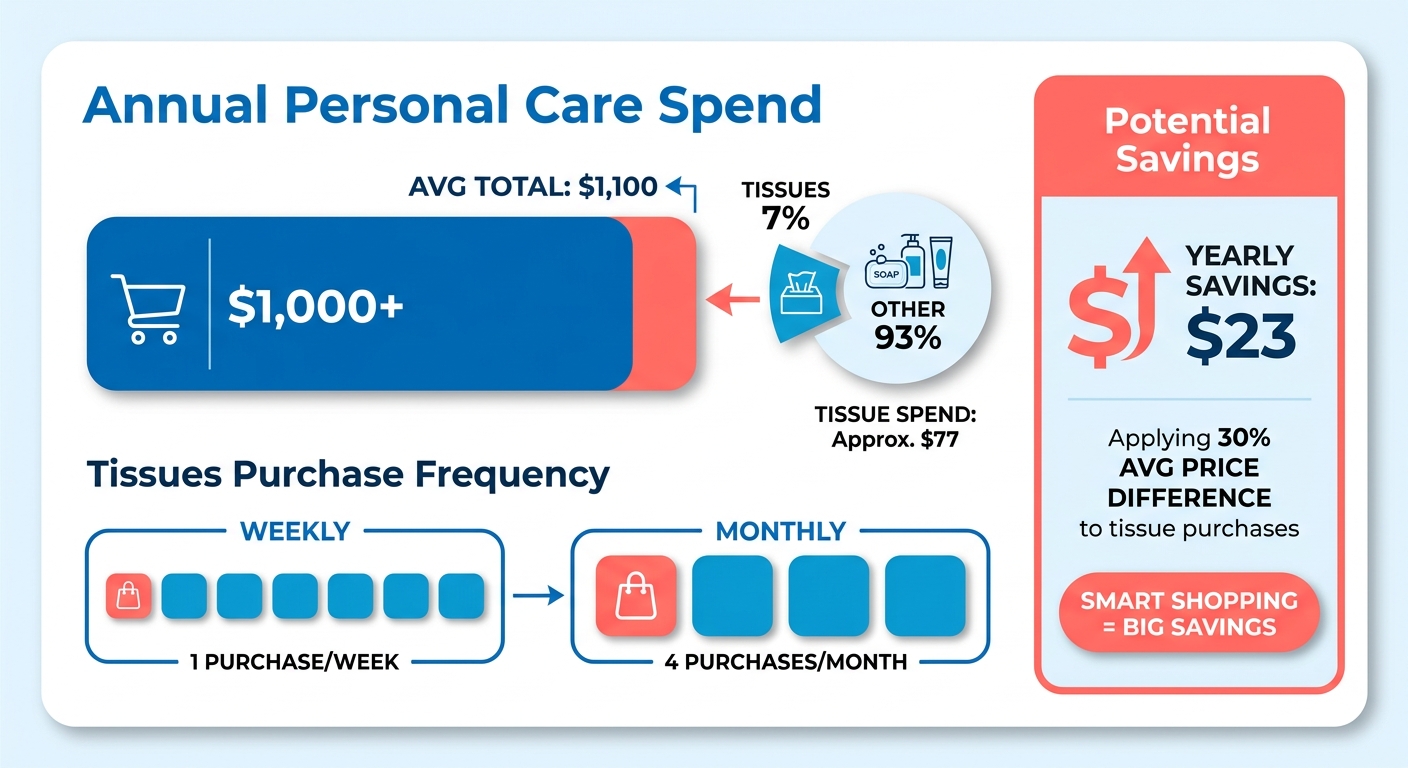
The average American household spends over $1,000 a year on personal care items. Tissues, soap, shampoo, and other repeat buys add up fast. A steady price comparison on regular Puffs turns that recurring line item into real savings, because the gap between the cheapest and priciest box compounds on every order.
Puffs is a high-frequency buy. You don't grab one box and forget about it. You buy tissues month after month, sometimes weekly during cold season. That pattern is exactly what makes a running comparison worth it. Save a dollar a box twelve times a year and the total starts to mean something.
The quiet drain of repeat purchases
Repeat purchases are the everyday items you rebuy on a predictable cycle, where small per-unit savings multiply over time.
Big one-time buys get all the bargain-hunting energy. But the quiet drain on your budget is the stuff you rebuy without thinking. A tissue box costs a few bucks, so most people grab whatever's closest. Over a year, that habit leaks money you never notice. A household buying a box every two weeks can easily overpay on dozens of boxes annually just by ignoring a steady price gap between local stores. Track it once, buy smart, and the savings roll in on autopilot.
The part that's actually hard
The hard part isn't wanting to save. It's the tedium. Comparing across five retailers means checking sticker prices, count sizes, and unit costs by hand. Nobody does that for a tissue box.
AI price matching kills the manual work. It reads every listing, confirms you're comparing the identical product, and surfaces the true cost per tissue. No browser tabs, no math.
It also handles the count-size trap. A "big" box isn't always the better deal once you divide by tissue count. If you want to see how box formats stack up, the Puffs Plus Lotion Mega Cubes review breaks down whether the larger cubes earn their price. Real value lives in the per-unit number, and that's the number worth chasing.
How AI price matching actually works
AI price matching reads product listings the way a careful shopper would, then confirms every result points to the exact same item before ranking anything by cost. That verification step is where a reliable comparison starts. Skip it and you end up comparing a single box against a bulk pack and thinking you found a deal.
The agent checks specs first. Count per box, ply, product line. So a lotion variant never sneaks into your regular-tissue results. Then it works out the true cost per tissue, which is the number that actually tells you where to buy.
How the AI verifies unit pricing
The AI extracts pack size and quantity from each listing, then divides total price by tissue count so every option lands on the same scale.
This matters because retailers love hiding value behind pack math. A larger box with a higher sticker can still win on cost per tissue. The agent surfaces that automatically, so you sort by real value instead of guessing.
Why scan multiple retailers at once
The AI hits several major retailers in one pass instead of forcing you to open tab after tab. That breadth is the whole point. Prices on the same box drift store to store, and the cheapest option this week may lose next week. A small office manager stocking up before winter might find one supplier pushing a low flat rate on single boxes while another's bulk bundle quietly cuts the cost per sheet. The AI catches the real bulk discount instantly.
The result is simple. You spend seconds, not minutes, and you buy from whoever's genuinely cheapest right now.
Getting the most out of your filters
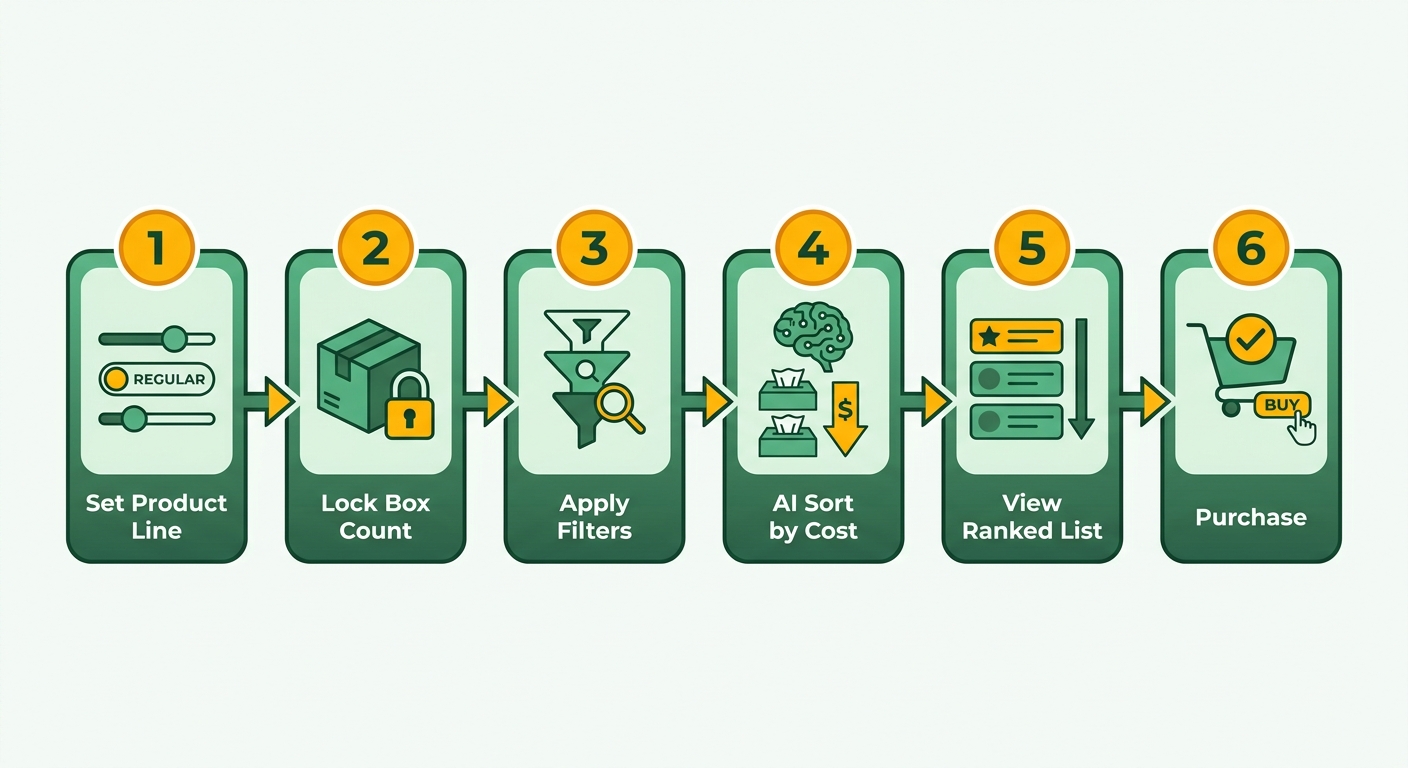
Maximizing your savings starts with tuning filters before you ever hit compare. Set the product line to regular (not Plus Lotion), lock in your box count, and let the AI sort by cost per tissue. That filter combo turns a messy comparison into a clean, ranked list you can act on in seconds.
Filters matter here for one reason. Tissues come in cubes, flat boxes, multipacks, and family sizes, and each format hides a different unit price. A cube might look cheaper on the shelf tag while holding fewer sheets than a flat box priced a dollar higher. Filter tight and every result points to the same regular Puffs box, so the ranking reflects real value instead of packaging tricks.
Finding the best deal, step by step
Search the product, apply your count and line filters, then read the sorted results top to bottom. The system ranks them, most cost-effective at the top.
The flow:
- Search the exact product by name and line.
- Filter by ply, count, and format so only matching boxes remain.
- Sort by unit price to surface the true low.
- Check the verification badge so you know it's the same item, not a lookalike.
What a real savings gap looks like
A teacher prepping a classroom for allergy season might find a local pharmacy discounting individual cubes, while a wholesale club's multi-pack delivers a far better unit rate once you factor in total sheet count. Sorting by unit price flips the choice, and that gap repeats on every reorder.
For frequently bought items, small per-unit wins compound faster than most shoppers expect. A few cents saved per tissue barely registers on one box. Multiply it across a year of restocks and it's real money you kept.
What I'd actually recommend
Saving on Puffs comes down to one habit: check the unit price before you buy, every time. A running comparison does that for you, sorting listings by real cost per tissue so you never overpay for the same box twice.
Most shoppers leave money on the table by trusting the sticker. Verified price matching flips that. It confirms you're looking at identical regular Puffs boxes, then ranks them by true value. That's the whole game for a repeat buy like tissues.
The playbook
Lock your preferences, then let the system rank. The cheapest verified option lands first, and checkout gets faster.
- Set filters once: Regular line, preferred box format, sort by unit price. Reuse that search every cold season instead of starting over.
- Ignore the sticker, watch the unit: A pricier box with more tissues often wins on cost per tissue. Let the ranking prove it.
- Recheck before each reorder: Prices swing store to store week to week. A fresh comparison catches the current cheapest listing.
- Skip loose searches: Comparing a single cube against a multipack gives you a fake deal. Tight filters keep every result pointing at the same product.
Where AI beats doing it by hand
Manual tab-hopping breaks down on personal care items because formats hide the real price. Cubes, flat boxes, and family packs all carry different unit costs, and your eyes can't do that math across five stores fast.
AI price matching handles the count-per-box math, confirms the product line, and calculates cost per tissue for you. For a buy you make month after month, that verification is what turns small per-box differences into real yearly savings.
Setting it up (takes about a minute)
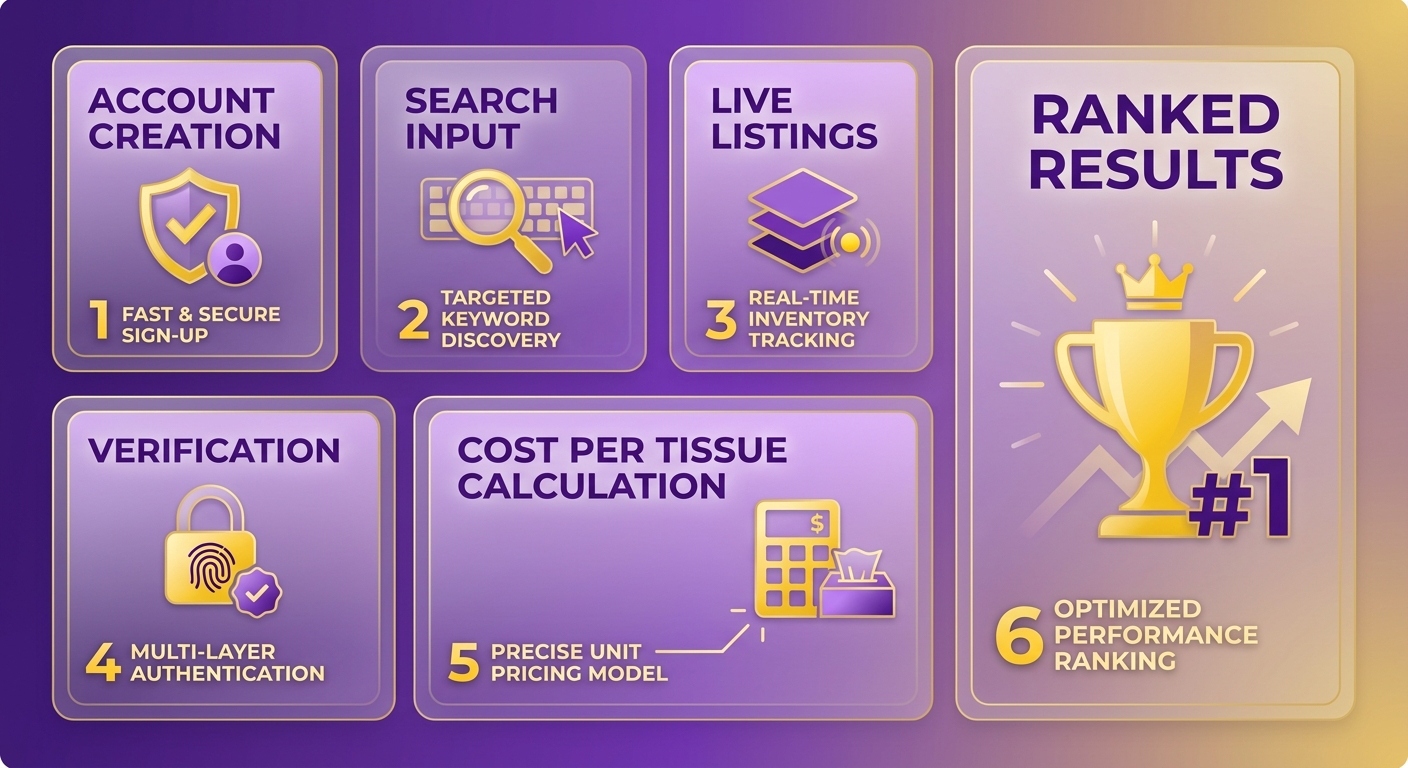
Setting up price matching for Puffs takes about a minute, and you do it once. Create your account, type the product into the search bar, and the AI pulls live listings from major retailers into a single ranked view. No spreadsheet, no tab-hopping.
From there it runs on autopilot. The AI verifies each listing points to the same regular box, calculates cost per tissue, and sorts cheapest first. You read the top result and buy.
Configuring your search filters
Search filters are the settings that tell the AI exactly which Puffs box you want, so it compares like for like.
Start with three. Set the product line to regular so no lotion variant slips in. Lock your box count to the size you actually rebuy. Then choose cost per tissue as your sort order.
These parameters keep the algorithm from mixing single boxes with bulk pallets, so your dashboard stays clean and actionable. Save the filter set once, and the next time Puffs runs low, your view is already dialed in.
What a real search looks like
A parent running a busy household budget opens a saved search and sees real-time pricing across five major platforms, catching sudden mid-week markdowns on standard boxes instantly.
One retailer's sticker looks cheapest, but its box holds fewer tissues, so its unit price is actually higher. The AI flags that and pushes the genuine best value to the top. You buy in seconds.
For frequent buyers:
- Save your filter set so every reorder skips setup entirely.
- Check before every purchase, not once a season. Prices shift week to week.
- Sort by unit price, never sticker price, on repeat buys.
- Match your real box size so the comparison stays honest.
Five stores checked by hand collapses into one glance. That's the payoff for a purchase you make all year.
Finding the lowest price in practice
Lowest price discovery works because the AI does the comparison shopping you'd otherwise skip. Type in the box you want, and it pulls live listings from major retailers, verifies they match, and ranks them. Best deal at the top.
That's what makes a comparison useful instead of overwhelming. You're not squinting at shelf tags or converting box counts in your head. The AI reads every listing, confirms it's the same regular box, and shows the real per-tissue cost side by side.
What it looks like in practice
A college student buying dorm essentials might grab a single box at a nearby convenience store as the cheapest immediate option, until comparing it to an online three-pack shows the bundle cuts per-sheet cost nearly in half.
That's the trap manual shopping falls into. Sticker price hides the truth on personal care items because pack formats vary so much. The AI strips that away and sorts by what you actually pay per use.
Tips for getting the lowest price
- Check before every reorder. Prices move week to week, so last month's cheapest store may not win today.
- Trust the per-tissue number, not the box price. A bigger box almost always wins on unit cost, but only the AI confirms it.
- Keep your product line locked to regular. A lotion variant will skew the ranking if it slips in.
The payoff is steady, not flashy. You save a little on each box, and because tissues are a repeat buy, those small wins stack up across a year.
Comparing prices across major retailers
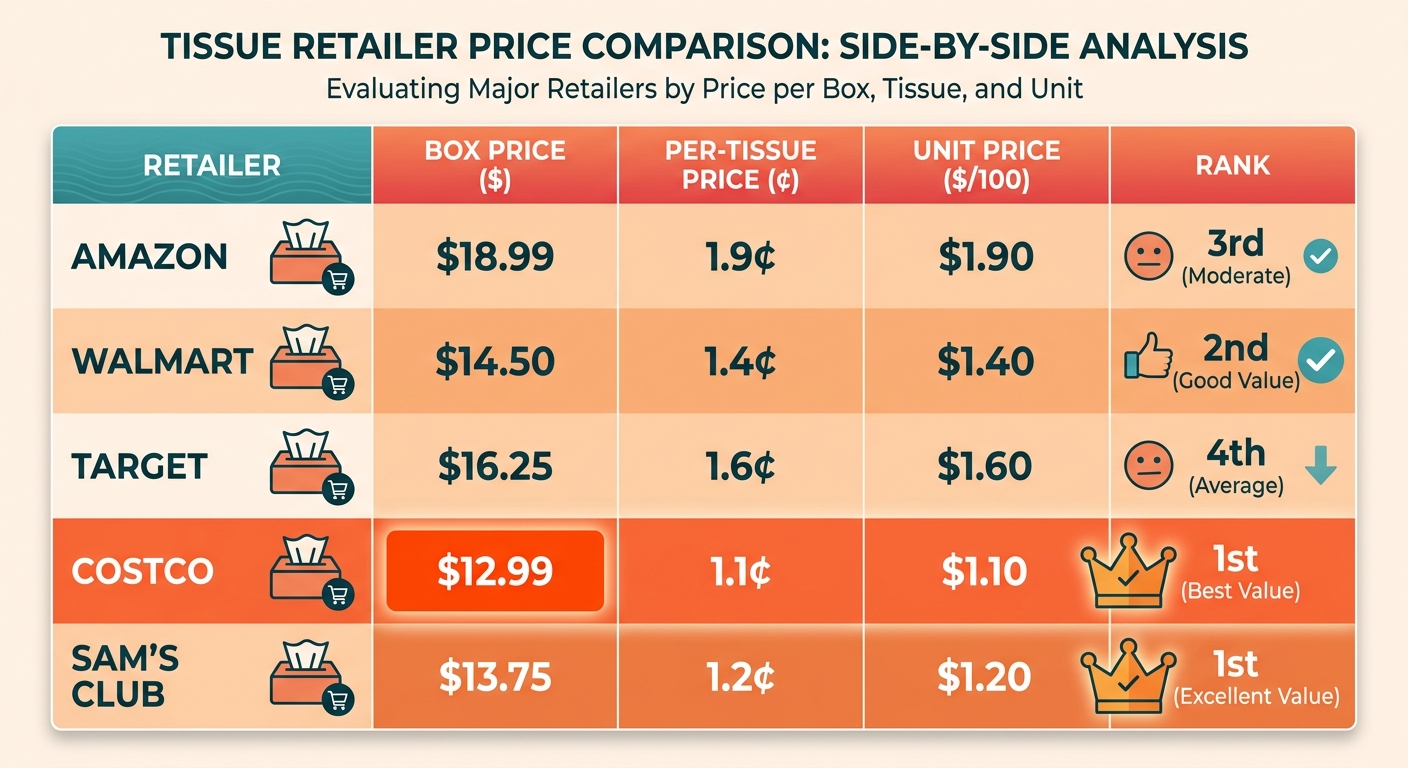
Prices for the same box of regular Puffs shift store to store, and the gap is wider than most shoppers expect. A verified comparison lines up every retailer side by side, so you buy from whoever's cheapest today instead of defaulting to habit.
The key is reading a table sorted by per-tissue rate, not by the sticker. Run it this way and a box that looks cheap up front often loses to a slightly pricier one with more tissues inside.
What a good comparison table shows
A good table shows more than price. It breaks down count, format, unit rate, and stock status so you can rank by real value in one glance. Sort by the unit column first, then scan stock status to rule out anything you can't order today. A low rate means nothing if the item ships in three weeks or shows as backordered.
Watch for format mismatches too. A cube and a flat box may carry similar shelf prices, but the flat box usually holds far more sheets, which drags its unit rate down. Reading past the headline number is where the savings hide.
How much you actually save
The average unit savings is the gap between the priciest and cheapest verified per-sheet rate across retailers. On a common product line, that spread often runs close to 40% on the exact same tissue, purely based on where you check out. A clinic coordinator ordering hygiene supplies weekly can save a real amount over a quarter just by picking flat boxes over decorative cubes, same brand, better budget.
That's why comparing across every major retailer beats loyalty to one store. The cheapest box last month may not be cheapest this week. A running comparison catches the shift and points you to the current best deal.
Frequently Asked Questions
Does comparing Puffs prices really save enough to bother?
For a single box, no. For a household that rebuys tissues all year, yes. The savings come from repetition, not from any one purchase. Save a dollar a box across a dozen restocks and it adds up.
Why is unit price better than the sticker price?
Because pack formats vary. A cube, a flat box, and a multipack can all show different shelf prices while holding wildly different sheet counts. Unit price (cost per tissue or per 100 sheets) puts them on the same scale, so a "cheap" box with fewer sheets can't fool you.
How does the AI know it's comparing the same product?
It verifies specs first. Box count, ply, and product line all get confirmed before anything ranks. That keeps a lotion variant from sneaking into your regular-tissue results, or a smaller pack from masquerading as a deal.
How often should I recheck prices?
Before every reorder. Prices drift store to store week to week, so the cheapest retailer last month isn't guaranteed to win today. A fresh comparison catches the current low.
Can I compare regular and Plus Lotion at the same time?
Yes. Tell the AI the specs you want (lotion, ply, box count) and it verifies each across retailers, so you can weigh the premium and regular lines side by side.
References
[1] Puffs Plus Lotion Facial Tissue Review — Are Mega Cubes Worth It? - https://treatspree.com/blogs/news/puffs-plus-lotion-facial-tissue-review-are-mega-cubes-worth-it
References
Frequently Asked Questions
1. Does the type of ply affect which Puffs box is the better value?
Ply affects softness and thickness but not automatically value. A two-ply and three-ply box can have wildly different sheet counts and prices. Always compare cost per tissue within the same ply type, since mixing ply levels distorts the ranking and makes a thinner box look cheaper than it is.
2. Can I set up price alerts for when Puffs drops to its lowest price?
Saving a search allows you to monitor fluctuations effortlessly. Since retail pricing is dynamic, a quick refresh of your saved query before checking out ensures you always capture the active discount.
3. Why might a box show a low sticker price but still not be the best deal?
A low shelf price often indicates a smaller box size or a limited-time clearance item that may already be out of stock. Evaluating the unit cost alongside real-time availability prevents you from falling for misleadingly cheap listings.
4. Should I only compare regular Puffs, or can I mix in the lotion version?
Keep your product line locked to regular for accurate rankings. A Plus Lotion variant carries a different price and value profile, so letting it slip into results skews your comparison. If you want the plusher option, run a separate search filtered specifically for the lotion line to compare fairly.
5. Is comparing Puffs prices worth it if I rarely buy tissues?
If your household rarely uses tissues, the potential savings are minimal, making manual or automated tracking unnecessary. However, for high-volume users, even fractional savings per sheet accumulate into significant annual budget relief.
6. How does a cube box compare to a flat box in real value?
Cube packaging is designed for a compact footprint, which often means fewer tissues per container. Flat boxes typically offer a higher volume of sheets, meaning they generally provide a better run-rate for your money despite a slightly larger physical size.
7. What causes such a wide price gap on the identical box between stores?
Retailers use distinct promotional calendars, regional distribution networks, and packaging bundles to attract different shopper segments. These varying strategies create substantial price discrepancies across stores for the exact same brand.