
The Big Diaper Price Comparison: Cheapest Per-Diaper Costs by Size

Key Takeaways
- The lowest per-diaper cost shows up on store brands and bulk boxes, not premium single packs, even though the bulk boxes cost more upfront.
- Parent's Choice runs about 14 cents per size 4 diaper, the cheapest option in Wirecutter's testing.
- Size 1 store-brand boxes sit around 12 to 15 cents per diaper, the cheapest place to start with a newborn.
- Premium name-brand size 4 diapers cost 20 to 30 cents each. That's more than double Parent's Choice in bulk.
- An Amazon size 3 subscription dropped a 168-count box from $94.99 to $89, about 5 cents off each diaper.
- Per-diaper cost climbs as your baby grows, so the gap between a smart buy and an overpriced one widens over time.
- A bigger box looks cheaper on the shelf. Unit price tells you what's actually cheaper.
Quick Summary
The cheapest diaper isn't the one with the lowest sticker price. Size 1 boxes usually win on entry cost, but the lowest price per diaper almost always lives on larger boxes and subscription multipacks at Amazon, Walmart, or Target. As your baby grows, each diaper gets pricier, and the gap between a good buy and a bad one opens up fast.
We pulled real listings and unit prices so this comparison is easy to follow. Short version: shop by per-diaper cost, not pack size.
What's the cheapest cost per diaper by size?
Store brands and bulk boxes, not premium single packs. Wirecutter's diaper testing flags store brands as the most budget-friendly, with Walmart's own line offering some of the lowest entry points in mid-tier sizes. Subscription boxes can go even lower per unit once you size the box up.
| Size | Brand / Model | Retailer | Pack Count | Price / Diaper | Weight Range |
|---|---|---|---|---|---|
| 1 | Store brand | Walmart | 200+ | ~$0.12–0.15 | 8–14 lb |
| 3 | Name brand (subscription) | Amazon | 168 | ~$0.52 | 16–28 lb |
| 3 | Name brand (non-sub) | Retailer site | 168 | ~$0.57 | 16–28 lb |
| 4 | Parent's Choice | Walmart | Bulk box | ~$0.14 | 22–37 lb |
| 4 | Premium name brand | Target/Walmart | Mega box | ~$0.20–0.30 | 22–37 lb |
These figures come from Karing's diaper breakdown, and they show how recurring delivery quietly lowers your ongoing cost. Opting into a regular shipment usually unlocks the lowest tier of name-brand box pricing you can get.
Why does pack size alone mislead you?
A bigger box looks cheaper, but the math depends entirely on the count inside. Two "jumbo" packs from different brands can hold wildly different numbers of diapers, so the only fair comparison is price per diaper. DiaperPricer exists for exactly this reason: brands shuffle pack sizes to make direct comparison hard.
Retailer matters too. Pampers Swaddlers at one store and Huggies Little Snugglers at another can carry very different unit prices for the same size. Target's own comparison tool lets you put Pampers and Huggies side by side.
This is the job we built our AI for. It reads each listing, pulls the real per-diaper price across Amazon, Walmart, and Target, and drops anything that doesn't match the size or features you need.
When is the cheapest diaper the wrong buy?
Skip it when it leaks, fits poorly, or pushes you into more changes a day. A diaper that fails the manufacturer weight range costs you more in blowouts and laundry than you saved per unit. Match the size to your baby's weight first, then chase price.
When fit holds, the savings are real. At 6 to 8 changes a day, shaving even 5 cents per diaper adds up to $100+ a year. That's the whole reason unit pricing beats the headline box price.
Why Diaper Price Comparison Matters
Diapers are one of the most relentless baby expenses, mostly because newborns go through so many. In the early months, many babies use 6 to 12 a day. That's a repeating purchase that doesn't quit for two full years, which is exactly why small per-diaper differences turn into real money.
How much do diapers actually cost per year?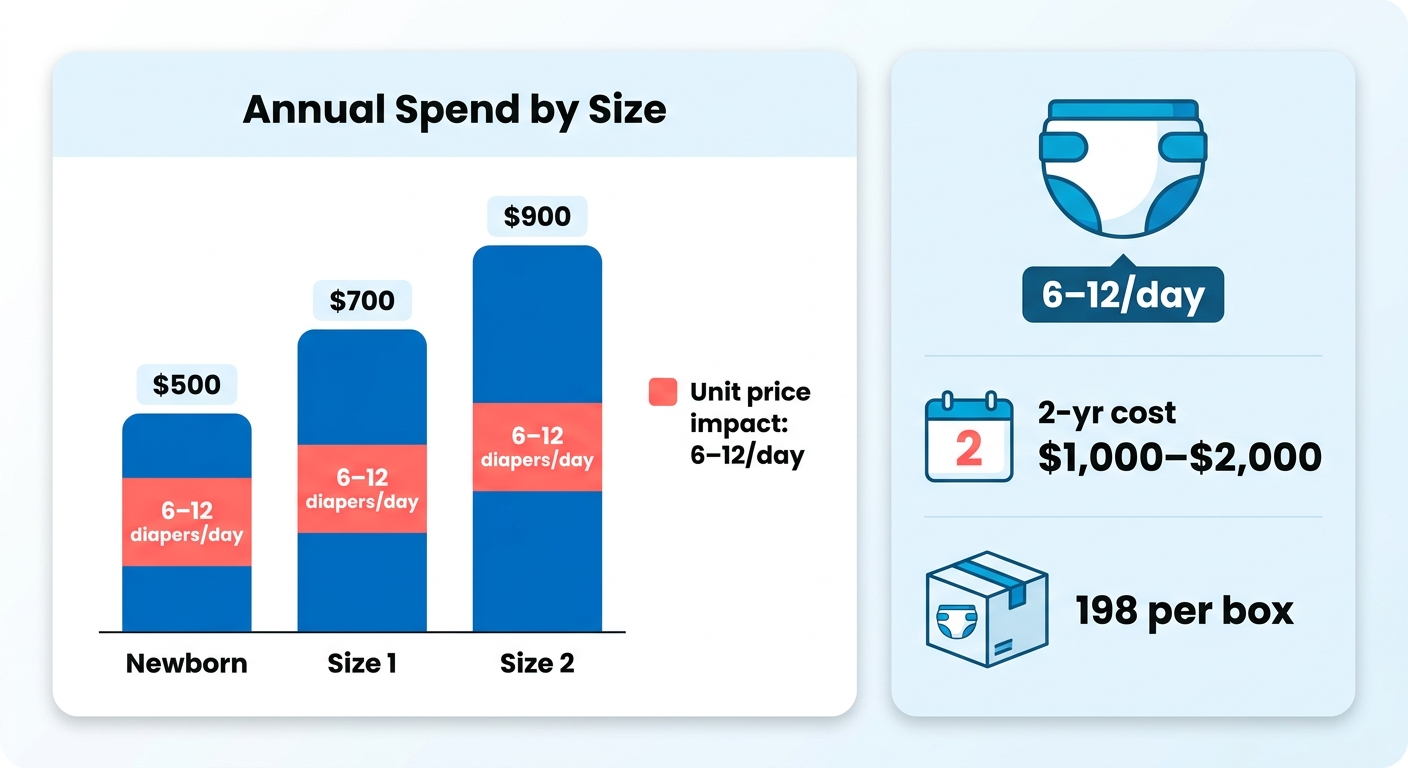
Families spend roughly $500 to over $1,000 a year, depending on brand, size, and how often you change. The math is simple and a little brutal. A few cents per diaper, multiplied across thousands of changes, decides whether you land at the bottom or the top of that range.
Size pulls it higher over time. As your baby grows, the cost per diaper climbs while the count per box drops. A newborn box might pack 198 diapers; a size 5 box of the same brand often holds closer to 120 for a similar sticker price. That shrinking count is easy to miss when you're staring at the number on the front instead of the cost per change.
For some families, access makes it worse. Research on diaper access in low-income neighborhoods found the lowest per-diaper cost isn't always available nearby. When you can't reach the cheapest retailer, you pay more for the exact same product.
Why do pack sizes make prices so confusing?
Retailers price diapers in ways that hide the true cost. Big boxes look like deals, but price per diaper is the only number that tells the truth. Two boxes at the same sticker price can hold very different counts.
Grocery shoppers hit the same trap. One Reddit user who compared stores line by line put it bluntly:
"Their posted price comparisons are bs but it's always cheaper than other places, even if by just a bit." - a r/bayarea commenter
Promotions add more noise. A "sale" on a smaller pack can still cost more per diaper than a full-price multipack. Unit pricing cuts straight through that, which is why an online tracker beats squinting at the marketing.
What do parents gain from comparing first?
Comparing per-diaper costs upfront means fewer emergency store runs and smarter stock-up timing. You buy the cheapest verified option in bulk before a growth spurt instead of grabbing whatever's on the shelf at full price.
It also kills the guesswork. Instead of checking three apps and reading fine print, you see the lowest cost per diaper across Amazon, Walmart, and Target in one place. One Seattle shopper who built a grocery comparison tool noted the "huge variance in size and sku" that makes manual checking so painful. Diapers have that exact problem.
The payoff is plain. Shop by verified unit price, buy ahead of size changes, and you keep hundreds of dollars over two years that would otherwise leak away a few cents at a time.
How Per-Diaper Unit Pricing Works Across Diaper Sizes
The math is simple: divide the total box price by the number of diapers inside. That one number tells you whether a deal is actually cheap or just looks cheap because the box is big.
How Do You Calculate Cost Per Diaper?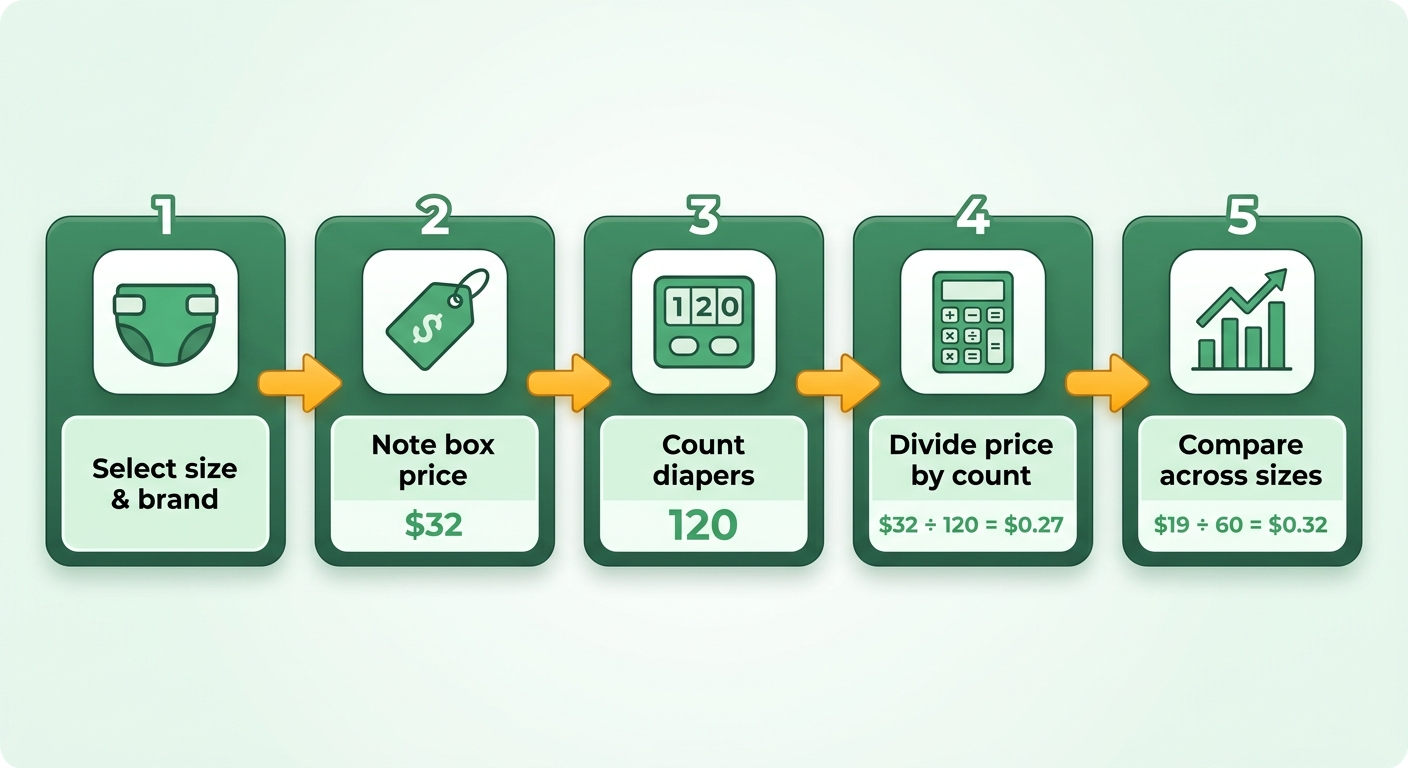
Unit price formula: total box price divided by diaper count.
Take a real listing. A size 4 box at $32 for 120 diapers works out to about 27 cents each. A jumbo pack of the same brand at $19 for 60 diapers lands closer to 32 cents. So the bigger box wins on true cost, even though it costs more upfront.
Run this on every box before you buy. An automated calculator does the comparison across brands and pack sizes for you, so you can spot the cheapest option without the arithmetic.
Why Does a Bigger Box Usually Win?
Bigger boxes almost always beat smaller ones on unit price, even when the cart total looks scarier. The sticker shock fools people into grabbing the small pack. A 100-count box at $26 costs 26 cents per diaper; a 48-count box of the same brand at $14 costs about 29 cents. The smaller box is cheaper at checkout and more expensive per change. Multiply that 3-cent gap across a year and the "cheaper" box quietly costs you more.
That's why shopping by total price is a trap. The bigger commitment usually carries the lower true cost.
How Do Sizes Change the Price?
Diaper sizes follow weight ranges, not ages, and the cost per diaper climbs as you go up. Each step up means fewer diapers per box and a higher unit price, even within the same brand.
The jumps between newborn, Size 1, and Size 2 hit hardest. Pack availability and demand differ at those early stages, so unit prices can shift abruptly right when babies are burning through the most. Check the manufacturer weight chart for fit before you commit, because a poor fit causes leaks no matter the price.
What Erases Your Savings?
A lower unit price means nothing if the diaper leaks. One extra change a day wipes out a cheaper box fast.
Here's the math. Say a cheaper diaper saves you 3 cents each but leaks enough to force one extra change daily. At roughly 8 changes a day, that extra diaper costs more than the 24 cents you saved. The deal loses. Performance reviews like Wirecutter's lean hard on absorbency and leak protection because fit and dryness decide real value, not the listed price.
Watch for these traps before you trust a price:
- Shipping fees that turn a low online price into the more expensive option
- Subscribe-and-save discounts that only apply to certain pack sizes
- Limited-time coupons that vanish on your next order and break your budget math
- Multipack anomalies where two retailers list the same diapers at different unit prices because of pack configuration or promotions
Always recalculate cost per diaper after shipping and discounts. That final number, not the headline price, tells you which box actually wins.
Smart Ways to Save on Diapers Without Sacrificing Quality
The lowest cost per diaper comes from matching your buy to your baby's size stage, not just grabbing the biggest box. Bulk packs and subscriptions cut the per-diaper price, but only if you can use the whole supply before your baby moves up a size. Plan around unit price and usage windows and you can shave real money off the annual spend.
When Do Bulk Packs Actually Save You Money?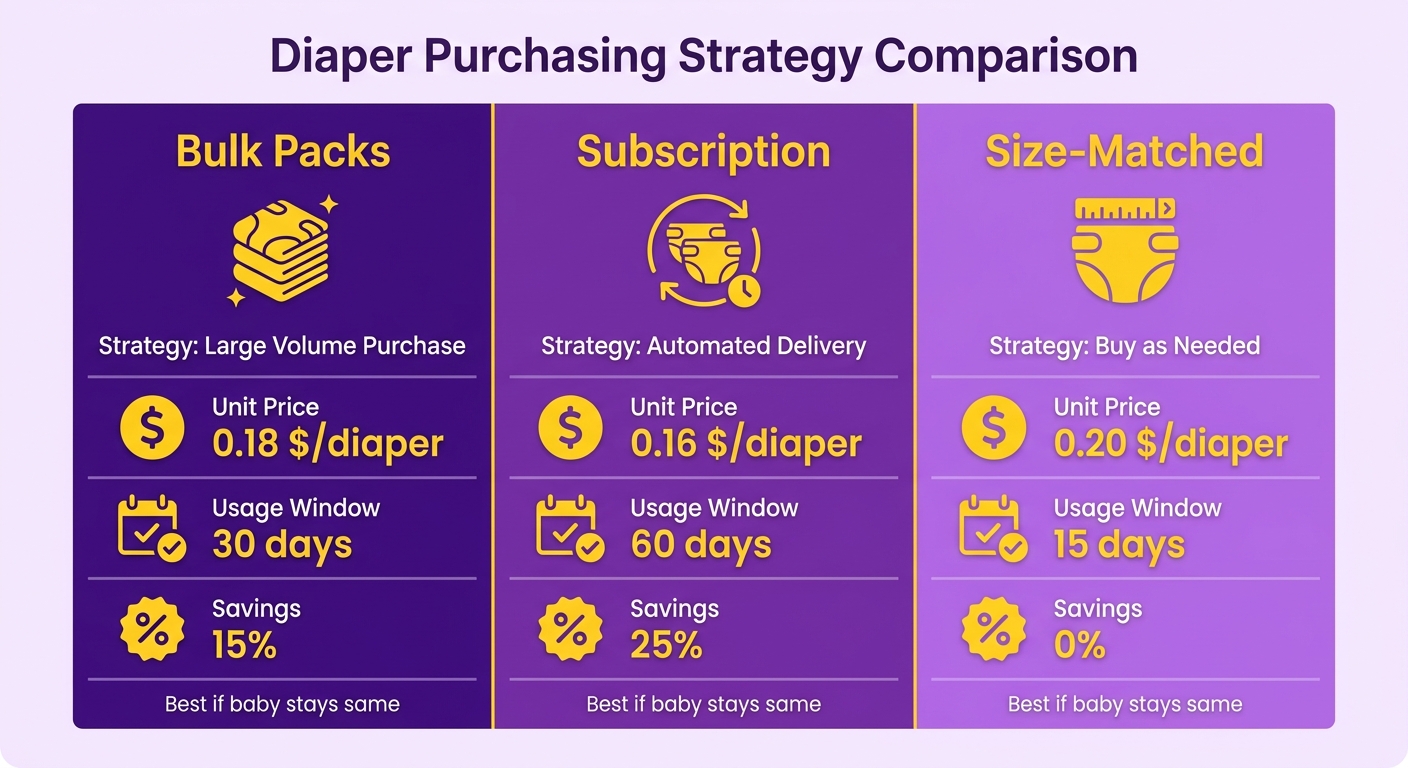
Bulk packs lower your cost per diaper, but the savings only land if your baby is settled into a size and will finish the box before outgrowing it. A jumbo supply of a size your baby is about to leave is wasted money, no matter how good the per-diaper price looks.
So your stock-up strategy should shift with size progression. Newborn diapers get used for a short, unpredictable window, so buy them lean. Bigger sizes stick around longer, so they're safer to buy deep.
Buy more Size 2 than Newborn. Babies wear Size 2 for a longer stretch, which means a bulk box gets fully used instead of half-abandoned in a closet. Run the numbers first with a price tracker that checks across major retailers before you commit.
How Do Subscriptions and Loyalty Offers Change the Price?
Subscriptions and pickup offers change your effective unit price, not just the sticker. The same product can cost less per diaper purely because you committed to a recurring order. Compare the price after discounts, not the headline number on the box.
Most recurring-order programs shave 5 to 15 percent off the shelf price, and that gap widens once you layer in membership perks. Some retailers add a flat percentage back on every baby-care order after you cross a monthly threshold, so the more predictable your buying, the deeper the discount compounds over a year.
Stack a recurring order with store pickup deals and loyalty rewards where they exist. You can also compare diaper prices directly to see how the tiers stack up before locking in a shipment.
A Simple Case Study in Planned Buying
Take a family that buys reactively, grabbing a single pack whenever they run low. They pay full retail every time, with no plan. Over a year, those one-off purchases pile up at the high end of the range.
Now they switch to planned unit-price buying. They check cost per diaper before each purchase, lock in a subscription for their baby's current size, and stock up deeper on longer-wearing sizes. The per-diaper savings repeat across thousands of changes.
Time the bigger stock-ups around price drops. Holiday sales, baby registry completion discounts, and membership promotions all lower the effective price on the same diapers. The discipline is simple: never buy on impulse, always buy on unit price. That one habit is what separates the bottom of the annual cost range from the top.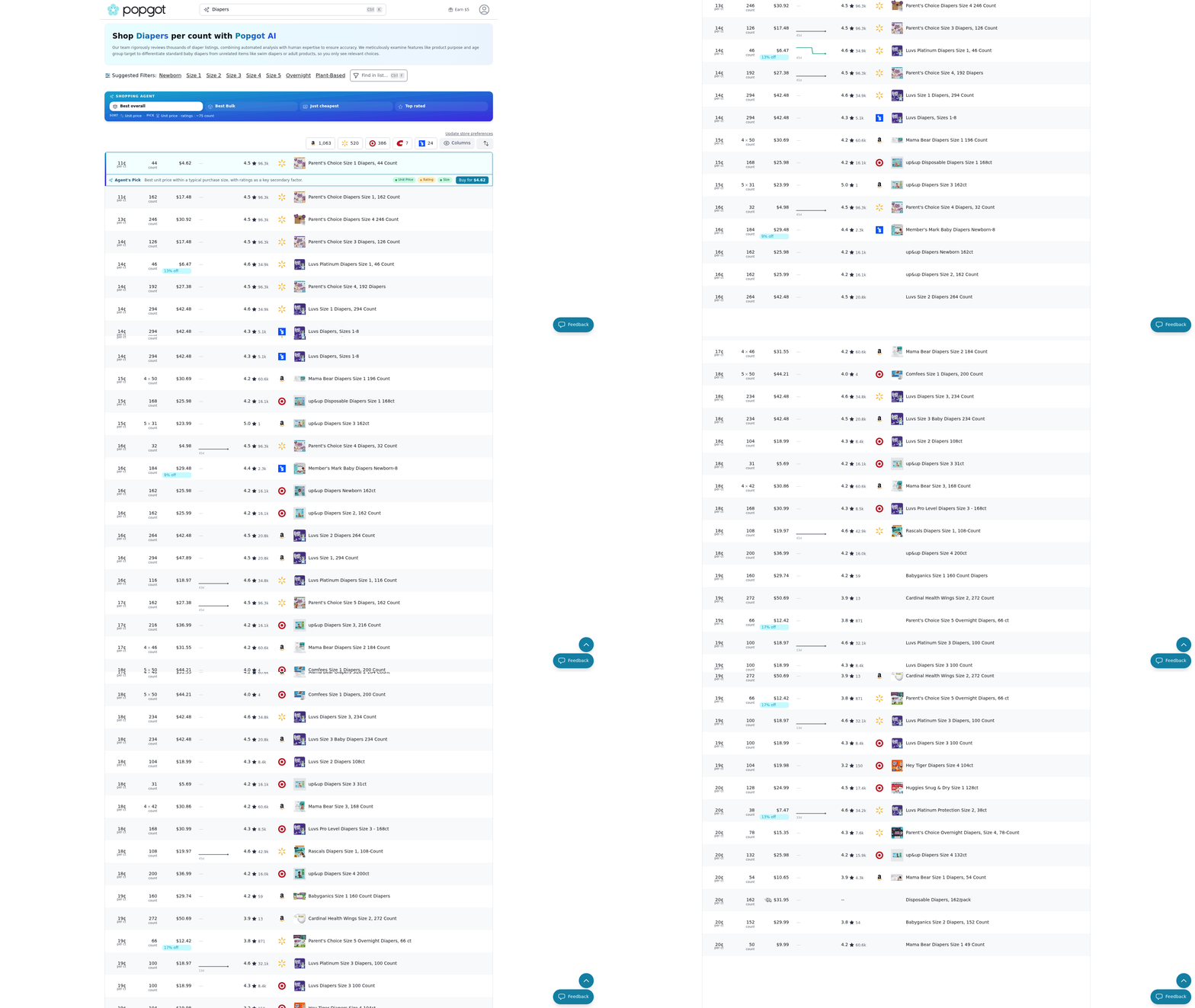
Cheapest Per-Diaper Costs by Retailer: Amazon vs Walmart vs Target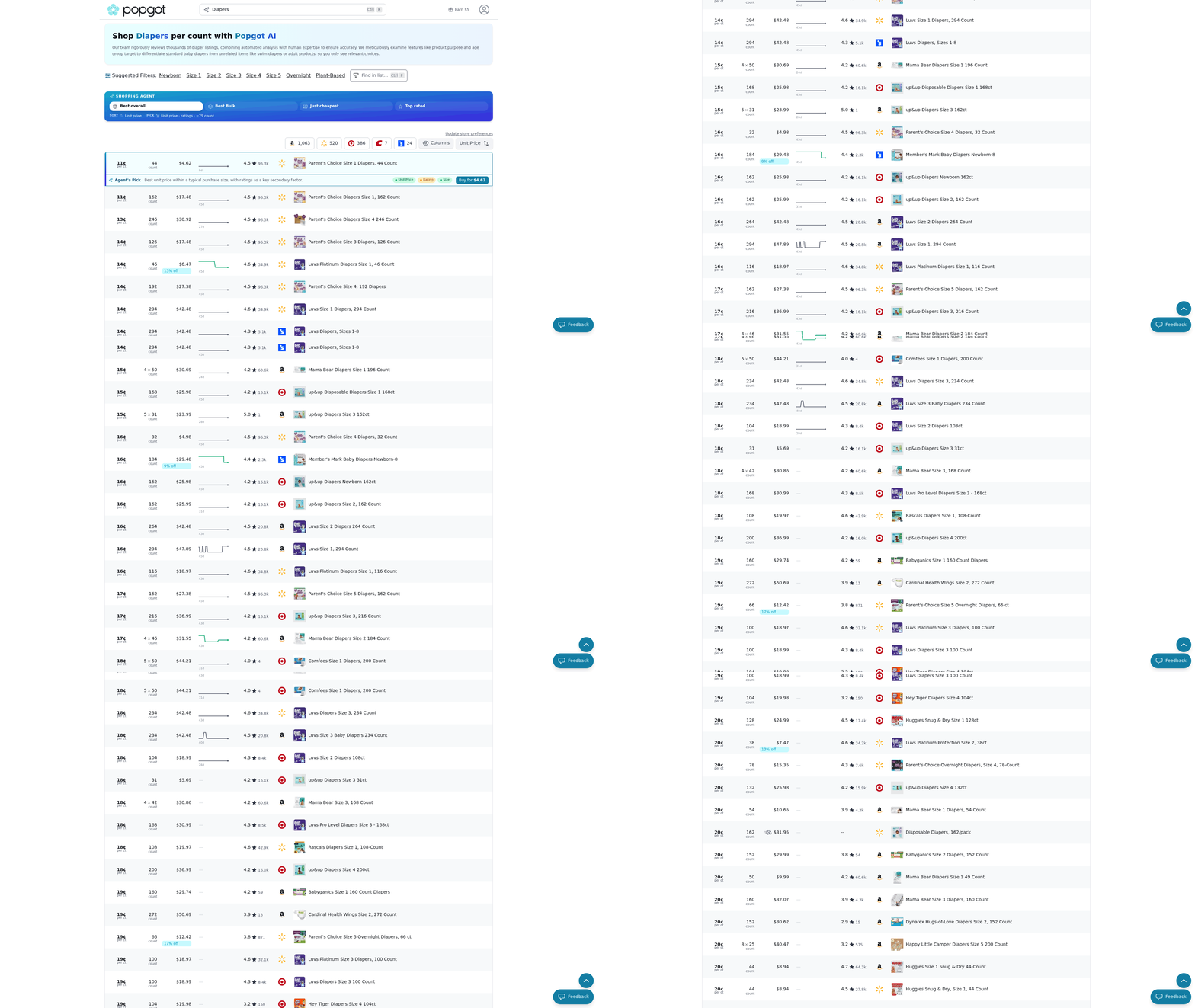
The same diaper at the same size can cost different amounts at Amazon, Walmart, and Target. Pack structure, membership pricing, and shipping minimums all push it around. To find the real cheapest, you have to compare matched listings, not headline prices.
Why Does the Same Diaper Cost Different Amounts at Each Retailer?
Matched comparison means pricing the identical brand, size, and count at all three retailers before factoring in subscriptions, rollbacks, and coupons. On Target's selection, the price per box swings widely based on count and packaging. A small jumbo pack might look cheaper on total price, while a giant box elsewhere wins clearly on cost per diaper.
The membership layers change everything. Amazon Subscribe & Save knocks a percentage off recurring orders. Walmart rollback drops select boxes for a limited window. Target Circle stacks store coupons on top of the shelf price. Each one moves the per-diaper number a different direction.
Here's the trap. A retailer can win on sticker price and lose on unit price after a coupon kicks in elsewhere. A $52 box of 168 looks great until a subscription discount turns a pricier $55 box into the cheaper diaper per change.
How Do Shipping Thresholds Erase Your Savings?
Shipping minimums can wipe out a good per-diaper price when you buy a single box. Most retailers only waive delivery above a spending threshold or with a membership, so one box often triggers a fee that pushes your real cost above a competitor's.
This is why bundled comparisons beat single-box ones. If you have to add a second item or hit a free-shipping floor, the math shifts. A box that was cheapest alone might cost more once shipping lands on top.
Store pickup changes the equation again. Buy online, grab the box in person, and you skip the delivery fee entirely. A specialized search engine helps here because it surfaces the cheapest diapers across brands and packs in one view.
How Does Verified Comparison Cut Shopping Time?
The biggest time sink is flipping through three tabs and confirming each listing is actually the same diaper. Near-identical listings trip people up constantly. A size 3-4 overlap pack and a straight size 3 box look alike but hold different counts and fit ranges.
Unit pricing gets pulled from each listing and normalized, so a 168-count box and an 84-count pack compare fairly on cost per diaper. Without that step, the bigger box always looks like the better deal, even when it isn't.
Spec verification matters as much as price. A tool that confirms size, count, and variant keeps you from buying a lookalike. Fewer misclicks, fewer returns, less time toggling between windows.
The variety of packaging configurations is exactly what makes manual comparison so painful. Match the exact variant first, then compare normalized unit prices. That's the only way a three-retailer comparison actually holds up.
Best Budget Diapers for Small Sizes: Brand-by-Brand Cost Comparison
For newborn through Size 2, the best value pairs a low per-diaper price with solid leak and fit ratings, not the cheapest box on the shelf. Store brands like Up & Up and Parent's Choice routinely undercut national lines on price per diaper, while Pampers and Huggies charge a premium for softness and indicators. A unit cost comparison tool lets you check across brands before you commit.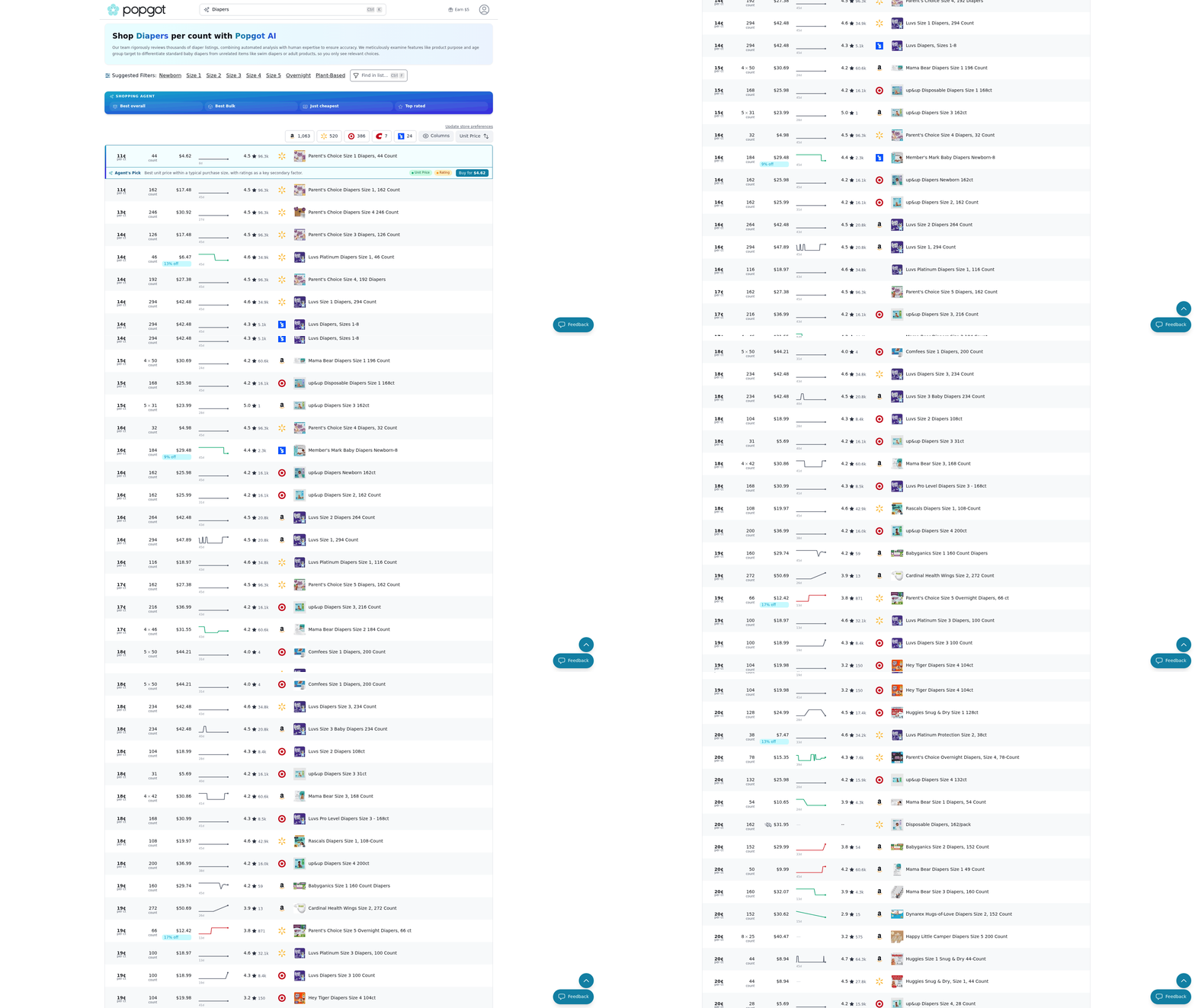
Which Small-Size Diapers Win on Price Per Diaper?
Store brands win on raw per-diaper cost in small sizes. National brands win on tested performance. The trick is finding the line that gives you both at a price you'll accept.
The value winner is a diaper with a low per-diaper cost and enough positive reviews to trust the leak protection.
Run the small sizes through a price comparison and the pattern holds across newborn, Size 1, and Size 2. Parent's Choice and Up & Up land at the bottom of the per-diaper range. Luvs sits in the middle as a budget national brand. Pampers Swaddlers and Huggies Little Snugglers anchor the premium tier.
If a Size 1 store-brand box runs around 11 cents per diaper and a comparable Pampers box runs 17, that 6-cent gap multiplies fast across the hundreds of changes a newborn needs each month.
When Does a Store Brand Beat a National Brand?
When its per-diaper price is lower and its review volume and ratings stay high enough to trust. Cheap means nothing if the diaper leaks at night.
Up & Up and Parent's Choice carry large review counts on their retailer pages, which matters as much as the star rating. A diaper with thousands of reviews and a steady score gives you a clearer read on real-world leak and fit than a niche line with a handful of ratings.
The same logic applies to access. Geographic retail patterns, documented in diaper access research, show that local store availability heavily dictates which budget brands families can actually reach.
Which Premium Features Push the Unit Cost Up?
Premium features raise the per-diaper cost without always improving the core job of holding liquid. Watch for these add-ons when you compare small-size boxes:
- Fragrance-free or sensitive materials: lines marketed for sensitive skin often cost more per diaper than the standard version.
- Wetness indicators: the color-change stripe is handy for newborns but adds to the unit price on premium lines.
- Plant-based or eco claims: these carry the highest premium and rarely show up in budget store brands.
Skip the premium features if your baby has no skin sensitivity and you change often enough that a wetness stripe is just convenience. For a closer look at how specific brands perform in testing, a detailed diaper comparison walks through how the lines stack up.
One last value factor: return policies. A retailer that lets you return an opened box if the fit fails protects you when you buy a bulk supply of a new brand. Factor that in, not just the sticker price.
Cheapest Diaper Sizes by Weight Range: Newborn, Size 1, and Size 2 Compared
Newborn diapers cost the most per diaper of any small size. The reason is structural: smaller pack counts and design features like umbilical cutouts push the unit price up right when your baby goes through the most. Size 1 and Size 2 usually deliver better per-diaper value because the boxes hold more and the design is simpler.
What Weight Ranges Define Newborn, Size 1, and Size 2?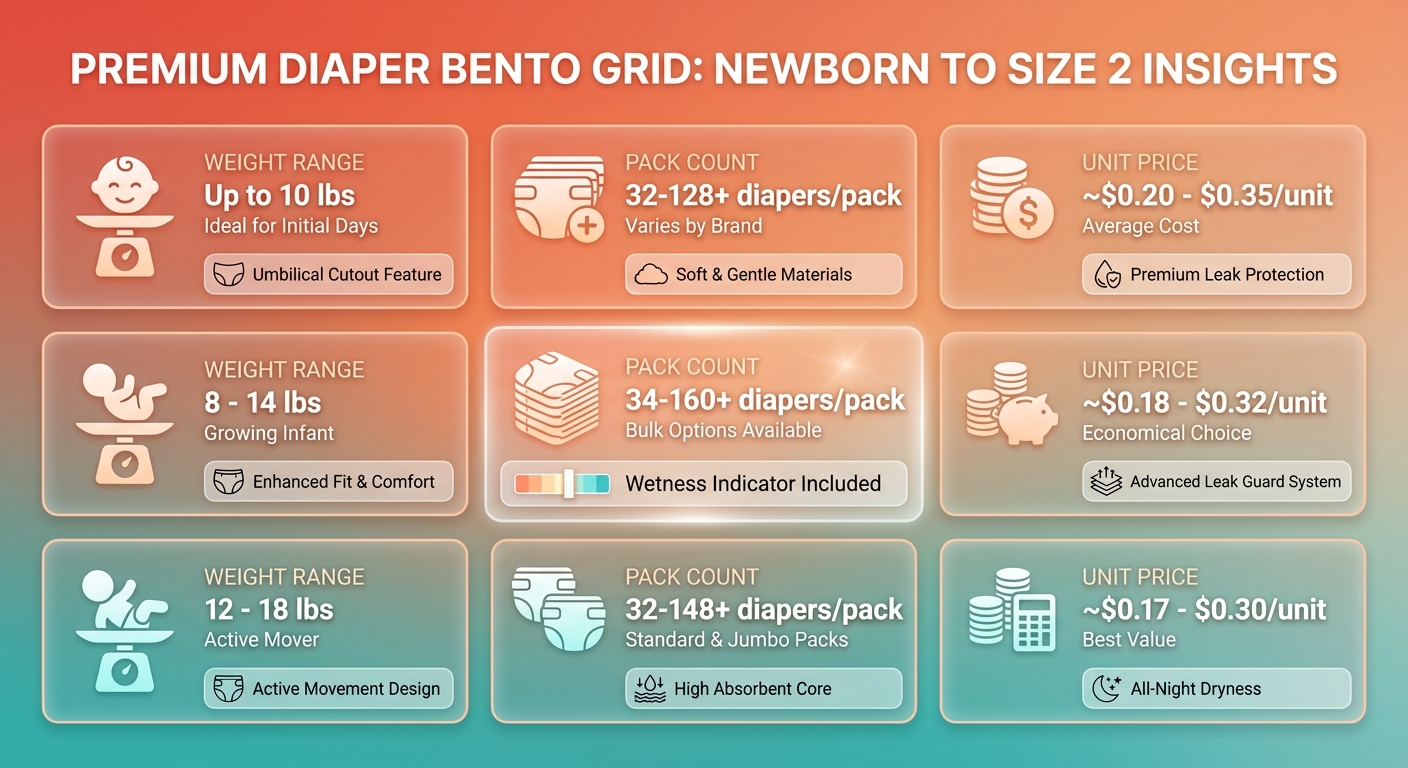
Each size maps to a manufacturer weight range, and those ranges overlap on purpose. Newborn generally covers babies up to about 10 pounds. Size 1 spans roughly 8 to 14 pounds. Size 2 covers about 12 to 18 pounds. The overlap means two babies at the same weight can sit in different sizes depending on body shape.
That's because weight isn't the only factor. A long, lean baby and a shorter, rounder baby can both weigh 12 pounds and need different sizes for a proper fit. You can check matched weight ranges and prices side by side with a real-time price index that lines up brands and counts so you're comparing the same thing.
The American Academy of Pediatrics ties infant sizing to steady early weight gain, with most babies adding several ounces a week in the first months. That fast progression is exactly why the newborn window is short and why over-buying that size wastes money.
Why Is the Newborn Stage So Expensive?
Newborn boxes carry fewer diapers and cost more per unit than Size 1 or Size 2. You burn through them in weeks, then your baby moves up. Buying a giant premium newborn supply almost guarantees waste. Moving a baby who has crossed 9 pounds from a premium newborn pack to a bulk Size 1 box can drop your cost per change right away.
Store brands stretch the budget here. Plenty of parents run up&up disposable diapers alongside national lines because store brands undercut premium prices in early sizes. The same price variance turns up in diaper access studies, which show how purchasing power tracks directly with retail options.
How Does the Wrong Size Make a Cheap Diaper Expensive?
A poorly fitting diaper costs more even when its sticker price is low. Bad fit means leaks, blowouts, and extra changes, which burns through the box faster and erases any per-diaper savings.
Watch for these warning signs of a poor fit:
- Red marks around the waist or thighs after a change
- Gaps at the legs where leaks escape
- Frequent blowouts up the back
- Leaks that soak clothing between normal changes
Don't size up just to grab a cheaper unit price. A loose diaper on a small baby leaks more, so you change more often and spend more overall. Two babies in the same weight range can need different sizes based on body shape and how much they wet, so fit beats the spreadsheet. The cheapest diaper is the one that fits and holds, not the one with the lowest number on the box.
References
[1] The Big Diaper Comparison | Karing for Postpartum - https://www.karingforpostpartum.com/blog/the-big-diaper-comparison
[2] DiaperPricer: Diaper Price Comparison | Home - https://www.diaperpricer.com/
[3] Compare Baby Diaper Prices - Pampers, Huggies - Target - https://www.target.com/s/compare+baby+diaper+prices
[4] The 4 Best Diapers of 2026 | Reviews by Wirecutter - https://www.nytimes.com/wirecutter/reviews/best-diapers/
[5] Priority Areas for Child Diaper Access: Low-Income Neighborhoods ... - https://www.researchgate.net/publication/363942235_Priority_Areas_for_Child_Diaper_Access_Low-Income_Neighborhoods_with_Limited_Retail_Access_to_the_Basic_Need_of_Diapers
Frequently Asked Questions
1. How do I avoid getting stuck with diapers my baby outgrows?
Buy newborn and early sizes in smaller packs, since babies pass through them in weeks. Reserve bulk boxes for Size 2 and up, which babies wear for longer stretches. Keep receipts and check retailer return windows, and trade unopened boxes through local parent groups if your baby jumps a size early.
2. Do cloth diapers actually cost less than disposables over time?
Cloth diapers carry a higher upfront cost, often several hundred dollars for a full set, but can save money across two years if you reuse them for multiple children. Factor in water, detergent, and your time. For single-child families chasing convenience, bulk store-brand disposables at verified unit prices often remain the simpler budget choice.
3. Can I return an opened box of diapers if the fit doesn't work?
Many major retailers accept opened diaper boxes when the fit or absorbency fails, though policies vary by store and require a receipt. Check the return window before buying a bulk supply of an untested brand. A flexible return policy lowers your real risk and should factor into the deal alongside per-diaper price.
4. How do I know when to move my baby up a diaper size?
Size up when you see red marks at the waist or thighs, frequent leaks or blowouts, or when the diaper no longer fastens comfortably. Weight ranges overlap by design, so fit signs matter more than the number on the box. Sizing up early often reduces leaks even before your baby hits the listed weight.
5. Do cheaper store-brand diapers cause more diaper rash?
Diaper rash usually stems from infrequent changes and trapped moisture rather than the brand itself. Store brands like Up & Up and Parent's Choice perform comparably for most babies. If your child has sensitive skin, choose a fragrance-free line and change often. Match the size correctly, since poor fit traps wetness regardless of price.
6. Should I pause my diaper subscription before a growth spurt?
Pause or adjust your subscription when your baby nears the top of the current size's weight range, typically the upper few pounds. This prevents a bulk delivery arriving just as your baby outgrows it. Most programs let you skip or resize shipments freely, so review your delivery date against recent weight gains each month.
7. Why do diaper prices keep climbing as my baby grows?
Larger sizes pack fewer diapers per box while the sticker price stays similar, pushing unit cost higher with each size up. As the physical size of the diaper increases, manufacturers package fewer units per box to maintain a consistent retail price point. Always recheck cost per diaper after every size transition.