
Why Price Per Softgel Lies: Calculate Cost Per Gram of EPA

Key Takeaways
- Price per softgel tells you the cost of swallowing a pill, not the amount of active EPA you actually get.
- Cost per gram of EPA (bottle price divided by total EPA grams) is the number that shows what the active ingredient really costs.
- Fish oil comes in regular, double, and triple strength, delivering 300, 600, and 900 mg of EPA plus DHA per serving.
- A cheap regular-strength softgel can cost more per gram of EPA than a pricier triple-strength one.
- Krill oil often costs a premium yet delivers far less EPA per softgel than concentrated fish oil. Bad per-gram deal.
- In one analysis of 47 supplements, only 21% contained at least 100% of their labeled EPA. Actual amounts ran from 66% to 184% of the claim.
- Because label shortfalls are so common, your cost-per-gram math usually understates what you actually pay for EPA.
The pricing trap on the shelf
Price per softgel is the wrong number to trust. It tells you what you pay to swallow a pill, not what you pay for the EPA inside. Two softgels can cost the same and carry wildly different amounts of active omega-3.
That gap is why a price per unit calculator matters here. Change "unit" from a single capsule to a gram of EPA, and the cheap-looking bottle often turns out to be the expensive one.
Why price per softgel lies to you
Start with the definition, because it's the whole game. Cost per gram of EPA is the real price of the active ingredient: bottle cost divided by total EPA grams delivered.
A low price per softgel usually hides low EPA content. Fish oil comes in regular, double, and triple strength, delivering 300, 600, and 900 mg of EPA and DHA per serving, according to published fish oil cost estimates. So a cheaper regular-strength softgel can cost more per gram than a pricier triple-strength one.
Krill oil is the clearest trap. Premium price, far less EPA per softgel than concentrated fish oil. Pay per softgel and krill looks reasonable. Pay per gram of EPA and it's one of the worst deals on the shelf.
Does the label even reflect what's inside?
Often, no. This is where the math gets slippery. Shortfalls are widespread, so your calculation may understate the true cost.
One analysis of 47 commercial supplements found only 21% contained at least 100% of the stated EPA, with actual amounts running from 66% to 184% of the claim, per this label comparison study. Nearly 80% fell short.
A later test of 48 top-selling products found 48% contained less EPA + DHA than declared, yet stayed within legal limits, according to this compliance study. The numbers differ because the second study tested best-sellers, which run somewhat cleaner.
So best-selling brands are better. They still fail about half the time. Base your math on the label, and the real cost per gram of delivered EPA can run much higher than what you calculated.
At a Glance: Cost Per Gram Comparison
| Product type | EPA + DHA per softgel | Relative price per softgel | Relative cost per gram of EPA |
|---|---|---|---|
| Regular fish oil | 300 mg | Low | High |
| Double strength | 600 mg | Medium | Medium |
| Triple strength | 900 mg | Higher | Lowest |
| Krill oil | Low | Premium | Highest |
Illustrative example based on strength tiers from fish oil cost data.
What to actually do with this
- Ignore price per softgel alone. It tracks pill count, not EPA.
- Read the EPA line, not "fish oil" or "omega-3." Those totals fold in DHA and filler oils.
- Discount the label. With up to 80% of products falling short, treat stated EPA as a ceiling, not a promise.
- Watch krill oil. Premium price plus low EPA is the double trap.
The math takes 10 to 15 minutes for one product: find total EPA per serving, multiply by servings per bottle, divide the price by that gram total. Do it once and you'll never trust a per-softgel price tag again. The Dietary Guidelines put the daily target at 250 mg of n-3 fatty acids, so your cost-per-gram figure tells you exactly what hitting that costs.
Calculating Cost Per Gram of EPA
Cost per gram of EPA is one number: bottle price divided by total EPA grams in the whole bottle. To get total EPA grams, multiply EPA per serving by the number of servings, then divide by 1,000 to convert milligrams to grams. Divide the price by that figure and you have your real cost.
That's the core of any price per unit calculator when the "unit" is active EPA, not a capsule. Run it once and cheap bottles often flip to expensive. A lower-potency option frequently carries a higher real cost once you price the active ingredient.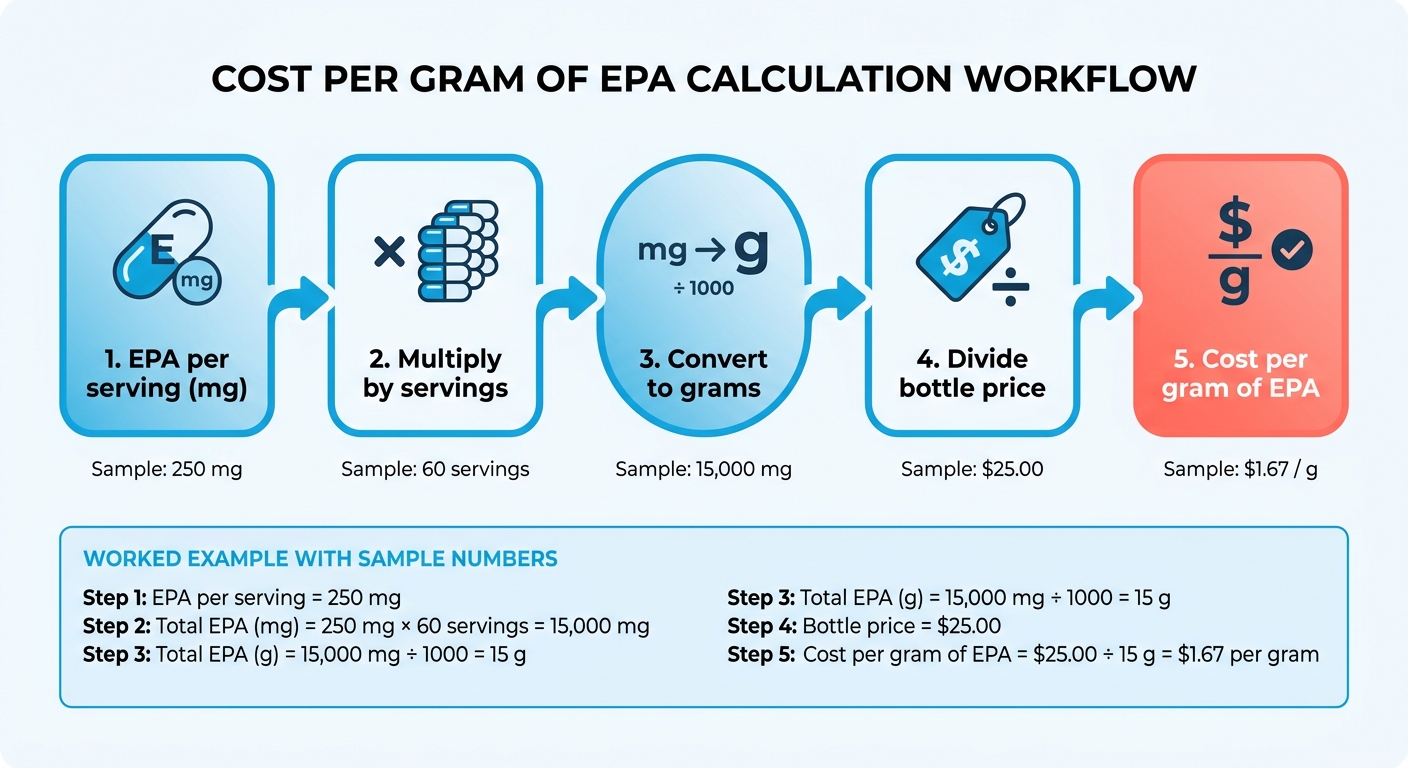
The step-by-step
Start with the label, but read it carefully. Supplement labels often list total omega-3s, which lumps in fatty acids that aren't EPA or DHA. You want the EPA line specifically.
- Find EPA per serving. Look for the EPA milligrams, not the "total omega-3" number. Watch the serving size here too. Some brands list their figures across two or three softgels, so a single capsule delivers a fraction of the big number printed up top.
- Multiply by total servings in the bottle to get total EPA milligrams.
- Divide by 1,000 to convert to grams.
- Divide bottle price by total EPA grams.
Do this for every product you're comparing. Two bottles at the same shelf price can land far apart once you see cost per gram side by side.
Why you should adjust for absorption and label shortfall
Your label-based number is optimistic. Testing repeatedly shows products deliver less EPA than they claim, so your real cost per gram runs higher than the sticker math suggests.
Quantity isn't the only variable. The chemical form changes how much EPA your body actually absorbs. Concentrated fish oils often use the ethyl ester form, which absorbs less efficiently than the triglyceride and re-esterified triglyceride forms in many premium products, per this bioavailability review. Two bottles with identical EPA milligrams on paper can leave different amounts in your bloodstream, which shifts the true cost per usable gram.
So pad your estimate. If a brand publishes third-party test results, use the tested EPA figure. If not, assume the delivered amount sits below the label and treat your calculated cost as a floor, not the truth.
Form matters for concentration too. Products built on lower-strength oils force you to swallow more softgels for the same dose, and that per-softgel price hides the real cost per gram. Another example of why the softgel number lies.
Where online tools save you time
The math is simple but tedious across five retailers and three strengths. This is where Popgot helps: tell our AI agent your EPA+DHA minimum, and it reads every label to verify each product meets your spec, then pulls the real unit price per serving so you can sort by what you actually pay.
Skip the manual spreadsheet only when a product publishes verified third-party EPA testing. Then trust the tested number and run your division once. Everywhere else, adjust down and compare.
Why the sticker price lies about value
Here's the number that should change how you shop: the price on the shelf rarely matches the price your body pays. Label claims and delivered content drift apart often enough that a sticker price tells you almost nothing about real value. Shortfalls aren't a scandal. They're legal.
That's why a cost-per-gram calculation built on label numbers only gets you partway. Automated tools can scan product specs and check declared active ingredients against your target dose. You start from the printed number with confidence, then adjust for the category's known shortfall risk.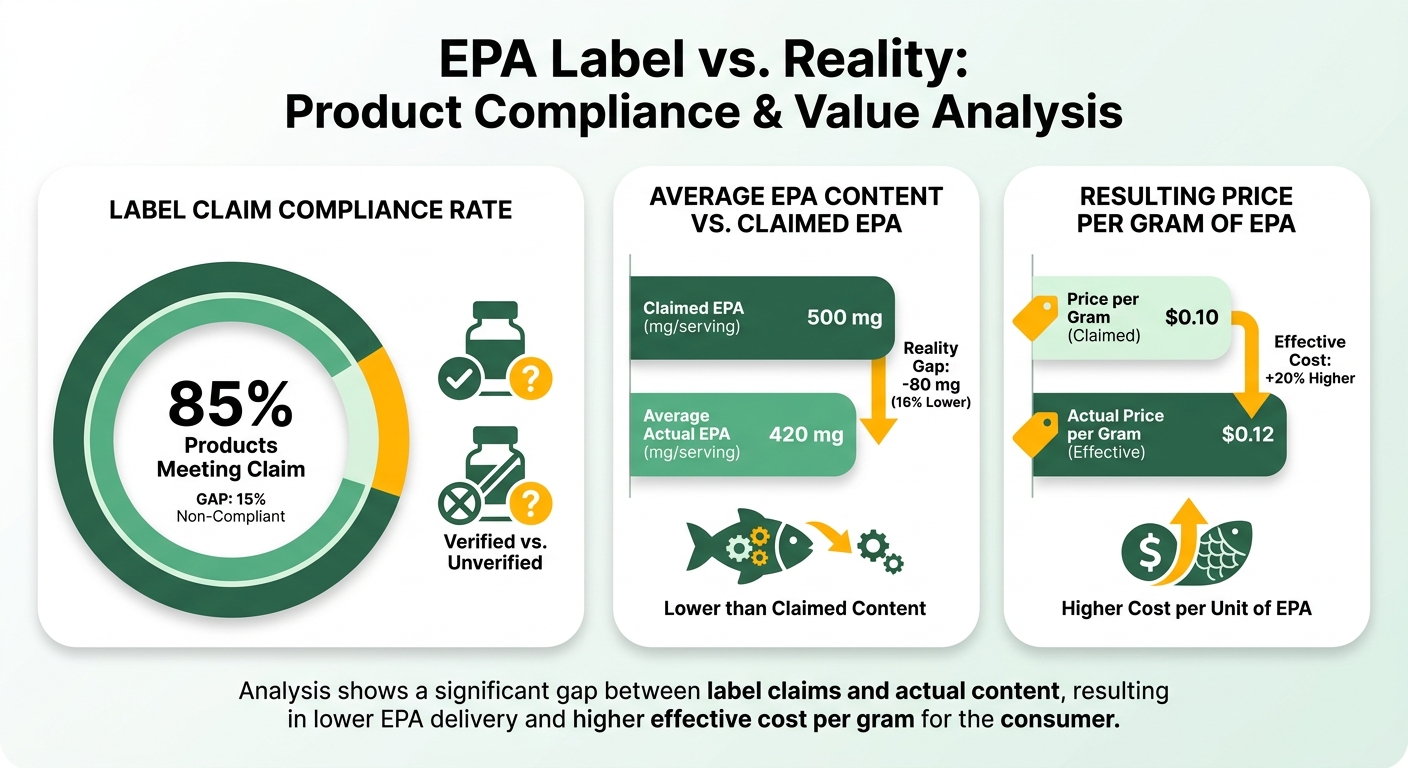
How bad is the shortfall problem?
It depends on which products you're testing. Oxidation makes it worse. Fish oil degrades over time, and rancid product loses potency before you ever open it. Studies measuring peroxide and anisidine values have flagged a large share of retail bottles as exceeding freshness thresholds, which means the active content was already breaking down on the shelf. Storage, transport heat, and time from manufacture all chip away at what you get.
One of the study authors put the oversight problem plainly:
"The quality of fish oil supplements is not being adequately monitored by manufacturers or government agencies."
That means the burden lands on you to verify. Shoppers already feel this. Ingredient transparency ranks among the top things health-conscious buyers say they want, and active content is exactly the kind of hidden number that transparency is supposed to fix.
Who saves the most here?
Anyone chasing a specific therapeutic target, because small discrepancies compound. If you need a high daily dose for cardiovascular or joint support, a bottle that under-delivers means you burn through your supply much faster than planned.
Parents dosing kids and shoppers managing a specific health need feel this hardest. You picked a product for a reason. A label shortfall quietly undermines the reason and the budget at the same time.
Practical approach: calculate cost per gram from the label, then apply a conservative discount for potential shortfalls. If a product's category tends to under-deliver, treat the calculated cost as a floor, not the real price. The bottle that looks cheapest per softgel is often the one carrying the biggest gap between what it promises and what lands in your body.
Skip the guesswork for products where third-party testing already confirms the label. When actual content matches the claim, your calculation holds and you can trust the printed number.
Understanding EPA Content per Softgel
EPA content per softgel is the number that actually decides your cost per gram. Two softgels can both list "1000 mg fish oil" and deliver completely different amounts of EPA. So before you plug anything into a calculation, you need to know what's really inside the capsule.
The catch: label and reality often don't match. Independent testing routinely finds gaps between what a bottle claims and what it delivers, which means any per-unit price you calculate from a label is a starting point, not a verdict. Treat the printed EPA figure as a claim to be verified.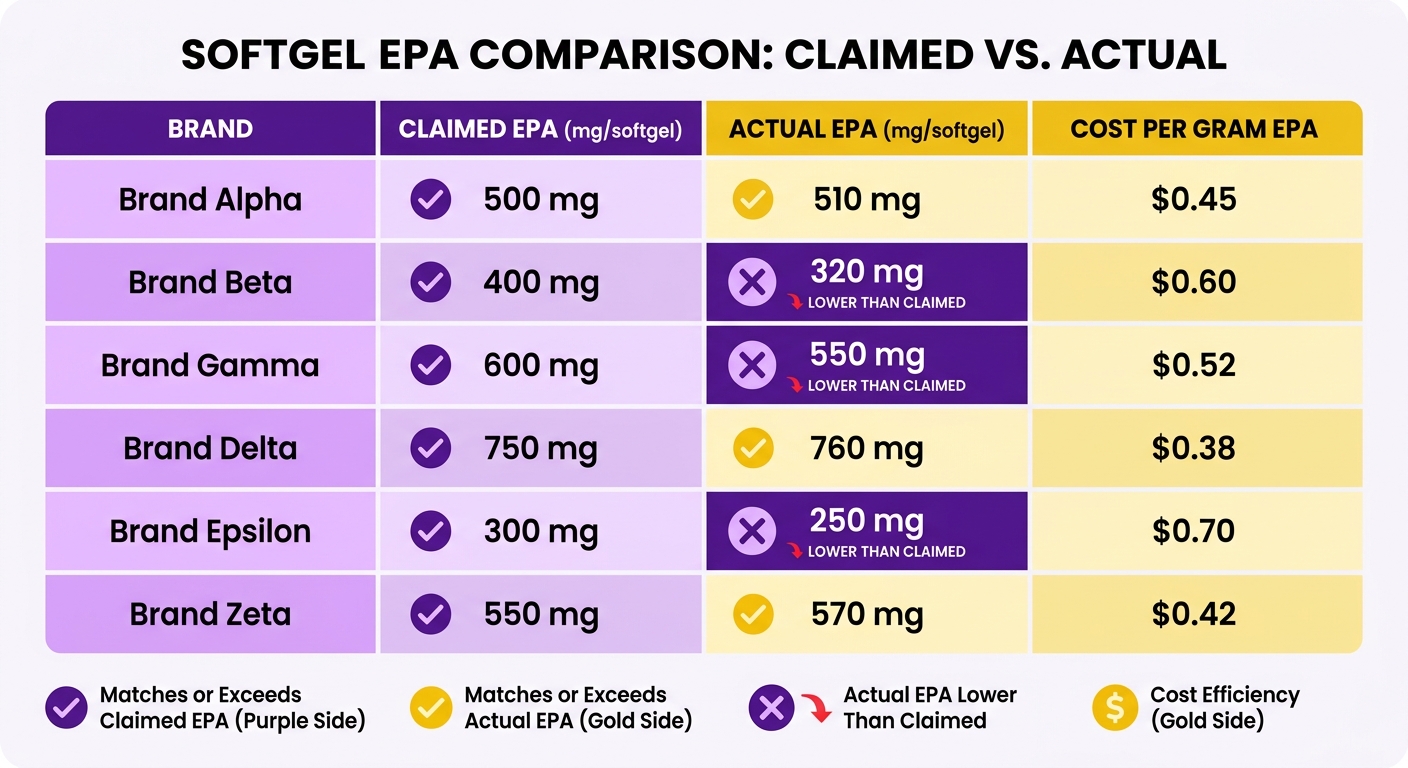
Why formulation changes EPA per softgel
Formulation is the chemical form of the omega-3 oil, which determines how much EPA fits in a capsule and how much your body absorbs. The common forms are triglycerides, ethyl esters, and phospholipids.
These forms aren't interchangeable. A label-compliance study tested products across all three types, and the spread in measured EPA per gram of oil was wide: 81.8 to 454.6 mg/g across the fish and krill products tested. That's more than a fivefold difference in concentration, so a capsule packed with a low-concentration oil forces you to swallow several softgels to hit the same dose one high-concentration capsule delivers.
Concentration is where the real cost hides. A re-esterified triglyceride concentrate might carry 500 to 700 mg of EPA in a single softgel, while a natural-form oil often sits closer to 150 mg. Same "1000 mg" front-of-label claim, wildly different denominators once you run the cost-per-gram math.
How to read EPA content on the label
Find the serving size first, then the EPA line specifically, then multiply by servings per bottle. Never trust the "total omega-3s" number, which lumps in fatty acids that aren't EPA or DHA.
A serving delivering 1000 mg of EPA at 60 servings gives you 60 grams of EPA in the bottle. That's your denominator. Just remember that verified content frequently comes in under the printed claim, so your calculated cost per gram is often the floor, not the true figure.
Check whether the EPA number reflects one softgel or the full serving, since many bottles quote a two- or three-capsule serving. Miss that and you can overstate the EPA in a single pill by double or triple, which quietly wrecks your comparison before you've even left the label.
Let the EPA spec do the filtering
To cut the work, filter products by your target EPA threshold. Modern search tools can scan listings, drop anything below your target, and isolate the exact serving metrics you need. Shop this way and the cheap-looking bottle and the genuinely cheap bottle finally stop being the same thing.
What I'd actually do at the shelf
Here's the whole method in one line: find the EPA per serving, multiply by servings, convert to grams, then divide the bottle price by that number. That single figure beats every sticker price and every per-softgel number on the shelf.
Treat any label claim as a starting point, not the final word. The math sorts the field fast. But the numbers feeding it are only as honest as the manufacturer, and about half of tested products come up short on their EPA claims. So the calculation narrows your choices; verification confirms them.
How much does running the numbers save?
Shopping by cost per gram of EPA instead of shelf price can cut your spend by roughly a fifth. The savings come from spotting high-strength bottles that look expensive but deliver cheaper active omega-3.
Here's why the gap is so wide. Regular-strength fish oil forces you to swallow more capsules for the same EPA, so you burn through the bottle faster. A triple-strength option costs more upfront but stretches further. Per gram, it often wins outright.
Run the numbers once and the pattern jumps out. The cheap bottle you almost grabbed frequently turns out to be the pricey one per gram of EPA.
Your three-step buying checklist
Three moves handle almost every EPA purchase you'll make:
- Read the EPA line, not the fish oil total. A "1200 mg fish oil" label tells you nothing about active EPA. Find the specific EPA figure.
- Convert to cost per gram. Bottle price divided by total EPA grams. It's the only number that compares products fairly.
- Check the claim against reality. Since label shortfalls are common and legal, trust verified content over the printed number when you can get it.
Saving money here isn't about chasing coupons. It's about reading one number correctly and ignoring the ones designed to mislead you.
Do this consistently and you stop overpaying for weak bottles dressed up in big-milligram marketing. Your body gets the EPA it needs, and your wallet keeps the difference.
Case Study: Comparing Popular Softgel Brands
Run three popular softgels through the same math and the shelf price stops meaning anything. What decides value is cost per gram of EPA, not what the bottle rings up at. That figure reorders the field every time we sit down and check.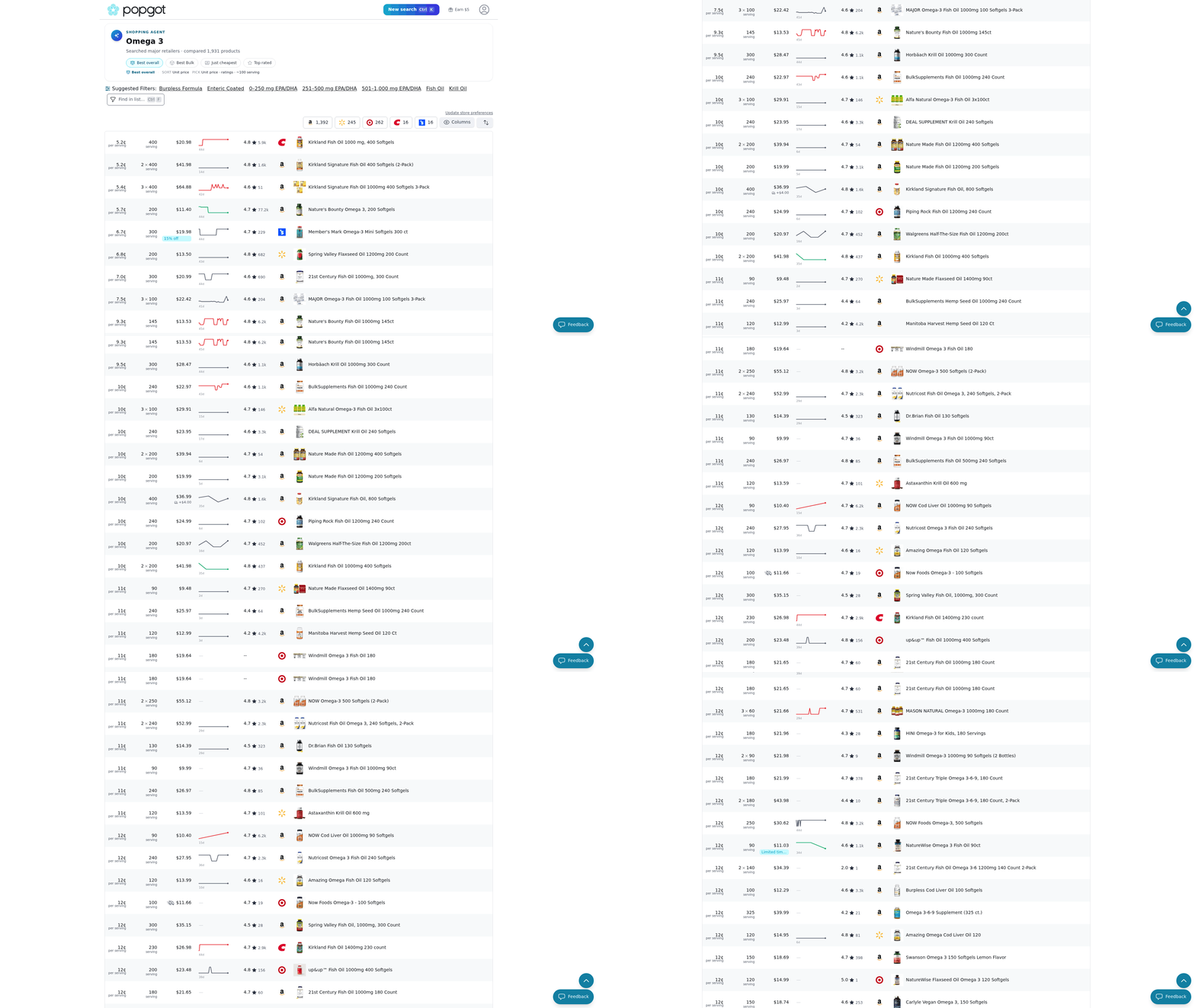
Below is how a side-by-side price per unit comparison plays out once you plug in real EPA content instead of capsule count. Treat these as worked examples for the method, not fixed retail prices. Prices move; the calculation doesn't.
Three brands, head to head
A high-concentration softgel can land near $1.25 per gram of EPA, while a standard-strength product runs closer to $1.50 per gram for the same delivered EPA. Take three shelf staples. A concentrated softgel packs more EPA per capsule, so even at a higher sticker price it wins on cost per gram. A standard-strength omega-3 looks cheaper per bottle but delivers less active EPA, pushing its real cost up. A mainstream fitness-brand fish oil often sits in the middle: decent price, modest EPA load.
The lesson repeats across every comparison we run. The bottle that looks expensive on the shelf is frequently the cheapest per gram of EPA. Strength beats sticker price almost every time.
Why krill oil breaks the comparison
Krill oil carries a low EPA payload per capsule while sitting at a premium price, so the two forces compound against you.
Run a concrete case. If a krill softgel delivers roughly 75 mg of EPA and sells for the same per-capsule price as a fish oil softgel carrying 300 mg, the cost per gram jumps roughly fourfold. You're paying more per softgel for a capsule that carries a fraction of the active omega-3. That's the cleanest demonstration of why price per softgel misleads you.
Unless you specifically need the phospholipid form, krill rarely wins on value. The premium buys you marketing, not milligrams of EPA. Run the math before you assume the "advanced" option is worth it.
What these numbers miss
These calculations assume the oil stays perfectly stable. Shipping and storage can compromise the product before it reaches your shelf. When active ingredients degrade, the actual amount of functional EPA you consume drops, so the real cost per active gram runs higher than the pristine label suggests.
That gap matters most for brands sitting close together. If two softgels are within a few cents per gram on paper, the one with the more honest label and fresher oil is the real winner. Batch freshness and verified potency both push your true cost above the tidy figure you calculated. The math sorts the field fast. Only verified EPA content settles which brand actually earns your money.
References
[1] How much EPA and DHA is in your omega-3 supplement? - https://www.grassrootshealth.net/blog/much-epa-dha-omega-3-supplement/
[2] The amount of EPA and DHA consumed and cost estimate ... - https://www.researchgate.net/figure/The-amount-of-EPA-and-DHA-consumed-and-cost-estimate-from-fish-oil-supplements-1_tbl2_221779181
[3] Ingredient label claim compliance and oxidative quality of ... - https://www.researchgate.net/publication/338859557_Ingredient_label_claim_compliance_and_oxidative_quality_of_EPADHA_omega-3_retail_products_in_the_US
[4] A Comparison Of Actual Versus Stated Label Amounts ... - https://www.researchgate.net/publication/263814046_A_Comparison_Of_Actual_Versus_Stated_Label_Amounts_Of_Epa_And_Dha_In_Commercial_Omega-3_Dietary_Supplements_In_The_United_States
Frequently Asked Questions
1. How much EPA should I take daily for general health versus a therapeutic dose?
For general wellness, standard nutritional guidelines suggest a modest daily intake of omega-3 fatty acids. However, therapeutic protocols often require substantially higher amounts of combined EPA and DHA. When aiming for these larger targets, calculating the cost per gram becomes essential, as even minor label discrepancies can significantly increase your long-term supplement expenses.
2. Is krill oil ever worth the premium price?
Krill oil is primarily valued for its phospholipid form, which some users prefer for digestive comfort or absorption. However, because krill naturally contains a much lower concentration of EPA per capsule compared to standard fish oil, it rarely makes sense from a pure cost-per-gram perspective. If your primary goal is maximizing EPA intake affordably, concentrated fish oil is the more economical choice.
3. How can I tell if my fish oil has gone rancid?
Fresh fish oil should have a very mild aroma and taste. If a bottle has a strong, sour, or intensely fishy odor, or if the softgels leave an unpleasant aftertaste, the oil has likely oxidized. This degradation not only affects taste but also reduces the biological activity of the EPA, meaning you get less active benefit than the label promises.
4. Does the chemical form of fish oil affect how much EPA I absorb?
Yes, bioavailability varies by chemical structure. Standard concentrates often use processed ester structures, whereas premium options typically feature natural or reconstituted lipid structures that the human body absorbs more readily. Consequently, a slightly more expensive, highly bioavailable product can sometimes deliver better value than a cheaper, poorly absorbed alternative.
5. Why do supplement labels list "total omega-3s" instead of just EPA?
Grouping all fatty acids under a single "total omega-3" heading allows manufacturers to display a much larger number on the front of the bottle. This total includes other compounds like DHA and minor fatty acids. To find the true value of your purchase, you must look past this combined figure and locate the exact milligrams of EPA listed in the supplement facts.
6. How do I verify a supplement actually contains what its label claims?
The most reliable method is to look for independent, third-party testing certifications from organizations like USP, NSF, or Labdoor. These groups verify that the active ingredients match the label claims and check for heavy metals or oxidation. Utilizing search tools that filter products based on verified specifications can also help you avoid low-quality options.
7. Does a two-capsule serving size change my cost calculation?
Absolutely. If a label lists a high EPA content but bases that number on a multi-capsule serving, each individual softgel contains only a fraction of that amount. Failing to account for this will cause you to overestimate the potency of each pill, leading to inaccurate cost-per-gram comparisons.