
Buying Tide? Popgot Surfaces Cheaper Detergents That Actually Clean

Key Takeaways
- Unit price is the real cost of your detergent: total price divided by the number of loads (or ounces).
- A generic at $11 for 64 loads runs 17 cents a load. A $20 Tide jug for the same 64 loads runs 31 cents.
- Wash five loads a week and switching from name brand to generic saves roughly $37 a year.
- Concentrated bottles can beat bigger jugs on cost per load even when they look pricier on the shelf.
- Brands sometimes shrink the recommended dose to pump up their advertised load count. The printed numbers lie.
- Compare on the same unit. Some jugs list loads, others list ounces, and mixing them wrecks the math.
- Generics clean well and cost less. For most households, they're a genuinely good swap.
The math that actually matters: cost per load
Unit price is the true cost of your detergent, not the number stamped on the jug. Divide the total price by the number of loads or ounces and you've got it. A $20 jug that washes 64 loads costs about 31 cents per load. A generic bottle at $11 for the same 64 loads drops to 17 cents per load.
That gap adds up fast. Five loads a week is roughly 260 loads a year. At 31 cents versus 17 cents, that's about $81 versus $44 annually. You keep close to $37 a year just by switching brands.
How to calculate detergent unit price
Unit price is the cost per load or per ounce: total price divided by the count of loads or fluid ounces.
Always compare on the same unit. Some jugs list loads, others list ounces, and concentrated formulas skew the math. A smaller concentrated bottle can beat a giant one on cost per load even when it looks pricier on the shelf.
And watch the load count printed on the cap. Brands sometimes shrink the recommended dose to inflate the number of "loads" they advertise. Divide by the realistic dose you actually use, not the optimistic one on the label.
If you'd rather not do arithmetic in the detergent aisle, a comparison tool pulls the numbers side by side. Popgot's unit-price shopping insights walk through how that works.
Are generics actually worth it?
Yes. And shoppers already know it. Research on private-label brands in the U.S. found that store brands have climbed in both quality and price, closing the gap with name brands while still costing less per unit.
That matters because value isn't only about the lowest number. It's price paired with performance. A generic that cleans nearly as well for half the cost per load wins even if it trails slightly on a stain test.
For a small bed-and-breakfast washing sheets and towels daily, those pennies multiply fast. Shave 14 cents off every load and you're looking at roughly $100 a year from one brand swap. The linens still come out crisp. The overhead just drops.
Cleaning power vs. price tag
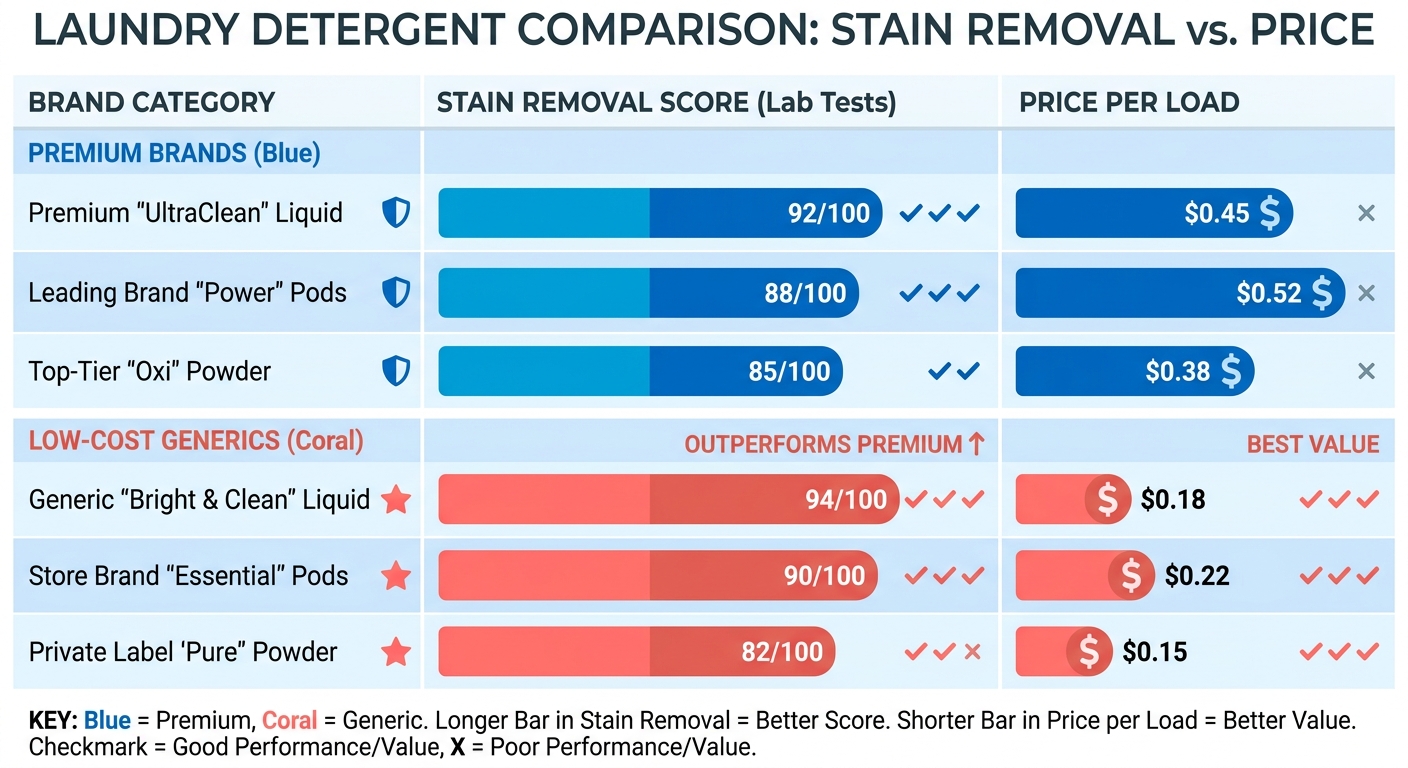
Price and cleaning power don't always move together. Independent lab testing shows the best liquid detergents remove common stains well, while some products barely clean at all. The part that matters for your wallet: that gap doesn't line up neatly with brand name or price tag. Plenty of low-cost generics land in the strong-performer group, and a few premium jugs underdeliver.
So a cheaper bottle isn't a downgrade by default. It comes down to the formula, not the label.
Do generics remove stains as well as Tide?
Many do. Stain removal comes down to the enzyme and surfactant blend inside the bottle, not the marketing on the front. A generic built with protease and amylase enzymes handles protein and starch stains. Grass, blood, chocolate, cooking oil, they respond to chemistry, not price.
Where generics fall short is consistency. Some skimp on active ingredients to hit a low price, and those wash out weak. The fix is simple: check the ingredient list for enzymes, read the load count, and compare on a per-load basis with a tool like Popgot.
What about whitening and pH?
Whitening depends on optical brighteners, plus oxygen-based bleaching agents in some formulas. Many store brands include the same brighteners that keep whites looking bright wash after wash. If your whites go dingy, the culprit is usually a formula without brighteners, not a generic label.
Most laundry detergents run mildly alkaline, which helps lift oily and greasy soils. A higher alkaline pH boosts grease-cutting on cottons and work clothes. For delicates and wool, a gentler near-neutral formula protects fibers better. Match the pH to the load and a generic handles both jobs.
Run the same mix of gym clothes and kids' shirts through a well-formulated generic and the results hold. Clothes come out clean, whites stay bright, and you keep the difference.
Where the cheap generics actually are
Generics cost less because you're not paying for national advertising, celebrity endorsements, or premium packaging. The formula inside can match a name brand load for load.
Store-brand liquids often share the same core building blocks as pricier jugs: surfactants to lift dirt, enzymes to break down stains, brighteners to keep whites fresh. When a generic carries that same active mix, you're buying identical cleaning chemistry with a cheaper label.
Part of why this works: many major retailers contract with the same large-scale chemical plants that produce national brands, adjusting only minor fragrance or dye concentrations for the store-brand run. You're often getting professional-grade formulation without the marketing tax.
Finding the best generic deals
Prices swing hard between retailers. The same generic jug can cost noticeably more at one store than another, and the cheapest seller changes week to week. Warehouse clubs, discount chains, and store-brand lines from major grocers all compete on laundry. Checking across sellers before you buy is how you catch the real low.
That's where a quick price comparison pays off. Instead of assuming your usual store has the best deal, compare unit prices across retailers and spot which generic actually wins on cost per load.
Do generics hold up in tough loads?
Yes, because the chemistry of soil removal doesn't change across price tiers. For heavy-duty jobs like motor grease, clay, or ground-in grass, look for generics built with water-softening builders like sodium citrate. These soften hard water so the surfactants can get deeper into the fabric.
Match the detergent's chemistry to your soil type instead of trusting brand prestige. A home mechanic fighting stubborn grease can grab a generic rich in lipid-targeting agents and get a clean wash without paying a premium.
What makes a detergent worth buying
A detergent earns its spot when cleaning power, cost per load, and ingredient list all hold up together. No single factor decides it. A jug can be cheap and still leave stains, or clean well and drain your budget. Weigh all four at once: what's inside, what it costs, how it performs, and what it does to the water it leaves behind.
Read the label before the price
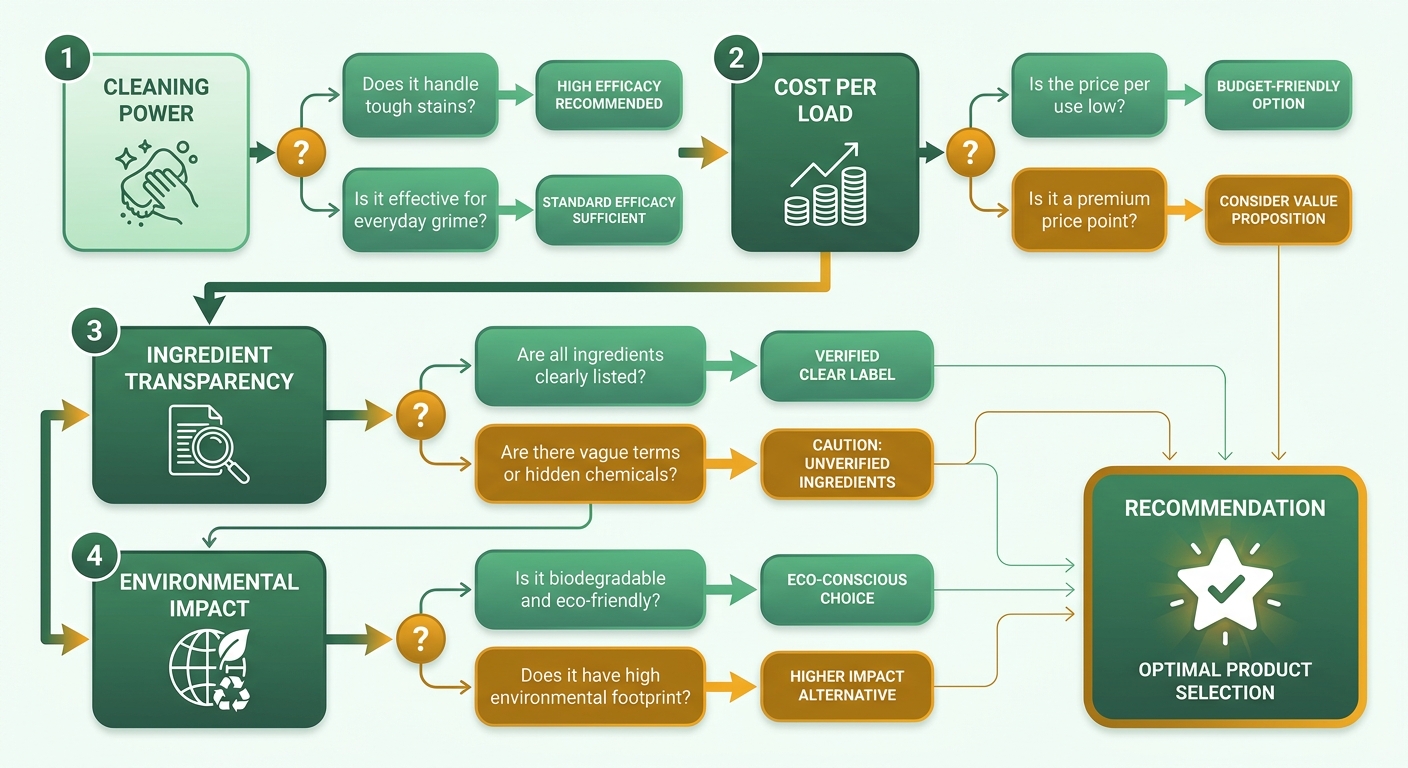
Check the active ingredients before the price. Look for a surfactant-and-enzyme base, a low or listed fragrance load, and clear dosing directions per load. Those tell you far more than the front-of-jug marketing.
Environmental impact belongs on this list too. Phosphate-heavy formulas and heavy dye content wash straight into wastewater. Many private-label jugs now skip dyes and cut fragrance, which trims both your skin exposure and what ends up in the drain. Part of a broader shift: as the private-label value research shows, modern shoppers weigh chemical transparency and functional performance over plain brand loyalty. That analytical mindset is what lets you find effective, eco-friendly options without the premium.
Tide vs. generics at a glance
Generics win on price while landing in the same performance tier on stain removal. Independent lab evaluations confirm that top liquids remove common stains with real consistency, which makes price a poor predictor of soil-lifting power. Look at the concentration of active cleaning agents instead of the name.
Here's a rough snapshot of how a name brand stacks up against store-brand alternatives on the factors that matter:
| Detergent | Cost per load (example) | Cleaning tier | Dye-free option |
|---|---|---|---|
| Tide (name brand) | ~31¢ | Strong | Yes |
| Store-brand liquid A | ~17¢ | Strong | Yes |
| Store-brand liquid B | ~15¢ | Strong | Yes |
| Warehouse-club pods | ~19¢ | Strong | No |
| Discount-chain liquid | ~13¢ | Mid | Yes |
| Private-label free & clear | ~18¢ | Strong | Yes |
Figures are illustrative. Actual prices swing by retailer and region, so verify before you buy.
How hard is it to switch?
Easy. You're swapping one liquid for another, not changing your machine or your routine. Most people notice no drop in clean clothes.
Finding the cheaper option takes a little more effort. Budget 10 to 15 minutes the first time to compare cost per load across a few retailers and confirm the ingredient base matches what you use now. After that, reordering the same jug takes seconds.
Price-comparison tools cut the research further by pulling unit prices side by side. Once you've found a strong generic at a lower cost per load, the only ongoing task is a quick label glance to confirm the formula hasn't changed. That's the whole switch.
How Popgot verifies a cheaper pick is actually better
Popgot checks products the way you would if you had time to read every label and every price tag at once. Its AI scans listings, pulls the real cost per unit, and flags when a cheaper option cleans or performs the same as the name brand. You get the math done without squinting at fine print in the aisle.
The goal is simple: show you which detergent actually saves money per load, not which one just looks cheap on the shelf.
How the verification works
Popgot pulls listings from across retailers and standardizes them onto the same unit so you're comparing apples to apples. It reads the pack size, the load count, and the live price, then ranks options by true cost. A jug that looks pricey up front can win once the per-load number lands.
This matters because retailers price the same generic differently, and package sizes rarely line up. The AI does the conversion instantly, so you skip the spreadsheet and see the real winner in seconds.
- Cross-retailer scanning: One search surfaces the same detergent across multiple stores, so you catch the lowest live price.
- Unit normalization: Every option gets converted to cost per load, cutting through concentrated-formula tricks.
- Match flagging: When a store brand carries the same active ingredients as a premium jug, Popgot surfaces it as a swap.
What you actually save
Time and money at once. Instead of price-checking four stores by hand, one search returns ranked results, pulled from live listings rather than stale guesses. A first-time renter standing in the laundry aisle, facing three jug sizes at different concentrations and confusing price tags, gets those options normalized into a single cost-per-load number, often revealing that an overlooked store brand offers the best long-term value.
Want the deeper method behind the numbers? The Popgot blog breaks down unit-price shopping so you can spot value on any product, not just laundry.
Best generic picks by laundry type
Matching a generic to the job matters more than matching it to a brand name. Delicates, heavy work clothes, and low-impact loads each want a different formula. Here's how the generics sort out.
Best generic for delicate items
For delicates, reach for a free-and-clear generic with no dyes and a light or zero fragrance load. These formulas skip the optical brighteners and heavy surfactants that wear down fine fibers over repeated washes. Store-brand "sensitive skin" liquids fit this role well.
Look for a short ingredient list and a gentle, low-enzyme base. Silk, wool, and lace hold up better without aggressive protease enzymes chewing at protein fibers. A cool-water rinse plus a mild generic protects the garment and your wallet at once.
Best generic for heavy-duty laundry
For grease, sweat, and ground-in grime, pick a generic with a full enzyme blend and strong surfactants. Protease, amylase, and lipase together break down protein, starch, and oil stains. That combination is what separates a workwear-ready formula from a basic one.
At high enough concentrations, those enzymes break down complex organic soils mid-cycle and render them water-soluble. Plenty of budget store brands build their heavy-duty lines around this exact enzymatic trio. Check the active-ingredient panel and you get the stain-fighting power without the brand markup.
Any good eco-friendly generics?
Yes. Many private-label liquids now run plant-derived surfactants, skip phosphates, and cut dye content, which keeps wastewater cleaner without a premium. Lower environmental load and lower cost per load in the same jug.
Concentrated generics deserve a look here too. Less water in the bottle means less packaging and lighter shipping, and a smaller pour still cleans a full load.
For a shared household splitting the cost of communal supplies, covering everyone's laundry doesn't require a shelf full of expensive bottles. Pair a gentle free-and-clear liquid with a high-efficiency, enzyme-rich generic and you've got everything from delicate fabrics to heavily soiled sports gear covered. Two generics, low communal cost, clothes still clean.
FAQ
How do I calculate detergent unit price?
Divide the total price by the number of loads (or fluid ounces) on the label. A $20 jug rated for 64 loads is about 31 cents per load. Always compare detergents on the same unit, and divide by the realistic dose you actually pour, not the optimistic one the brand prints to inflate its load count.
Do generic detergents clean as well as Tide?
Many do. Stain removal comes down to the enzyme and surfactant blend inside the bottle, not the brand on the front. Independent lab testing puts plenty of low-cost generics in the same performance tier as premium jugs. Check the ingredient list for enzymes and you'll weed out the weak ones.
How much can I actually save switching to generic?
Washing five loads a week, roughly $37 a year on the per-load gap alone. Households doing daily laundry, like a small bed-and-breakfast, can push that closer to $100 by shaving 14 cents off every load.
What should I check on the label before buying?
A surfactant-and-enzyme base, the load count, dosing directions, and fragrance or dye content. For delicates, want a short, low-enzyme ingredient list. For heavy-duty loads, want the full protease-amylase-lipase enzyme trio.
Are concentrated detergents a better deal?
Often, yes. A smaller concentrated bottle can beat a bigger jug on cost per load even when it looks pricier on the shelf. Run the per-load math instead of trusting the sticker, and concentrated formulas also cut packaging and shipping weight.
References
[1] Best and Worst Laundry Detergents From Consumer Reports' Tests - https://www.consumerreports.org/appliances/laundry-detergents/best-and-worst-laundry-detergents-from-consumer-reports-tests-a9342715268/
[2] The effect of private label brands on U.S. shoppers - https://www.sciencedirect.com/science/article/abs/pii/S0969698912001282
References
[1] Best and Worst Laundry Detergents of 2026 - Consumer Reports - https://www.consumerreports.org/appliances/laundry-detergents/best-and-worst-laundry-detergents-from-consumer-reports-tests-a9342715268/
[2] The value of private label brands to U.S. consumers: An objective ... - https://www.sciencedirect.com/science/article/abs/pii/S0969698912001282
Frequently Asked Questions
1. Can I use generic detergent in a high-efficiency (HE) washing machine?
Look for the HE symbol on any generic detergent before using it in a high-efficiency machine. HE formulas produce less suds, which prevents residue buildup and protects the machine. Many store brands now offer HE-compatible liquids and pods that work identically to name-brand HE options at a lower per-load cost.
2. Does switching detergent brands affect people with sensitive skin or allergies?
Switching can help sensitive skin, since many free-and-clear generics skip dyes and fragrances that trigger irritation. Choose a store-brand liquid labeled hypoallergenic with a short ingredient list. If you have known allergies, patch-test one load first and check for optical brighteners, which occasionally cause reactions in sensitive individuals.
3. How should I store detergent to keep it effective between purchases?
Store detergent in a cool, dry place away from direct sunlight and temperature extremes. Heat can degrade enzymes over time, weakening stain-removal power. Keep caps sealed to prevent liquid thickening or drying out. Most liquid detergents stay effective for six months to one year after opening.
4. Do liquid, powder, or pod generics differ in cost and performance?
Pods offer convenience but cost more per load due to packaging, often running 19 cents versus 13-17 cents for liquids. Powders can be cheapest and work well for heavily soiled loads. Liquids handle grease and pretreating best. Compare all three on cost per load rather than format.
5. How much detergent should I actually use per load?
Most manufacturers design their measuring caps with generous fill lines that encourage over-pouring. For an average-sized wash, using about two tablespoons of a concentrated liquid is typically sufficient. Using too much detergent doesn't make clothes cleaner; instead, it leaves a dulling residue on fabrics and can cause buildup inside your washing machine's drum.
6. Can I mix or alternate between generic and name-brand detergents?
Alternating between generic and name-brand detergents is completely safe and won't damage clothes or machines. Some households keep a premium jug for tough stains and a generic for everyday loads. Avoid mixing two detergents in a single wash, as combined surfactants can create excess suds and residue.
7. Why does the same generic detergent cost different prices at different stores?
Price discrepancies occur because retailers use laundry detergent as a key promotional driver to attract foot traffic. A grocery chain might offer a steep discount on a specific brand to draw shoppers in, while a big-box store relies on bulk packaging to lower the baseline cost. Additionally, regional distribution networks and localized inventory levels influence shelf prices. Utilizing a digital comparison tool helps cut through these fluctuating retail strategies by instantly calculating the real cost per wash.