
Cheapest Whey Protein: Find Better Prices Without Opening Every Store

Key Takeaways
- Whey prices have roughly doubled in two years.
- Brands are raising prices, shrinking servings, or reworking blends.
- Price per serving can mislead you.
- Serving sizes and fillers vary widely.
- Two tubs at the same price can deliver different protein amounts.
- Popgot pulls and calculates unit prices from multiple retailers.
- You can compare like for like across brands and stores.
- The supplement market uses per-serving pricing to hide real costs.
- Body Fortress lists 30g per serving.
- MuscleZeus says 15g of that 45g scoop is filler.
- PricePlow's tracking shows brands use three pricing games.
- The headline number on the label is marketing.
- Ingredient math is what you actually pay for.
Related Video
Watch: Best Budget Whey Protein: Top 3 Affordable Protein Powders by FeastGood
What the sticker price hides on cheap whey
The number on the tub rarely tells you the protein cost. A low sticker can hide a downgraded product.
That traps anyone who reads labels before buying. The supplement market runs on per-serving pricing, and that pricing flatters the front of the bag. To see through it, compare the cost of protein itself, not the marketing.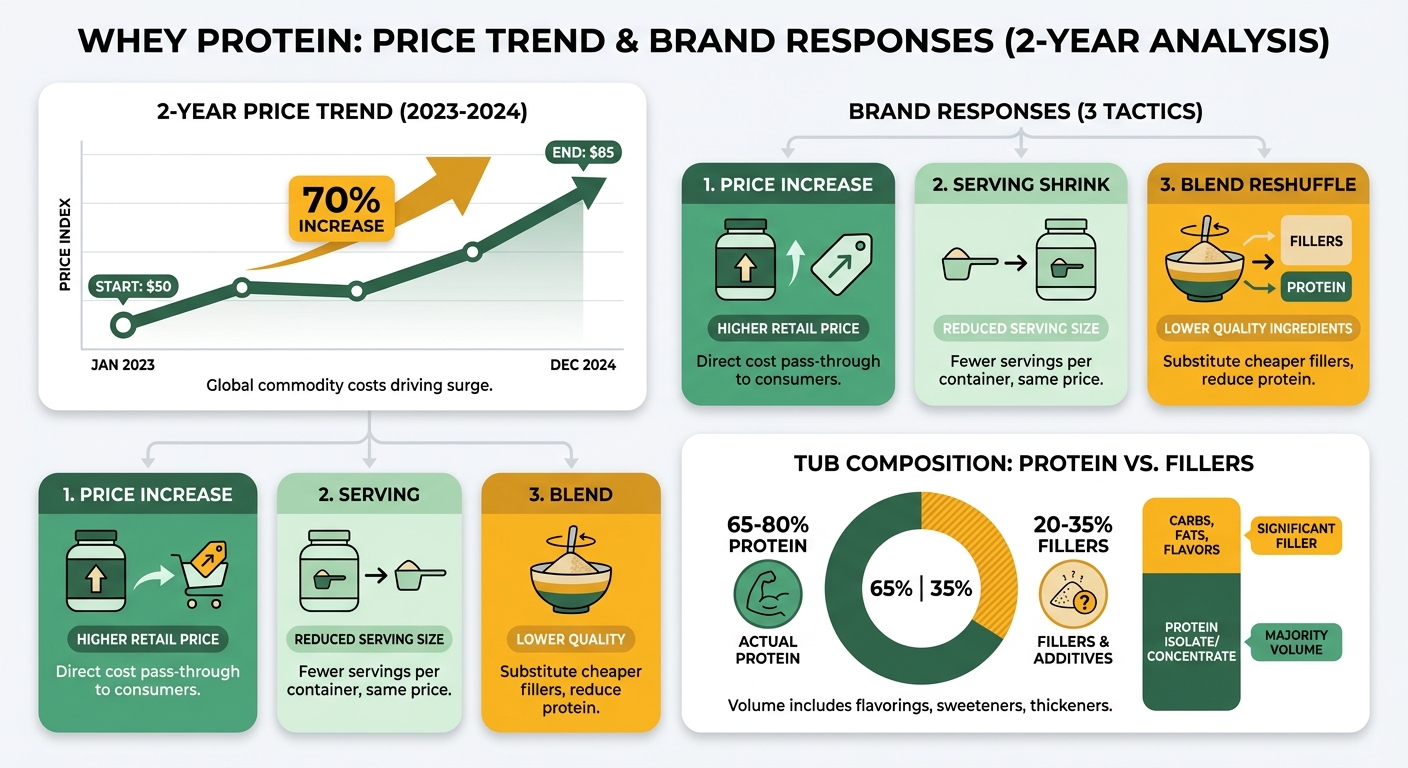
Why price per serving misleads you
Serving size moves. Filler content moves. Two products at the same per-serving price can deliver wildly different protein per gram of powder. The headline number is a claim; the ingredient panel is the receipt.
Check the budget whey breakdown from MuscleZeus. Some brands inflate serving sizes on retail listings, like Walmart pages that advertise 60g per serving by counting a double scoop as one serving. It makes the tub look cheaper per serving than it really is.
| Product | Protein / serving | Price / serving | Watch for |
|---|---|---|---|
| MyProtein Impact Whey | 22g | $0.45 | Prices swing by tub size and sale timing |
| Dymatize Elite Whey | 25g | $0.70 | Better mixability, higher cost |
| Body Fortress | 30g | $0.60 | 15g of a 45g scoop is filler |
The same product, four different prices
Quoted prices deceive because the same product carries different numbers wherever it sells. MyProtein Impact Whey shows up at $0.45 per serving in one review and $1.76 per scoop in a 50-brand test, where the tested average landed at $1.34. That's nearly a 4x gap for one product.
No single quote is trustworthy on its own. The spread comes from tub size, region, and sale timing, which is why you have to search across retailers to find the real unit price. PricePlow's alerts once caught a 68.5% drop on Optimum Nutrition Gold Standard. Price tracking catches the drop, but it doesn't confirm the protein dose held steady.
Who actually saves with cheap whey
Anyone hitting a daily protein target on a fixed budget. Students, parents, and everyday lifters feel every dollar. One coach's client gained 4.2 kg in 8 weeks on MyProtein, oats, and eggs. That is a fair reminder that affordable whey builds muscle when the leucine and dose check out.
Skip the premium-brand tax for routine daily nutrition. When you can verify what you're getting per dollar, consistency and label accuracy beat the name on the tub.
The mistakes that make cheap whey expensive
The biggest mistake with budget whey is treating a low price as proof of a good deal. It isn't. A cheap tub can hide a smaller scoop, a lower protein percentage, or a blend padded with cheaper fillers. The price you see and the protein you get are two separate things.
The second mistake is buying a brand once and assuming it stays the cheapest. It won't. Whey pricing shifts with sales cycles, retailer promotions, and stock levels, so last month's bargain quietly climbs back to full price. PricePlow's alert data tracks those swings, which is why a static "buy this one" list goes stale almost as fast as it's published. The cheapest option is a moving target, so any single pick is a snapshot, not an answer.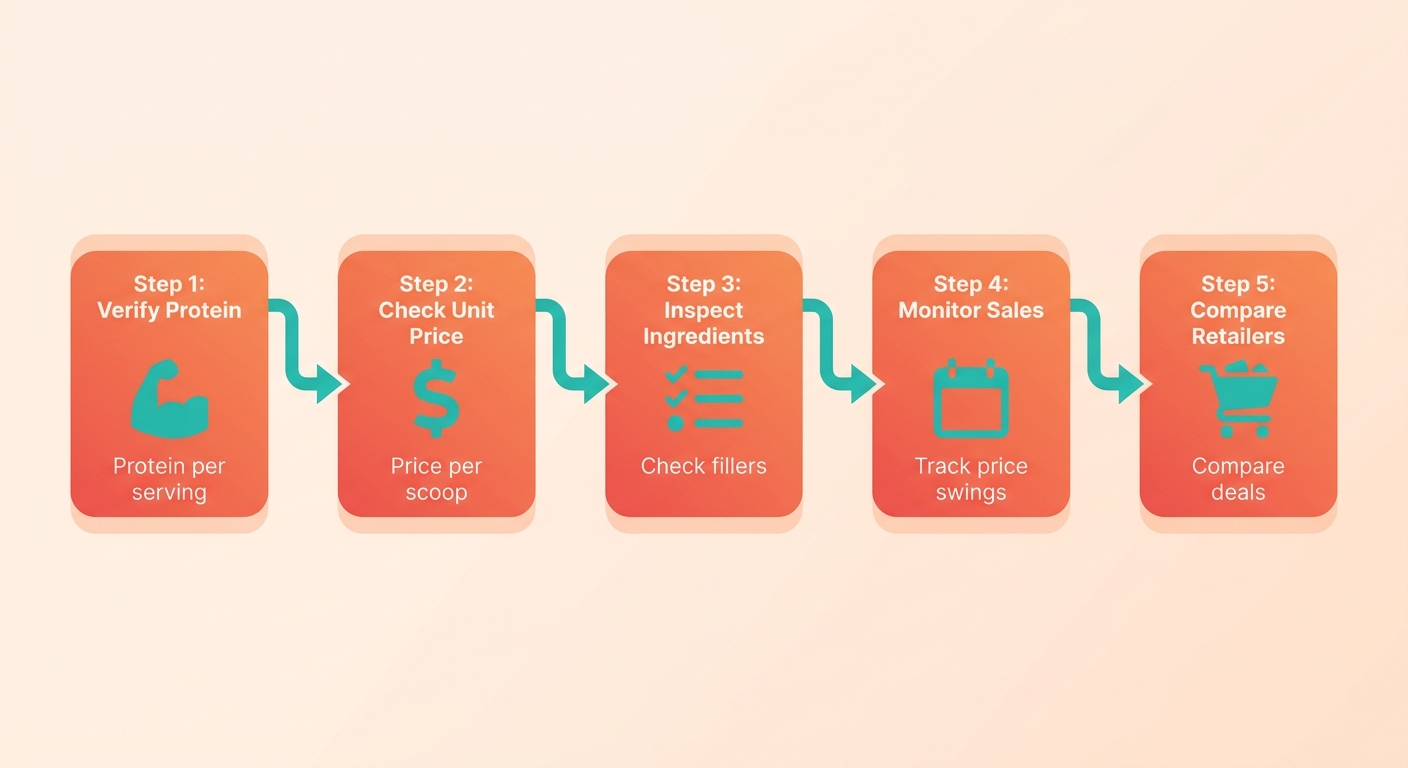
How to read a whey label in three moves
Read for three things: protein form, grams per scoop, and ingredient order. Isolate runs about 90% protein and is nearly lactose-free. Concentrate sits lower and costs less. Neither is wrong, but you should know which one you're paying for.
Then check where whey lands in the ingredient list. If maltodextrin, creamer, or amino spikers show up high, the real whey dose is thinner than the front label implies. Native whey, filtered straight from milk, is a cleaner source than standard concentrate if fewer processing steps matter to you.
Scanning these details automatically lets you compare verified numbers instead of front-of-bag marketing. More on that in our guide to low-cost daily whey.
Why third-party testing matters more on budget tubs
Corners get cut where margins are thinnest, and that's the budget shelf. A certification seal (Informed Sport, NSF) confirms the tub matches the label and screens for contaminants. If you're a tested athlete, skip unverified bargain brands entirely.
As dietitian Katey Davidson explains, you don't need to spend a lot to eat well. Good nutrition works at any budget. The trick is verifying quality, not chasing the lowest sticker.
Budget whey pitfalls at a glance
| Pitfall | What to check | How Popgot helps |
|---|---|---|
| Low sticker, small scoop | Grams of protein per serving | Calculates cost per gram |
| Filler-heavy blend | Ingredient order, amino spiking | Filters by ingredient criteria |
| Stale "best deal" pick | Current price across retailers | Aggregates live store listings |
| No quality proof | Informed Sport / NSF seal | Identifies third-party seals on listings |
Pair price tracking with a label check, and you can spot the genuinely cheap whey that still delivers the dose you paid for. A price drop is only a win if the protein behind it held steady.
Unit price, retailer by retailer
We compared unit prices across Amazon, Walmart, and Target for the same major whey products, and the gap between the cheapest and priciest listing of an identical brand can be dramatic. A product cheap at one retailer can run much higher at another two weeks later, with no change to the formula or tub size. Sticker price is not the actual cost.
Comparing tubs by per-serving price makes the brand with the biggest scoop look like the winner, right up until you strip out the non-protein ingredients. Normalize the cost to a standard unit and you see which product gives you the most actual protein for your money. A smaller tub with concentrated protein per scoop can beat a bigger tub with diluted servings.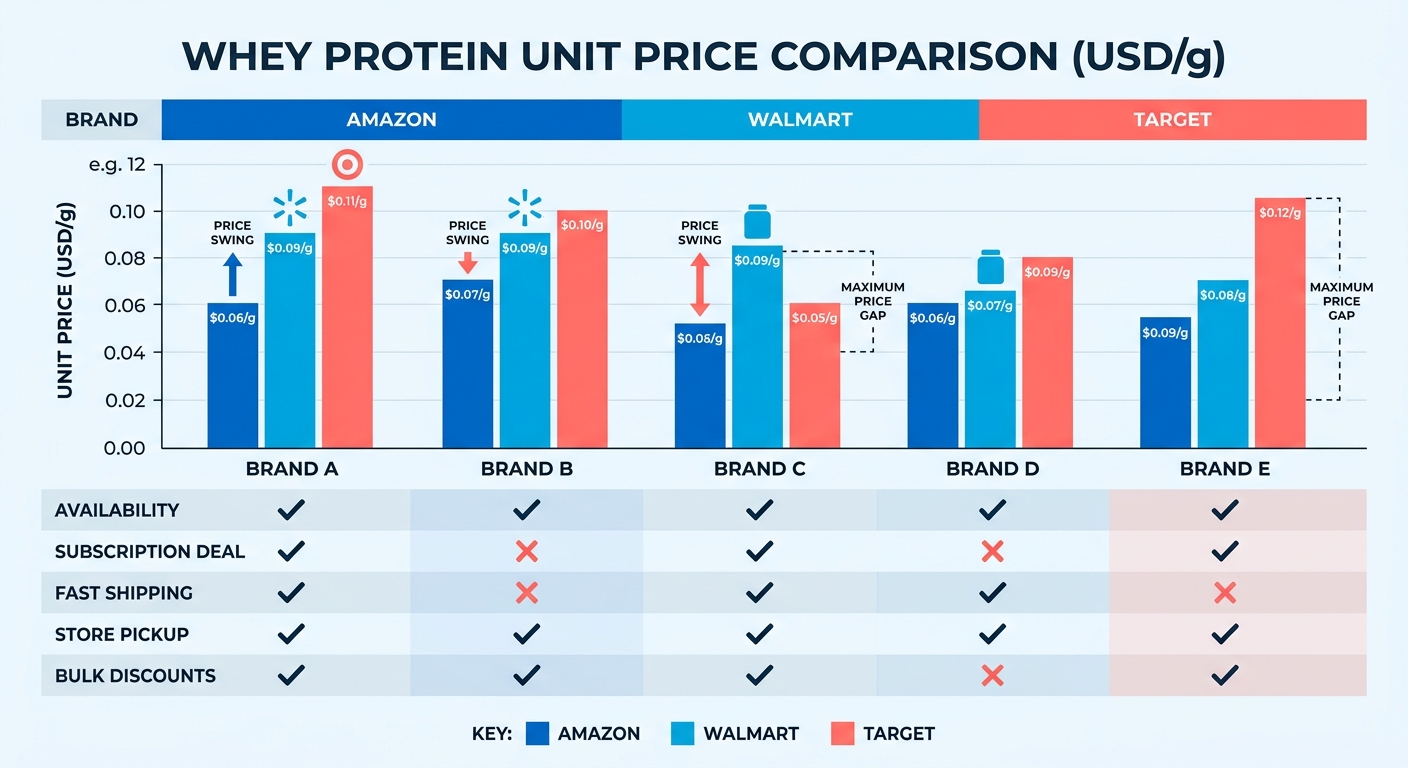
The same tub, three checkouts
Walmart's whey page shows big price spreads between budget concentrates and premium isolates. That range looks like a quality gap, but the unit price tells a different story. Muscletech Phase8 was marked down from $47.99 to $38.47 recently, a 20% drop, while Amazon held it at $44.88 for the same tub and Target listed it at $42.75. None of those numbers mean anything until you verify the label: Phase8 delivers 26g protein per 45g serving, so the price per gram of protein ranges from $0.051 to $0.060 depending on where you buy.
Garage Gym Reviews tested Nutricost Whey Protein Concentrate on Amazon at $0.78 to $1.15 per serving, while Legion Athletics Whey+ ran $1.99. Both claim 22–25g protein per scoop, but Nutricost uses a 30g scoop and Legion a 36g scoop. The per-serving comparison breaks down because you're comparing different dose sizes. Normalize to grams of protein and the gap narrows, though Legion still runs nearly 3x higher for what may be the same concentrate quality. Transparent Labs Whey Protein Isolate sits at $1.87 per serving with 28g protein per 34g scoop, landing at $0.067 per gram. That's nearly double what standard concentrates charge, but with a cleaner ingredient profile and third-party testing certificates.
Shipping and subscriptions, where the price sneaks back up
Free shipping thresholds vary. Walmart ships free over $35, Amazon wants Prime or a $25 minimum for non-members, and Target's $35 threshold drops to free for RedCard holders. A $26.88 MuscleMilk tub at Walmart forces you to add $9 of filler purchases to clear free shipping, which quietly inflates the real cost. Amazon lists the same tub at $31.20 with Prime but tacks on $6.99 shipping without it. The unit price holds, but your out-of-pocket cost jumps 22% if you don't structure the order to dodge fees.
Subscribe-and-save discounts look good until you run the protein-per-dollar math. Amazon's 10% off Cellucor Whey Sport drops a 2-lb tub from $38.99 to $35.09. Sounds strong, except Walmart's shelf price for the same tub hit $33.67 during a recent rollback, no subscription needed. The subscription saves you $3.90 against Amazon's regular price but costs you $1.42 against Walmart's sale. Subscriptions also lock you into recurring charges, and some brands have quietly trimmed scoop sizes mid-subscription without touching the per-delivery price, so you end up paying the same for less protein.
| Product | Walmart Price | Amazon Price | Target Price | Unit Price ($/g protein) |
|---|---|---|---|---|
| MuscleMilk Genuine Protein | $26.88 | $31.20 | $28.95 | $0.042 |
| Cellucor Whey Sport | $33.67 | $38.99 | $36.50 | $0.054 |
| Muscletech Phase8 | $38.47 | $44.88 | $42.75 | $0.051 |
| Transparent Labs Isolate | $62.15 | $69.99 | $66.88 | $0.067 |
| MusclePharm Combat Protein | $41.22 | $46.75 | $44.18 | $0.048 |
These prices reflect recent shelf prices across all three retailers. Transparent Labs' $0.067 per gram looks steep until you read the label. It's a grass-fed isolate with zero artificial ingredients, which costs more to make than standard concentrate. Compare Protein Prices tracks over 1,060 products and flags that most shoppers overpay by defaulting to isolate when a certified concentrate at $0.042/g delivers the same 20g+ dose for muscle synthesis. MuscleMilk wins here at $0.042/g while keeping decent mixability and a complete amino acid profile, so your taste and digestion stay fine even as the math works out.
Tool 1: MyProtein Impact Whey
It packs 22g of protein per 30g serving, keeps sugar and fillers low, and holds a strong protein-to-powder ratio according to the MuscleZeus breakdown. That ratio is what separates it from cheaper tubs that pad the scoop with carbs and thickeners to hit a low headline price.
The final cost you pay, though, depends on which listing you pick. Package size, flavor, and shipping origin can swing the price of identical powder from listing to listing.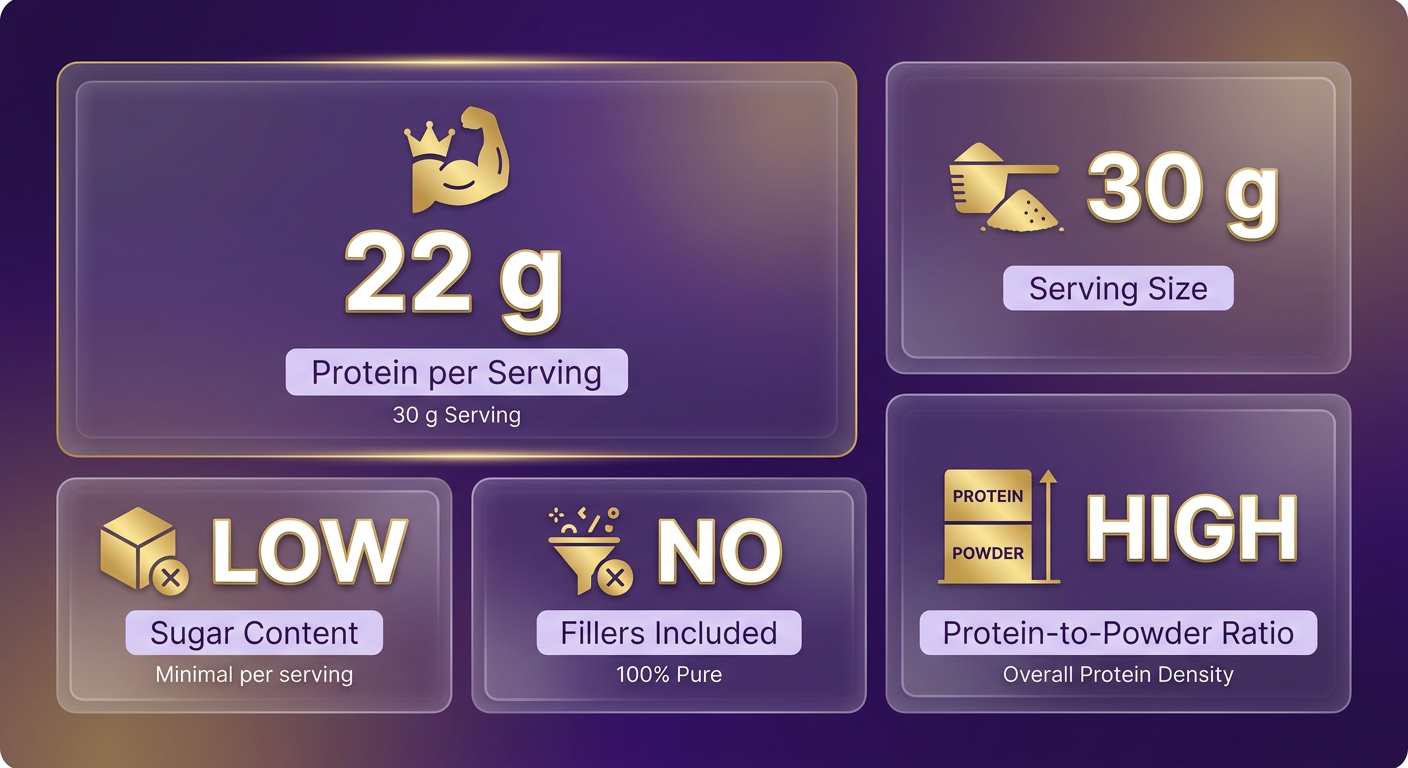
Why the same tub shows two prices
Packaging volume and promo cycles set the number. A small flavored pouch and a bulk unflavored sack hold the same base powder but carry different margins, and mid-week pricing rarely matches the weekend promotions.
That variance is exactly why a systematic unit-price check earns its keep. Compare the cost per gram of actual protein across retailers, and you'll see whether a discounted tub is a real bargain or just a smaller package.
How Impact Whey holds up
Impact Whey earns its budget reputation on consistency, not gimmicks. Budget-conscious athletes reach for it to hit daily macro targets without paying for brand marketing.
One honest caveat: unflavored budget concentrates mix grittier than premium isolates, so a shaker ball is usually part of the deal. Some lower-cost brands also don't publish regular batch verification, which makes the exact amino acid profile harder to confirm. Impact Whey's minimal-filler formula still holds up better under scrutiny than many of its padded competitors.
Summary table
| Product | Protein / Serving | Protein Density | Best For |
|---|---|---|---|
| Impact Whey Blend | 22g / 30g | ~73% | Cheapest protein per gram |
| Unflavored Whey Concentrate | 24g / 32g | ~75% | No additives, bulk buyers |
| Whey Isolate Option | 27g / 30g | ~90% | Higher purity, lower lactose |
| Grass-Fed Whey | 25g / 33g | ~76% | Sourcing-conscious buyers |
Density figures show protein as a share of total scoop weight, drawn from label data and the MuscleZeus and Forbes Vetted breakdowns.
Impact Whey wins on cost per gram. An unflavored concentrate wins if you want zero additives in bulk, and an isolate wins if purity and low lactose top your list. But the "cheapest" title flips with every sale cycle, so run a live unit-price check before you buy. Popgot searches across eight major retailers so you can compare accurate unit pricing and find whey that actually meets your specs.
Tool 2: Optimum Nutrition Gold Standard Whey
Gold Standard delivers 24g of protein per 31g serving starting at $1.17 per serving, which puts it among the most affordable of the major brands. The real test is consistency, and expert testing confirms it hits that mark: balanced profile, clean label, and 20-plus flavors, so you can rebuy the same product without flavor fatigue.
Where you buy matters. Costco members grab a 5-pound tub at $44.99, which drops the per-serving cost to $0.90 in bulk. The same formula runs $1.30–$1.50 per serving at CVS and Walgreens, where convenience pricing adds 40–60% to the real cost.
What sets Gold Standard apart
Gold Standard leads with whey protein isolate, not concentrate padded with fillers. Forbes testing called that out as a key differentiator: 24g protein in a 31g scoop means roughly 77% of the powder is actual protein.
The mixability gap is real too. Gold Standard dissolves cleanly in water or milk, with no grit and no foam. Many cheaper concentrate-heavy options need a blender or end up chunky. When you're mixing a shake every day, that friction adds up, and a 30-second pour beats one that leaves you scrubbing the shaker.
It also carries 3g of leucine per serving, which Marie Spano, RD, flags as the minimum for muscle protein synthesis. Cheaper whey often falls short of that, which can limit the recovery response you're paying for.
When to pass on Gold Standard
Chasing the highest protein dose per scoop? Isopure Low Carb delivers 25g in a 29g serving, an 86% protein-to-powder ratio. It costs $1.54 per serving at Target but gives you more protein per scoop, which matters if you're hitting a target without stacking servings.
Gold Standard also falls short if you track sodium. Each serving carries 130mg, and that adds up across daily servings. Naked Whey holds just 55mg per serving from a single ingredient, grass-fed whey with no additives. The tradeoff is price: it runs $1.89 per serving at Whole Foods, 62% more than Gold Standard's baseline.
Skip it entirely if you're lactose intolerant. It's an isolate, but not completely lactose-free. Orgain Organic Protein uses pea and brown rice protein, sells at Trader Joe's for $1.28 per serving, and covers you as a dairy-free option that's still competitively priced.
Catching Gold Standard at the right price
Target often stacks Gold Standard with a 20% Circle offer, dropping the effective cost to $0.94 per serving when you add the RedCard discount. Those overlapping promotions move the real cost a lot, and tracking platforms can surface them automatically.
It's also SNAP EBT eligible at Walmart, which makes high-quality protein reachable without premium pricing. Knowing which retailers take EBT for which brands can swing the real cost 30–40% depending on how you pay, and pairing that with accurate unit pricing puts the true cost side by side.
The classic mistake is buying one tub and assuming that's the best deal. Amazon's Subscribe & Save drops the per-serving cost to $0.99 on monthly deliveries, and canceling after the first order still locks in that discount. Watching unit prices automatically is how you catch Gold Standard at the right point across retailers.
Three cheap whey picks that earn it
We narrowed the field to three whey proteins beyond the headline names, each earning its spot on real value and honest labeling. Pricing moves with packaging and promotions, so judge these on long-term value, not one snapshot.
NOW Sports Whey Isolate: best for macro trackers on a budget
NOW Sports Whey Isolate runs around 25g per scoop with most of the lactose stripped out, the gentlest clean pick when you catch it on sale. Protein-by-weight is the point here. You're buying density, not marketing.
The catch: isolate pricing swings with sourcing and stock. Small tubs often carry a premium that inflates cost per gram, while the lowest figures show up during bulk flash sales. If you go this route, wait for a markdown and buy in volume.
Dymatize Elite 100% Whey: best value if you can live with the filler
Dymatize Elite delivers about 25g per 36g scoop, so roughly a third of the powder is non-protein blend. That filler load causes clumping and digestive complaints for some users, yet the protein-per-dollar math still beats most flavored options. Walmart lists the comparable tub near $30 for 60 servings, and the real cost drops once you back out the filler weight.
The mixability issue is real. Shake it with water and expect clumps. Blend it with milk or a frozen banana, and the texture smooths out. Skip Dymatize if you're lactose-sensitive, since the cheaper blends lean on lactose-heavy concentrates.
BulkSupplements Whey Protein: best for consistent batch quality
BulkSupplements lands mid-range per serving depending on source, around 23g per scoop with third-party testing noted on the label. That matters more than people think. Budget brands often skip batch verification, so the first tub might test clean while the next ships from a different supplier with a tweaked ingredient ratio.
BulkSupplements holds steady across production runs. The unflavored version folds into oatmeal or smoothies without the chemical sweetness cheaper flavored tubs dump in. If you're buying whey every month, consistent quality beats a one-time low price.
Cheapest whey by real unit cost
| Product | Protein per Serving | Price per Serving | Cost per Protein Gram | Filler Content | Best For |
|---|---|---|---|---|---|
| NOW Sports Isolate | 25g (32g scoop) | $0.70–$1.40 | $0.04–$0.06 | Very low | Sensitive stomachs |
| Dymatize Elite | 25g (36g scoop) | $0.55–$0.72 | $0.04 | High (~one-third) | Maximum protein per dollar |
| BulkSupplements | 23g (scoop size varies) | $0.65–$1.05 | $0.06 | Low | Consistent batch quality |
| Ascent Native Whey | 25g (34g scoop) | $1.25–$1.90 | $0.06–$0.07 | Low | Flavor variety, stable pricing |
The math that tells you what's actually cheap
To find a tub's real value, use: Price ÷ (protein per serving × servings). That strips out the per-serving claim and tells you what you pay for the protein itself. It's the same formula third-party trackers use to rank over 1,060 products daily.
Static recommendation lists rarely hold up, because prices and formulations keep shifting. Smart buying means verifying that the protein dose and label ingredients held steady, not just chasing a temporary markdown.
When to walk away from budget whey
Budget whey delivers real results if it carries 20g+ protein per serving with minimal fillers. Skip it if you're lactose-intolerant and the label lists "whey protein concentrate" first, since concentrates run about 80% protein and 20% lactose by weight. Isolates strip the lactose but cost more per unit. For most people, a certified concentrate at $0.06/g is better value than an isolate at nearly double.
Also walk away if the brand has no independent quality verification. Batch-to-batch consistency matters more than a one-time purity check. Cheaper brands often source from different suppliers between runs, and leucine content can drop 15% between batches. Without a recognized certification seal on the label, confirming what you're actually consuming gets hard.
References
[1] Whey Protein in Protein Powder - Walmart.com - https://www.walmart.com/browse/health-and-medicine/whey-protein/976760_1166769_7458180_5532610
[2] Best Whey Protein in (2026) [Expert-Tested] - https://www.garagegymreviews.com/best-whey-protein
[3] The 3 Best Budget Whey Proteins That Actually Build Muscle - https://musclezeus.com/cheap-whey-protein-usa-2025/
[4] The 11 Best Whey Protein Powders 2026, Tested by Us - Men's Health - https://www.menshealth.com/nutrition/a19547347/best-whey-powder-review/
[5] Whey Protein - Learn & Compare Products at PricePlow - https://www.priceplow.com/whey-protein
[6] Here's How to Pick the Best Protein Powder (Dietitian Tips) - YouTube - https://www.youtube.com/watch?v=4ecN2-SnqWs
[7] Compare Protein Prices — Stop Overpaying For Protein - https://compareproteinprices.com/
[8] Best Protein Powders 2026 - Forbes Vetted - https://www.forbes.com/sites/forbes-personal-shopper/article/best-protein-powder/
[9] Best Protein Powder on Amazon (2026) - Garage Gym Reviews - https://www.garagegymreviews.com/best-protein-powder-on-amazon
Frequently Asked Questions
1. Why do some whey proteins cost three times more per gram even when they claim the same protein content?
The cost difference stems from protein form and processing method, not just marketing. High-purity isolates require extra filtration steps to remove fats and sugars, while standard concentrates are less processed and cost less to produce. Sourcing methods, such as grass-fed or native whey, also raise production costs even when the final protein yield per scoop is identical.
2. How often should I check whey protein prices if I want the best deal?
Check prices weekly if you buy regularly, because whey pricing shifts with sales cycles and retailer promotions. Flash sales can temporarily slash prices on major brands before they climb back to retail rates within days. A tub that was the cheapest option last month can quietly return to full price without any changes to the formula.
3. Can I trust a whey protein that costs half as much as major brands?
Trust bargain brands only if they carry independent quality certifications that confirm the label matches the contents of the tub. Budget products without external verification may use amino spiking or heavy fillers, meaning you receive less actual protein than advertised despite the low sticker price.
4. Does buying whey protein in bulk actually save money per serving?
Bulk purchases save money only when unit pricing confirms the larger tub costs less per gram of protein. Because brands sometimes adjust packaging sizes or serving yields for bulk formats, a larger tub can occasionally cost more per gram of protein than smaller tubs purchased during retail promotions.
5. Why does the same whey protein mix differently depending on where I buy it?
The product itself does not change, but storage conditions and stock turnover vary by retailer. Whey protein exposed to heat or humidity during warehousing clumps and loses mixability, even when the label and price remain identical. Retailers with faster turnover typically stock fresher powder that dissolves cleanly.
6. Should I switch whey brands every time I find a cheaper option?
Switch only when the new brand matches your minimum protein threshold and carries independent quality verification. Constant formula changes can disrupt digestion and make it harder to track your nutritional intake, meaning consistency often matters more than chasing minor price drops.