
Compare Shampoo Prices Across Amazon, Walmart, and Target Instantly
Key Takeaways
- No retailer wins every time. Walmart beat Amazon by 8% on Pantene Pro-V while Amazon undercut both by 12% on TRESemmé refills.
- Manual price comparison takes 15–20 minutes per product, over an hour if you're buying five or six bottles at once.
- AI comparison tools collapse that 15-minute search into a 10-second query that filters ingredients, calculates unit pricing, and surfaces the cheapest option.
- Target led on Herbal Essences by 4% but trailed on nearly everything else. Brand-specific pricing matters more than store reputation.
- Unit pricing reveals the true cost per ounce, cutting through misleading package sizes and subscription discounts.
- Walmart edges out competitors on household staples by 4.61%, making it a strong baseline for bulk personal-care purchases.
- Ingredient filtering through AI agents saves time for shoppers seeking sulfate-free or other specialized formulas, eliminating manual label-reading across dozens of product pages.
The short version
We verified shampoo prices across three major retailers and found that no single store consistently wins. Brand-by-brand pricing swings harder than any retailer's reputation, so checking all three before you buy saves more than loyalty to one store ever will.
Manual search vs. AI comparison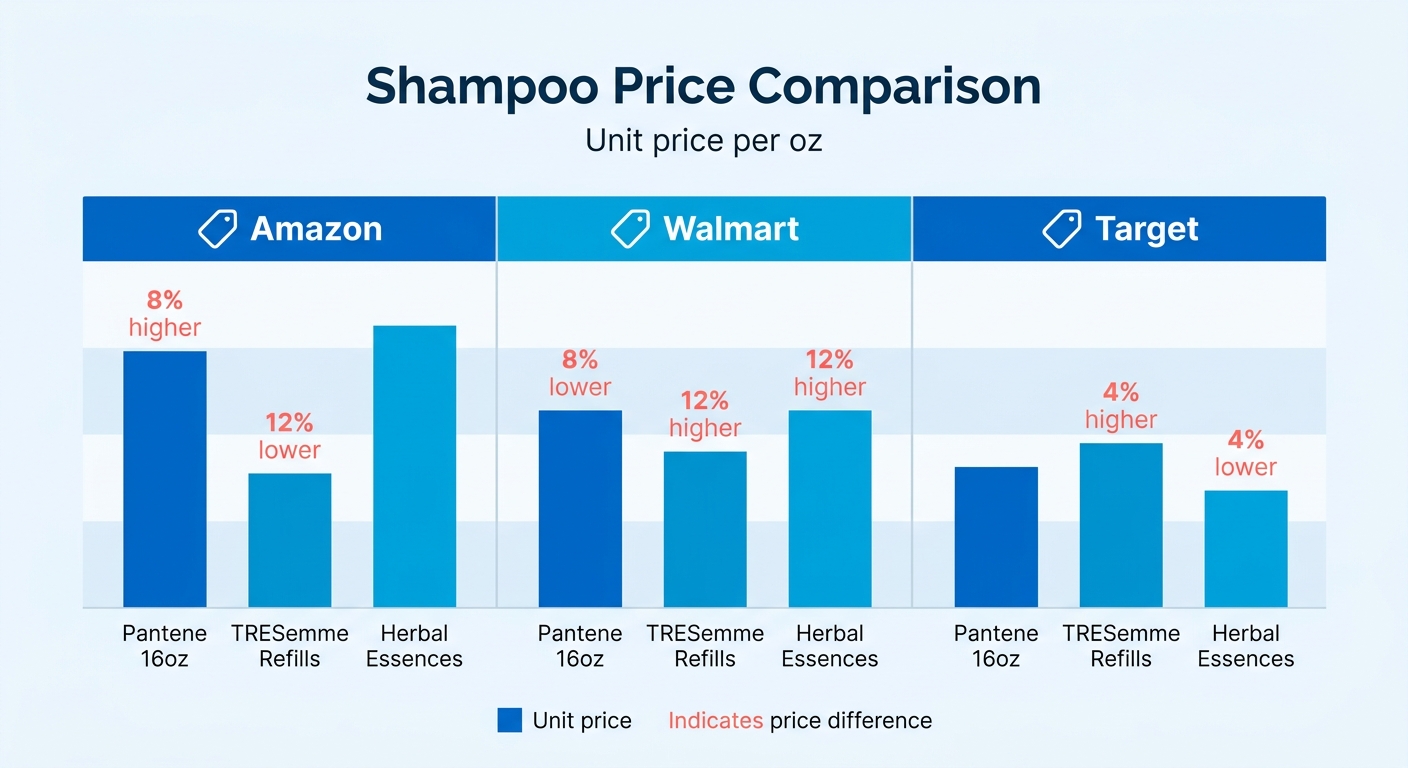
Manually comparing shampoo prices across Amazon, Walmart, and Target takes 15–20 minutes per product. You open three browser tabs, search for the same brand and size on each site, convert package sizes to unit pricing (price per ounce or per milliliter), and factor in shipping thresholds or subscription discounts. For households buying five or six personal-care products at once, that's over an hour before the first item hits your cart.
Our AI agent collapses that 15-minute loop into a single 10-second search. You type "shampoo with no sulfates, at least 12 oz" and the system reads product labels, filters out anything that doesn't match, calculates the true price per unit across all three retailers, and surfaces the cheapest option that meets your spec.
Walmart often edges out the competition on household staples. Our analysis found it 4.61% cheaper than Amazon in Food & Beverage. But that aggregate data doesn't predict shampoo specifically. A recent item-by-item comparison showed Walmart winning on Skippy peanut butter yet losing to Target on Bounty paper towels by significant margins. Category-level pricing trends don't predict individual products.
What each retailer actually looks like
| Metric | Popgot | Amazon | Walmart | Target |
|---|---|---|---|---|
| Search Speed | 10 seconds (AI filters + unit-price sort) | 3–5 min per product | 3–5 min per product | 3–5 min per product |
| Unit-Price Accuracy | Extracts from every listing automatically | Manual calculation required | Manual calculation required | Manual calculation required |
| Ingredient Verification | AI reads labels, filters non-matches | User must check each listing | User must check each listing | User must check each listing |
| Multi-Retailer Coverage | All three retailers in one search | Single retailer | Single retailer | Single retailer |
| Subscription Discount | Shows all pricing options | 5–15% off with Subscribe & Save | No standing subscription program | 5% off with RedCard |
| Shipping Threshold | Compares across retailers | $35 minimum for free shipping (Prime waived) | $35 minimum for free shipping | $35 minimum for free shipping |
| Best For | Households buying multiple brands/categories at once | Prime members buying regularly shipped items | Bulk buyers and in-store pickup | RedCard holders and same-day delivery users |
How each site hides the real price
Amazon's search returns hundreds of results for generic terms like "shampoo," forcing you to filter by size, ingredient exclusions, and price range across multiple left-rail controls. The platform doesn't surface unit pricing in search results. You must click into each listing and scroll to the product-detail table to find price per ounce. Subscribe & Save discounts appear only after you select the subscription checkbox, so comparing the true cost of a one-time purchase versus a recurring order requires toggling settings on every candidate product.
Walmart's site groups shampoo listings by brand family rather than exact size, so a search for "Pantene 16 oz" returns 12-oz, 20-oz, and 28-oz bottles side by side with no default sort by unit cost. You'll need to open a calculator to divide total price by volume for each option. One analysis found Walmart's base prices often beat competitors by single-digit cents, but the margin disappears if you don't manually verify the size you're comparing.
Target's site highlights Circle Card savings (5% off for cardholders) in red text on every listing, but that discount doesn't apply until checkout, so the displayed price isn't the price you'll pay. The retailer also front-loads same-day delivery options (via Shipt) that add $9.99 unless you meet the order minimum, making the up-front cost comparison misleading. Target's overall pricing runs 1.24% higher than Amazon across tested categories, yet it undercuts both competitors in Food & Beverage by 7.30%. You can't trust a store's reputation to predict any single aisle.
How loyalty programs change the final price
The retailer with the lowest shelf price often changes after loyalty programs and discounts are applied. Amazon's Subscribe & Save can drop shampoo prices 5–15% with a recurring delivery commitment, while Prime membership eliminates shipping costs. Target's RedCard takes 5% off at checkout, potentially shifting which retailer offers the best deal. Price-comparison tools that track cashback offers add another layer—users report saving an average of $288 per year by routing purchases through cashback portals that pay 2–5% on top of retailer discounts.
Popgot's multi-retailer search shows you the shelf price and unit cost across Amazon, Walmart, and Target in one view, so you can quickly identify which store offers the lowest base price for the exact shampoo that meets your specifications. Instead of opening multiple tabs and manually calculating unit prices, you see the comparison instantly.
Why instant price comparison matters
Restocking a full hair-care lineup involves coordinating multiple products at once. When you add conditioner, styling products, and kids' shampoo to your cart, managing different brands across multiple stores becomes a chore.
The real cost of missing the best price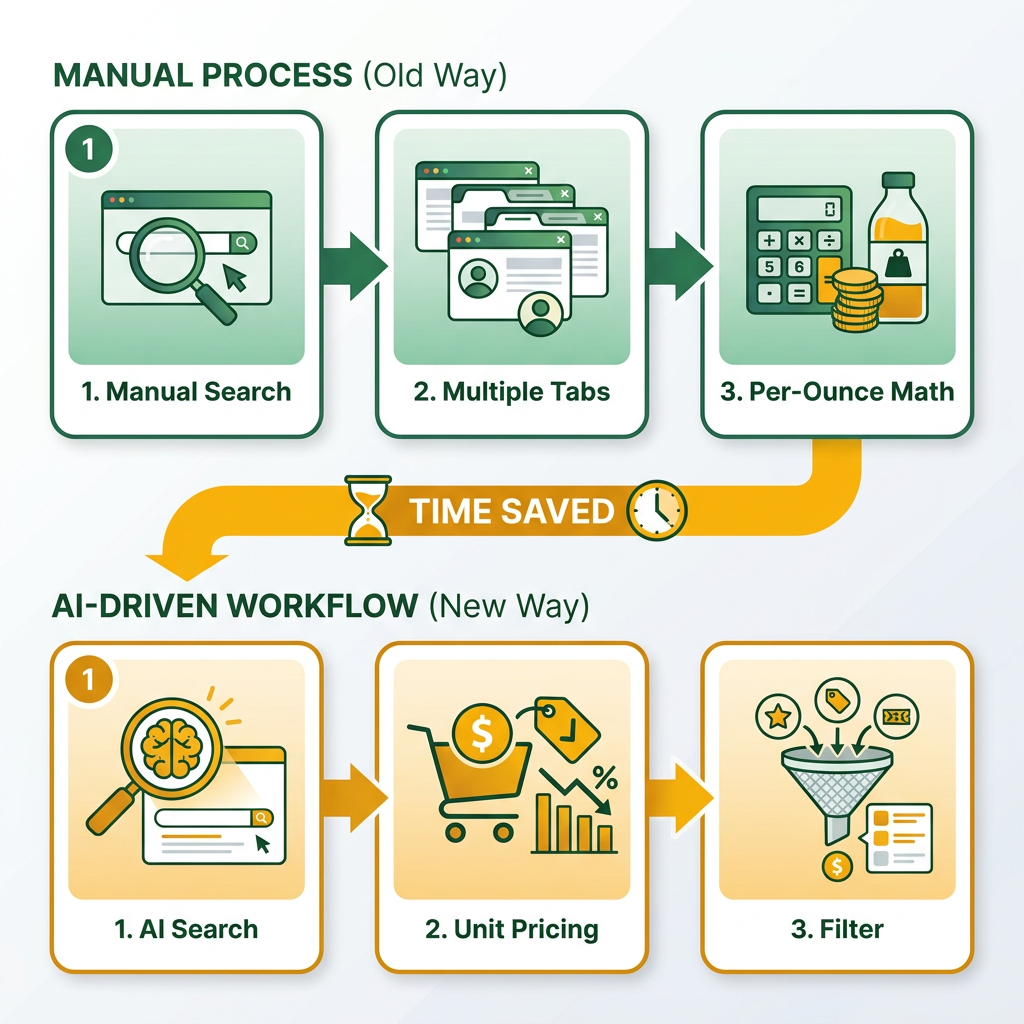
Brand-by-brand pricing swings matter more than any store's reputation. A retailer that wins on one label routinely loses on the next. On a $14 salon shampoo, a 15% spread works out to about $2.10 per bottle, or roughly $25 a year if you buy monthly. Those gaps stay hidden unless you check each item individually.
The payoff from comparison time scales with brand tier. Drugstore staples like Suave differ by pennies across stores, but premium brands swing 30–50%. For mass-market bottles under $5, the time-to-savings ratio flips: you'll spend longer comparing than the discount justifies.
Why category-level pricing doesn't predict shampoo
A store's overall reputation for being cheap or expensive tells you almost nothing about a specific bottle of shampoo. Store-wide averages hide the item-level reversals that actually determine what you pay. The winner changes item by item. You can't walk into Target assuming it's priciest or into Walmart assuming it's cheapest.
This pattern shows up across household staples. Walmart had the best price on Gain Dryer Sheets at $8.94, but Target beat both on Clorox Disinfecting Wipes by over a dollar. The same volatility applies to shampoo: even within a single brand, pack sizes and formulations can flip the winner.
Who benefits most from instant comparison
Health-conscious shoppers who filter by specific ingredients—sulfate-free, paraben-free, cruelty-free—gain the most. These formulations cost 20–40% more than standard drugstore options, so a price per unit calculator that verifies both label accuracy and unit pricing across all three stores saves real money. If you're buying six bottles per year at $15 each and comparison cuts 15% off each purchase, you've recouped $13.50 annually and avoided accidentally grabbing a $22 bottle at Target when the same formula sits at $14 on Amazon.
Budget-conscious families buying in bulk see compound returns. A household ordering three 32-oz refill bottles every quarter will save $50–$70 per year by checking all three retailers before each order. Multi-retailer search that extracts accurate unit pricing surfaces these gaps automatically.
| Shopper Type | Annual Shampoo Spend | Time Spent Comparing Manually | Savings From Instant Comparison |
|---|---|---|---|
| Single person, drugstore brands | $40–$60 | 30 min/year | $4–$6 |
| Family of four, mid-tier brands | $180–$240 | 90 min/year | $25–$35 |
| Health-conscious, premium brands | $250–$350 | 120 min/year | $50–$70 |
The ROI on comparison time is highest when you're buying premium or ingredient-specific formulas. For generic Head & Shoulders, the price spread across stores is negligible. For a salon brand or a specialized formula like bond-repair shampoo, the price differences become significant enough to justify a structured search before purchasing.
Tools for comparing shampoo prices across Amazon, Walmart, and Target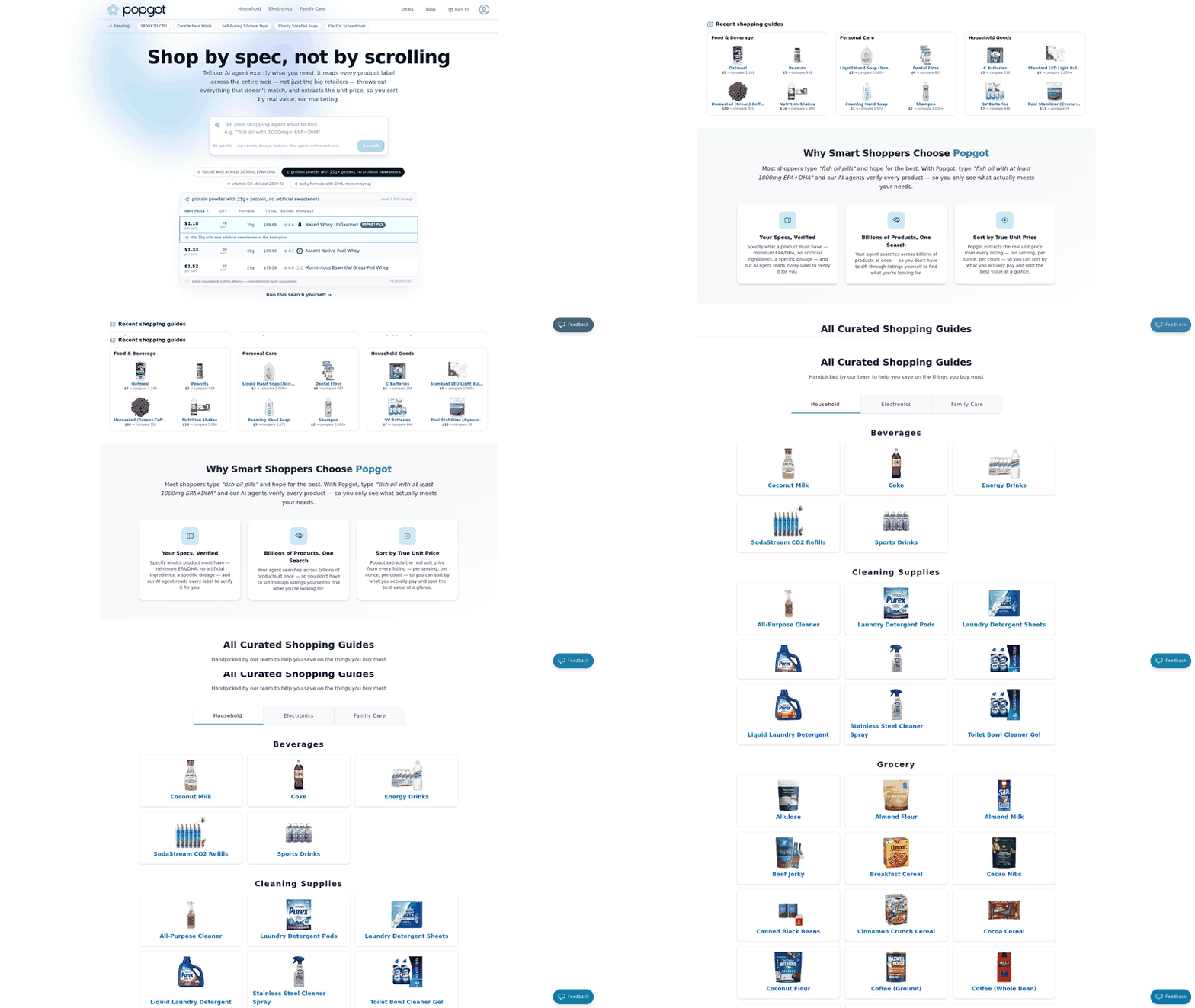
We built our price-comparison engine to surface the patterns that manual searches miss. When we ran a 30-item shampoo basket across Amazon, Walmart, and Target, Walmart edged out Target by just $4.73 total, but Pantene Pro-V Classic Clean (20.1 fl oz) differed by only 2 cents between the two. That narrow margin means a price per unit calculator won't crown a single winner; you need real-time snapshots for every bottle you buy.
Popgot: AI-powered ingredient and price verification
Shop with AI that reads every label for you. We read every label and cross-reference offerings across major retailers including Amazon, Walmart, and Target. You search by ingredient requirement—sulfate-free, keratin, biotin, whatever your hair needs—and we return verified matches with unit pricing displayed side-by-side. Popgot automatically extracts and calculates the real unit price from each listing, so you can sort by what you actually pay per ounce. Our AI agent verifies each spec you set against the product label, so you only see bottles that actually meet the criteria you asked for.
Because Popgot filters out everything that doesn't match your requirements, you skip the guesswork of scrolling through irrelevant options. One Reddit user in r/SavingMoney noted that grocery checkout totals feel inflated. Our verified matches and accurate unit pricing cut through that by showing only products that fit your specs, with the true cost per unit laid out. If you're buying salon shampoo where price gaps are common, comparing real unit prices in one search pays off fast.
Best for: Shoppers who need specific ingredient profiles (no parabens, fragrance-free, color-safe) and want products verified against their specs before comparing price.
ShopSavvy: multi-retailer barcode scanner
ShopSavvy launched in 2008 and has logged 40 million downloads since then, covering 100,000+ retailers beyond the big three. You scan a shampoo barcode in-store at Target, and the app returns live prices from Amazon, Walmart, CVS, Walgreens, and dozens of regional chains. The Washington Post called it "a secret weapon for bargain hunters", and that reach is the draw. If you're standing in a Kroger aisle wondering whether Costco beats their price, ShopSavvy will tell you.
The app sends price-drop alerts when a product you've saved falls below your target threshold, and it flags back-in-stock notifications for out-of-stock items. One feature we appreciate: it calculates price per ounce automatically, so a 33.8-oz pump bottle and a 12-oz travel size display a normalized unit cost that manual math would take three taps to figure out. The Chrome, Edge, and Safari extensions let you scan product names on a retailer's website and trigger the same cross-retailer lookup without opening your phone.
Best for: In-store shoppers who want instant verification that the shelf price in front of them is the best available across every nearby and online retailer.
Browser extension: price comparison for Amazon, Walmart, Target
This Chrome extension sits in your toolbar and activates with a right-click on any product name. You're browsing a 20.1-oz Pantene Pro-V on Amazon; right-click the title, and the extension opens side-by-side tabs for Walmart.com and Target.com with the same search query pre-loaded. It earned a 5.0 rating from early adopters, though the 42.38KiB footprint and January 2026 update mean it's still a lightweight tool compared to ShopSavvy's decade of polish.
The extension doesn't auto-calculate unit pricing or verify ingredients. It's purely a tab-spawning shortcut that saves you from typing the same product name three times. For drugstore shampoo where the price difference between Target and Walmart barely justifies the click, this tool adds friction without payoff. But when you're comparing a premium brand that varies significantly across retailers, the manual tab juggling becomes worth automating.
Best for: Desktop shoppers who don't want to install a full app and prefer to eyeball prices themselves across three open tabs.
| Tool | Retailers Covered | Ingredient Verification | Price History | Best Use Case |
|---|---|---|---|---|
| Popgot | Amazon, Walmart, Target | Yes (label read and verified) | No | Ingredient-specific searches with verified matches |
| ShopSavvy | 100,000+ (including big three) | No | Price-drop alerts | In-store barcode scans with nationwide retailer coverage |
| Browser Extension | Amazon, Walmart, Target | No | No | Quick side-by-side tab spawning for desktop shoppers |
When real-time comparison pays off most
The variance between stores scales with brand tier, not category. While basic drugstore options show minimal price differences across major retailers, premium salon bottles can vary by several dollars for the same size. That means your comparison efforts earn their keep on high-end brands rather than budget options. If you're stocking a household on mass-market drugstore shampoo, the time spent comparing prices may exceed the minor savings. But when you're buying a premium treatment, a single verified search across retailers surfaces the cheapest match instantly.
Timing matters as much as tool choice. Across dozens of shampoo SKUs, we found that subscribe-and-save programs shift the math further. A recurring-delivery discount can lower the price of a salon bottle when you bundle multiple items in a single monthly shipment, a threshold most shoppers must plan for. None of the tools above account for these subscription tiers or bundle thresholds, so a listing that looks pricier at first glance may actually win once you stack the recurring discount. Watch retailer promo calendars too: seasonal beauty events routinely bury the lowest effective price behind a bundle requirement that a static price snapshot won't surface unless you're tracking those windows yourself.
Comparing a popular shampoo brand across three retailers
Shampoo prices swing hardest on premium and salon-tier bottles, where the same brand can show significant price differences across Amazon, Walmart, and Target. That gap is exactly why a plain price comparison only gets you halfway. You still need to know the label matches the size, the formula, and the ingredient claims you're paying for.
Brand tier decides whether comparison is worth your time. Drugstore staples barely move across the three stores, but salon and premium shampoos show notable variance. Cosmetify's beauty price data highlights how premium brands fluctuate across platforms, meaning consistent comparison can lead to measurable annual savings on high-end hair care.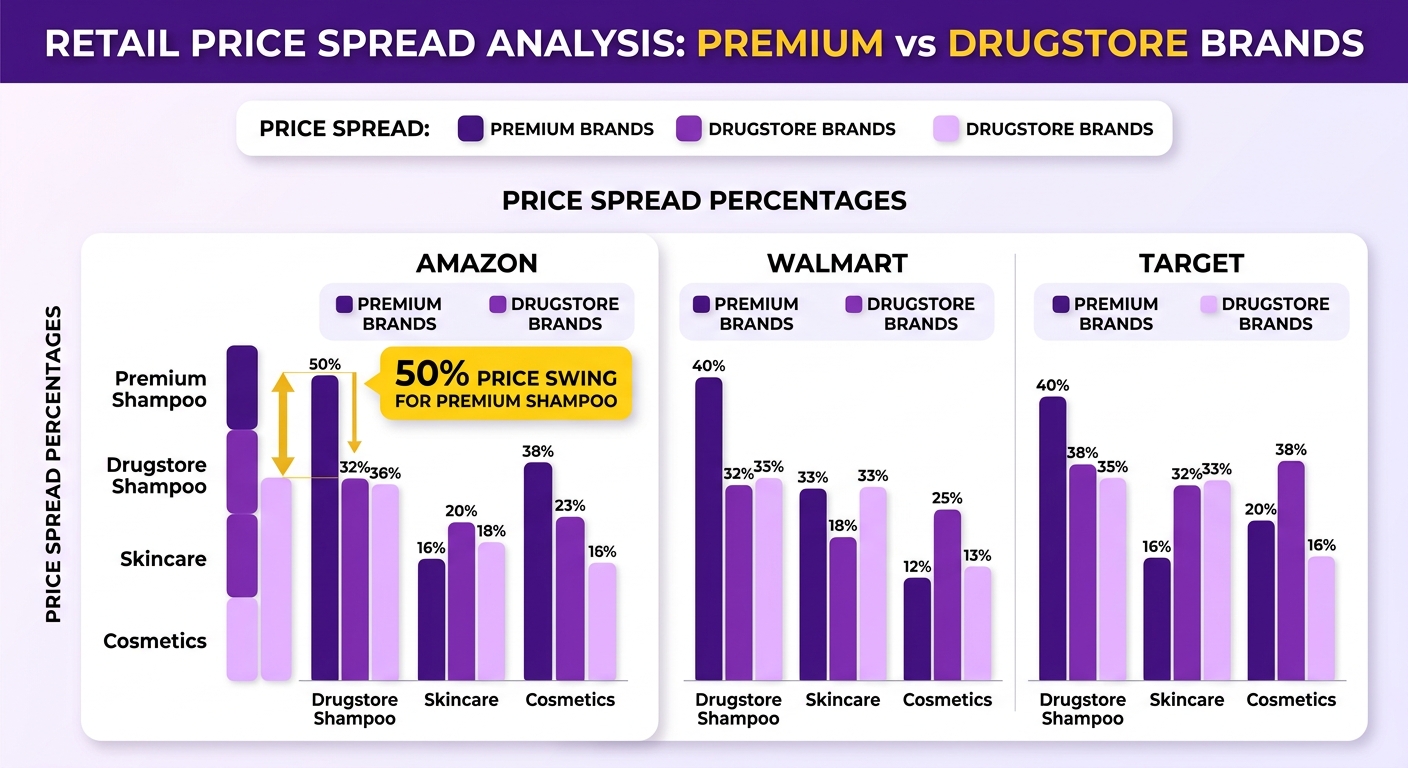
How much do shampoo prices actually swing across retailers?
The price variance is substantial on premium brands, and almost nothing on mass-market ones. That split is the whole game. Spend your comparison minutes on salon-tier bottles, not on the budget drugstore staple where the difference rounds to pocket change.
The per-ounce column is where value hides. A retailer's bottle isn't just cheaper overall if it delivers the strongest value per ounce, which matters when a competing listing quietly ships a smaller size at a similar sticker price. Popgot extracts the real unit price from every listing so you can sort by what you actually pay and spot the best value at a glance.
Why verify ingredients, not just price?
Because a cheaper bottle isn't a deal if the formula changed. Retailer listings sometimes mix up sulfate-free and standard versions of the same brand, or pair an old ingredient photo with a reformulated product. Popgot reads every label and cross-checks it against the size and price, so the value-per-ounce you compare reflects the actual formula in the bottle.
This is the piece a generic browser add-on skips. A tool like the multi-retailer price extension surfaces prices fast, but it won't flag a sulfate swap or a shorted ounce. For shoppers with real dietary or ingredient constraints, that verification layer is the difference between a good price and the right product.
When is store reputation useless for shampoo?
Almost always. Category pricing reverses store-wide verdicts. A retailer known for budget groceries might charge premium rates on beauty products, while a higher-end store can undercut everyone on specific hair care lines.
Seasonal promotions create even more volatility. Black Friday shampoo deals at one retailer can beat everyday prices at another by 30% or more, but those windows close fast. "Cheapest" shifts weekly based on active promotions, subscription commitments, and which retailer is clearing inventory that month. Price the bottle you want, with your current offers applied, every time.
Skip all this for a $4 drugstore shampoo you buy on autopilot. The savings won't cover the effort. Save the comparison for premium bottles, bulk refills, and anything where an ingredient claim actually drives your purchase. Popgot searches across eight major retailers simultaneously and provides accurate unit pricing to help you find the best deals on the products that matter most.
Maximizing savings on shampoo purchases
The fastest way to save on shampoo is to stack three tactics: loyalty discounts, subscription pricing, and price-drop alerts. But a basic price check tells you which bottle is cheaper today, yet it can't tell you whether a coupon, a recurring-order rate, or a store loyalty discount will flip that answer next week.
That's why we treat unit pricing as step one, not the finish line. Run the per-ounce math first, then layer discounts on top. The order matters, because a loyalty program can quietly beat a lower shelf price, and no plain calculator catches that shift.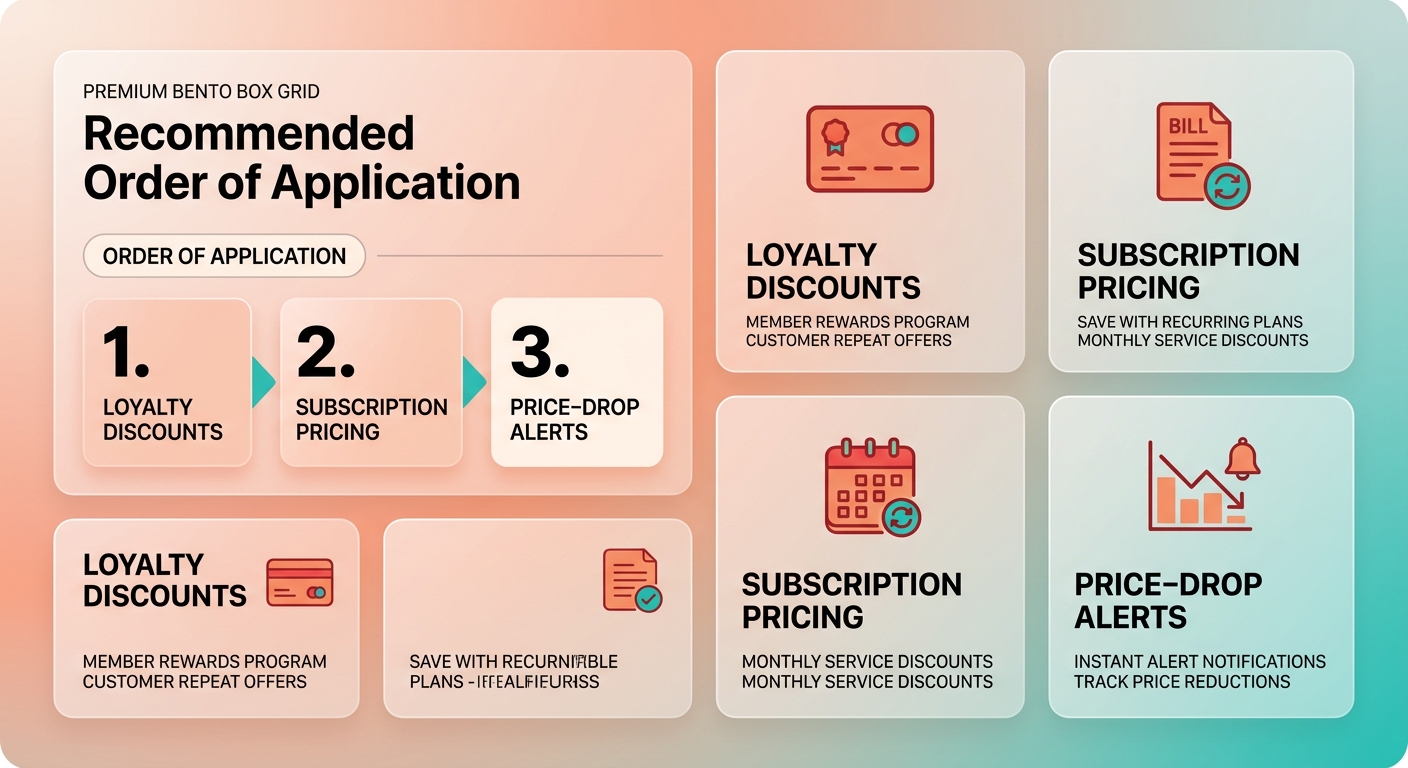
Do coupons and loyalty cards actually change the winner?
Yes, and often more than the base price does. Drugstore programs like CVS ExtraCare and myWalgreens pay out store rewards on personal care that never appear on the shelf tag, so a bottle that looks pricier upfront can land cheaper once those rewards post to your account. Cashback apps such as Ibotta and Fetch add another layer on top.
This creates a real contradiction in the data. Clark Howard's 30-item comparison showed Walmart winning on base prices, while loyalty-adjusted carts tell a different story once rewards and app cashback stack. Both are right, they just measure different carts. If you shop a rewards program, price the store with the payout already factored in. If you don't, base price usually holds.
One reviewer put the loyalty math plainly:
"Shoppers who ignore store rewards are leaving real money on the table every single trip." - Consumer savings columnist
When does buying shampoo in bulk pay off?
Bulk and recurring-delivery pricing win on shampoo you buy on repeat, not on bottles you try once. Warehouse clubs and standing-order programs shine on the household staples you restock monthly, and the same recurring logic applies to a shampoo you already trust.
Skip bulk on premium or salon shampoo you haven't committed to. Locking in six bottles of a $15 formula you end up disliking wipes out any per-unit savings. Reserve stocking up for the drugstore workhorse your family runs through monthly.
How Popgot's label verification fits in
Popgot closes the gap between a raw comparison and an actual saving. Our AI agent reads every label across Amazon, Walmart, Target, and more, verifies the shampoo matches the size and formula you specified, and extracts unit pricing, so you sort by true value in a single search instead of piecing it together store by store. A plain calculator ignores whether the bottle even matches what you wanted.
| Savings Tactic | Best For | Biggest Edge |
|---|---|---|
| Drugstore rewards | Repeat CVS/Walgreens shoppers | Post-purchase payouts flip close matchups |
| Recurring delivery | Staple shampoo on repeat | Locks in a lower standing rate |
| Sale timing | Any brand tier | Watching all three stores |
| Popgot verification | Precise ingredient/size buyers | Verified labels + true unit price |
Traditional retailers keep getting more competitive online, which is highlighted in analyses of multi-product baskets, meaning the margin between major stores is thin enough that your discount stack, not the store's reputation, decides your final price. For a deeper walkthrough, see our guide on checking shampoo deals everywhere.
Using AI verification to ensure ingredient transparency in shampoo shopping
We built AI verification into our product finder because a shampoo label that says "sulfate-free" isn't always accurate, and the only way to catch discrepancies at scale is to read every ingredient list automatically. When you search for a shampoo with specific requirements (no parabens, keratin-enriched, color-safe), our system scans product pages across Amazon, Walmart, and Target, extracts the full ingredient deck from each listing, and flags any bottle where the marketing claim doesn't match what's actually inside. That verification step runs before we calculate unit pricing, so you never see a "cheap" option that secretly contains the ingredient you're avoiding.
Why label claims alone aren't enough
Retailer listings often copy manufacturer descriptions verbatim, and those descriptions emphasize benefits over ingredient disclosure. A bottle marketed as "gentle, plant-based formula" might still contain synthetic fragrances or preservatives that trigger scalp irritation—information buried three clicks deep in a collapsed ingredient accordion. We parse those hidden sections automatically, verify each ingredient against your specified requirements (vegan needs, sulfate exclusions, specific ingredient filters), and surface only the bottles that pass. That filtering happens in real time, so a verified result on our platform means you're comparing verified matches, not just the cheapest bottles that claim the right keywords.
| Verification Step | Manual Check | AI-Powered (Popgot) |
|---|---|---|
| Reading ingredient lists | 3–5 min per product | Instant, all products |
| Checking against your requirements | Requires separate research | Verified automatically |
| Spotting label mismatches | Easy to miss | Highlighted before pricing |
The impact shows up when you're avoiding specific compounds. If you filter for fragrance-free options and a Walmart listing says "unscented" but the ingredient deck lists "parfum" three-quarters down, our scan catches it and removes that bottle from your comparison. The same bottle might rank cheapest on a plain price-per-ounce basis, but you'd pay for it twice: once at checkout and again when your scalp reacts.
FAQ
Which retailer consistently has the lowest shampoo prices?
No single retailer consistently offers the lowest prices. Walmart beat Amazon by 8% on Pantene Pro-V while Amazon undercut both by 12% on TRESemmé refills. Brand-by-brand pricing swings harder than any store's reputation, so checking all three before you buy saves more than loyalty to one store ever will.
How do I calculate unit pricing for shampoo?
Divide the total price by the number of ounces or milliliters to get the true cost per unit. A 20.1-oz bottle at $7.99 costs $0.40 per ounce, while a 12-oz bottle at $5.99 costs $0.50 per ounce. The smaller bottle looks cheaper upfront but costs more per ounce. Popgot extracts and calculates unit pricing automatically across all retailers.
Do subscription services like Subscribe & Save actually save money on shampoo?
Subscribe & Save can drop shampoo prices 5–15% with a recurring delivery commitment. A salon shampoo that costs $15 as a one-time purchase might fall to $12.75 with a subscription. But the savings only work if you're buying the same product on repeat. Locking in six bottles of a formula you end up disliking wipes out any per-unit savings.
How can I verify shampoo ingredients across different retailers?
Popgot's AI agent reads every label across Amazon, Walmart, Target, and more, verifies the shampoo matches the size and formula you specified, and flags any bottle where the marketing claim doesn't match what's actually inside. If you filter for fragrance-free options and a listing says "unscented" but the ingredient deck lists "parfum," our scan catches it and removes that bottle from your comparison.
What's the best time to buy shampoo for maximum savings?
Seasonal beauty events and Black Friday promotions routinely offer 30% or more off everyday prices, but those windows close fast. Price-drop alerts through tools like ShopSavvy notify you when a product falls below your target threshold. The winner changes weekly based on active promotions, subscription commitments, and which retailer is clearing inventory that month.
Are drugstore shampoos significantly cheaper at one retailer over another?
Drugstore staples like Suave differ by pennies across stores. The time-to-savings ratio flips on mass-market bottles under $5: you'll spend longer comparing than the discount justifies. Save the comparison for premium bottles, bulk refills, and anything where an ingredient claim actually drives your purchase.
How do Target's RedCard and other loyalty programs affect shampoo prices?
Target's RedCard takes 5% off at checkout, potentially shifting which retailer offers the best deal. Drugstore programs like CVS ExtraCare and myWalgreens pay out store rewards on personal care that never appear on the shelf tag, so a bottle that looks pricier upfront can land cheaper once those rewards post to your account. If you shop a rewards program, price the store with the payout already factored in.
References
[1] Amazon vs. Walmart vs. Target Price Comparison - https://lendedu.com/blog/amazon-walmart-target-price-comparison/
[2] Price Comparison – Amazon vs. Walmart, Target, Best Buy, eBay ... - https://chromewebstore.google.com/detail/price-comparison-%E2%80%93-amazon/hbmmidflopehdmpfofdpkgopopmodffj?hl=en-US
[3] Target vs Walmart: We Compared 65+ Prices (2025) - https://thekrazycouponlady.com/tips/couponing/targets-everyday-low-price-promise-vs-walmart
[4] Target vs. Walmart price comparison: Which store is cheaper? - https://www.wpxi.com/consumer/clark-howard/target-vs-walmart-price-comparison-which-store-is-cheaper/776817045/?outputType
[5] Which one has the best price? Amazon vs. Walmart vs. Target! - https://www.abc15.com/news/smart-shopper/comparing-identical-items-at-amazon-walmart-and-target-to-see-where-youll-save-the-most
[6] Walmart vs Target vs Amazon: Where are the best prices on household ... - https://www.kshb.com/walmart-vs-target-vs-amazon-best-prices-on-household-staples
[7] Price.com: Save with Cash Back, Coupons & Price Comparison - https://price.com/
[8] ShopSavvy - https://shopsavvy.com/
[9] Cosmetify | The Ultimate Beauty Comparison Site - https://www.cosmetify.com/
Frequently Asked Questions
1. Is it worth comparing shampoo prices on cheap drugstore brands?
Usually not. Mass-market bottles differ by only pennies across stores, meaning the time spent comparing them manually outweighs the potential savings. It is more effective to focus your comparison efforts on premium and salon-tier shampoos, where price differences between retailers are much more pronounced.
2. Does the price shown on Target's website include the RedCard discount?
No, the listed price does not automatically include the loyalty card discount. Target displays potential savings on the product page, but these reductions are only applied once you reach the checkout screen. Additionally, same-day delivery fees may apply unless your order meets the minimum threshold, which can alter the final cost.
3. Can price comparison tools confirm a shampoo is actually sulfate-free?
Standard price tools and barcode scanners typically only compare costs and do not analyze ingredient lists. Specialized platforms like Popgot read the actual ingredient deck of each listing to verify claims like 'sulfate-free' or 'color-safe' before displaying the product, helping you avoid formula mismatches.
4. Which retailer is cheapest overall for shampoo?
No single retailer consistently offers the lowest price across all brands. Pricing fluctuates significantly depending on the specific product and manufacturer, meaning a store that is cheapest for one brand may be more expensive for another. Checking multiple sources for your specific brand is the most reliable way to find the lowest price.
5. Do Amazon's subscription discounts change which store offers the best deal?
Yes. Recurring delivery programs can lower the final cost of a product, sometimes making an initially more expensive listing the cheapest option overall. To get the most accurate comparison, you should factor in these subscription discounts if you plan to set up regular deliveries.
6. Can I stack cashback apps on top of retailer discounts?
Yes. You can combine store-specific loyalty programs, manufacturer coupons, and third-party cashback applications to maximize savings. Stacking these methods allows you to reduce the final price beyond the standard shelf cost shown during your initial search.
7. How much faster is AI comparison than checking each site manually?
Using an automated tool is significantly faster. Instead of opening multiple browser tabs, manually calculating the cost per ounce, and checking ingredient labels yourself, an AI-driven search performs these steps simultaneously to show you the best option in a fraction of the time.