
Find Healthy Nuts at Lowest Prices with Popgot's AI Comparison Tool

Key Takeaways
- Popgot's AI reads nut labels across major retailers, pulls the real unit price, and drops any listing that doesn't match what you asked for.
- In one sample search, Costco's 48 oz raw whole almonds led at $0.37 per ounce with a 4.8 rating.
- Walmart's 16 oz bag beat Amazon's 32 oz listing per ounce. Bigger isn't always cheaper.
- Three steps: type your spec plainly, let the AI verify, sort by unit price, buy.
- Unit prices come off the label, not the marketing copy, so "value pack" claims get checked automatically.
- No account, no onboarding. If you can type a grocery item into a box, you can use it.
- Sorting by price per ounce kills the mental math on mismatched bag sizes that trips up sticker shoppers.
Quick Summary
You tell the AI agent what nuts you want. It reads the labels across major retailers, pulls the real unit price, and drops anything that doesn't match. No tab-juggling, no math on bag sizes.
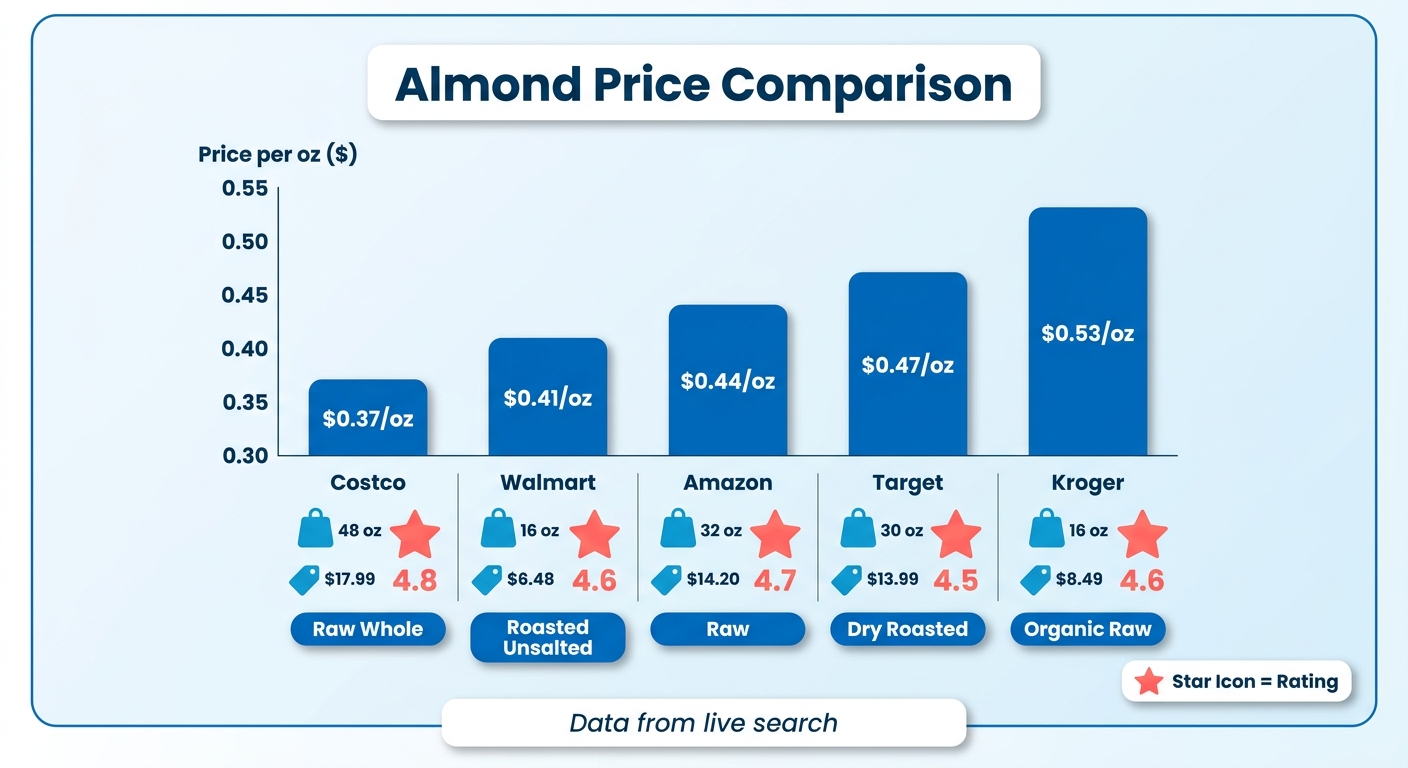
Here's what a typical almond search returns, sorted by price per ounce:
| Product | Retailer | Size | Price | Unit Price | Rating |
|---|---|---|---|---|---|
| Raw Whole Almonds | Costco | 48 oz | $17.99 | $0.37/oz | 4.8 |
| Roasted Unsalted Almonds | Walmart | 16 oz | $6.48 | $0.41/oz | 4.6 |
| Raw Almonds | Amazon | 32 oz | $14.20 | $0.44/oz | 4.7 |
| Dry Roasted Almonds | Target | 30 oz | $13.99 | $0.47/oz | 4.5 |
| Organic Raw Almonds | Kroger | 16 oz | $8.49 | $0.53/oz | 4.6 |
Illustrative example. Run the live search for current pricing.
Notice the bulk bag isn't the automatic winner. The 16 oz Walmart bag beats the 32 oz Amazon listing per ounce. That's exactly the kind of thing you miss shopping by sticker price.
What you actually do
Three steps. Type your spec plainly: "raw unsalted almonds" or "walnut halves, no added oil." The AI reads every listing and checks it against what you asked. You sort by unit price and buy.
Difficulty: Easy. No account setup, no onboarding wall before you get results.
Why trust the unit price
Because it's pulled from the label, not the marketing copy. A "value pack" that costs more per ounce than a smaller bag happens constantly with nuts. Cost per ounce gets calculated automatically, so the real deal floats to the top.
The verification step also kills mismatches. Ask for unsalted and salted roasted mixes stay out of your results. Ask for raw and you skip the honey-coated snack packs pretending to be baking almonds.
Bought smart, nuts are one of the cheapest sources of protein and healthy fat per serving, as Sweet Spot Nutrition lays out. The whole job here is making "bought smart" simple. You say what you need. The agent does the label-reading and the price math.
Why healthy nuts are worth the money
Nuts pack real nutrition into a small handful: healthy fats, plant protein, fiber, and minerals that support your heart and keep you full between meals. That combination is why cardiologists and dietitians keep pushing them as an everyday snack.
The American Heart Association recommends unsalted nuts as part of a heart-healthy eating pattern. Research links regular nut intake to lower heart disease risk, mostly because the unsaturated fats help manage cholesterol. Almonds, walnuts, and pistachios all fit the profile.
The catch: they're not cheap. Prices have climbed over the past few years, and demand keeps growing as more shoppers work them into daily routines. A bag of raw almonds or walnuts can run higher per ounce than most pantry staples.
Which nuts give you the most nutrition per dollar
The cheapest heart-healthy nuts and seeds vary widely by store and format. A price comparison from Sweet Spot Nutrition tracked in-store Costco prices against a large chain grocer and found big gaps between retailers for the same items. Buying in bulk often wins. Not always.
That last point matters more than people expect. A warehouse bulk bag looks like the obvious deal, but the per-ounce math sometimes favors a smaller bag on sale elsewhere. Popgot's own breakdown on why Costco isn't always cheaper shows how these assumptions cost you money.
Who gets the biggest payoff
Health-conscious shoppers and parents feeding growing kids. If you buy nuts weekly, small per-ounce differences add up fast over a year. Checking five retailers by hand for every purchase is tedious, and nobody keeps a spreadsheet of unit prices in their head.
Parents packing school lunches hit this constantly. So do people managing cholesterol who eat nuts daily on a dietitian's advice.
That's the gap an AI comparison tool fills. It reads the labels, pulls the real unit price, and drops the options that don't match. You keep the health benefits without overpaying for them.
Where this is headed
Finding the cheapest healthy nuts used to mean five open tabs and mental math on bag sizes. Now you describe what you want, the AI reads the labels, verifies the product, and hands you the real price per ounce across every major retailer. That's the whole pitch, and it holds up.
The advantage isn't just speed. It's accuracy. The tool checks that a "raw almond" listing is actually raw and unsalted before ranking it, so you're comparing the same thing across stores. Unit pricing gets normalized too, which is where bulk bags quietly win or lose.
Why label accuracy matters this much
A wrong or vague listing can steer you toward a product that doesn't fit your diet or your budget. The Food and Drug Administration enforces nutrition and ingredient labeling rules precisely so shoppers can trust what a package claims. An AI that verifies those claims against the label extends that same protection to your cart.
This is the gap most shopping tools ignore. They match keywords and stop there. Reading the actual nutritional data means you skip the salted, sweetened, or oil-roasted versions when you asked for plain almonds.
What comes next
Expect the verification engine to widen beyond nuts into other everyday essentials, applying the same unit-price math to pantry staples where bag sizes play the same tricks. Separating real nutritional data from a plain product feed already sets it apart from a basic aggregator, as the comparison with Google Shopping lays out.
Try it on your next order. Search almonds, walnuts, or pistachios, sort by price per ounce, and see what your usual pick actually costs against the field.
The bigger shift is what happens when shoppers stop trusting the sticker price and start demanding verified unit data. Retailers respond to that pressure. Cleaner labels and honest per-ounce pricing benefit everyone who buys food online.
How the AI comparison tool works
The AI agent does something a search bar can't: it reads product labels and confirms the specs match. Type "raw unsalted almonds" and it filters out roasted, salted, or flavored listings before ranking anything. You get a clean comparison of the same product across stores.
How the AI verifies specs
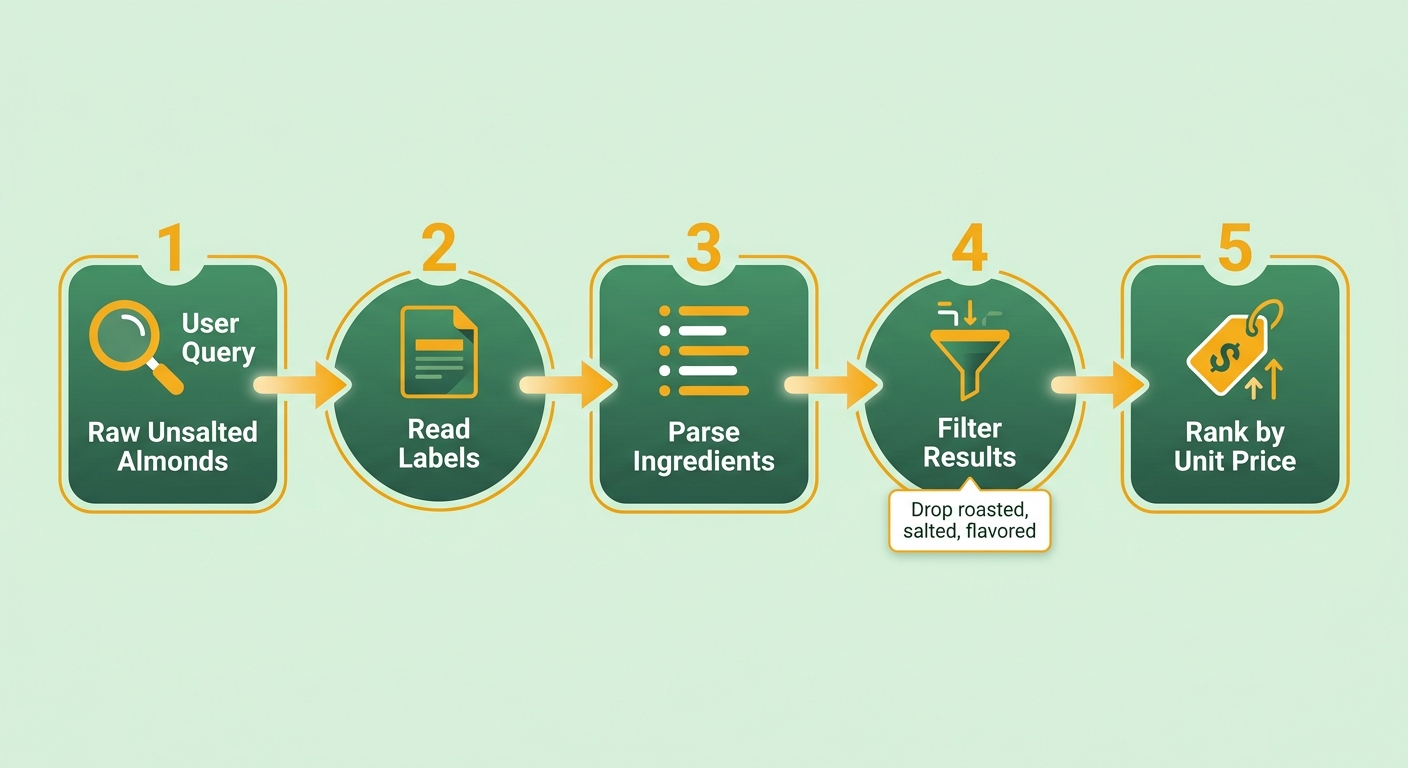
The agent parses each listing's ingredients and product attributes, then keeps only the items that match your request. Ask for raw almonds and a "dry roasted" bag gets dropped. Ask for unsalted and salted versions never make the cut.
This matters because retailer titles lie by omission. A listing might say "almonds" in big letters and bury "honey roasted" in the fine print. The AI catches that so you're not comparing a plain nut against a candied one.
Ingredient checking also protects the price ranking. A flavored or coated product often costs more per ounce for reasons that have nothing to do with the nut itself. Filtering those out keeps your price-per-ounce comparison honest.
How the unit pricing works
The tool pulls the pack size and shelf price from each retailer, then calculates a normalized price per ounce so bags of different weights line up on one scale. A 12 oz pouch and a 32 oz resealable bag stop being a guessing game once both show the same per-ounce figure.
That normalization is where bulk buys get exposed. A warehouse-size bag looks like a deal until the math says otherwise.
The payoff is simple. You skip the tabs and the arithmetic, and you see the true cost side by side.
Two things stand out:
- Time savings: One request replaces five tabs and a calculator.
- Price transparency: Every result shows the real cost, verified against the actual label.
You describe what you want. The agent reads, verifies, and ranks. You buy the cheapest bag that actually matches.
Running a real nut search
Getting the best price on healthy nuts takes three steps: enter your specs, let the agent read the labels, then sort by unit price. The whole thing runs from a single search box. Here's how to work it.
Setting your product requirements
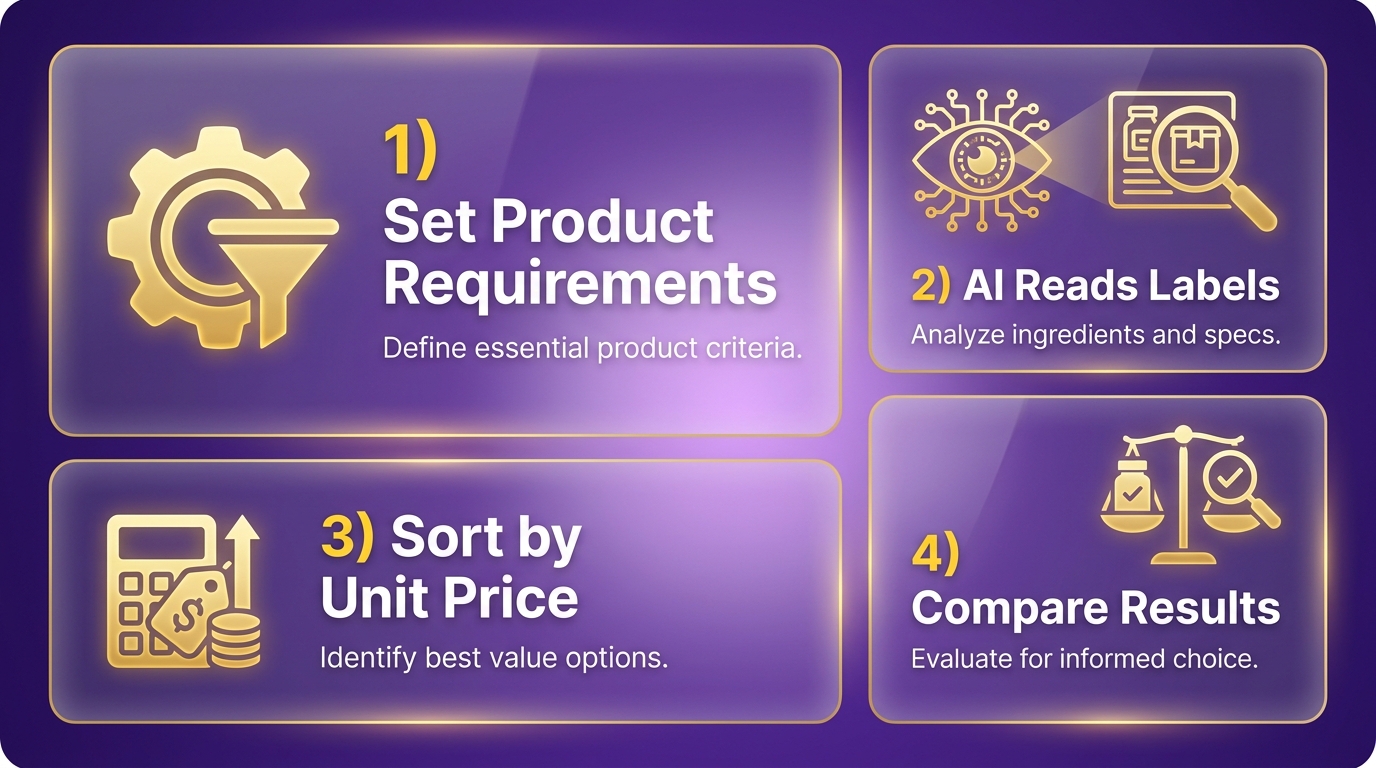
Type exactly what you need, including any dietary limits or health goals. The more specific the request, the tighter the results. A vague "almonds" pulls everything. "Organic raw unsalted almonds" filters out roasted, salted, and conventionally grown bags before you see a single price.
Spell out what matters:
- Type: raw, dry roasted, blanched, or slivered
- Sodium: unsalted or lightly salted
- Sourcing: organic or conventional
- Format: whole nuts, halves, or pieces
The agent confirms each listing matches, so a "walnut" search won't hand you a candied trail mix. That step is what keeps the comparison honest across stores.
What a real search looks like
Ask for "organic raw almonds under $0.60 per ounce" and the agent scans listings across major retailers, then ranks them by real price per ounce. You get a clean table showing size, total price, and normalized unit cost side by side. Search organic walnut halves and two listings look close on the sticker, but one comes in a resealable pouch and the other in a plain bag. The table strips away the packaging noise and lines up the per-ounce cost, so the cheaper actual value stands out instead of the flashier label.
Bulk isn't automatic savings, though. A warehouse bag sometimes loses to a mid-size online listing once you check the per-ounce number.
Narrowing results further
Add filters once the first results load. Push the price ceiling lower, switch from whole to pieces if you only need them for baking, or bump the minimum rating to skip low-reviewed bags.
Cross-reference the ratings column too. A bag at $0.37 per ounce with a 4.8 rating beats a slightly cheaper option sitting at 4.1. Price and quality live in the same table, so you weigh the tradeoff in one glance.
Popgot vs. coupon tools
Most price comparison tools were built to find coupons, not to compare products. That's the core gap. Coupon browser extensions scan for discount codes at checkout. They don't read ingredient labels, they don't normalize unit pricing, and they don't verify that two "almond" listings are actually the same product.
What makes it different from coupon extensions
The difference is product verification plus accurate unit pricing. A coupon extension might save you a dollar on a bag you already picked. It won't tell you that bag costs more per ounce than a bigger one two clicks away.
Search "raw unsalted almonds" in a typical coupon or deal-finder tool and it returns a list of stores selling almonds, sorted by sticker price or by whatever affiliate deal pays best. A 12-ounce salted bag shows up next to a 16-ounce raw bag. The tool has no idea they're different products. You're left doing the math yourself, which is the tab-juggling problem you started with.
Popgot skips that. It confirms the almonds match your request, then sorts by price per ounce so a small pricey bag never masquerades as a deal.
Why unit pricing beats coupons
Unit pricing decides the real winner more often than any coupon code. A 5% checkout discount means nothing if the underlying bag runs 40% higher per ounce than a bulk option. Sticker-price tools hide that. Popgot surfaces it.
This is where a lot of shoppers get burned on warehouse sizes. Bigger isn't automatically cheaper.
There's also the nutrition angle. Deal tools compare prices; they ignore what's inside the package. The Popgot vs Google Shopping comparison walks through how structured nutritional data changes which product actually wins your search. If you want the lowest true cost on healthy nuts, verified specs and normalized unit pricing beat a stack of coupon codes.
How the savings actually add up
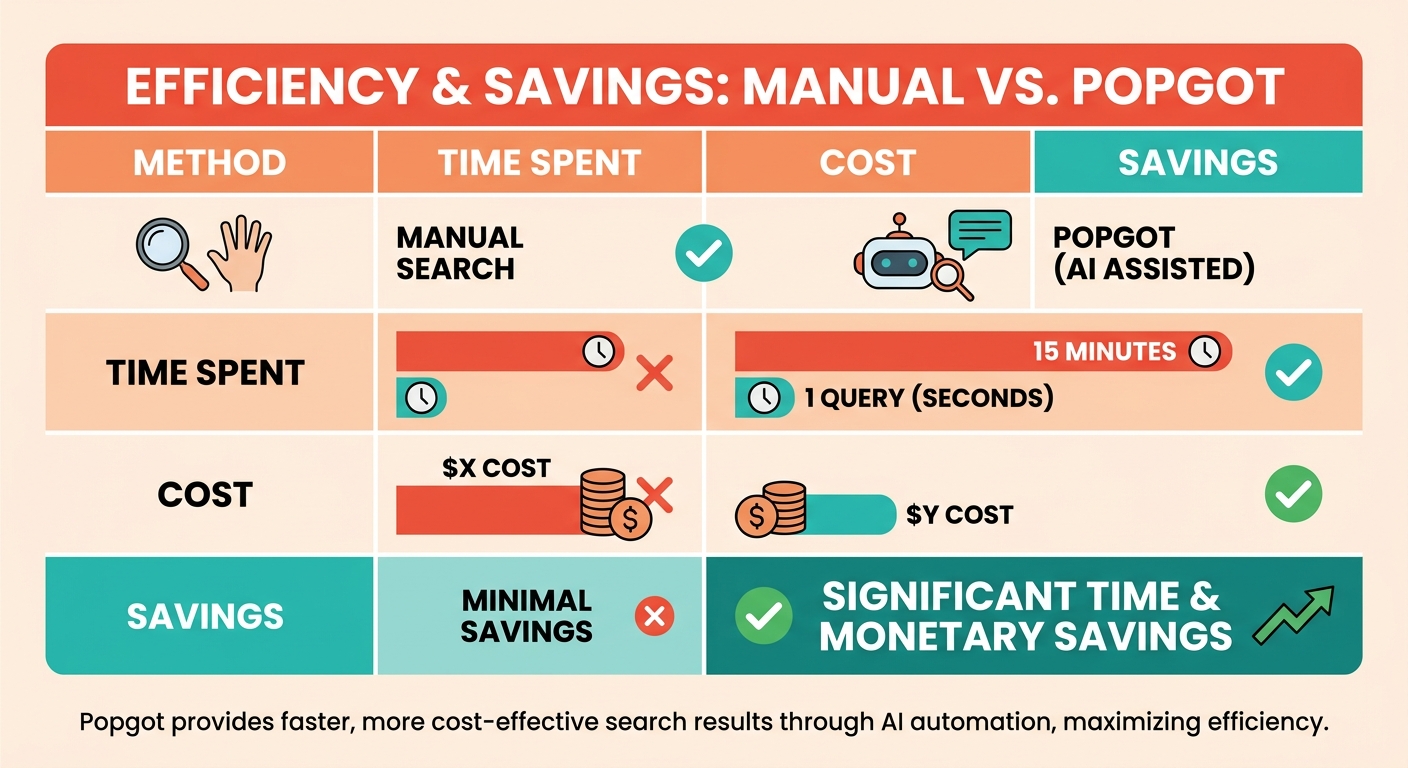
The biggest savings come from skipping the manual price-per-ounce math entirely. A single search reads every label, normalizes the unit price, and ranks results in seconds. What used to take fifteen minutes of tab-switching now takes one query.
Price transparency is where the real money hides. When you can see the true cost per ounce side by side, the cheapest bag stops being a guess. That visibility changes what you actually buy.
How much accurate unit pricing saves you
The savings come from spotting the gap between sticker price and real value. Retailer prices for the same nut vary widely between stores, and the biggest bag isn't always the winner. That Canadian price comparison of nuts and seeds pulled in-store warehouse prices against a large online chain and found the ranking shifts depending on where you look and what size you compare.
That's the trap. A bag priced lower on the shelf can cost more per ounce than a bigger one across town. Without normalized unit pricing, you'd never catch it. Say you want raw unsalted cashews. One store lists a 12-ounce bag at a friendly-looking price, another lists a 32-ounce bag that seems expensive up front. Run the numbers and the big bag wins by a wide margin per ounce. The tool does that comparison before you commit.
How to squeeze the most out of it
Get specific and sort ruthlessly. The tighter your request, the fewer irrelevant results you sift through, and the faster you land on the genuine best deal.
Three habits stretch every dollar:
- Search with full specs: Include type, sodium, and format so the agent filters mismatches before ranking.
- Sort by unit price, not sticker price: The lowest tag rarely means the lowest cost per ounce.
- Check the warehouse assumption: Bulk sometimes loses. The Costco isn't always cheaper breakdown shows how often the big bag falls short.
Run these three moves on every nut search and you stop overpaying by default.
References
[1] The Least Expensive Nuts and Seeds for Heart Health - https://sweetspotnutrition.ca/cost-nuts-seeds/
Frequently Asked Questions
1. Can I use Popgot's tool to compare nut butters or other nut-based products?
The tool currently focuses on whole nuts and their attributes like raw, roasted, salted, and organic formats. The verification engine is expanding beyond nuts into other pantry staples where bag sizes create pricing confusion, so broader nut product coverage may follow over time.
2. Does the tool factor in shipping costs when calculating price per ounce?
The tool extracts shelf price and pack size directly from product labels to calculate normalized cost per ounce. Shipping isn't mentioned as part of the unit-price calculation, so factor delivery fees separately, especially when comparing online-only listings against warehouse or in-store retailer prices.
3. How do nut ratings factor into choosing the cheapest option?
Ratings appear alongside price in the comparison table, letting you weigh quality against cost. A bag at $0.37 per ounce with a 4.8 rating beats a cheaper option sitting at 4.1. You can also set a minimum rating filter to skip poorly reviewed products entirely.
4. Why have healthy nut prices risen in recent years?
Nut prices have climbed largely due to growing consumer demand as more shoppers add them to daily routines on dietitian and cardiologist advice. Raw almonds and walnuts now often cost more per ounce than most pantry staples, making per-ounce comparison shopping increasingly valuable for regular buyers.
5. What dietary specifications can I include in my search?
You can specify type (raw, dry roasted, blanched, slivered), sodium level (unsalted or lightly salted), sourcing (organic or conventional), and format (whole, halves, or pieces). The more precise your request, the tighter the results, since vague searches like "almonds" return everything unfiltered.
6. How does Popgot differ from Google Shopping for nut searches?
Popgot uses structured nutritional data to verify product specifications, while Google Shopping largely matches keywords against a plain product feed. This distinction means Popgot confirms a "raw almond" listing is genuinely raw and unsalted before ranking it by verified unit price.
7. Is bulk buying from warehouse stores always the cheapest choice for nuts?
Warehouse bulk bags frequently lose on per-ounce cost despite looking like obvious deals. A price comparison from Sweet Spot Nutrition found rankings shift depending on store and size compared. Sometimes a mid-size online listing or a smaller sale bag beats the giant warehouse option per ounce.