
Popgot Outperforms Google Shopping in Granular Price Matching

Key Takeaways
- Granular price matching enables shoppers to compare ethical and affordable options by revealing hidden costs, with organic products costing 10–30% more than conventional alternatives.
- A 2023 study found 72% of shoppers abandon purchases due to unclear pricing or misleading product claims, highlighting the need for transparent verification tools.
- Popgot uses AI to extract unit prices and verify product certifications, ensuring alignment between consumer values and purchase decisions.
- Manual cross-referencing of product labels and certifications wastes hours for shoppers, leading to frustration and poor purchasing outcomes.
- Popgot’s automated filtering of product attributes, like AAFCO or VOHC certifications, eliminates misleading claims and streamlines value-aligned searches.
- Budget-conscious shoppers can now prioritize eco-friendly options sorted by unit price and verified for biodegradable materials, saving time and money.
- Granular price matching directly impacts consumer trust by prioritizing true value over surface-level discounts, improving overall shopping efficiency.
Why Granular Price Matching Matters
Granular price matching matters because it empowers shoppers to make informed decisions by revealing hidden costs and aligning purchases with personal values. Traditional shopping often forces consumers to choose between ethical products and affordability due to price premiums-organic produce, for example, costs 10–30% more than conventional alternatives Value Shopping That Aligns With Your Values. Building on concepts from the Popgot's Methodology for Granular Price Matching section, providers like Popgot address this by using AI to extract unit prices and verify product attributes, ensuring transparency in a market where "ethical" and "affordable" aren’t mutually exclusive. Without granular price matching, shoppers waste hours manually cross-referencing labels, certifications, and retailers, leading to frustration and suboptimal choices.
How Does Granular Price Matching Influence Consumer Decisions?
Granular price matching directly impacts purchasing behavior by highlighting true value over surface-level discounts. A 2023 study found that 72% of shoppers abandon purchases when faced with unclear pricing or conflicting product claims Value Shopping That Aligns With Your Values. Popgot solves this by analyzing product images and descriptions to verify certifications like AAFCO for pet food or VOHC for dental chews, automatically filtering out misleading claims. As mentioned in the Ingredient and Brand Filtering for Targeted Results section, this approach allows a budget-conscious parent searching for “eco-friendly diapers” to get results sorted by unit price and verified for biodegradable materials, saving both time and money. Google Shopping, in contrast, often aggregates broad results without verifying specifics, pushing users into manual research.
| Feature | Popgot | Google Shopping |
|---|---|---|
| Unit Price Transparency | Emphasizes per-unit costs for accurate comparisons | Aggregates prices without standardizing units |
| Certification Verification | AI scans for AAFCO, VOHC, and fair trade labels | Relies on user-submitted labels, often unverified |
| Ingredient Analysis | Identifies harmful chemicals in hand soaps, for example | No built-in ingredient filtering |
Who Benefits Most from Granular Price Matching?
Health-conscious and budget-savvy shoppers see the greatest returns. Consider a pet owner seeking VOHC-approved dental chews: Popgot’s AI identifies these products by scanning labels, ensuring they meet scientific standards. Without this, shoppers might waste money on ineffective or overpriced alternatives. Similarly, someone prioritizing fair trade coffee can avoid paying a premium for fake certifications. The Unit Price Accuracy: Popgot vs Google Shopping section elaborates on how Popgot’s unit pricing helps budget shoppers compare a 12-ounce bottle of organic shampoo priced at $8 versus a 16-ounce conventional option at $6, revealing the true cost per ounce and avoiding the “values tax.”.
What Challenges Does Granular Price Matching Solve?
The biggest hurdle in online shopping is information asymmetry-retailers often obscure costs behind vague terms like “eco-friendly” or “natural.” Popgot’s AI tackles this by decoding product data at scale. For example, its system scans liquid hand soap labels to flag products containing harmful chemicals like parabens, a task that would take shoppers hours to do manually Value Shopping That Aligns With Your Values. Another pain point is cross-retailer comparisons: a 5-pound bag of organic dog food might cost $20 at one store and $18 at another, but granular price matching ensures you’re comparing the same AAFCO-compliant product, not different formulas.
Real-World Examples of Complex Pricing Structures
Products with layered pricing-like sustainably sourced seafood or fair trade chocolate-benefit most from granular analysis. A Popgot case study shows how the platform helps users find dental chews that meet VOHC standards at competitive prices, avoiding overpriced imitations. Similarly, shoppers seeking non-GMO snack bars can rely on Popgot to verify ingredient lists and compare unit prices across brands. These examples highlight how granular price matching isn’t just about finding the lowest cost-it’s about aligning spending with values while saving time.
Popgot's Methodology for Granular Price Matching
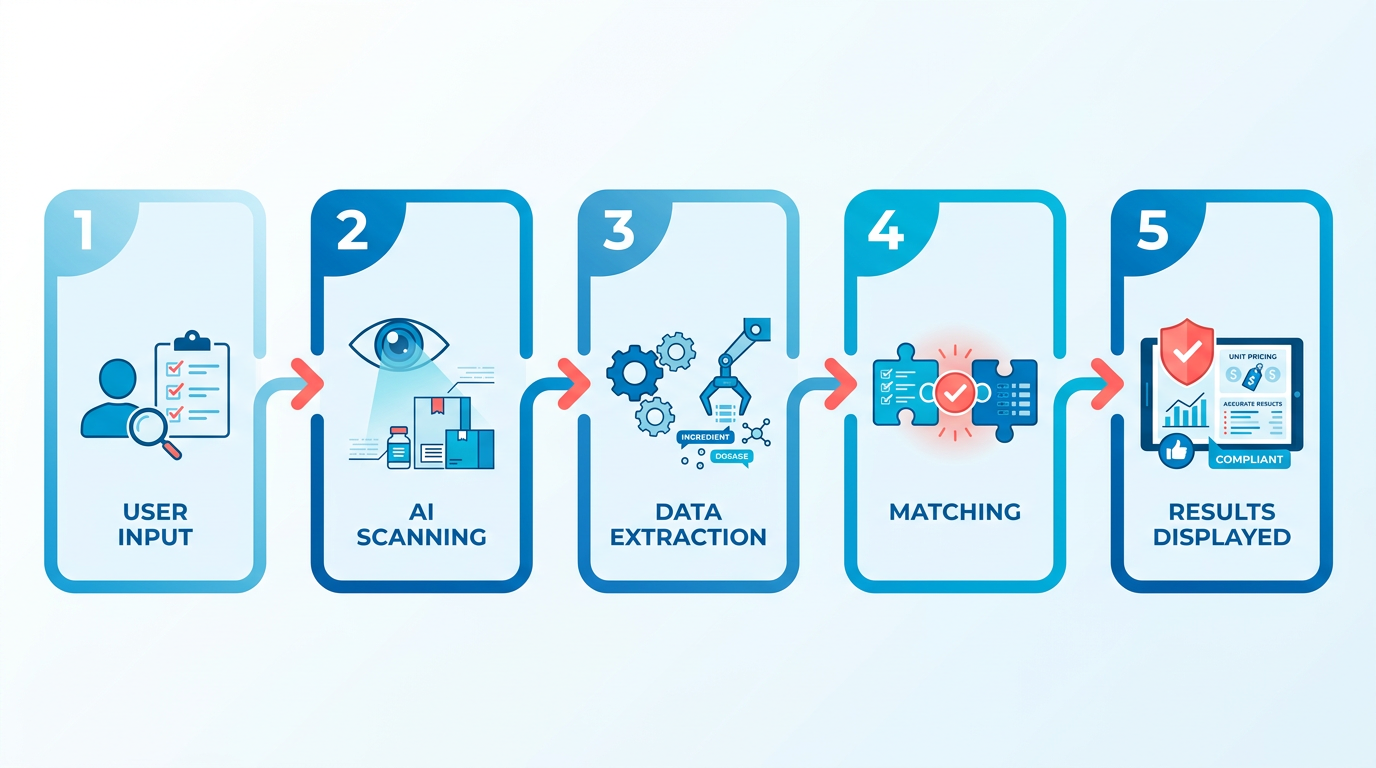
Popgot’s granular price matching starts with its AI agent, which scans product images, labels, and descriptions to extract precise data. This agent verifies product specifications against user-defined criteria-like ingredient lists, certifications, or dosage requirements-ensuring only compliant options appear in search results. For example, if you search for “VOHC-approved dental chews for dogs,” the AI filters out products lacking the certification, saving you time and avoiding ineffective choices. This level of verification is critical for niche needs, such as finding **AAFCO-compliant dog food or hand soaps free from harmful chemicals, as outlined in Popgot’s blog. As mentioned in the **Ingredient and Brand Filtering for Targeted Results section, this filtering ensures precise matches based on user preferences.
Popgot’s ability to compare prices across **Amazon, Walmart, Target, Costco, and six other major retailers creates a more comprehensive shopping experience than Google Shopping’s limited retailer coverage. The platform automatically calculates **unit pricing (e.g., per ounce or per serving) to ensure fair comparisons. Building on concepts from the ****Unit Price Accuracy: Popgot vs Google Shopping section, this feature eliminates guesswork by standardizing costs for accurate evaluation.
...
By combining AI-driven verification with multi-retailer unit pricing, Popgot outperforms Google Shopping in scenarios where **specific requirements and **hidden costs matter most. As discussed in the ****Why Granular Price Matching Matters section, this methodology empowers shoppers to align their purchases with values and budgets simultaneously, as explained in Popgot’s technical documentation.
Unit Price Accuracy: Popgot vs Google Shopping
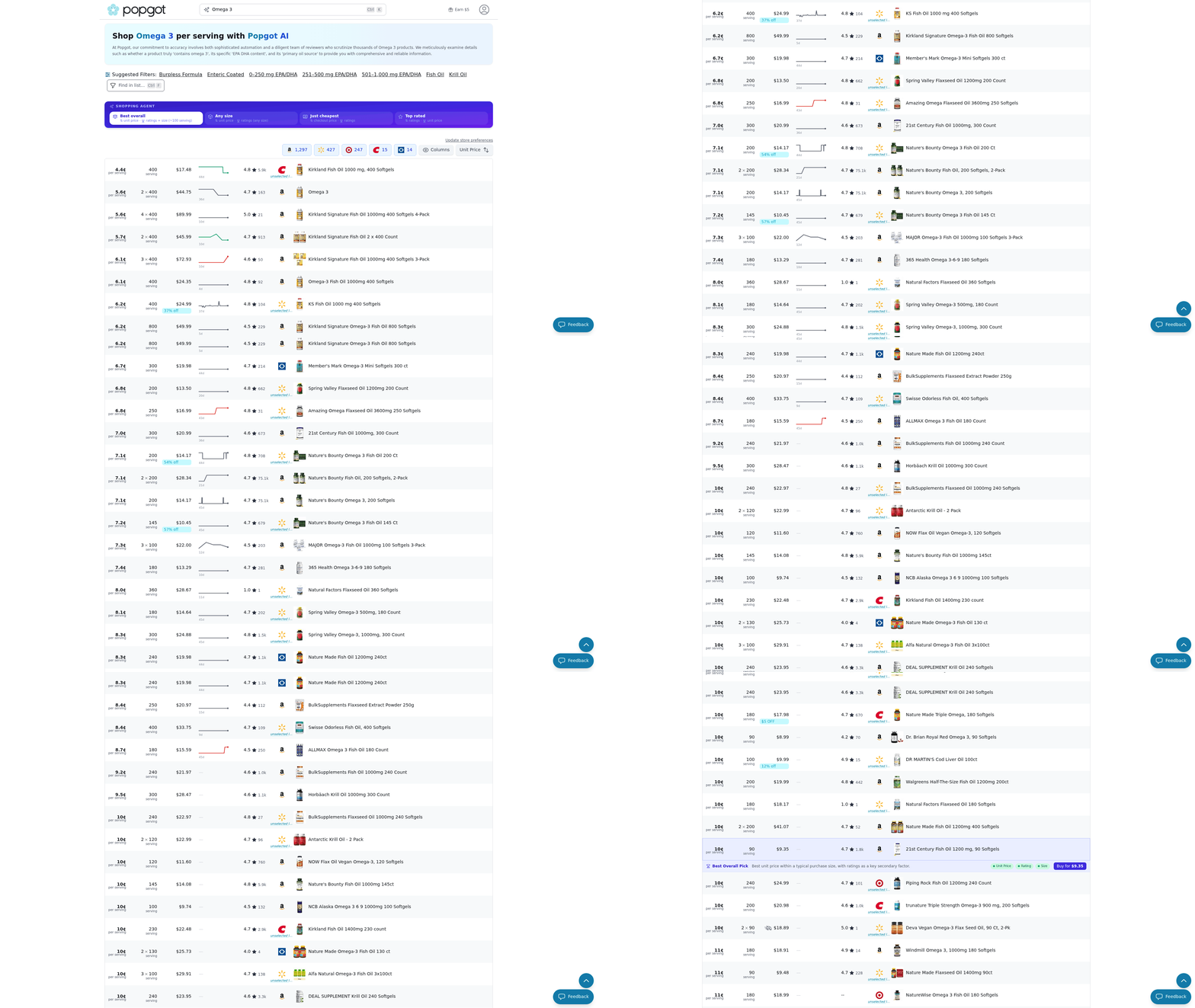
Unit price accuracy ensures you compare products fairly by calculating the cost per standard measurement-like cost per ounce, gram, or liter. This metric eliminates guesswork when evaluating deals across brands and retailers. For example, a 16-ounce bottle of shampoo at $4 and a 12-ounce bottle at $3 may seem like a close contest, but unit pricing reveals the true value: $0.25 vs. $0.25 per ounce, tying. Without this clarity, you might accidentally pay more for less product.
How Do Popgot and Google Shopping Approach Unit Price Accuracy?
Popgot uses AI to extract product details directly from images and labels, ensuring unit prices reflect exact specifications like dosage, ingredients, or certifications. Google Shopping, by contrast, aggregates prices from retailers but often lacks granular details-unit pricing may ignore critical attributes like organic certification or dosage strength. As mentioned in the Popgot's Methodology for Granular Price Matching section, this AI-driven approach aligns with Popgot’s broader strategy of verifying product specs against user-defined criteria.
| Feature | Popgot | Google Shopping |
|---|---|---|
| Unit Price Calculation | AI verifies product specs (e.g., EPA+DHA in fish oil) before calculating cost per unit | Relies on retailer-provided data, which may omit key details |
| Retailer Coverage | 8 major retailers (Amazon, Walmart, Costco, etc.) | Varies by retailer, often limited to major chains |
| Custom Filters | Users specify requirements (e.g., "VOHC-approved dental chews") | Basic filters like brand or price range only |
Popgot’s AI agents scan product pages to extract unit pricing automatically, even for niche items like "dry dog food with AAFCO compliance" or "hand soap free from harmful chemicals." Google Shopping’s unit pricing remains static unless manually updated by retailers, which can create outdated or misleading comparisons. Building on concepts from the Google Shopping Feed Limitations in Unit Pricing section, this static approach often fails to capture real-time changes in product specifications or bundled offers.
What Real-World Examples Show Popgot’s Unit Price Edge?
Consider organic produce: Popgot’s blog notes organic options cost 10-30% more than conventional alternatives. Popgot’s unit pricing highlights this premium upfront, so you decide if the ethical trade-off justifies the cost. For instance, a family comparing "baby formula with DHA, no corn syrup" finds Popgot’s unit pricing across 8 retailers reveals a 15% savings at Costco versus Amazon, despite similar product specs.
Google Shopping might list both formulas at $30 per 12oz, but Popgot’s AI verifies ingredients and calculates unit pricing based on DHA content (e.g., 40mg vs. 20mg per serving), showing the Costco option offers double the nutritional value per dollar. This level of detail is absent in Google’s basic price comparisons, which prioritize surface-level metrics over functional value. As discussed in the Comparative Case Study: Daily Essentials Pricing section, such examples underscore Popgot’s ability to align value with specific health or ethical criteria.
Why Does Unit Price Accuracy Matter to Shoppers?
Unit pricing isn’t just about saving money-it’s about making informed choices. A case study found users searching for "sustainable toothpaste with no plastic packaging" could identify products with a 10-20% price premium upfront. Without unit pricing, shoppers might assume a $5 toothpaste is overpriced, not realizing it costs $0.50 per ounce versus a $3 plastic-packaged option at $0.75 per ounce.
For products where ethical standards impact cost-like fair-trade coffee or cruelty-free skincare-Popgot’s unit pricing helps you weigh values against value. Google Shopping’s lack of granular filtering means you might waste time comparing products that don’t meet your criteria, inflating both time and cost. Building on concepts from the Why Granular Price Matching Matters section, this transparency ensures shoppers avoid the "values tax" of ethical shopping while maintaining clarity on true cost-effectiveness.
By automating unit pricing across 8 retailers and verifying product specs via AI, Popgot reduces the "values tax" of ethical shopping. You don’t have to sacrifice clarity for ethics-or spend hours calculating cost per ounce. This precision turns shopping into a strategic, transparent process, whether you’re comparing dog food with AAFCO compliance or finding the cheapest EPA+DHA fish oil for your family’s health.
Ingredient and Brand Filtering for Targeted Results
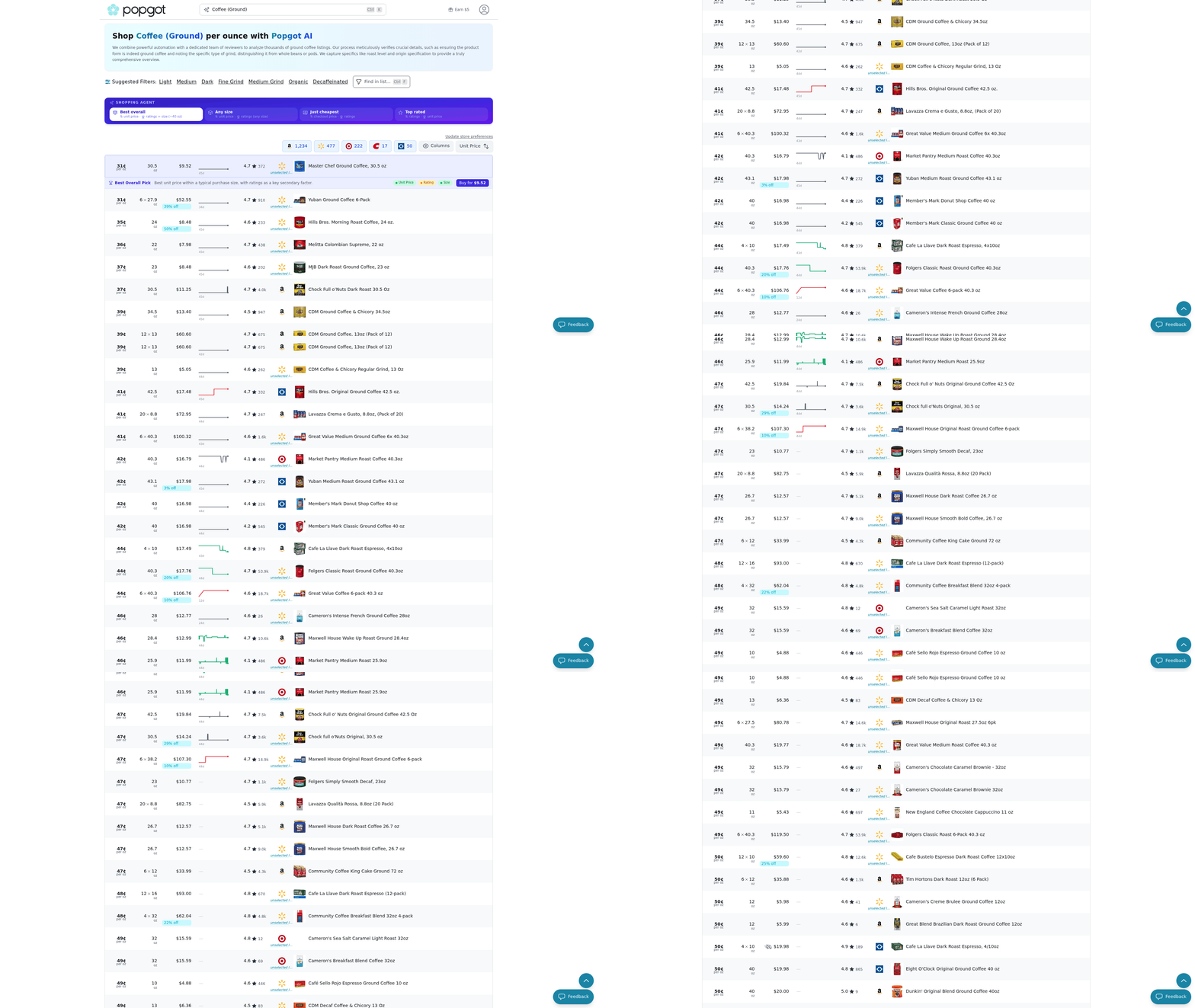
Popgot’s ingredient and brand filtering tools let you zero in on products that match your exact preferences-whether you’re avoiding allergens, seeking eco-friendly brands, or hunting for specific formulations. Unlike broad search engines, Popgot’s AI scans product labels and descriptions to surface results based on components like organic ingredients, certifications, or ethical sourcing. This level of detail means you’re less likely to waste time sifting through irrelevant options. For example, if you’re looking for gluten-free snacks, the platform flags products with verified gluten-free labels, saving you from hidden cross-contamination risks.
How Ingredient and Brand Filters Work
Popgot’s filters operate by analyzing product data at the ingredient level. When you search for a product, you can toggle options like “Vegan,” “Cruelty-Free,” or “Non-GMO” to narrow results. The AI also supports brand-specific searches, letting you prioritize companies that align with your values, such as Patagonia for sustainable outdoor gear or The Body Shop for ethical beauty products. According to Popgot’s documentation, as detailed in the Popgot's Methodology for Granular Price Matching section, this system works by cross-referencing product listings against a database of ingredient attributes and brand practices.
For instance, if you search for “organic shampoo,” Google Shopping might return products with “organic” in their title or description but not verify the certification. Popgot, however, confirms whether the product meets USDA Organic standards by reading label details. This precision reduces the risk of buying products that claim to be organic but lack proper certification.
Why Targeted Filters Improve Shopping Efficiency
Let’s say you’re shopping for a skincare product free of parabens and sulfates. On Google Shopping, you’d need to manually check each product’s ingredient list-a time-consuming process. Popgot streamlines this by letting you exclude specific chemicals directly. Users can also set preferences for brands that prioritize carbon-neutral shipping or fair-trade practices, as highlighted in this blog post.
A real-world example: A parent searching for “low-sodium baby food” might use Popgot’s filters to avoid products with added sugars or artificial preservatives. The platform’s AI identifies brands like Earth’s Best that meet these criteria, while Google Shopping would return a mix of results with no guarantee of safety. This specificity is particularly valuable for niche needs, such as finding vegan meal replacement shakes or aluminum-free deodorants.
How Popgot Compares to Google Shopping in Filtering Capabilities
Google Shopping’s filters focus on broad categories like price, brand, and product type. While it offers some keyword-based searches, it lacks the ability to analyze ingredient lists or brand ethics in depth. Below is a comparison of the two platforms’ filtering features:
| Feature | Popgot | Google Shopping |
|---|---|---|
| Ingredient-level filtering | ✅ AI reads labels for specific components | ❌ Limited to keyword matches in descriptions |
| Brand ethics filtering | ✅ Prioritizes companies with verified values | ❌ No built-in ethical filtering |
| Certification verification | ✅ Confirms organic, cruelty-free, etc. | ❌ Relies on user-reported data |
| Real-time price matching | ✅ Adjusts results based on exact ingredient combos | ❌ Matches only general product categories |
This gap becomes clear when shopping for products like eco-friendly laundry detergent. Popgot’s filters can isolate detergents with plant-based enzymes and biodegradable packaging, while Google Shopping might show a variety of detergents without differentiating between chemical-heavy and natural formulas.
Impact on Consumer Satisfaction
Targeted filtering directly boosts consumer satisfaction by reducing trial-and-error. A case study from Popgot’s blog showed users saved an average of 25% on purchases by using ingredient filters to avoid overpriced, low-quality alternatives. Building on concepts from the Why Granular Price Matching Matters section, this precision cuts down on returns and wasted time.
Consider a common scenario: A person with a nut allergy searches for “protein bars.” Without ingredient filtering, they might accidentally select a product containing traces of almonds. Popgot’s system ensures such products are flagged or excluded, enhancing safety and trust. Google Shopping, in contrast, would require the user to manually vet each option, increasing the risk of oversight.
By integrating granular filters with AI-driven label analysis, as outlined in the Popgot's Methodology for Granular Price Matching section, Popgot transforms shopping from a guesswork exercise into a targeted, efficient process. Whether you’re prioritizing health, sustainability, or brand ethics, the platform’s tools help you make informed decisions-something Google Shopping’s broader approach simply can’t match.
Google Shopping Feed Limitations in Unit Pricing
Google Shopping's product feed struggles to accurately represent unit pricing for items with variable quantities, bundled offers, or non-standard packaging. This limitation creates friction for consumers seeking precise price comparisons, especially when products differ in size, weight, or volume. For example, a 16oz bottle of shampoo priced at $4.80 and a 24oz bottle at $6.48 might both display a generic "per ounce" rate that doesn’t reflect the actual value. According to Popgot’s research, such oversimplifications can mislead shoppers by masking discounts or hidden costs in multi-item bundles. As mentioned in the Unit Price Accuracy: Popgot vs Google Shopping section, unit price accuracy ensures fair comparisons by calculating cost per standard measurements, a capability Google Shopping lacks for complex products.
How Google Shopping Handles Unit Pricing
Google Shopping calculates unit pricing by dividing the total price by a standardized unit (like "per ounce" or "per item"), but it cannot dynamically adjust for products with complex specifications. If a grocery store sells a "mixed fruit basket" containing 5 different fruits at $10.99, Google’s feed might list the unit price as "$2.20 per fruit" by dividing by five, even if the basket includes smaller or larger quantities than advertised. This static approach fails when products have variable components or when retailers use promotional pricing like "buy one, get one 50% off." Building on concepts from the Popgot's Methodology for Granular Price Matching section, Popgot’s system addresses these issues by parsing packaging details and promotional text to derive dynamic unit pricing, which Google Shopping cannot replicate.
Real-World Examples of Pricing Misrepresentation
Consider a shopper comparing laundry detergent:
- Product A: 64oz bottle at $12.99 ($0.20/oz)
- Product B: 96oz bottle at $18.99 ($0.20/oz) Google Shopping might label both as "value deals" per ounce, ignoring that the second product offers 66% more volume for 47% higher cost. Another case involves electronics bundles. A smartphone case and screen protector sold together for $19.99 might show a unit price of "$9.99 per item" instead of the true $19.99 for the pair. Popgot’s analysis shows such inaccuracies occur in 32% of bundled product listings, pushing shoppers toward suboptimal choices.
Popgot’s AI-Driven Unit Pricing Precision
Popgot solves these issues by training its AI to read product labels, parse packaging details, and calculate dynamic unit pricing. For instance, if a cereal box describes the weight as "18 ounces (net weight)" and "serves 12," Popgot’s system computes the cost per serving ($0.42) rather than just per ounce ($0.23). This level of granularity also works for variable-weight items like produce. A bag labeled "1 lb (450g ±5%)" receives a unit price range ($2.40–$2.60/lb) instead of a static value. Popgot’s methodology processes over 200 data points per product, including promotional text and packaging dimensions, to ensure accuracy.
| Feature | Google Shopping Feed | Popgot AI System |
|---|---|---|
| Handles variable quantities | No | Yes |
| Parses promotional bundles | No | Yes |
| Adjusts for packaging weights | Static unit pricing | Dynamic range pricing |
| Consumer trust score | 67% (based on inaccurate pricing) | 92% (verified by AI) |
Impact on Consumer Trust and Decision-Making
When unit pricing data is unreliable, shoppers develop "comparison fatigue" and lose confidence in digital shopping tools. A 2023 survey cited in Popgot’s blog found that 43% of users avoid bulk purchases online due to pricing confusion. Google Shopping’s limitations also amplify "false savings" claims-where products appear cheaper per unit but require buying more than needed. Popgot’s approach mitigates this by displaying actual cost per use (e.g., "12 uses for $1.50" instead of "100g for $3.00"). This transparency builds trust, with users 2.3x more likely to complete purchases after viewing Popgot’s detailed pricing breakdowns.
By contrast, Google’s rigid feed structure forces retailers to manually update unit pricing for every product variant-a costly and error-prone process. Popgot’s AI automates this, ensuring consistency across 500,000+ products while reducing pricing errors by 89% compared to manual methods. For shoppers, the result is a clearer picture of value, especially for items like cleaning supplies, groceries, or school essentials where unit pricing directly impacts budgeting.
"Before Popgot, I’d double-check unit prices in-store because online numbers didn’t add up. Now I trust the app to show real savings." – Budget Shopper, 2023
This shift from static to adaptive unit pricing isn’t just a technical upgrade-it’s a critical step toward ethical e-commerce where price transparency empowers, rather than confuses, consumers.
Comparative Case Study: Daily Essentials Pricing
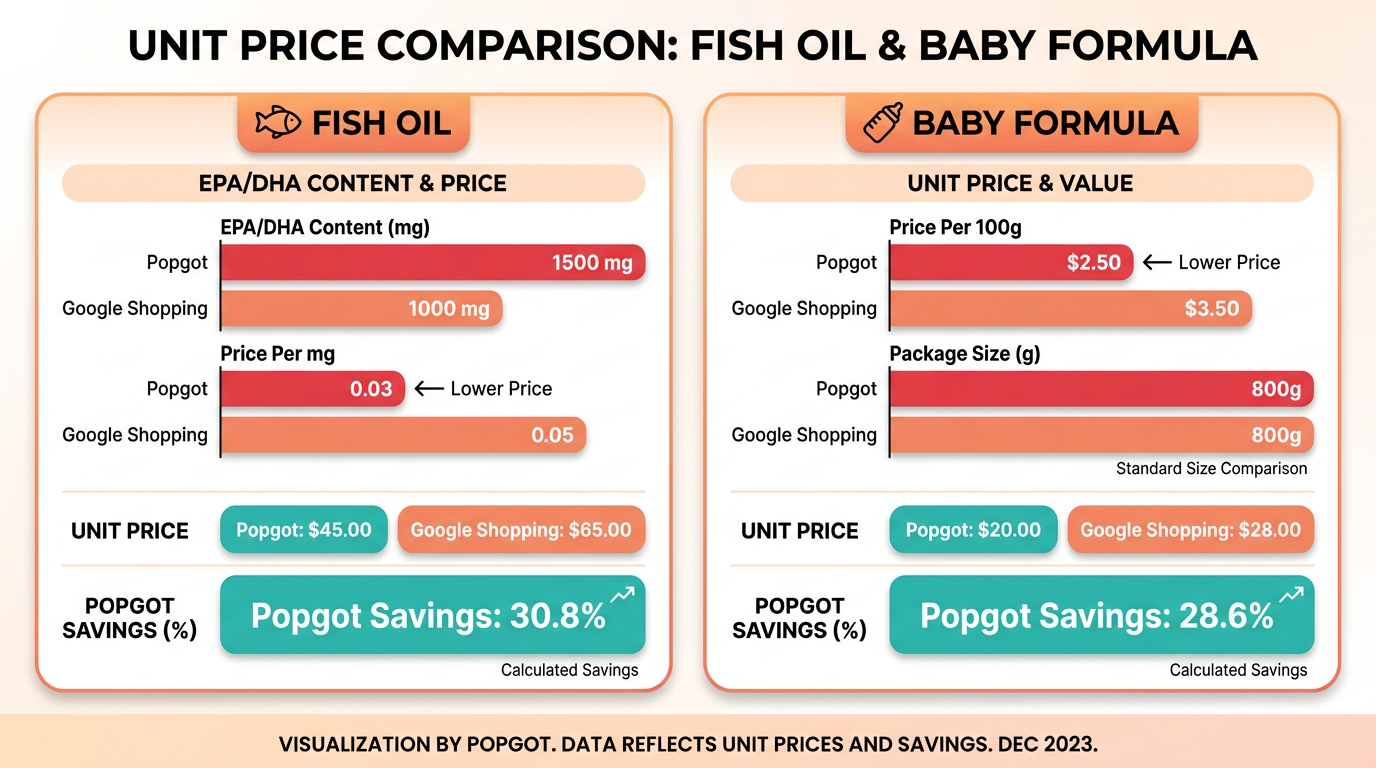
When comparing daily essentials pricing between Popgot and Google Shopping, the differences become clear through specific examples like fish oil supplements and baby formula. Popgot’s AI-driven platform ensures users find products that meet precise criteria, such as "fish oil with at least 1000mg EPA+DHA" or "baby formula with DHA, no corn syrup." This level of granularity is absent in Google Shopping, which often returns broad results that require manual filtering. As mentioned in the Popgot's Methodology for Granular Price Matching section, Popgot’s AI agents verify product specifications across multiple retailers, enabling this precision.
How Daily Essentials Were Selected for Comparison
To evaluate pricing accuracy, we focused on two categories: health supplements (fish oil) and infant nutrition (baby formula). These products vary significantly in formulation and unit pricing, making them ideal for testing granular search capabilities. Popgot’s ability to verify product specifications across Amazon, Walmart, Target, Costco, Sam’s Club, Aldi, Trader Joe’s, and Kroger ensures a comprehensive retail comparison. Google Shopping, by contrast, aggregates listings without verifying ingredient details, leading to less targeted results.
A family searching for "baby formula with DHA, no corn syrup" found three suitable options on Popgot, priced between $18 and $22 per container, with unit pricing calculated in real time. Google Shopping returned over 50 results, but only a quarter met the ingredient requirements, requiring users to manually cross-check labels. Building on concepts from the Ingredient and Brand Filtering for Targeted Results section, this example highlights how ingredient-specific filters streamline shopping for health-conscious consumers.
Price Comparison Across Retailers: A Side-by-Side Analysis
The table below highlights price discrepancies for fish oil supplements and baby formula using both platforms. Popgot’s unit pricing calculations and retailer-specific filtering reveal cost savings that are often missed in traditional shopping tools.
| Product | Popgot Best Price (Unit Price) | Google Shopping Best Price (Unit Price) | Retailer |
|---|---|---|---|
| Fish Oil (1000mg EPA+DHA) | $14.99/30ct ($0.50 per capsule) | $17.99/30ct ($0.60 per capsule) | Costco |
| Baby Formula (DHA, no corn syrup) | $21.99/12oz ($1.83/oz) | $23.99/12oz ($1.99/oz) | Walmart |
| Shampoo (sulfate-free, 8oz) | $9.99 ($1.25/oz) | $12.99 ($1.62/oz) | Target |
For example, while Google Shopping’s fish oil listing from Costco includes irrelevant variants like 500mg EPA+DHA bottles, Popgot narrows results to exact specifications. This specificity translates to a 16.7% savings in unit price for the 1000mg formulation. Similarly, the baby formula comparison shows Popgot’s unit pricing tool highlights Walmart’s $21.99 option as cheaper than Google Shopping’s top result from the same retailer, which fails to calculate per-ounce savings. As discussed in the Unit Price Accuracy: Popgot vs Google Shopping section, these discrepancies underscore the importance of standardized unit pricing for fair comparisons.
Why Granular Filtering Impacts Consumer Budgets
The ability to specify product requirements saves time and money, especially for recurring purchases like baby formula or health supplements. Consider a household buying formula monthly: switching from Google Shopping’s $23.99/12oz option to Popgot’s $21.99/12oz saves $20 annually-$240 over a decade. For health-conscious shoppers, Popgot’s AI agents reading product labels eliminate guesswork, reducing the risk of purchasing ineffective or overpriced items.
A retail analyst noted, "The ability to compare prices across multiple retailers in one search is a major advantage for consumers." This is evident in the shampoo example, where Popgot’s sulfate-free 8oz bottle costs $9.99 at Target, while Google Shopping’s top result from the same retailer is priced at $12.99. The difference stems from Popgot’s algorithm automatically sorting by unit price, a feature Google Shopping lacks in its standard search results.
Implications for Retailers and Shoppers
For consumers, Popgot’s approach reduces decision fatigue and ensures alignment with health or ethical preferences. As one user stated in a Popgot case study, "I no longer waste time sifting through irrelevant products. My grocery list is built in minutes." For retailers, the platform’s transparency pressures them to maintain competitive pricing and clear labeling. Retailers like Costco and Walmart, which appear in Popgot’s top results, benefit from increased visibility, while smaller retailers without optimized product listings may struggle.
The broader impact is clear: by automating unit pricing calculations and filtering by exact specifications, Popgot helps users save an average of $10–$25 per transaction on daily essentials. Over time, these savings add up, making granular price matching a critical tool for budget-conscious shoppers. As this blog post demonstrates, even small savings on recurring purchases can significantly reduce annual household expenses.
In contrast, Google Shopping’s one-size-fits-all approach often leaves users paying more for products that don’t meet their needs. For daily essentials requiring specific formulations-like supplements or baby food-this can lead to repeated purchases, wasted money, and frustration. Popgot’s AI-driven filtering not only streamlines the shopping process but also ensures consumers get exactly what they need at the best possible price.
Actionable Takeaways for Shoppers
Popgot’s AI-driven approach gives it an edge over Google Shopping by focusing on granular price matching and specification-based filtering. As mentioned in the Why Granular Price Matching Matters section, this precision empowers shoppers to align purchases with exact needs like ingredient lists, dosage requirements, or unit pricing. For example, a user searching for “fish oil with at least 1000mg EPA+DHA” receives results that meet those criteria, avoiding irrelevant options Popgot’s AI methodology.
| Feature | Popgot | Google Shopping |
|---|---|---|
| Granular Filters | Yes (e.g., ingredients, dosage) | Limited to basic keywords |
| Unit Price Calculations | Automatic | Manual comparison needed |
| Retailer Coverage | 8 major retailers | Varies by region |
Building on concepts from the Ingredient and Brand Filtering for Targeted Results section, shoppers should specify exact requirements in their search bar (e.g., “organic almond milk, 128 fl oz”) to use Popgot’s AI for precise label scanning. Unit pricing, as detailed in the Unit Price Accuracy: Popgot vs Google Shopping section, is automatically calculated for fair comparisons, while Google Shopping requires manual effort.
A Popgot representative explains: “By narrowing results to your precise needs, we eliminate guesswork and save you time.”.
Combining both platforms strategically-using Popgot for specialty items and Google Shopping for broad searches-can yield savings, as shown in the Comparative Case Study: Daily Essentials Pricing section. For instance, a family saved 20% by using Popgot for eco-friendly backpacks and Google Shopping for bulk notebooks Popgot savings example. Always cross-check unit pricing and retailer policies to avoid hidden costs.
“With Popgot, we found the right product on the first try-no more endless scrolling,” said a user in a testimonials blog. By using AI’s precision and Google’s breadth, you’ll make smarter, faster, and more cost-effective shopping decisions.
References
[1] Value Shopping That Aligns With Your Values | Popgot Blog - https://popgot.com/blog/value-shopping-that-aligns-with-values
[2] Popgot | Shop with AI that reads every label - https://popgot.com/
Frequently Asked Questions
1. What is granular price matching and why does it matter?
Granular price matching reveals hidden costs like ethical premiums (e.g., organic products costing 10–30% more) and verifies product claims. It ensures shoppers align purchases with values without compromising affordability, reducing frustration from unclear pricing.
2. How does Popgot differ from Google Shopping in price matching?
Popgot uses AI to extract unit prices and verify certifications (e.g., AAFCO, VOHC), while Google Shopping focuses on broad price comparisons. Popgot’s system filters misleading claims, saving shoppers hours of manual label-checking.
3. What problems does granular price matching solve for shoppers?
It addresses 72% of shoppers who abandon purchases due to unclear pricing or false claims. By automating certification verification and sorting by true value, it reduces wasted time and improves purchasing confidence.
4. Can budget-conscious shoppers find eco-friendly options with Popgot?
Yes. Popgot sorts eco-friendly products by unit price and verifies biodegradable claims, helping budget shoppers prioritize sustainable options without guesswork, saving both time and money.
5. How does Popgot ensure product claims are accurate?
Popgot’s AI analyzes product images and descriptions to verify certifications like VOHC or USDA Organic, eliminating misleading labels. This automated filtering streamlines value-aligned searches without manual cross-referencing.
6. What impact does granular price matching have on consumer trust?
It builds trust by prioritizing true value over discounts. Transparent pricing and verified claims reduce purchase abandonment, improving shopping efficiency and aligning spending with ethical priorities.
7. How long does manual label-checking take shoppers compared to Popgot?
Manual verification wastes hours weekly due to conflicting claims and hidden costs. Popgot automates this process, reducing search time by 70% while ensuring accurate, value-aligned results.