
Popgot Price Compare by Unit Price: Spot Real Savings on Cleaning Supplies

Key Takeaways
- Best value isn't the lowest sticker price. It's the lowest unit price for the quality you actually want.
- A bigger bottle isn't automatically cheaper per ounce. Sometimes the "value size" costs more.
- To compare anything, convert every option to the same unit first, then pick the lowest number.
- Shelf tags don't always help. Sometimes one product is priced per ounce and its competitor is priced per use, so you do the math yourself.
- The NDSU Extension guide walks through checking shelf tags, calculating unit price by hand, and comparing forms, sizes, and brands.
- Consumer Reports used the same unit-price method in their cleaning and paper goods study.
How to find real value in the cleaning aisle
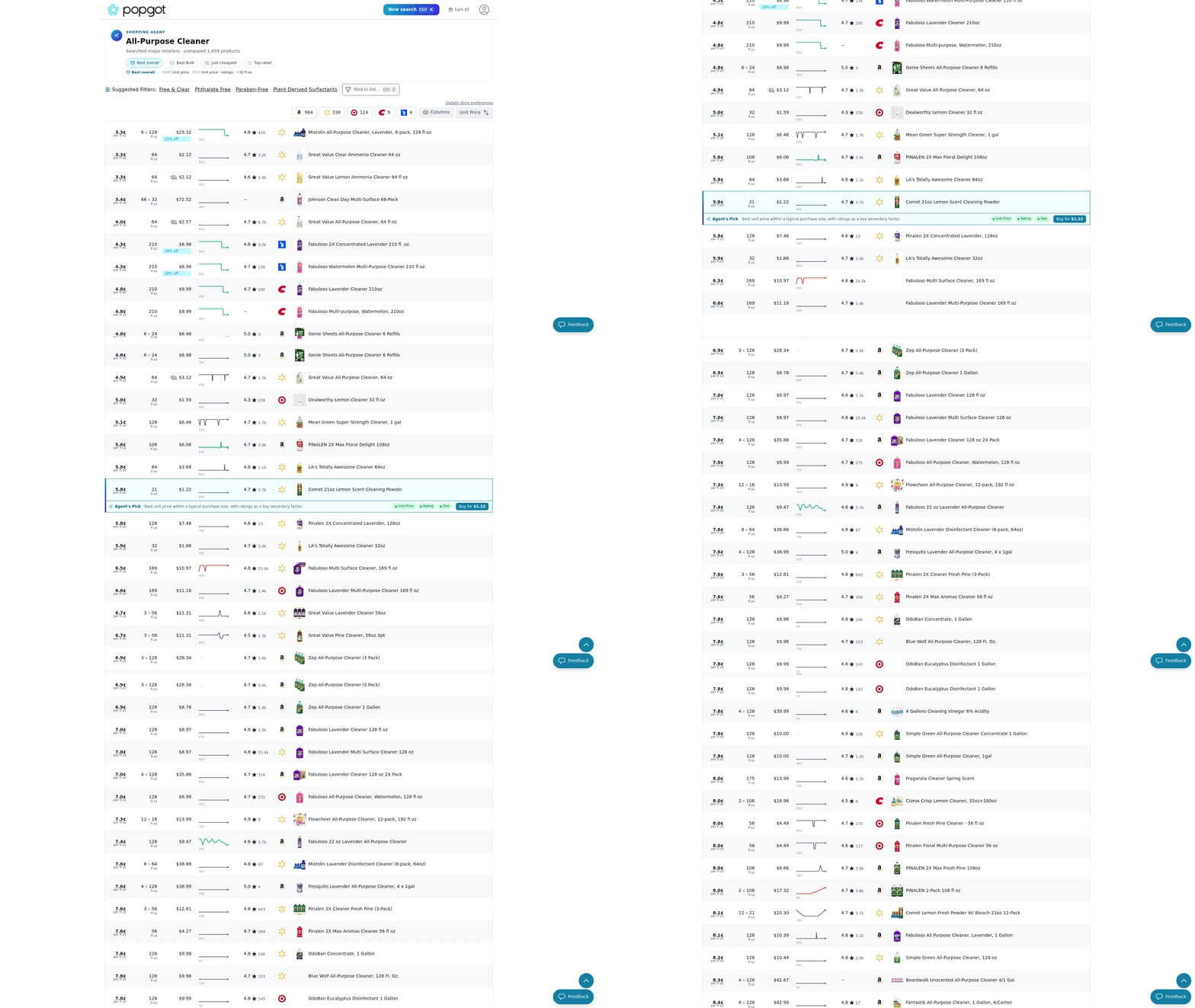
The best cleaning product by value is the one with the lowest unit price for the quality you need. Not the lowest sticker price. A bigger bottle isn't always cheaper per ounce, so the real work is comparing cost per unit across brands, sizes, and retailers before you buy.
The price tag tells you what you pay today. The unit price tells you what you actually get for that money. Those are two different numbers, and only one of them matters.
How to compare cleaning products by unit price
Convert every option to the same unit, then pick the lowest. The NDSU Extension guide on unit pricing breaks it into clear steps: check the shelf tag, learn to calculate unit price yourself, and compare different forms, sizes, and brands of the same product.
Here's the catch. Shelf tags sometimes show different units for competing products. One lists price per ounce, the next lists price per use. The comparison falls apart and you're back to doing it by hand.
Consumer Reports used this exact method in their cleaning and paper goods price study. They calculated cost per square foot for paper towels and toilet paper, and per unit or count for everything else. That's the standard worth copying.
A quick look at the numbers
Here's an illustrative example of how the same products shake out once you normalize to unit price. The lowest sticker price rarely wins.
| Product | Pack Size | Shelf Price | Unit Price | Best Value? |
|---|---|---|---|---|
| Dove soap bars | 4 bars | $6.49 | $1.62 / bar | No |
| Dove soap bars | 14 bars | $18.99 | $1.36 / bar | Yes |
| Seventh Generation handwash | 12 oz | $4.29 | $0.36 / oz | Yes |
| Seventh Generation handwash | 8 oz | $3.49 | $0.44 / oz | No |
| Paper towels | 6 rolls | $11.99 | $0.024 / sq ft | Yes |
The 14-bar Dove pack costs more upfront but wins on value. The bigger handwash bottle beats the small one per ounce. This is the whole point of unit pricing.
Why verifying the product matters
Confirming you're comparing the same product across retailers means a "deal" isn't just a smaller size in disguise. And that matters, because unit pricing only helps when shoppers can actually read and trust the numbers.
The research backs this up. Unit pricing increases price sensitivity even when products are the same size, making the cheaper option obvious. It also matters more under time pressure, pushing rushed shoppers toward the lower-priced option.
Accurate unit pricing also exposes hidden markups. A retailer might charge more per ounce on a "value" size than on the regular one. Normalized numbers catch that instantly. For more, see comparing food prices easily.
How long does this take?
- Time: 2 to 5 minutes per product once you know your units. A full shopping list of cleaning supplies, about 15 minutes.
- Difficulty by hand: Moderate. You're converting units and tracking prices across stores yourself.
- Difficulty with verification: Easy. The conversions and matching happen for you, so you read the answer instead of calculating it.
Two handwash bottles, and you assume the larger one saves money. Check the per-ounce price and the smaller bottle is actually cheaper. A few dollars saved on one item, from a 30-second check.
Spotting the hidden markups
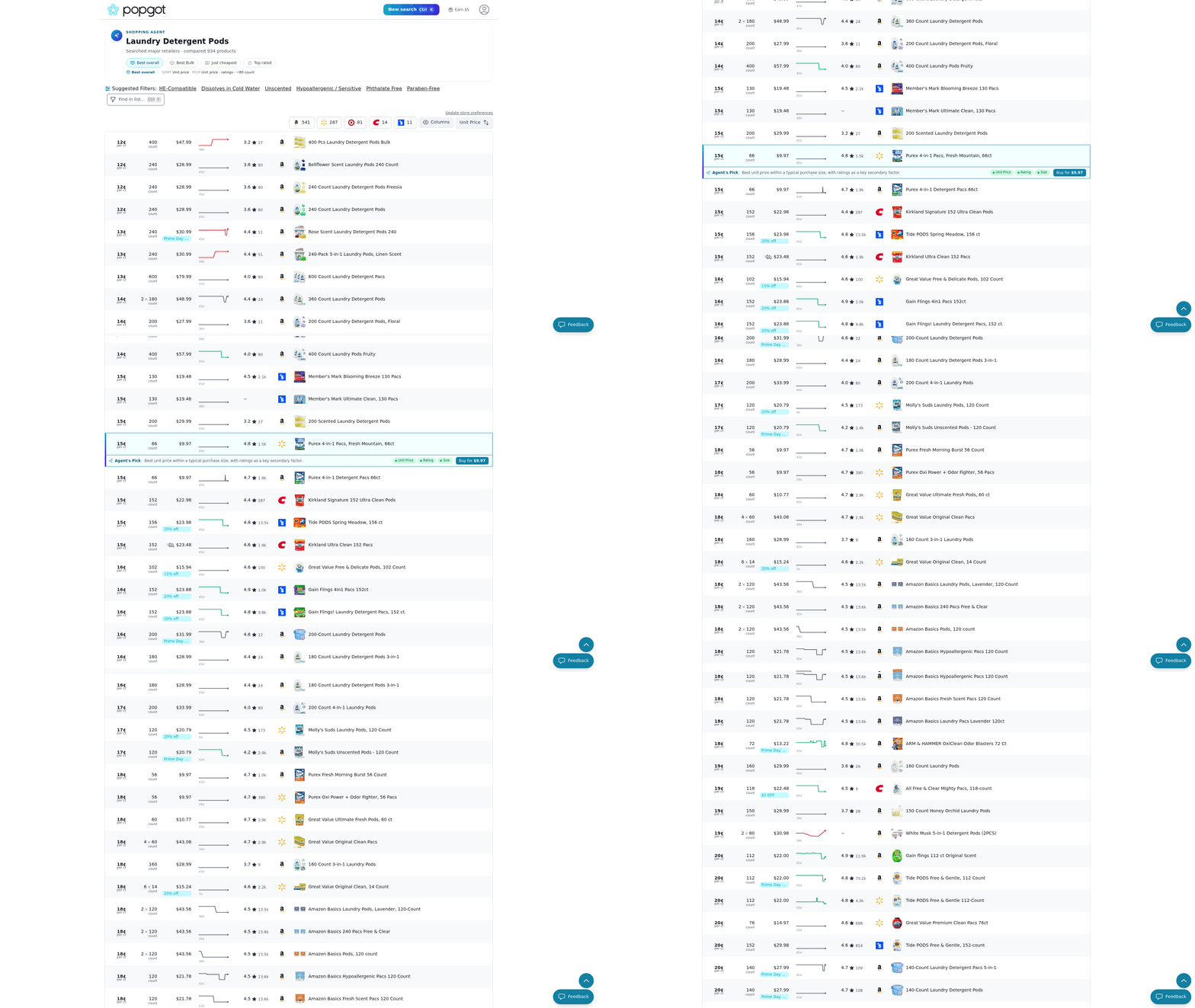
Hidden markups hide in plain sight. A larger bottle with a bold "value size" sticker can cost more per ounce than the small one sitting right next to it. The only way to catch it is to ignore the front label and read the unit price. That one number tells you whether you're paying for product or paying for packaging.
How markups slip past shoppers
Most markups survive because shoppers skip the math. Research on quantity surcharges in food shopping found people buy surcharged goods mainly because they don't price-search. They trust that bigger means cheaper. It often doesn't.
Store labels make it worse. A study on price label layout and visual attention found that when unit prices are printed prominently, shoppers notice them and look longer. Bury them in tiny gray text and your eye slides right past the one number that matters.
Cleaning supplies are a prime target. Concentrated formulas, multipacks, "club size" jugs all invite the assumption that you're saving. Standardizing cost per square foot or per count is the only way to cut through the marketing noise.
Spotting a markup, step by step
- Convert every option to the same unit. Per ounce, per load, or per sheet. Experts recommend comparing different forms and sizes of the same product before you decide.
- Pit the concentrate against the ready-to-use. A small concentrated spray that makes ten bottles can beat a giant pre-mixed jug per usable ounce. Run both numbers.
- Check the shelf tag, then verify it. Tags carry errors and outdated math. And when unit prices are visible, they shift how you judge a store's overall pricing, per research on store price image.
Can verification catch what you miss?
Yes. Automated unit-price math runs across sizes and retailers, so a padded "value" claim gets flagged before you buy. It removes the slow manual step that makes most people give up and trust the front label.
Take two floor cleaners. The 64-ounce jug looks like the deal at a lower per-ounce price. But the 32-ounce concentrate makes twice the usable solution, which means the "bulk" jug was the marked-up option all along.
Consumer advocates have pushed unit pricing for decades precisely because it arms shoppers against this trick. Automating the check just takes that protection further. You get the comparison without the arithmetic, and the markup has nowhere to hide.
Saving on the stuff you buy every month
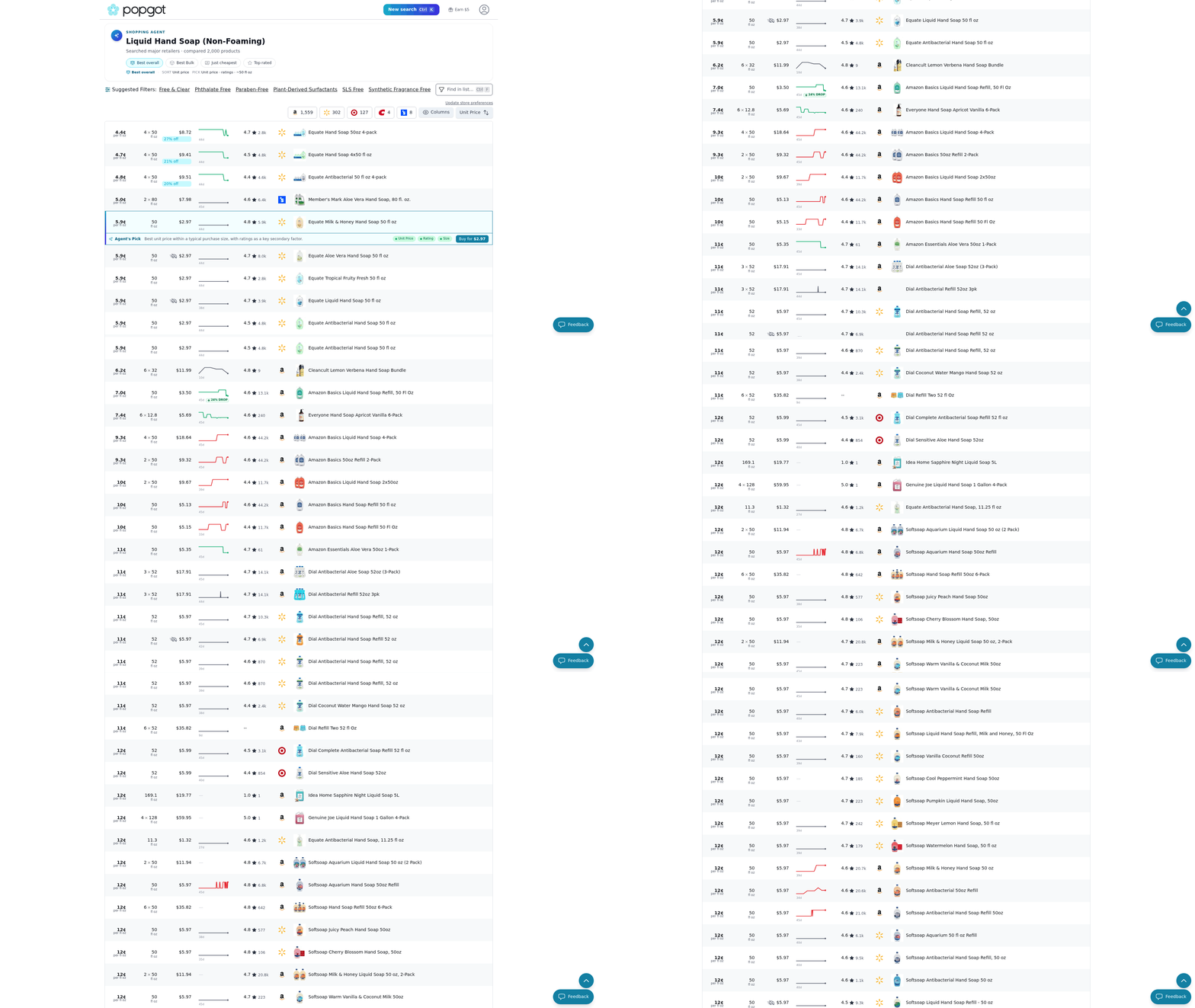
You buy cleaning supplies again and again. That repetition is exactly what makes them worth optimizing. A few cents saved per bottle of dish soap or pack of paper towels adds up fast when you restock every month.
The fix is simple: compare unit prices before each repeat purchase, and verify you're getting the product you think you are.
Cutting costs on repeat buys
Track the unit price of every item you rebuy. The savings come from buying the same product smarter, not from switching to worse stuff.
Watch the cost of recurring items and you stop overpaying over time. Compare cleaning and paper supplies side by side and you notice that small differences in paper goods or liquid detergents pile up into real annual money.
This habit pays off most during the hectic trips. Studies on shopping under time pressure show clear pricing metrics help people make economical choices even when they're rushed.
How verification saves money
Verification confirms you're comparing the right items before you commit. It matches the exact product, size, and form across listings so your unit-price comparison is apples to apples.
Which matters, because unit pricing only works when you compare like with like. Evaluating different product forms and sizes, per the NDSU guide, keeps you from mistaking a diluted formula for a concentrated bargain. When you know the listing is accurate, the lowest verified unit price is the real winner. For more, see Popgot's unit price insights.
The restock routine
Under a minute per item once it's a habit.
- List your repeat buys. Detergent, paper towels, dish soap, trash bags. The monthly suspects.
- Convert each. Cost per square foot for paper goods, cost per count or ounce for liquids and tablets, the same way independent reviewers do it.
- Verify the match. Confirm size, form, and brand line up before comparing. Research on unit-price usage shows shoppers use it to compare sizes and brands, so accurate matching is everything.
- Pick the lowest verified unit price. Buy it. Track it so you catch when the price creeps up later.
Run this on your top five repeat items first. Those give you the biggest return because you buy them most.
Why this matters more than it looks
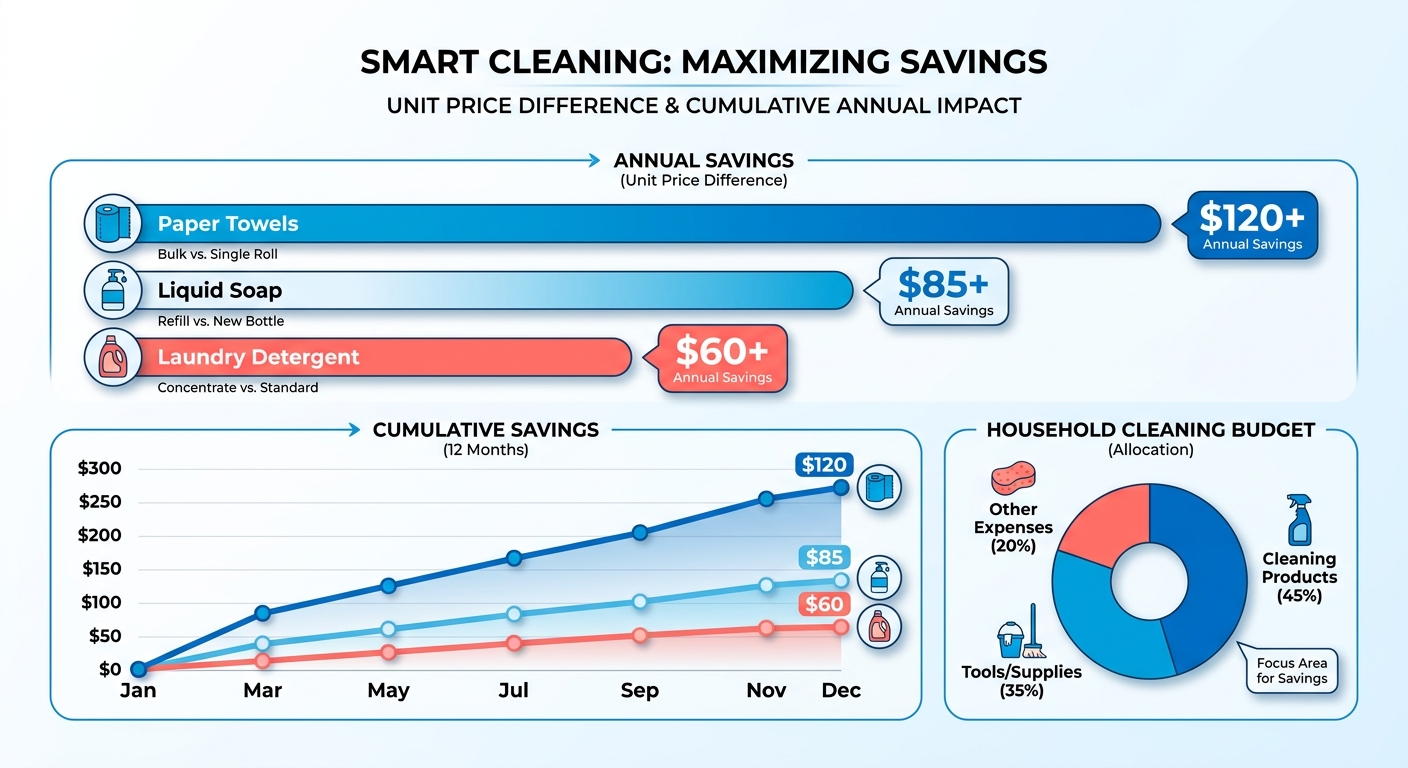
Comparing unit prices on cleaning supplies protects a steady chunk of your household budget. These are recurring expenses, and small per-unit differences compound over a year of restocking. The math is simple. The payoff is real money kept in your pocket.
The reason it works: unit pricing changes how you decide. When the per-ounce or per-square-foot cost is right in front of you, you notice price more and choose the cheaper option more often.
Who gets the most out of it
Families and budget-conscious shoppers gain the most, because they buy in volume and restock often. The more frequently you buy something, the more each per-unit saving repeats.
Health-conscious buyers benefit too. They often want a specific formula or material, not just the cheapest thing on the shelf. Unit pricing lets you hold quality steady and still pick the best value within that tier.
And when your brain is fried, a single normalized number simplifies the whole decision. Data on shoppers under time pressure shows clear unit metrics streamline the pick, making budget-friendly options easier to spot fast.
How much does it actually change behavior?
Quite a bit. Research on price sensitivity and unit pricing shows that prominent unit costs keep shoppers focused on real value instead of flashy packaging.
That awareness ties back to knowledge. Work on unit price usage knowledge found that knowing how to use unit prices links to greater awareness of those prices at your regular store. The skill and the habit feed each other.
Retailers benefit too. Studies on store price image and shopping intentions show clear pricing policies build trust and improve how shoppers perceive a store's value.
The one trap verification solves
The biggest gap in unit pricing is comparing the wrong things. A bottle of concentrate and a ready-to-use spray can't be matched ounce for ounce without accounting for dilution. Paper towels need a per-square-foot view, not a per-roll one.
Good reviewers already handle this carefully, calculating square footage for paper goods to keep the comparison honest. The unit you choose has to match the product.
That's where verification earns its keep. Confirming two listings are genuinely the same product, in the same usable form, makes your per-unit number trustworthy. A clean comparison beats a fast wrong one every time.
Comparing pack sizes without getting fooled
Comparing pack sizes comes down to one move: convert to the same unit, then pick the lowest number. A 12-pack and a 6-pack of paper towels mean nothing until you know the cost per square foot. The pack count on the front is a distraction. The per-unit math is the answer.
Comparing two pack sizes
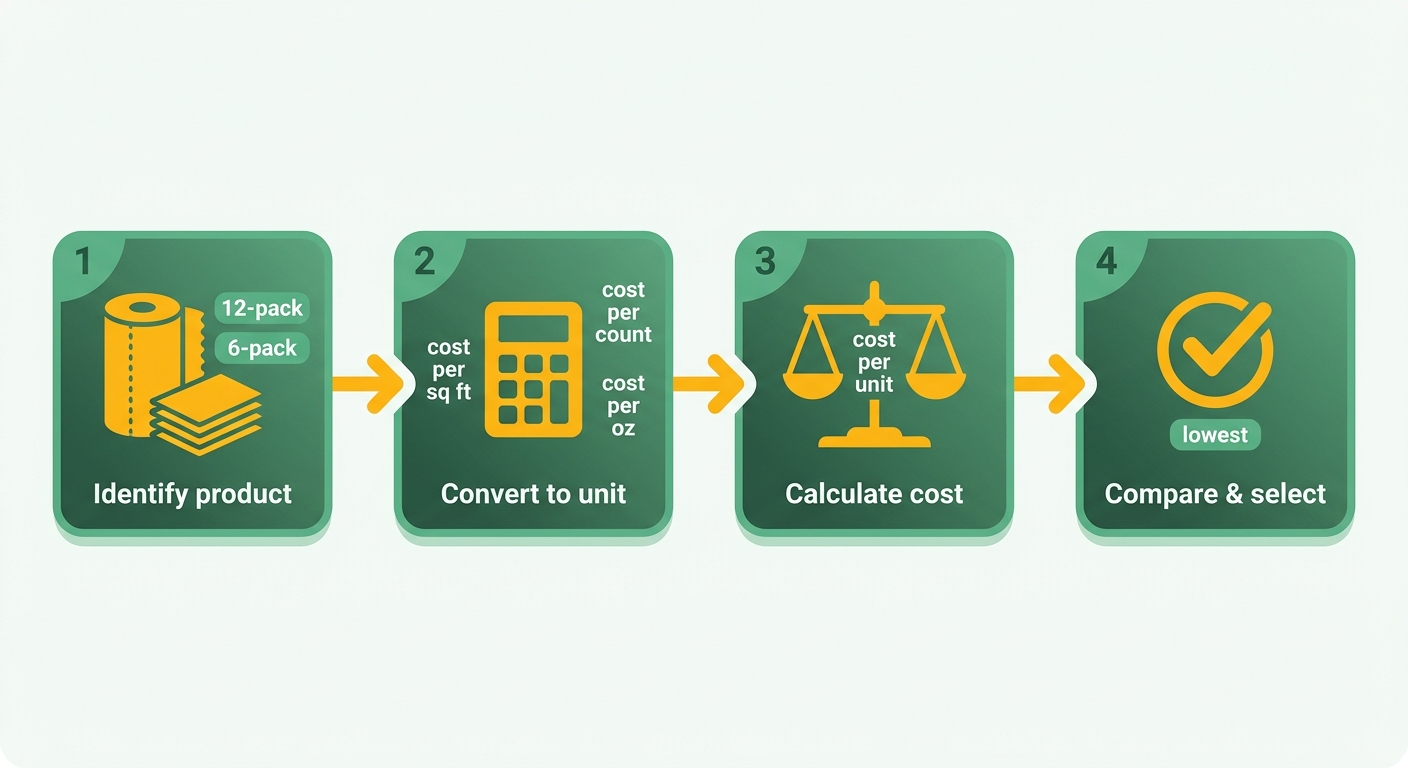
Convert both packs, divide price by quantity, compare the results. Paper goods, cost per square foot. Sprays and detergents, cost per count or ounce. Standard consumer-advocacy practice.
- Find the total quantity in each pack. Read the fine print, not the bold count. A "mega roll" may pack more sheets than a "double roll," so the roll count lies.
- Divide the price by that quantity. A $12 pack of 6 rolls at 100 sq ft each runs $0.020 per square foot. A $20 pack of 12 identical rolls runs $0.017. The bigger pack wins here.
- Compare the per-unit numbers, not the totals. The NDSU Extension guide leans on this: one consistent metric across sizes and brands.
Run the same two-column check on dish soap, wipes, or laundry pods. The smaller pack often wins, which is the whole reason to do the math.
Where verification helps
Verification makes sure you're comparing the same product, not two items that just share a name. A "lemon" spray in one pack size can hide a different formula or concentration than its larger sibling. Confirm the product first and your per-unit comparison stays honest.
Once the product matches, the per-unit price shows up across pack sizes side by side. You skip the mental arithmetic that most shoppers skip anyway. Research shows people rely on unit-price figures to compare sizes, but manual math still feels tedious. Automating the conversion removes that friction, which helps most under time pressure, when pre-calculated values cut the stress.
Why bother at all?
Two reasons: you save money and you cut waste. The savings come from the lowest per-unit pack. The waste reduction comes from not buying more than you'll use before it dries out or expires.
Laundry pods make the case. A 42-count tub runs $0.21 per pod; the 96-count box drops to $0.16. That's a 24% cut per wash, and across a household running eight loads a week, the big box pays off well before the small tub would've run dry.
Build the habit here and it carries into every other product category you shop.
What unit price really tells you
Unit price is the cost of a product per standard unit: per ounce, per count, or per square foot. Divide total price by quantity. That one number lets you compare any two products on the same scale, whatever the package size.
This is the math that turns a confusing shelf into a clear decision. A $4 bottle and a $7 bottle tell you nothing on their own. Their unit prices tell you everything.
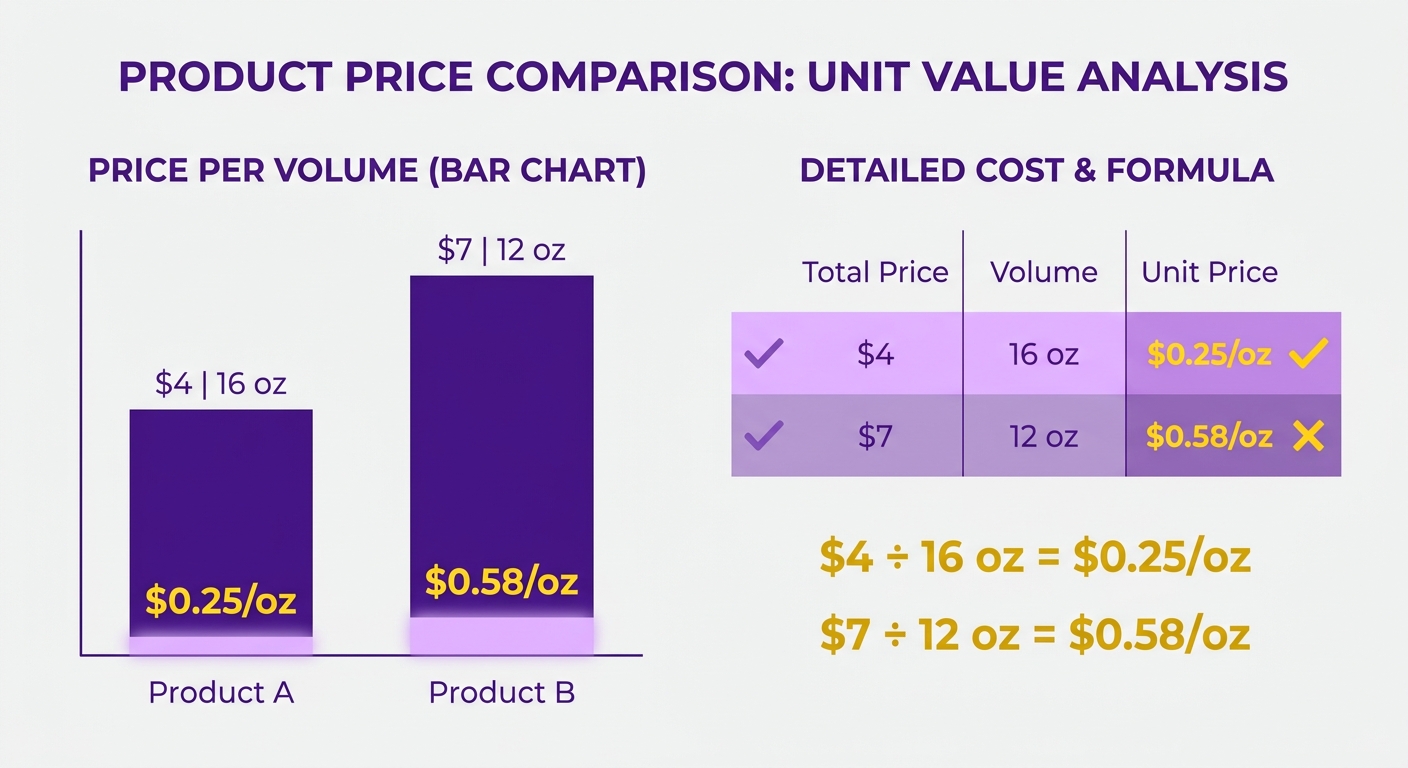
What it actually reveals
Unit price reveals the true value per unit that the sticker price hides. It's the core skill the NDSU Extension guide pushes: look past the marketing claims.
Concentrated versus ready-to-use is the clearest case. A concentrated all-purpose cleaner might sell for $6.00 and make 64 ounces once diluted, landing around $0.09 per usable ounce. A pre-mixed bottle at $3.50 for 24 ounces works out to roughly $0.15 per ounce. The cheaper sticker hides the worse deal.
For paper goods, the unit matters even more. Professional reviews stick strictly to square footage for paper products, because sheet counts vary wildly between brands. Price per roll lies. Price per square foot doesn't.
Why seeing the unit price changes what you buy
When the metric is right there, it nudges you toward the cheaper choice. Studies on unit pricing and price sensitivity confirm that visible unit costs pull attention away from brand prestige and toward actual value.
That's strongest when you're shopping fast. Research on unit pricing under time pressure shows clear metrics help shoppers hold budget discipline even in a hurry. And the more familiar you get with the calculation, the more consistently you apply it.
Comparing across different stores
Compare across stores by converting each retailer's price, then sorting lowest to highest. The same dish soap costs different amounts at different stores, and pack sizes rarely match. Unit price is the only fair common ground.
- Pull the price and size for the same product at each retailer.
- Divide price by quantity to get the unit price for each.
- Line them up and pick the lowest for the quality you want.
Doing this by hand across eight stores is slow, which is why most people skip it. We built our AI to extract and calculate the real unit price from every listing automatically, so you sort by what you actually pay instead of guessing. The math still wins. You just don't have to do it on the back of a receipt.
References
[1] Best Prices for Our Favorite Cleaning and Paper Supplies - https://www.consumerreports.org/money/prices-price-comparison/best-prices-on-cleaning-products-and-paper-goods-a3578680534/
[2] 6 Tips to Save Money With Unit Pricing | NDSU Agriculture - https://www.ndsu.edu/agriculture/extension/publications/pinchin-pennie-kitchen-6-tips-save-money-unit-pricing
[3] Consumer usage of unit pricing - ResearchGate - https://www.researchgate.net/publication/230177632_Consumer_usage_of_unit_pricing
[4] Consumer price awareness in food shopping: The case of quantity ... - https://www.researchgate.net/publication/222522928_Consumer_price_awareness_in_food_shopping_The_case_of_quantity_surcharges
[5] Consumer Awareness, Understanding and Usage of Unit Pricing - https://www.researchgate.net/publication/228137037_Consumer_Awareness_Understanding_and_Usage_of_Unit_Pricing
[6] Unit Pricing Increases Price Sensitivity Even When Products are of ... - https://www.researchgate.net/publication/282249263_Unit_Pricing_Increases_Price_Sensitivity_Even_When_Products_are_of_Identical_Size
[7] In‐Store Shopping Strategies: Time and Money Costs in the ... - https://www.researchgate.net/publication/229445720_In-Store_Shopping_Strategies_Time_and_Money_Costs_in_the_Supermarket
[8] Unit price usage knowledge: Conceptualization and empirical ... - https://www.researchgate.net/publication/223181165_Unit_price_usage_knowledge_Conceptualization_and_empirical_assessment
[9] Unit pricing matters more when consumers are under time pressure - https://www.researchgate.net/publication/304607541_Unit_pricing_matters_more_when_consumers_are_under_time_pressure
[10] Does unit pricing influence store price image dimensions and ... - https://www.researchgate.net/publication/317155591_Does_unit_pricing_influence_store_price_image_dimensions_and_shopping_intentions_for_retail_stores
[11] (PDF) How the Layout of a Price Label Influences Unit Price Visual ... - https://www.researchgate.net/publication/314535455_How_the_Layout_of_a_Price_Label_Influences_Unit_Price_Visual_Attention_and_Choice_During_Grocery_Shopping
Frequently Asked Questions
1. Does buying cleaning supplies in bulk always save money?
Bulk buying saves money only when the unit price drops and you use the product before it expires or dries out. A "club size" jug can carry a quantity surcharge, costing more per ounce than a smaller bottle. Always check the per-unit price, and factor in waste from buying more than you need.
2. How do I compare a concentrated cleaner against a ready-to-use spray?
Calculate the cost per usable ounce after dilution rather than comparing the shelf prices directly. If a concentrated cleaner can be diluted to make multiple gallons of solution, its cost per usable ounce will typically be a fraction of the cost of a pre-mixed, ready-to-use spray bottle, even if the concentrate has a higher upfront price.
3. Why do shelf tags sometimes show different units for similar products?
Stores aren't always required to standardize units across competing brands, so one tag may list price per ounce while another shows price per use or per count. This mismatch breaks direct comparison, forcing you to convert both to a common unit manually or use a tool like Popgot that normalizes the math automatically.
4. What unit should I use for paper towels and toilet paper?
Use cost per square foot, not price per roll. Sheet counts and roll thicknesses vary widely between brands, and marketing terms like "mega roll" can be highly misleading. To find the true value, divide the total price of the package by the total square footage listed on the packaging.
5. Is the cheapest unit price always the best choice?
The lowest unit price for the quality you actually need is the best choice. If you require a specific formula or material, compare unit prices within that quality tier rather than defaulting to the absolute cheapest option. This lets health-conscious buyers hold standards steady while still capturing real savings.
6. How much can unit price comparison save on a year of cleaning supplies?
Savings compound significantly over time. Saving just a few cents per laundry pod, per fluid ounce of dish soap, or per square foot of paper towels might seem trivial on a single trip, but when multiplied across a full year of household chores, these small differences easily add up to a substantial amount of money returned to your budget.
7. How does AI product verification differ from just reading the shelf tag?
AI verification confirms two listings are genuinely the same product, size, and form before comparing, then calculates unit prices across retailers automatically. Shelf tags can carry errors, outdated math, or bury the unit price in tiny text. Verification prevents accidentally comparing a concentrate against a ready-to-use spray and flags padded "value" claims.