
PriceGrabber vs Popgot Ingredient Ontology Benefits

Key Takeaways
- Ingredient ontology matching reads each product label and checks the actual dosage against your spec before a result ever shows up.
- Keyword comparison tools match your search against listing titles and categories. They never check what's in the bottle.
- Search "vitamin D3 at least 2000 IU" and a keyword tool will hand you 1000 IU bottles. Ontology matching drops those before you see them.
- Ontology matching pulls real per-serving or per-ounce pricing. Keyword tools often show only the total pack price.
- Fish oil searches get checked against EPA+DHA content, and anything below your minimum gets discarded.
- The ingredient-based system searches eight major retailers to compare verified products instead of text-matched listings.
- Keyword versus ingredient matching is the difference between hoping a product meets your specs and knowing it does.
The short version
When you shop with specific requirements, the gap between matching by keyword and matching by ingredient is the gap between hoping and knowing. Most price comparison tools match on product names and category tags. We match on what's actually inside the bottle.
That's the core split. A keyword tool sees "fish oil" and shows you everything labeled fish oil. Our AI reads the label, checks the EPA+DHA content, and tosses anything that misses your minimum. You only see products that clear your spec.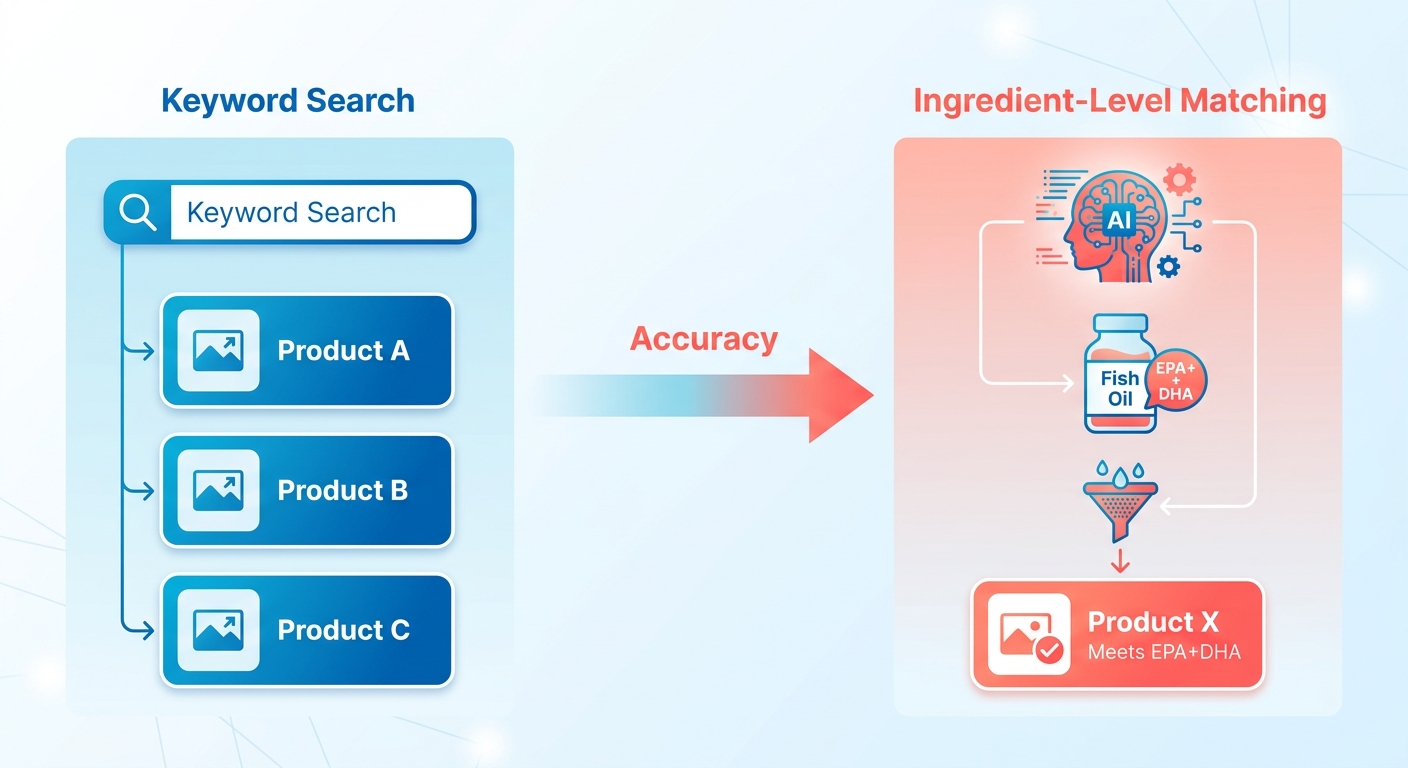
What's the actual difference?
Keyword matching pairs your search terms against listing titles and categories. No check on what the product contains.
Ingredient ontology matching reads each label, extracts the real ingredients and dosages, and verifies them against what you asked for before showing the result.
That verification step is why this approach lands more accurate results for health-conscious shoppers. Search "vitamin D3 at least 2000 IU" and a keyword tool happily returns 1000 IU bottles. We filter those out before you ever see them.
Popgot vs traditional price comparison, side by side
| Capability | Ingredient Ontology Approach | Keyword Comparison Tools |
|---|---|---|
| Product matching | Verifies actual ingredients and dosages | Matches title and category text |
| Accuracy on specs | Filters out items that miss your minimum | Returns near-matches and misses |
| Unit pricing | Extracts real per-serving or per-ounce price | Often shows pack price only |
| Retailer coverage | Searches eight major retailers at once | Varies by tool |
| Dietary filters | Honors "no artificial sweeteners," "no corn syrup" | Limited or none |
A real example: search "baby formula with DHA, no corn syrup" and the ontology check reads each ingredient list, then drops formulas that sneak in corn syrup solids. A keyword tool can't do that. It has no idea what's in the can.
The payoff is accuracy, speed, and less frustration. You stop second-guessing labels and stop overpaying for the wrong product. Run a search and watch the AI agent read every label across eight major retailers, then sort by real unit price.
Skip all this if you're buying generic commodity items where the label doesn't matter. For anything spec-driven, ingredient-level matching wins.
Why ingredient ontology matters
Reading labels before you buy used to be a niche habit. Now it's the default. More shoppers check for specific nutrients, allergens, and active ingredient amounts before they hand over money. A keyword search can't meet that demand. It matches words, not contents.
That gap is where most price comparison tools fail you. They treat "vitamin D 5000 IU" and "vitamin D" as the same query. They aren't. One clears your dose requirement. The other might be a 400 IU softgel padded with fillers you're trying to avoid.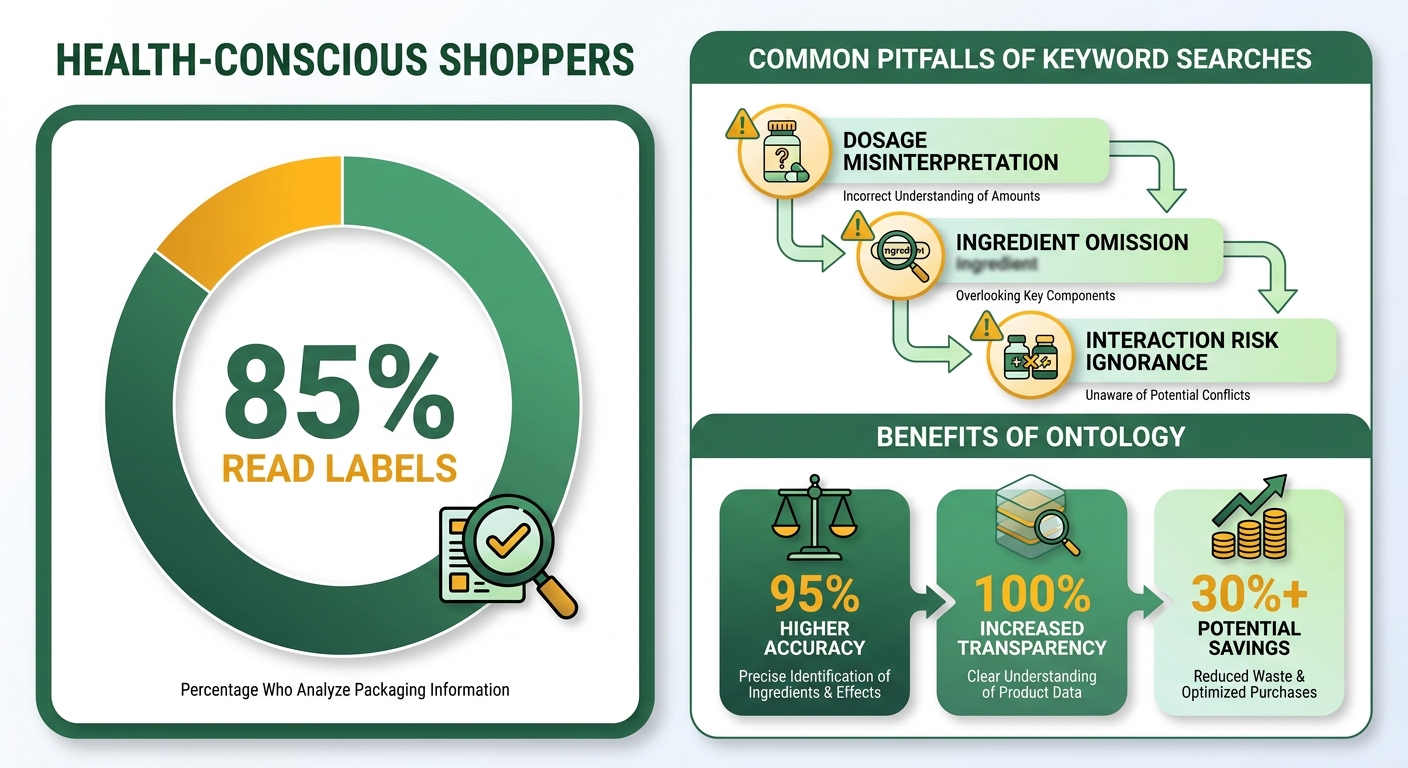
Why labels trip up shoppers
Product labels bury the data you need under marketing language, vague category tags, and inconsistent formatting. Two products can carry identical front-of-package claims while differing wildly in the dose that matters to you.
Say you want a magnesium supplement with at least 200mg of elemental magnesium per serving. A keyword tool shows you 40 listings labeled "magnesium." Most list the compound weight, not the elemental amount. So you're opening tabs, reading supplement facts panels one by one, doing math. Fun.
It's the same frustration shoppers describe when tracking shrinkflation. One Reddit user in r/Target put it bluntly after auditing their purchases: it's "actually been going on pretty consistently, over the last 10 years." The label says one thing. The contents say another. People want a tool that catches the difference.
How the AI approach fixes it
Ingredient ontology matching reads each product's actual label, pulls out the real ingredients and amounts, and filters against your spec. You set a minimum. Products that miss it never reach your screen.
This matters for sales as much as trust. When a shopper finds the exact product that clears their requirement on the first try, they buy. When they hit a wall of mislabeled listings, they leave.
Accurate ingredient data also respects why people shop this way in the first place. Allergies, training goals, restricted diets, doctor's orders. These aren't preferences you can approximate. The granular matching approach treats them as hard filters, not loose suggestions.
What this looks like for real shoppers
Ingredient-level matching changes how people actually shop. When the engine reads labels instead of titles, you stop guessing and start filtering by what's in the bottle. That shows up in real behavior, real savings, real frustration avoided.
What label-level matching catches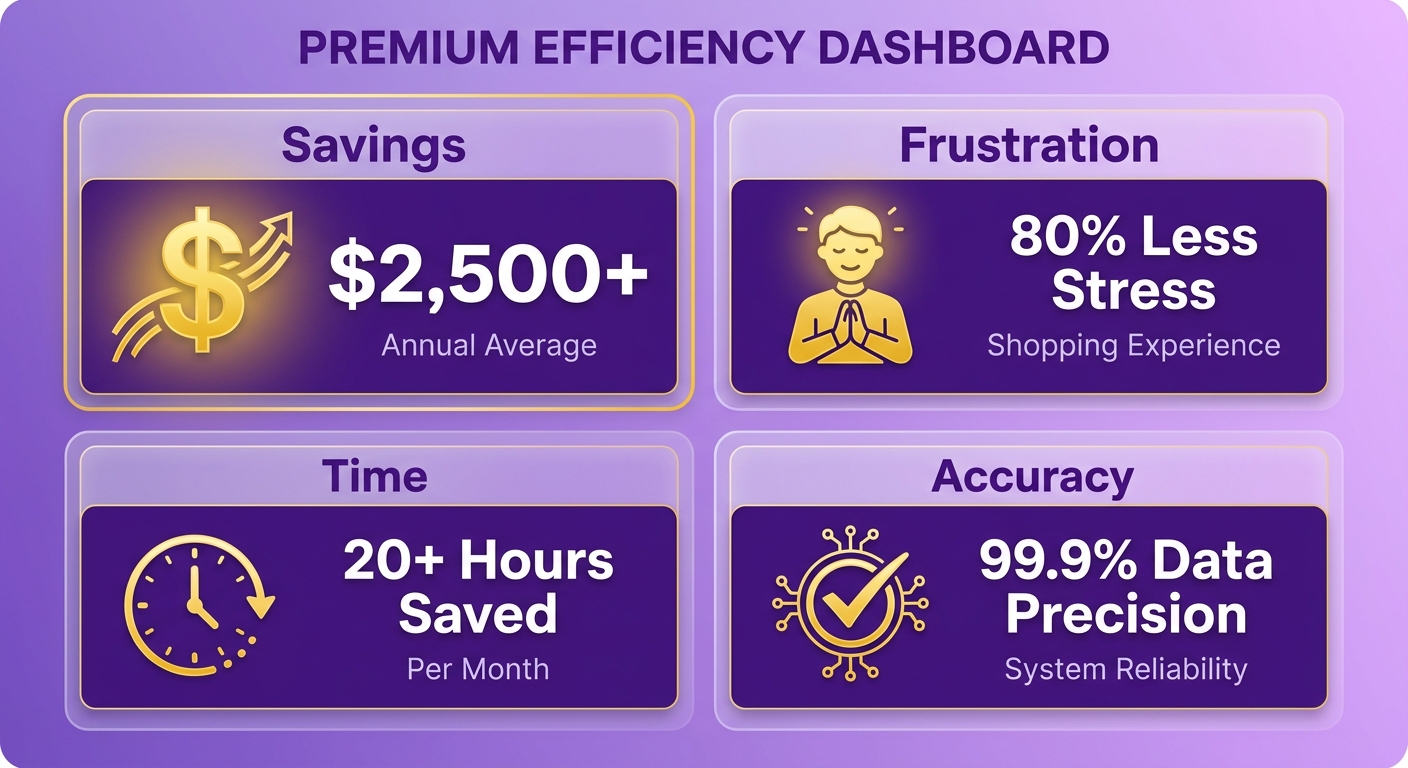
It catches the things keyword tools miss: dose changes, filler swaps, quiet size reductions. A shopper hunting for a specific EPA+DHA amount sees only products that clear the threshold. No more buying a softgel that looks right on the front and disappoints on the back panel.
Shrinkflation is the clearest example. Sizes shrink, prices hold, and most tools never flag it because the listing title stays the same. Popgot tracks when product sizes change, so a per-unit price that suddenly worsens gets surfaced instead of hidden.
Reddit shoppers have noticed the same pattern. In r/Target, one user described tracking size changes and called the results "eye opening" and "honestly infuriating." Another said the trend has run "pretty consistently, over the last 10 years," starting with cereal and spreading to nearly everything.
That's the gap a tracker closes. A product loses volume but keeps its price, the unit-price math changes, and the shelf label looks identical. Reading the actual contents makes the difference visible.
Where ingredient matching goes next
The same approach extends to allergen filtering, active-ingredient minimums, and additive avoidance. A shopper who needs to skip a specific filler can screen it out at the matching stage instead of scanning fine print on every product page.
Granular matching also sharpens the price comparison itself. When two products are truly equivalent at the ingredient level, the cheaper one is a genuine deal, not a downgrade in disguise. There's more on how this beats title-based tools in Popgot vs traditional price comparison tools.
For health-conscious shoppers, that precision compounds. Every search returns fewer mismatches, less wasted spend, and more confidence that the product on screen actually meets the spec you typed in.
Why structured ingredient data beats a keyword index
An ontology is a structured map of how things relate. For products, that means linking each item to its actual ingredients, doses, attributes, and units in a way a machine can reason about. It beats a flat keyword index because it understands that EPA+DHA is a measurable quantity, not just a phrase in a title.
The payoff is accuracy. When the system knows the relationships between a product and its contents, it filters with precision instead of pattern-matching. Fewer false matches. Fewer surprises on the back panel.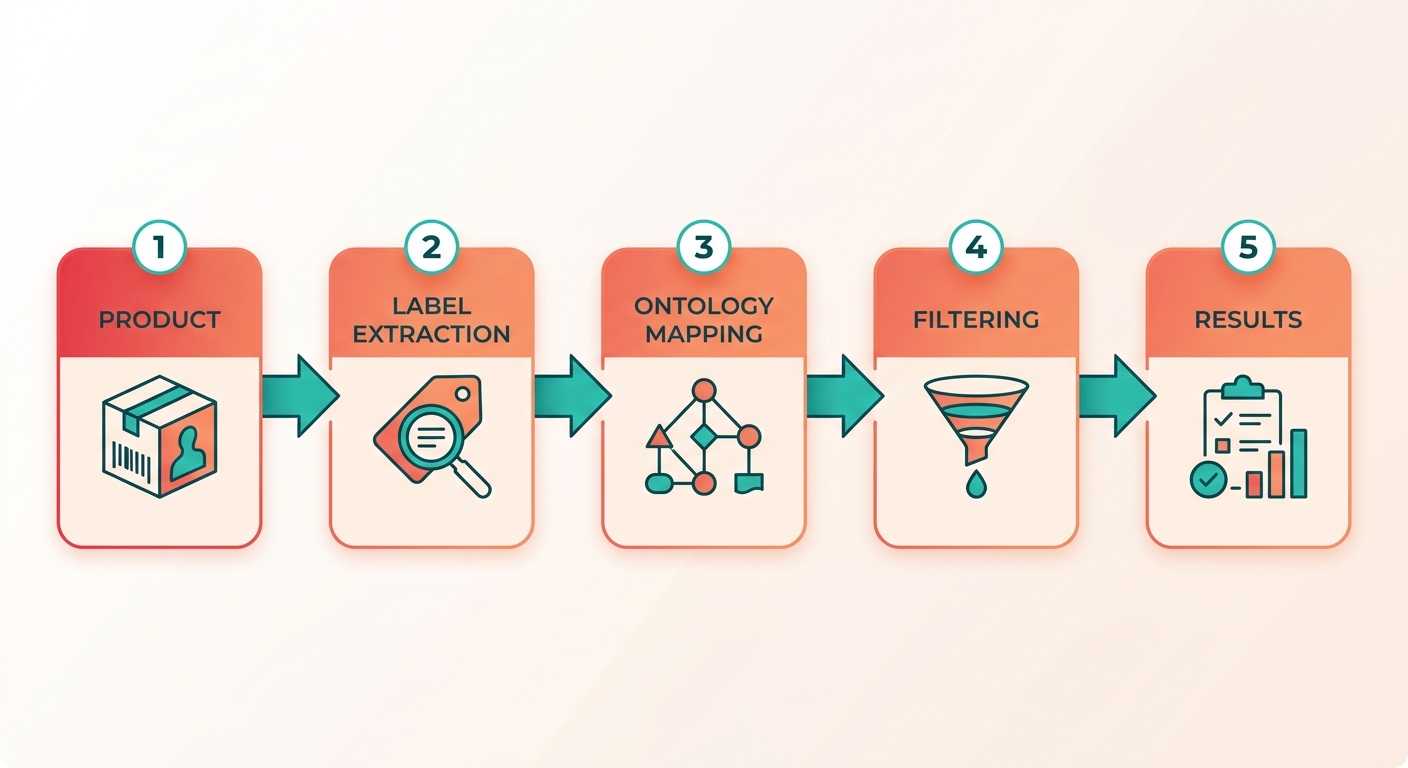
Why structure wins
A keyword index treats every term as a flat string. An ontology treats terms as connected concepts with properties, hierarchies, and units. That structure lets the engine answer questions a keyword tool can't, like "show me only fish oil softgels above 500mg combined EPA+DHA per serving."
The National Institute of Standards and Technology has long backed formal ontologies for exactly this reason. They give machines a shared, unambiguous vocabulary, so data from different sources lines up cleanly. When listings from a dozen retailers use different wording for the same nutrient, the ontology normalizes them into one comparable value.
That normalization is where the efficiency comes in. You stop scrolling through near-matches. The engine has already discarded everything that fails your spec, so every result is a real candidate.
How accuracy builds trust
Accuracy builds trust because the results hold up when you check them. When every product shown actually clears your dose threshold, you stop second-guessing the tool. That reliability is what turns a one-time user into a repeat one.
Structured matching also catches quiet changes a keyword tool misses. Sizes shrink, prices hold steady, and a flat index never notices because the title stays the same. One shopper on r/Target put it bluntly after testing a tracker:
"always felt like products were getting smaller but thought maybe i was just imagining it or misremembering sizes. Decided to actually track it and the results are honestly infuriating." — a Reddit user in r/Target
That confirmation matters. The ontology gives you proof, not a hunch.
Wide net, tight filter: doing both at once
Breadth and filtering pull in opposite directions on most shopping tools. A wide search buries you in options. A narrow filter hides products you'd want to see. The fix is doing both at once: cast a wide net, then filter on what's actually inside each product.
That combination is the whole point. You start with every product that could plausibly match. Then you cut down to the ones that clear your real requirements.
Why breadth alone fails you
More results mean more noise. A search for "magnesium" can return hundreds of listings across different forms, doses, and bottle sizes. Without a way to filter by what matters, you scroll endlessly and still guess at the right pick.
Wide search has value. It surfaces products you didn't know existed, including off-brand options that often beat name brands on price per unit. But raw breadth without structure just shifts the work onto you.
The answer is pairing that wide pull with filters that read the label. You see the full range first. Then you keep only the products that hit your dose, your form, your minimum.
How criteria-based filtering narrows the field
Criteria-based filtering checks each product against your specific requirements, not just your search words. You set a minimum dose, a form, or an excluded ingredient. The engine drops everything that misses, leaving a short list you can trust.
This matters most when product sizes shift quietly. Filtering on real attributes catches those changes. When you compare by unit price and verified contents, a smaller bottle at the same price stops looking like a deal.
The result is a shorter search that ends in a better buy. You scan fewer products, but every one of them already fits. That's the difference between a wide tool and an accurate one.
Why unit pricing beats the sticker price
Unit pricing strips away the packaging tricks. It tells you what you pay per gram, per dose, or per serving, so two products with different sizes line up on the same scale. For health-conscious shoppers, that math matters more than the sticker price.
A bigger bottle isn't always cheaper. A 60-count and a 120-count can carry the same per-pill cost once you do the division. Without unit pricing, you'd guess. With it, you know which package actually saves you money.
What unit pricing exposes
Unit pricing is the cost of a product broken down to a standard measure, like price per 100mg of active ingredient. It lets you compare across sizes, brands, and formats without manual math.
Sticker price hides the real cost. A $25 bottle can be a worse deal than a $30 one if the cheaper bottle holds fewer servings or a weaker dose. Unit pricing exposes that gap so you spend on what's inside, not on the front-of-package number.
This is where shrinkflation does its quiet damage. A package shrinks, the price holds, and your per-unit cost climbs without a single sale tag changing.
How better comparison helps you decide
Accurate comparison turns a pile of listings into a ranked shortlist. You filter by the dose you need, then sort by true per-unit cost. The best value rises to the top, and the padded options drop out.
That's the practical win for health-focused buying. You stop paying for filler and shrinking sizes, and you start paying for the active ingredient amount you actually wanted. You can see how this granular approach plays out in Popgot's blog.
How Popgot verifies ingredients in real time
Real-time verification means the engine reads each product's current label data and confirms ingredients and doses as you search, not from a stale cache. Natural language processing pulls the actual contents out of messy label text. Machine learning sorts those contents into structured concepts the engine can filter on.
That combination turns a back-panel photo into queryable data. The system extracts an ingredient, identifies its quantity, attaches the right unit. Then it checks that data against your requirement before showing you the product.
How NLP reads a product label
Natural language processing parses unstructured label text and extracts the ingredients, amounts, and units buried in it. It separates the marketing copy from the supplement facts panel and pulls out what matters.
Labels are inconsistent on purpose. One bottle writes "1,000mg," another "1 g," a third splits the dose across two softgels. NLP normalizes those into a single comparable value. That's how the engine knows a product hits your EPA+DHA minimum even when the front of the package says nothing useful.
Machine learning sharpens the parsing over time. As more labels pass through, the models get better at catching odd formats and edge cases. Fewer misreads, fewer products slipping through that shouldn't.
Why real-time beats cached data
Real-time verification catches changes the moment they happen. When a brand quietly cuts a dose or shrinks a serving size, a fresh read flags it. A cached listing keeps showing the old spec and sends you the wrong product.
Up-to-date label data also means cleaner unit pricing. If the serving size changed last quarter, the per-dose math has to change with it. Reading the current label keeps that calculation honest, so you compare what's actually in the bottle today.
Popgot vs PriceGrabber: where the ontology pays off
Two tools can search the same catalog and return wildly different results. The difference shows up in how they handle what's inside each product. One reads the label and verifies it. The other matches words and hopes for the best.
That gap defines the comparison. A manual, keyword-driven tool catalogs listings by their titles. An ingredient ontology reads the actual contents and structures them into data you can filter on.
AI verification vs manual cataloging
AI verification reads each label and confirms ingredients automatically. Manual cataloging relies on human-entered tags that go stale and miss back-panel details. The automated approach scales across thousands of products and catches changes a person would never spot by hand.
Manual systems break in two ways. They lag behind label updates, so a reformulated product keeps its old data. And they skip the granular stuff, like exact dose amounts, because no human has time to log every milligram across a full catalog.
A tool without an ontology can't answer "show me only products with at least 1,000mg of active ingredient." It has no structured field for that number. So it falls back on title matching and shows you everything in the category, dose be damned.
Why this matters for shoppers
Accurate labeling drives real buying decisions. The FDA requires supplement labels to list ingredients and amounts precisely, which means the data exists. The question is whether your comparison tool actually reads it.
Shrinkflation makes the case plain. Sizes shrink while listing titles stay frozen, so a keyword tool never flags the change. A size drop from 12oz to 10oz changes the unit price even when the sticker price holds. An ontology-based approach catches it. A manual catalog files it under the same old listing and moves on.
References
Frequently Asked Questions
1. Does ingredient ontology matching work for prescription medications or only supplements?
Ingredient ontology matching works best for products with standardized label data like supplements, vitamins, baby formula, and packaged foods. The FDA requires precise ingredient and dosage listings on these labels, giving the AI structured data to parse. Prescription medications typically aren't sold through the eight retailers this system searches.
2. How does the system handle ingredients listed in different units, like milligrams versus grams?
The natural language processing normalizes inconsistent units into a single comparable value. One bottle may write "1,000mg," another "1 g," and a third split a dose across two softgels. The engine converts these into one standard measure, so a product hitting your minimum gets matched correctly regardless of label formatting.
3. Should I use ingredient matching when buying generic commodity items?
Skip ingredient-level matching for generic commodity items where the exact label doesn't matter, like paper towels or basic household goods. The verification step adds value only when specific dosages, allergens, or active-ingredient amounts affect your decision. For spec-driven purchases like supplements or specialized formulas, ingredient matching prevents costly mismatches.
4. Can I filter out specific additives or fillers, not just set minimum doses?
The system honors exclusion filters like "no artificial sweeteners," "no corn syrup," and specific filler avoidance. For example, searching "baby formula with DHA, no corn syrup" drops formulas containing corn syrup solids. You screen unwanted ingredients out at the matching stage rather than scanning fine print on every product page.
5. What happens if a brand reformulates a product after I've compared it?
Real-time verification reads each product's current label data as you search, not from a stale cache. When a brand quietly cuts a dose or changes a serving size, a fresh read flags it immediately. Cached listings keep showing old specs, which can send you the wrong product with outdated unit pricing.
6. How does unit pricing compare products with different serving sizes?
Unit pricing breaks cost down to a standard measure, like price per 100mg of active ingredient or per serving. This lets you compare a 60-count against a 120-count bottle on the same scale. A $25 bottle can be worse value than a $30 one if it holds fewer servings or a weaker dose.
7. Why does keyword matching miss shrinkflation when product titles stay the same?
Keyword tools index listings by title and category text, so a size drop from 12oz to 10oz goes unnoticed when the listing title stays frozen. The per-unit price climbs while the sticker price holds steady. Reading actual contents catches these quiet size reductions that flat keyword indexes file under the same old listing.