
Product Search That Shows Accurate Unit Prices Instantly

Key Takeaways
- A unit price only means something when the two products are actually the same thing. A 600mg listing and a 1,200mg one aren't comparable, no matter what the per-serving math says.
- The fix is order of operations: match the spec first, then rank by real unit price. That kills false comparisons and the repetitive math in one move.
- The system extracts label details from listings across eight major retailers and filters out anything that misses your requirements.
- You set the specs, ingredient, dosage, size, pack count, and the system pulls the unit price to sort by value.
- Checking prices by hand can run 20-plus minutes of tab-hopping and mental math. Verified search hands you a ranked list in seconds.
- Multi-retailer search normalizes to price per serving, ounce, or count. Single-store shopping is stuck in one retailer's format.
- Generic results verify nothing and can rank by ad spend rather than value.
Quick Summary
A unit price only helps when the products you're comparing are the same thing. Sorting by price per serving is worthless if one listing has 600mg of EPA+DHA and the next has 1,200mg. So we built the verification step to handle both problems at once: match the spec first, then rank by real unit price.
The short version: you tell the system what you need, down to ingredients, dosage, size, or pack count. It extracts the relevant details from each listing's label data across eight major retailers, drops anything that doesn't match, and pulls the unit price so you can sort by value. One search, no tab-hopping.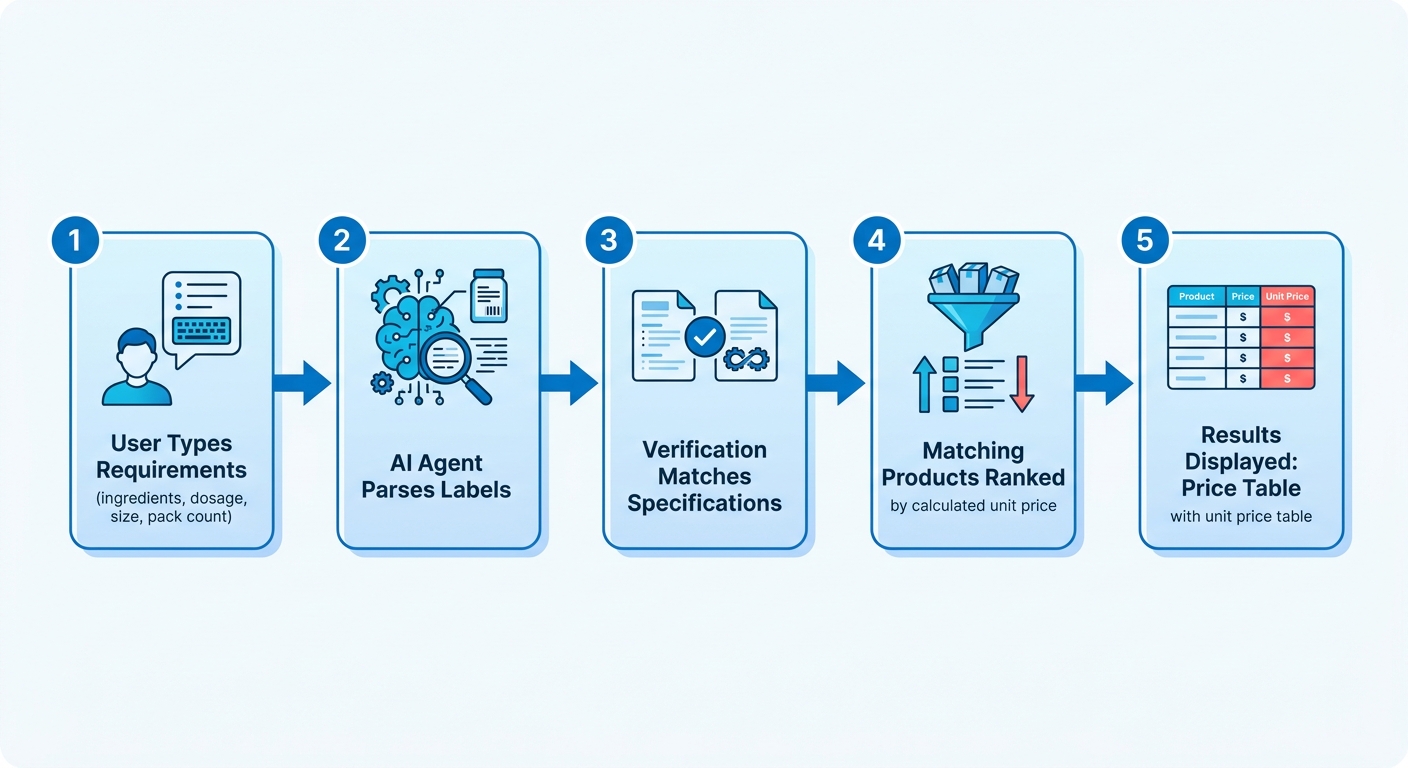
How verified search beats checking prices by hand
Verified multi-retailer search removes the two time-sinks: false comparisons and repetitive math. Instead of ten tabs and a squint at the fine print, you get one ranked list where every option already clears your requirements.
| Method | Product Verification | Unit Price Accuracy | Retailer Coverage | Time to Decision |
|---|---|---|---|---|
| Verified multi-retailer search | Every label checked against your specs | Extracted per serving, ounce, or count | 8 major retailers at once | Seconds |
| Manual price checking | You read each label yourself | You calculate by hand | Whatever you open | 20+ minutes |
| Single-store shopping | Limited to that store's data | Store's own format only | One retailer | Fast but narrow |
| Generic search results | None; can rank by ad spend | Rarely shown | Mixed | Slow, error-prone |
A real comparison across retailers
Say you want fish oil with at least 1,000mg EPA+DHA. For example, if a specialty-store listing ran a lower per-serving cost and cleared your minimum, while a big-box option sat higher for the same dose, and a warehouse pick came in higher still but stayed above your 1,000mg floor, all three would remain in the ranking. A listing that dropped to 600mg EPA+DHA would get filtered out entirely.
That last part is what matters most. A lower sticker on a weaker formula isn't a deal. Guidance like the FTC's advice on comparison shopping reflects the same idea, and it only means something once the items are truly equivalent.
Fewer tabs, no false matches, and a faster route to the cheapest valid option that actually fits what you need.
Why accurate unit pricing matters for product search
A lower shelf price often hides worse value. That gap is the whole reason unit pricing exists, and why we built it into the core of every search we run.
Unit pricing shows you the cost per ounce, pound, quart, or gallon so you can compare across brands and sizes honestly. Without it, a smaller package with a smaller sticker grabs your attention even when it costs more per serving. The bigger container isn't automatically the better buy either. Waste and storage matter, and a "value size" you can't finish is money down the drain.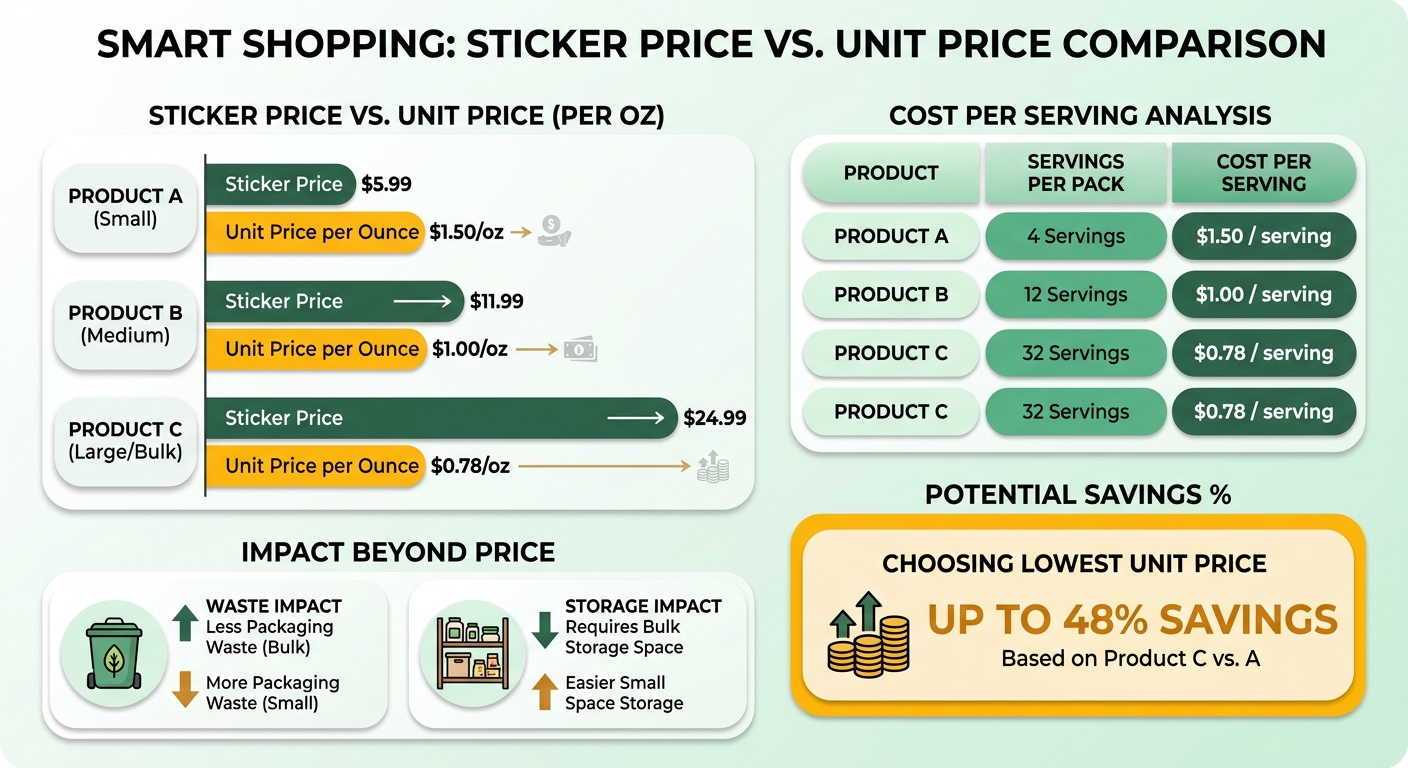
Why a lower price tag misleads you
Because the sticker and the true cost per unit rarely line up. Different package sizes, multipacks, and concentrated formulas all break simple tag-to-tag comparison.
For example, a gallon of apple juice can cost less per ounce than a 32-ounce container even when the smaller bottle has the lower sticker. There are 128 ounces in a gallon, so the math can flip the winner once you standardize the unit.
Now stretch that across a full cart of recurring staples. The errors compound fast, and converting every listing across multiple retailers by hand eats real time.
Where unit price alone falls short
Unit price breaks down the moment specs stop matching. This is where health-conscious shoppers get burned.
Active ingredient concentration is the usual culprit. Two bottles of sunscreen might cost the same per ounce, but one is 20% zinc oxide and the other only 5% active blockers. Cost per ounce of lotion is a false metric; cost per unit of actual UV protection is the real one. Same trap hits allergy-sensitive buyers comparing "free-from" labels that aren't actually equivalent.
That's why we match the label first, then rank by real unit price. Checking the Nutrition Facts panel yourself works fine. Doing it across every listing by hand is slow and error-prone.
Who gains most? Families buying in bulk, parents managing recurring household orders, and anyone whose ingredients or dosage are non-negotiable. If you buy the same essentials every month, the savings and the accuracy both add up. Want to skip the tab-hopping? Our product finder handles the conversions for you.
How instant product search with unit prices works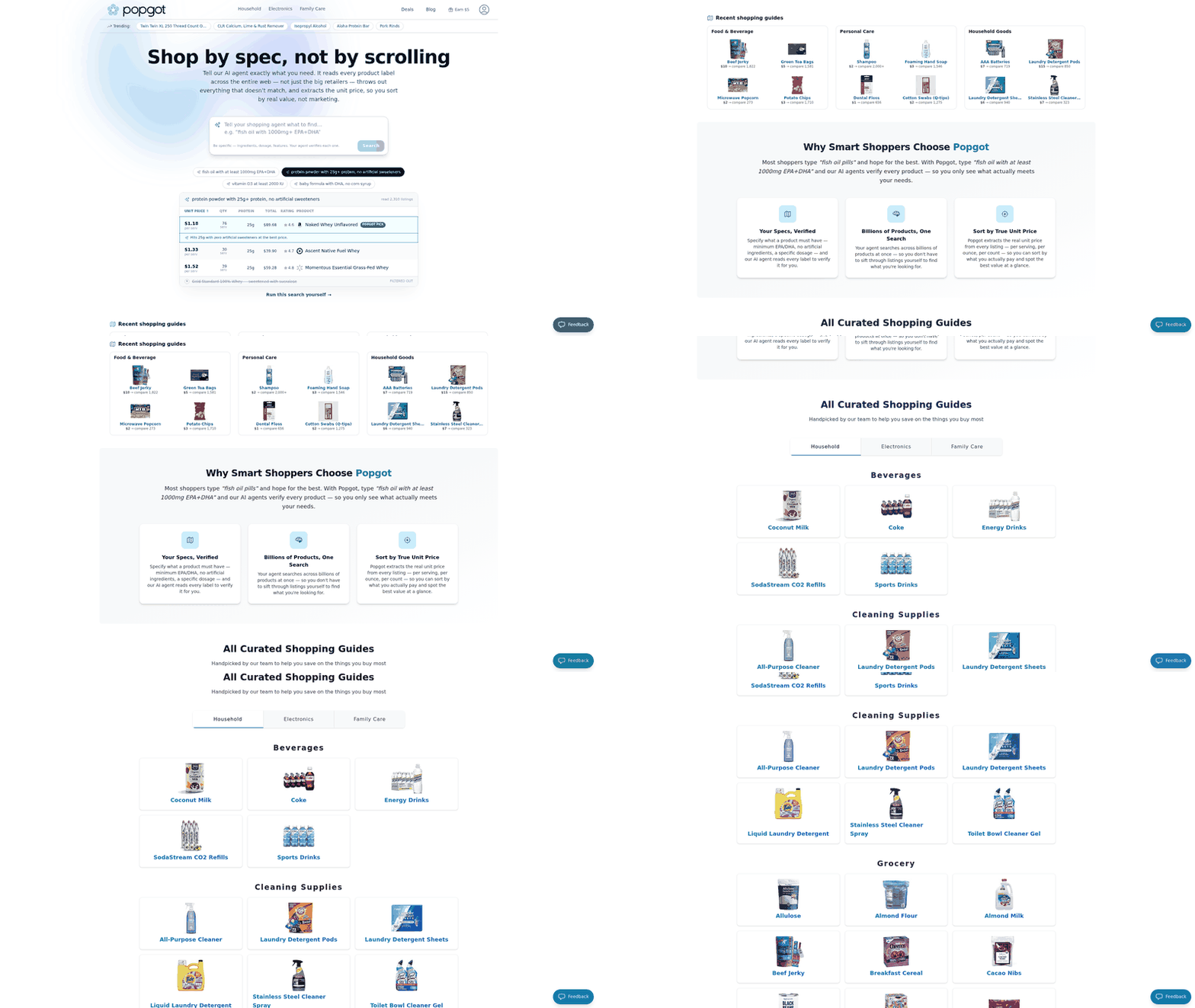
Here's the workflow behind every search we run, broken into the steps that actually change what you see on screen.
You type what you need in plain language. Rather than matching keywords alone, the system parses each listing's available label data, extracting the specs you asked for, then pulls the unit price so you can compare on equal footing. That last part matters because raw listings almost never agree with each other.
Why raw retail listings are such a mess
Product data quality: the same item often carries different titles, units, and pack descriptions across stores, so a naive search treats near-duplicates as distinct.
One store lists "32 fl oz," another writes "1 quart," a third buries the count in the description and leaves the structured field blank. Titles get stuffed with marketing words, images show a three-pack while the price applies to one unit, and serving sizes hide in the fine print.
The system parses the available label data on each listing to extract what a product actually contains, so you only see products that meet the specs you asked for.
How unit normalization actually works
We convert every matched listing into the same unit before ranking anything. Ounces, grams, fluid ounces, count, price per serving — all normalized so you compare like with like.
Take laundry detergent. A 150-load jug priced higher up front can still beat a 40-load bottle per load, but only if you account for concentrated formulas that use less detergent per wash. A label might claim "150 loads" using a smaller scoop than a competing "100 loads" bottle assumes, so the per-load tag on the shelf can mislead even when both stores report it. Where the underlying label data is available, the per-load cost can be recalculated from the stated fill volume and dose rather than the marketing claim.
Where verification filters out the wrong items
Search for whey protein with at least 25 grams of protein per serving, and a standard search returns a chaotic mix: meal replacements, high-carb mass gainers, low-protein isolates. Our verification step reads each label's available data, drops gainers that fall below your per-scoop floor, and ranks the survivors by cost per gram of protein.
Search across multiple retailers, verify the spec, then see accurate unit pricing. That order is the whole point.
Popgot vs manual tab-hopping and generic shopping search
Manual tab-hopping is the default, and it's slow. Open one retailer, search, repeat the same query in two more tabs. Then squint at three different product titles and try to remember which one had the right size. A verified search collapses that whole ritual into one query that checks every label for you.
The core problem is match quality, not just speed. Generic shopping search ranks by keyword overlap, so it happily shows you similar-but-not-equivalent items. Search "fragrance-free shampoo, 32 oz" and you get a "fragrance-free" variant in 12 oz, a scented bottle with "unscented" in the reviews, and a two-pack listed as a single unit. The search returns a mess, and you become the filter.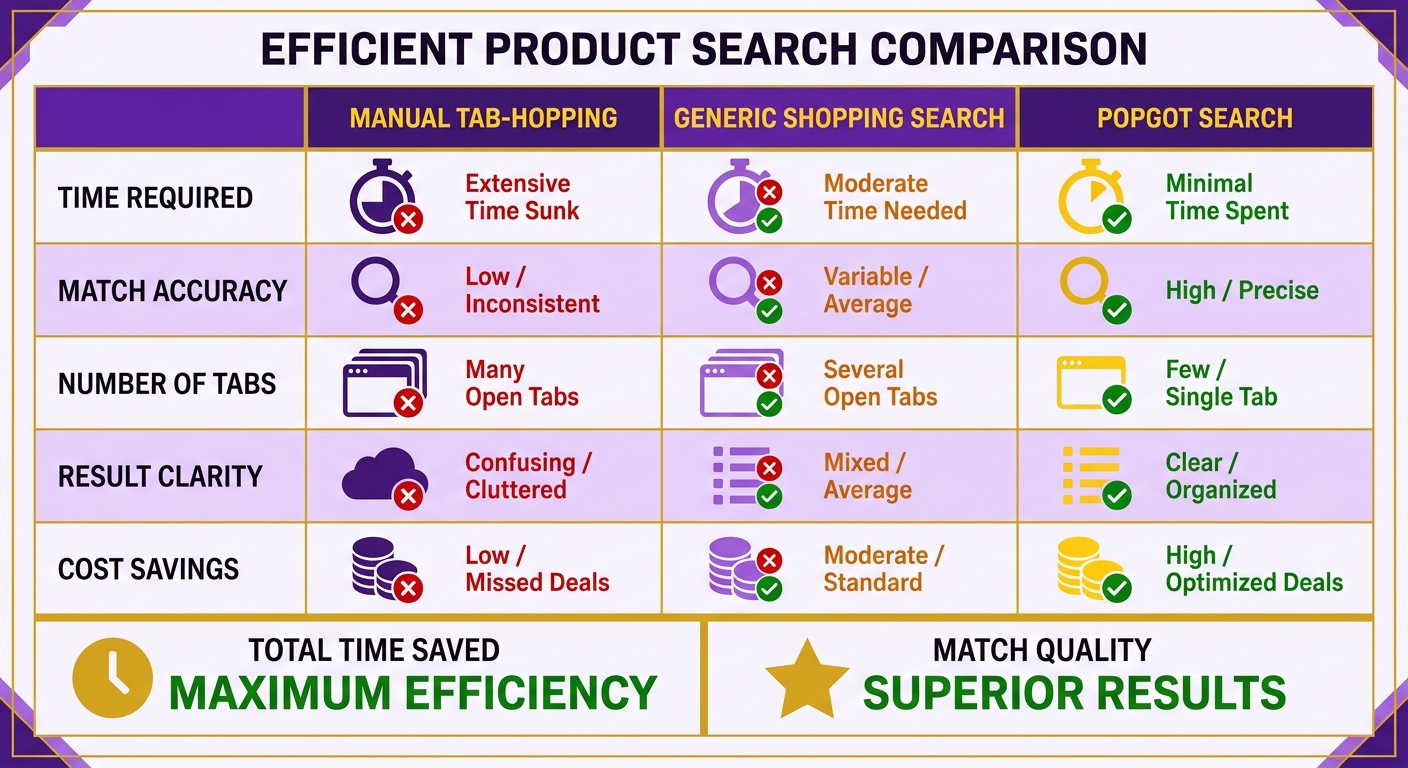
What manual vs verified actually looks like
Manual: three tabs, three searches, three inconsistent titles, and mental math on price per ounce. Verified: one query, label-checked matches, unit price sorted for you.
Take a recurring pantry staple across three big retailers. By hand, you'd check each store, confirm the size, confirm the count, then divide the price to find real value. That can take several minutes for one item, and it's where errors creep in. You compare a 24 oz bottle against a 16 oz bottle and call it a win because the sticker was lower.
Our approach parses the label data on every listing, drops the ones that fail your size, ingredient, or count requirement, and shows the survivors ranked by cost per unit. Same three retailers. No tabs. No math.
Why the cheapest unit price isn't always the right buy
A lower unit price is useless if the product fails your actual requirement. The cheapest bottle per ounce doesn't help if it's scented and you need fragrance-free, or a smaller concentration than you asked for.
That's the difference we build for every query. The system verifies the spec first, extracting label details to confirm it meets your minimum dosage, ingredient, or size. Then it ranks the matches by unit price, so you sort by what you actually pay instead of the sticker.
Using product requirements to filter out bad matches
A cheap product is only a good deal if it does the job you bought it for. That's why we let you set hard requirements before ranking anything by price. Tell the system your exact specs and the search filters out cheaper listings that would fail you, then sorts what's left by value.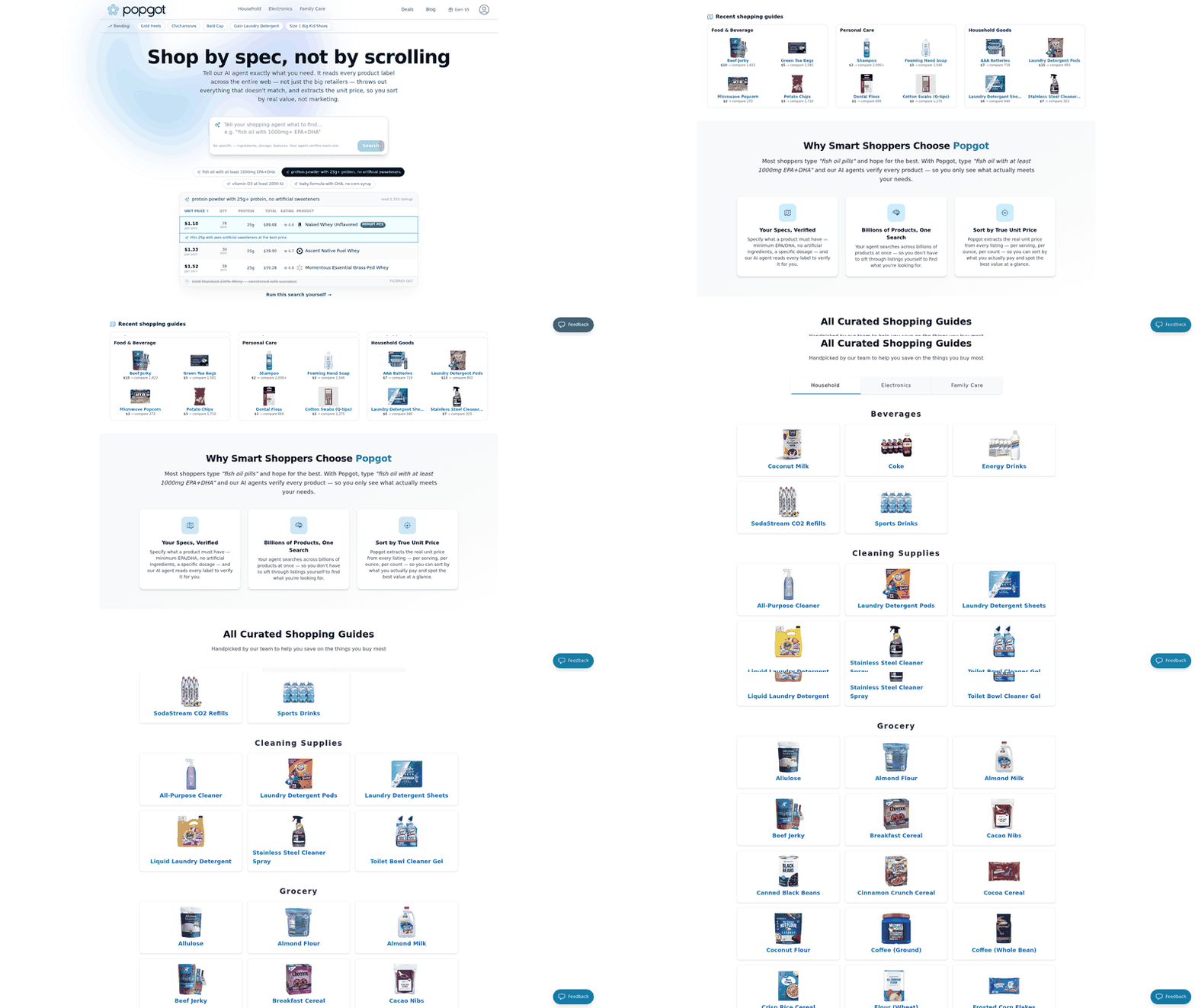
Price alone answers the wrong question. The right one is: what's the best valid deal? A valid deal meets your minimum dosage, excludes your allergens, and matches the formula you actually need. Set those constraints first, and every result you see is already usable.
What you can set beyond price
You can specify the things that decide whether a product works for you, not just what it costs. Think pass/fail gates, not preferences.
- Minimum active ingredient: a floor of 500mg elemental calcium per tablet, so a cheaper low-active formula never wins on price.
- Formulation type: fragrance-free handwash for sensitive skin, dye-free, or unscented rather than "lightly scented."
- Allergen exclusions: no peanuts, no gluten, no dairy, screened against the label.
- Dosage strength and pack count: 500mg vs 250mg, 60 count vs 120 count.
Guidance from the NIH Office of Dietary Supplements on reading supplement labels notes that the specific form and amount of an active compound matter. Two supplements with identical titles can carry different active yields. Our filter reads the available Supplement Facts data to enforce your floor before any price ranking happens.
Why exact matching saves parents money
For a parent buying a specific baby formula or a fragrance-free baby wash, formula matters as much as the sticker. FDA food labeling rules require major allergens to be declared, and we read the available label data so a cheaper substitute with the wrong protein source or an added fragrance never sneaks into your results.
That's how you cut returns and wasted purchases. When every listing already clears your constraints, you stop buying the almost-right thing, opening it, and driving it back. You buy once, and it fits.
Skip the constraints only when the products are genuinely interchangeable, like standard AA batteries. For anything with a spec that touches your health, set the floor first.
How Popgot finds the cheapest valid option across retailers
Searching multiple retailers at once changes the result set completely. Instead of trusting one store's price, you see the same valid product ranked across every major channel, then buy the cheapest one. The best deal rarely lives at the store you happened to open first.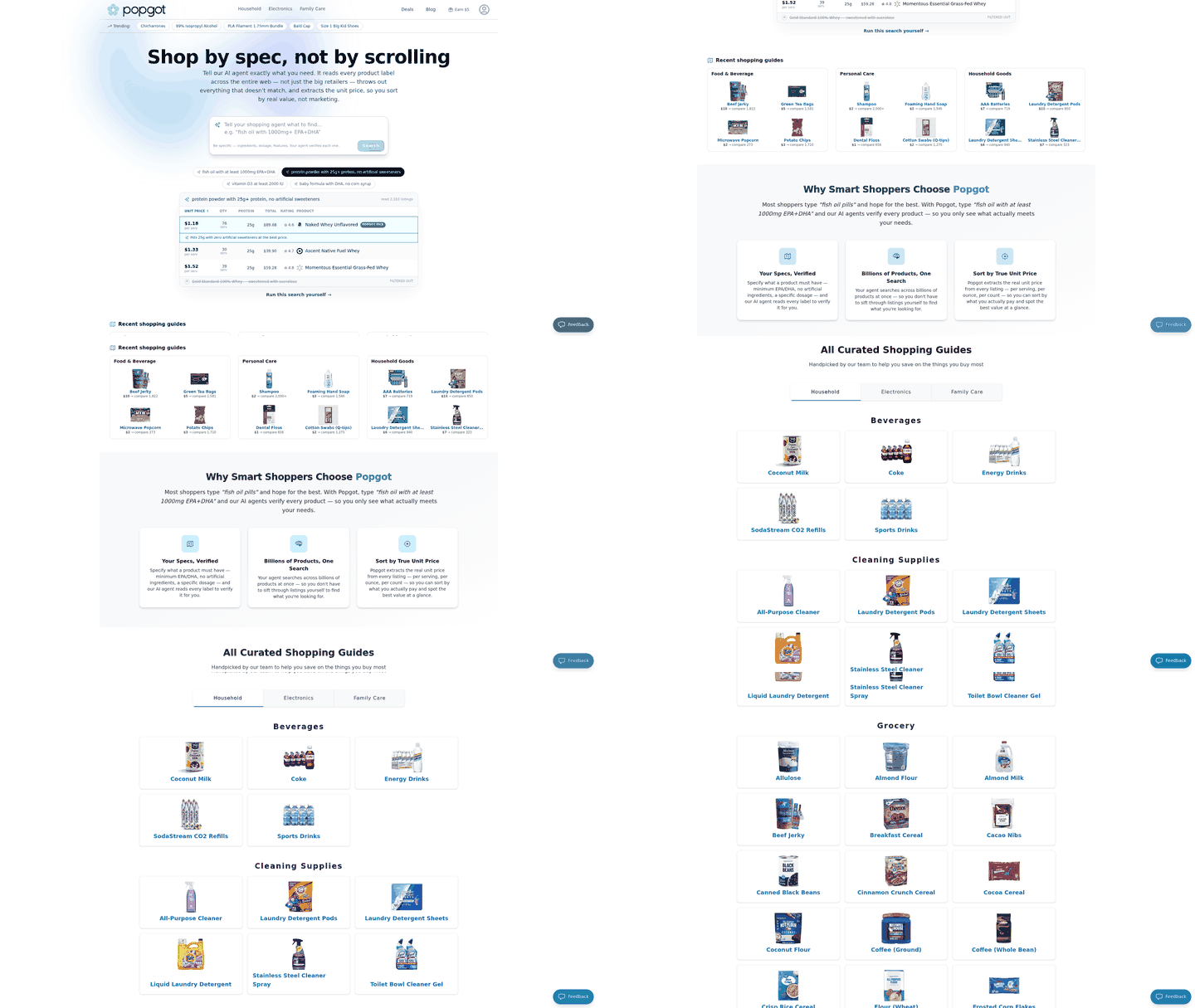
Checking one store at a time hides the cheapest valid option by design. When the system runs a cross-retailer search across places like Amazon, Walmart, and Target at once, it can surface price gaps you'd never catch tab by tab. Same spec, same pack count, different price. You pick the winner in one pass.
Why the same item costs different amounts per store
Price dispersion: identical or near-identical products sell for different prices across retailers because each channel sets its own margins, promotions, and pack configurations. That spread is exactly what cross-retailer comparison captures.
Promotions drive a lot of it. A retailer running a weekly loss leader might price a household staple below cost to pull you in, while a competitor holds at full margin. Regional pricing adds another layer: the same product can carry different tags depending on distribution zone. A single-store view flattens all of that into one number and hides the context that would tell you whether it's a genuine deal or a padded sticker.
Membership pricing muddies it further. One channel may show a lower price only after a paid subscription; another posts an open price anyone can hit. Platforms like Popgot can be configured to flag which price applies, so the ranking reflects what you'd really pay at checkout.
How this plays out on pantry staples
Pantry staples and personal care items swing hard because pack counts and sizes rarely line up between stores. That volatility is where a normalized search pays off.
Take extra virgin olive oil. One retailer lists a 16.9 oz glass bottle, another a 51 oz plastic jug, a third a club-sized two-pack. Once the system normalizes these to cost per fluid ounce, the true value option becomes clear, often defying which store you'd have guessed was cheapest.
Two things have to be right for the ranking to mean anything: the unit price has to be accurate, and the spec has to actually match what you asked for. Get both right, and the top result is the deal.
Shopping use cases for everyday essentials and recurring buys
The categories where accurate unit pricing matters most are the ones you buy again and again: shampoo, body wash, bar soap, snacks, pantry staples, cleaning supplies, baby products. This is where a smart search pays off, because you're comparing the same items across sizes and packs every month. Small per-unit differences that look trivial add up fast when you repurchase all year.
Run one query and you skip the repeat browsing you'd otherwise do dozens of times a year. Search "Dove body wash, 22 oz, sensitive skin" and the system reads every listing's label data, tosses the scented variants, and ranks what's left by cost per ounce. A repeat-friendly search you can rerun the moment you're low.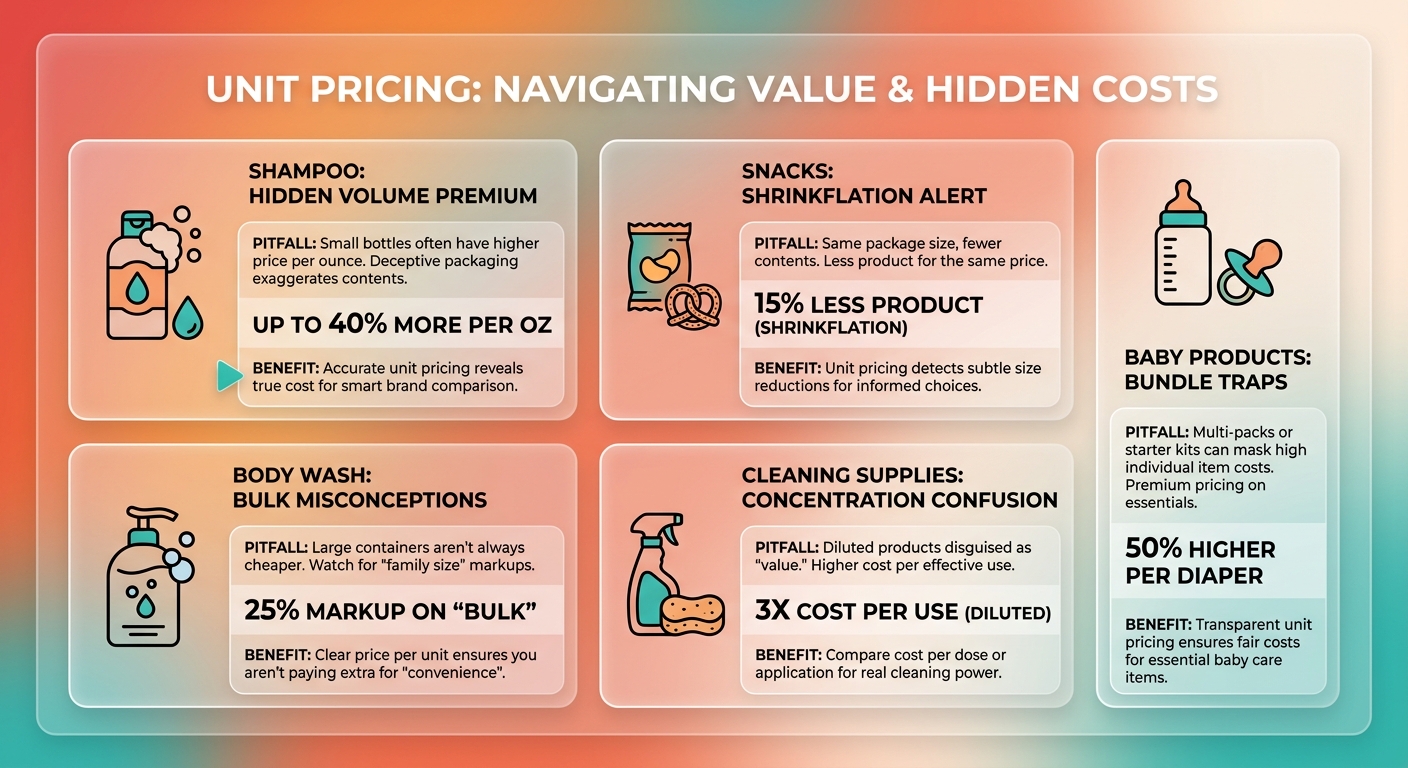
When the refill pack is actually cheaper
Not always. A "value" refill only wins if you'll use it before it goes stale or takes over your cabinet. Unit pricing settles the question fast.
Take rice. A single 2 lb bag, a 10 lb sack, and a 4-pack often carry three different prices per pound. The big sack usually wins on cost per pound. But if you cook rice twice a month, the small bag beats a bulk buy you'll never finish. Waste isn't value.
Same logic for Dove soap in a single bar versus an 8-count. Compare cost per bar, not sticker price, and the multipack frequently comes out ahead. Baby wipes and protein snacks follow the same pattern: check the per-wipe or per-serving number before you assume bulk saves money.
How small savings add up over a quarter
They compound quietly. Grocery prices have climbed in recent years, so shaving even a little off every recurring buy protects your monthly budget more than one big-ticket deal ever will.
Trim a modest amount off several recurring items each week and it can add up over a quarter, and you didn't lower your standards to get it. You still filtered for sensitive-skin formulas, fragrance-free, or the exact protein count you wanted.
That's the whole point of a verified repeat shop. Fast rebuys, less wasted browsing, and fewer misbuys where you grab the wrong formula because two labels looked alike.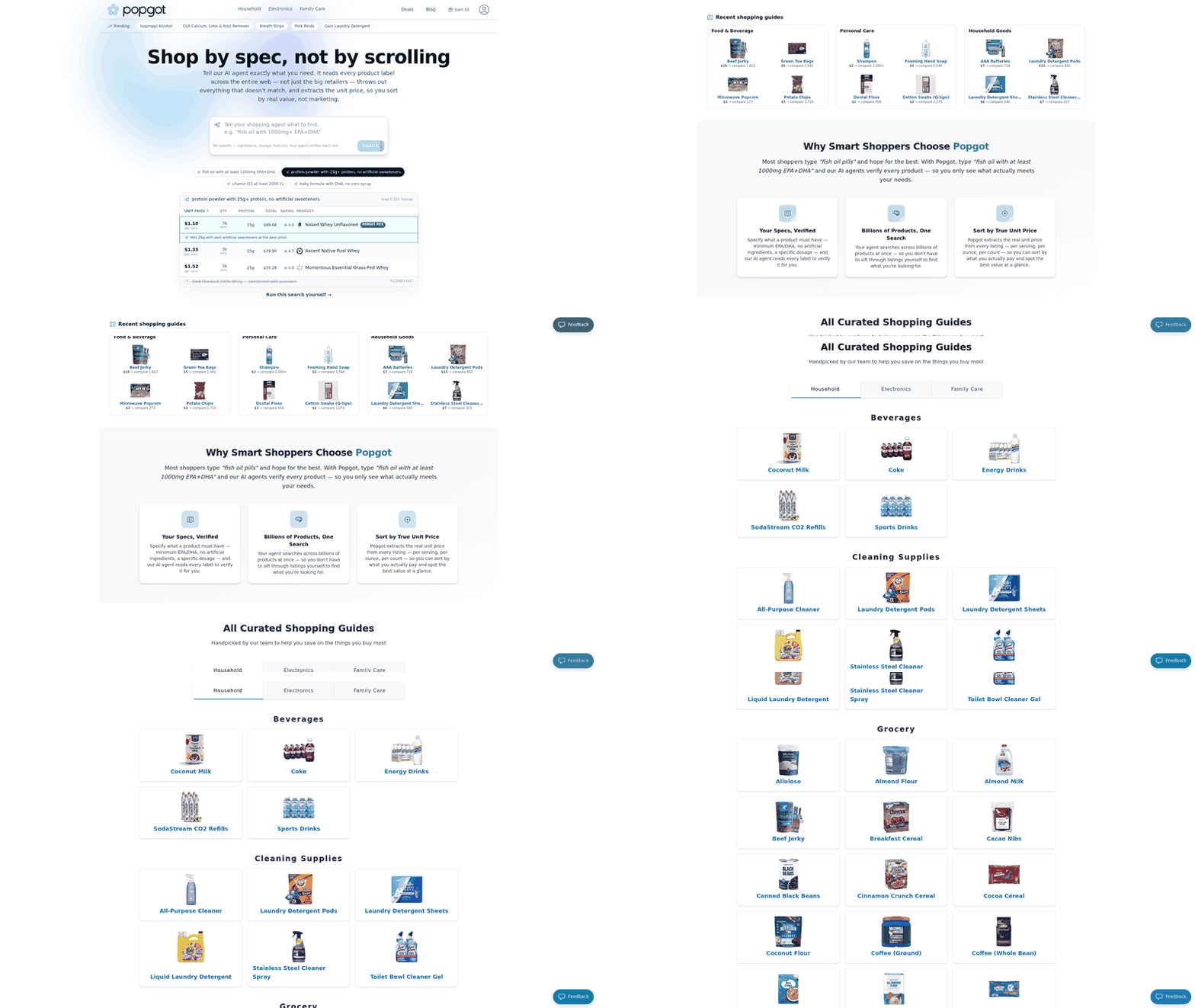
How to read search results for trust, accuracy, and value
A trustworthy result shows five things at once: the size, the count, the unit price, the retailer, and the match criteria it passed. If any of those is missing, you can't trust the ranking. We build every result card to show all five, so a search never asks you to take the top spot on faith.
Correctness and usability are two different tests, and a good result passes both. Correctness means the spec is real. Usability means you understand why this listing ranked first. When a search hides its reasoning, you're back to guessing.
How to spot a fake-equivalent match
Check the active ingredient and count before you trust the price. Two listings can share nearly identical names and still be different products. That's the trap generic search walks you straight into.
Take two "Vitamin D3 5000 IU, 120 softgels" listings. If one is actually a lower per-softgel dose with the total on the front label while the other is a genuine 5000 IU per softgel, they'd share the same title and headline number but carry a very different dose. A price-only sort ranks the cheaper bottle first. Match validation is meant to catch that kind of mismatch before you ever see it.
Why the bigger sticker price sometimes wins
Because the larger container often costs less per unit. Laundry detergent is a clear case: a large-count jug can look steep next to a small bottle, yet run cheaper per load once you standardize. The higher sticker can be the cheaper wash.
That's the calculation the system runs on every listing, so you don't need a calculator in the aisle. Popgot pulls the unit price from each listing's available data, per serving, per ounce, per count, per load, so you can sort by what you actually pay and spot the best value at a glance.
Watch for data-quality gaps that break the comparison: missing dimensions, bundled offers with no clear per-item count, or a two-pack listed as one unit. Complete size and quantity attributes matter for a reason.
Building a smarter price-comparison routine
Here's the routine we'd tell a friend to follow: define your requirements, run the comparison, check unit price, then pick the cheapest option that actually passed. Four steps, every time you shop. Once you've run one product search this way, the next one takes seconds because you already know what "good" looks like.
Start with requirements, not price. If you buy the same specialty supplement every month, lock in your minimum active dose and let everything else fall away. Then compare the verified results, glance at unit price, and buy the top of the list. No second-guessing.
How to track a recurring item over time
Rerun the same query every time you're running low and watch how the ranking shifts. That's how you catch a price creeping up quietly, or a seasonal dip worth timing your purchase around.
Say you buy the same 32 oz sensitive-skin body wash every six weeks. Run the query each cycle and you'll notice when your usual pick drifts from cheapest to mid-pack. That's your signal to switch, but only after the new option clears the same requirements. It's easy to stay loyal to a familiar bottle for years past the point it stopped being the best deal, purely because nothing flagged the shift. Which is exactly why rerunning the same verified search each cycle beats memory or habit.
Waiting vs buying now: if the unit price on your item has been stable for a while, buy what you need and move on. If you've just watched it dip below its recent range, that's when stocking up on a shelf-stable staple makes sense. Skip the "buy more just in case" instinct on anything perishable or bulky; the savings rarely cover the waste.
Curated guides help for one-off categories where you don't have a repeat pattern yet. But for anything you rebuy, search beats browsing every time. The real requirement was never just "cheap." It's cheap and correct — and that's the whole reason a verified search beats treating price as the only signal.
Frequently Asked Questions
How does Popgot verify that two products are actually the same before comparing prices?
The system parses each listing's available label data rather than matching keywords in the title. It checks the specs you set, active ingredient amount, dosage, size, pack count, allergen exclusions, against what the label data reports, and drops anything that doesn't match. Only then does it rank the survivors by unit price. So a 600mg listing never gets compared head-to-head with a 1,200mg one.
What can I set as a requirement besides price?
Minimum active ingredient (say, 500mg elemental calcium per tablet), formulation type (fragrance-free, dye-free, unscented), allergen exclusions (no peanuts, gluten, or dairy), and dosage strength or pack count. These work as pass/fail gates: a listing either clears your floor or it's filtered out before ranking.
Why is the cheapest unit price sometimes the wrong choice?
Because a low unit price is worthless if the product fails your actual requirement. The cheapest bottle per ounce doesn't help you if it's scented and you need fragrance-free, or if it's a weaker concentration than you asked for. That's why the spec gets verified first, then the valid matches get ranked by price.
How many retailers does Popgot search at once?
Eight major retailers simultaneously, including places like Amazon, Walmart, and Target. Searching them all in one pass can surface price gaps you'd never catch checking one store at a time, since the same valid product often carries different prices across channels.
Does bulk always save money?
No. A bulk pack only wins if you'll use it before it goes stale or it takes over your cabinet. Normalizing to cost per pound, per load, or per serving settles it fast — but for something you use slowly, a smaller size can beat a bulk buy you'll never finish. Waste isn't value.
References
[1] Unit Pricing: Compare Apples to Apples - https://solutions.tennessee.edu/?view_pub_pdf=2495