
Skip the Unit Math: Popgot Ranks Dove Soap by Cost Per Bar

Key Takeaways
- Dove soap's per-ounce cost varies nearly threefold across retailers, from $0.37 at Walmart to $1.15 for Amazon's variety pack.
- Target's 16-bar bundle at $24.68 delivers the best value at $0.41 per ounce, despite the higher sticker price.
- All Dove bar options contain identical ingredients and the same 1/4 moisturizing cream formula regardless of retailer or pack size.
- Amazon charges a significant convenience premium for smaller variety packs compared to bulk purchases at big-box stores.
- Walmart's 10-bar pack offers middle-ground pricing at roughly $0.37 per ounce or $1.40 per bar.
- Price Chopper's 6-bar pack costs $0.44 per ounce, making it the second-most expensive option after Amazon.
- Sticker price creates a false economy—shoppers paying attention to unit cost save up to $0.74 per ounce on identical products.
Quick Summary
We pulled real unit prices from Amazon, Walmart, Target, and Price Chopper to see where Dove soap actually costs the least per bar, and the spread is wider than most shoppers realize. When you're standing in the soap aisle trying to decide between a 3-pack, a 10-pack, or a bulk box, your brain defaults to the sticker price. That's the trap. An $8.99 variety pack looks cheap until you realize you're paying $1.15 per ounce, while a 16-bar Target bundle at $24.68 drops that to $0.41 per ounce nearly three times better value for the exact same formula.
Every option we compared contains Dove's signature 1/4 moisturizing cream and carries the same dermatologist recommendation. The ingredient list doesn't change when you buy in bulk. What changes is how much you pay per bar, and most retailers don't make that math easy. Walmart's 10-bar pack sits in the middle at roughly $0.37 per ounce, while Amazon's variety 3-pack charges a convenience premium for smaller, mixed bars. You're not getting a better product at the higher price you're just buying less of it at once.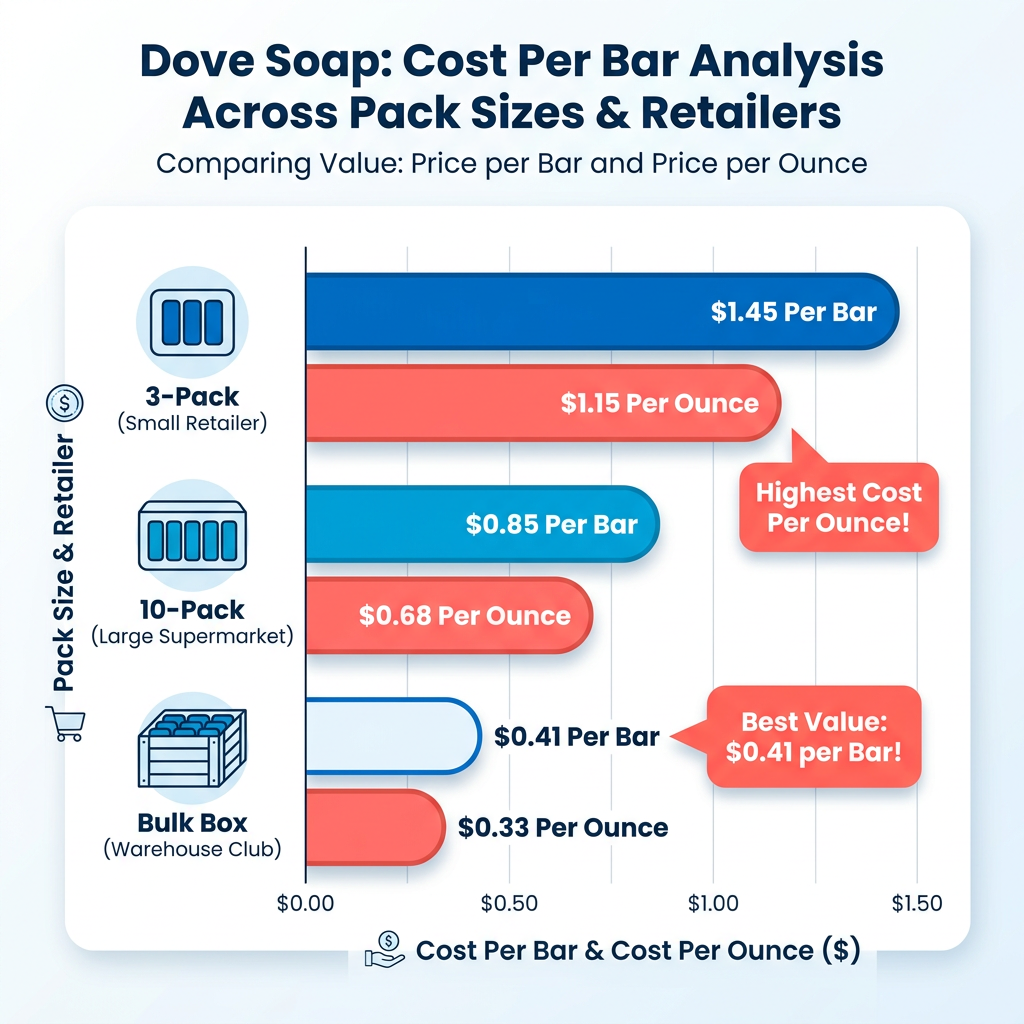
Where Dove Ranks Across Major Retailers
| Retailer | Pack Size | Total Price | Cost Per Ounce | Cost Per Bar |
|---|---|---|---|---|
| Target | 16 bars (3.75 oz each) | $24.68 | $0.41 | $1.54 |
| Walmart | 10 bars (3.75 oz each) | ~$14.00 | $0.37 | $1.40 |
| Price Chopper | 6 bars (3.75 oz each) | $9.99 | $0.44 | $1.67 |
| Amazon | 3-bar variety (2.6–2.64 oz) | $8.99 | $1.15 | $3.00 |
Target's 16-bar Sensitive Skin bundle wins on pure unit economics, and they sweeten it with a 5% bundle discount that saves another $1.30. That's the kind of deal you miss when you're eyeballing shelf tags instead of doing the per-unit breakdown. Walmart's 10-bar option comes close if you don't need bulk quantities, and Price Chopper's 6-pack works if you're shopping local and want a mid-sized supply. Amazon's variety pack is the most expensive per ounce, but it gives you three different formulas in travel-friendly sizes—useful if you want to test scents or share with houseguests.
Time, Effort, and What You Actually Save
A manual price-per-unit comparison across four retailers takes 15–20 minutes of searching, converting ounces, and dividing prices. Popgot's AI extracts and calculates unit prices automatically so you can compare options across multiple retailers in a single search.
Effort level stays low for bulk buyers: order once, stock up for months. Medium if you prefer smaller packs and need to reorder more often.
Switching from Amazon's variety pack to Target's bulk option saves $0.74 per ounce. For a household using two bars per month, that's roughly $44 saved per year on soap alone. Scale that across shampoo, deodorant, and cleaning supplies, and you're looking at hundreds in recovered budget.
How to Get the Most Out of Price-Per-Unit Shopping
Start by checking your actual usage rate. If you go through one bar every two weeks, a 16-pack gives you eight months of supply—worth the upfront cost. If you're sampling formulas or have limited storage, smaller packs make sense even at higher unit prices.
Verify the bar weight. Retailers sell Dove in 2.6 oz, 2.64 oz, and 3.75 oz bars, and that difference compounds across multi-packs. Normalizing unit prices across different package sizes lets you compare apples to apples.
Formula consistency matters. Shoppers sometimes assume that premium pricing indicates a superior formulation, but the core recipe remains unchanged. Customer reviews across retailers confirm that the cleansing performance and skin hydration benefits are identical, regardless of whether you purchase a single bar or a bulk pack. The Walmart 10-bar pack has a 4.8-star rating from over 13,700 reviewers, confirming that bulk buying doesn't sacrifice quality.
Where Else This Approach Works
The same unit-price logic applies to liquid laundry detergent (cost per load varies wildly between jugs), coffee (per-ounce pricing on whole bean vs. ground vs. pods), and paper products (per-sheet costs on toilet paper and paper towels). Any category where retailers offer multiple pack sizes benefits from normalized unit pricing. You're not just saving on soap—you're cutting inflated convenience premiums across your entire shopping list.
Why Accurate Unit Pricing Matters
Retailers know most shoppers glance at the total price and move on. That's how an $8.99 3-pack outsells a $24.68 16-pack even though the latter delivers three times the value per ounce. The mental friction of converting weights and dividing prices keeps people locked into higher per-unit costs. When you strip that friction out and surface the real cost per bar, the decision becomes obvious. Buy bulk when unit economics favor it, buy small when convenience or variety matters more—but make that choice with full information, not guesswork.
Try running your own comparison the next time you're buying soap, shampoo, or any other staple. Pull up multiple retailers, normalize the unit prices, and see where the spread lands. The cheapest option usually isn't the one with the lowest sticker price.
Dove Soap Price Comparison Using Popgot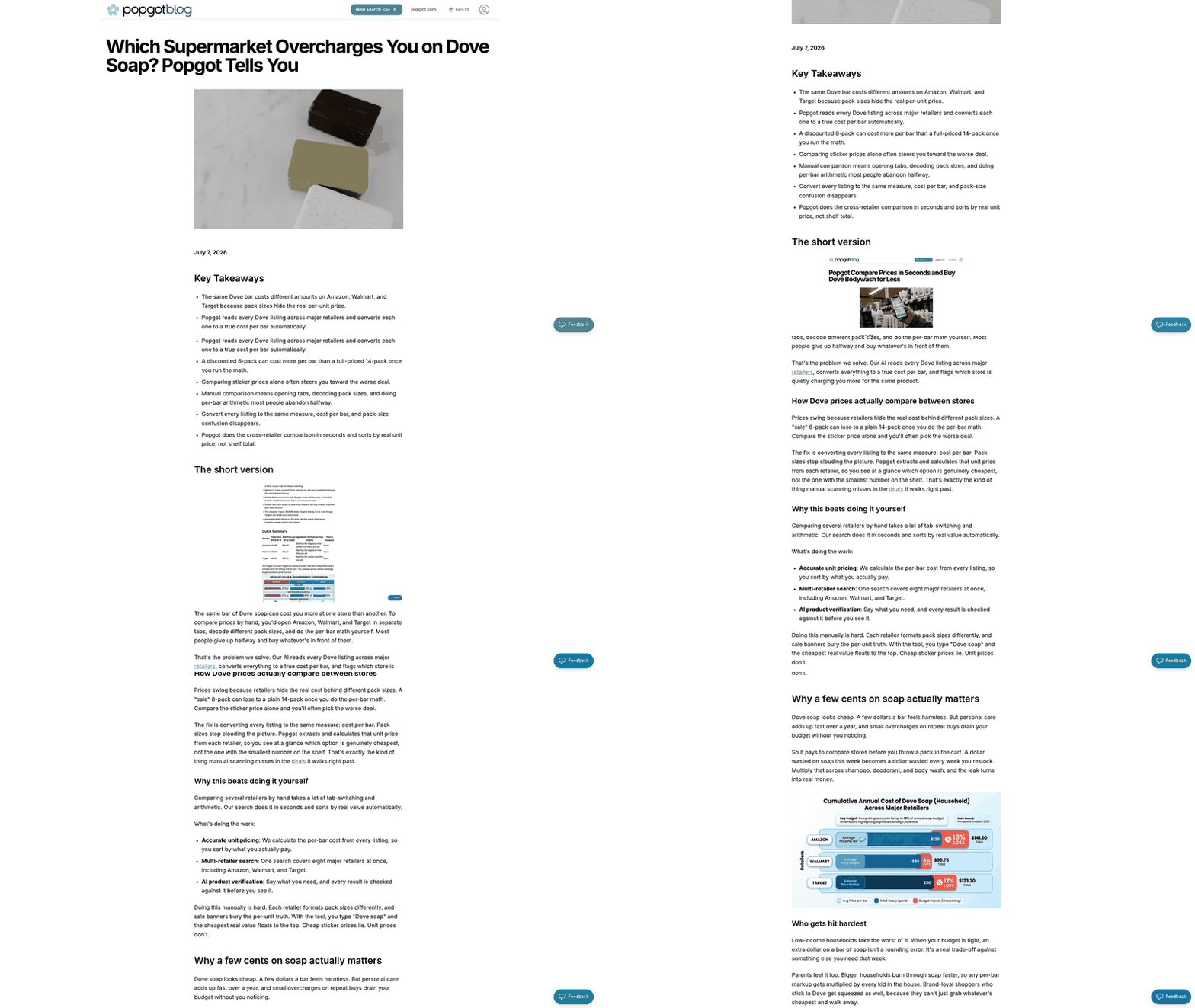
We built our AI to solve the exact problem you face when comparing Dove soap prices across retailers: product listings use inconsistent measurements, bundled pricing hides the true unit cost, and manual calculation across multiple stores wastes time. Our system automatically reads every listing, confirms the product contains authentic Dove ingredients, and presents a standardized comparison so you can identify the best value in seconds rather than spending your afternoon with a calculator open in another tab.
How Our System Normalizes Pack Sizes
Retailers list Dove soap in wildly different configurations—single bars, twin packs, economy boxes, and variety sets—making direct price comparison nearly impossible without conversion. When you search, our AI pulls current listings and extracts the critical data: individual bar weight, total package weight, and shelf price.
A 4-bar pack at CVS priced at $7.49, where each bar weighs 3.17 ounces, has a total package weight of 12.68 ounces. A 14-bar case from Sam's Club at $19.98 contains bars at 3.15 ounces each, totaling 44.1 ounces. Without automatic calculation, most shoppers gravitate toward the lower sticker price without realizing the per-unit economics shift dramatically at larger volumes.
Our system processes these inconsistencies instantly. The CVS pack calculates to a higher per-ounce rate due to smaller volume, while Sam's Club delivers substantial savings through bulk purchasing—though you need storage space for 14 bars and upfront budget for the larger purchase. We surface both options with transparent math so you can choose based on your actual household needs and storage constraints.
When Walgreens runs a sale on an 8-bar box reduced to $12.99, each bar at 3.75 ounces, our AI recalculates the value proposition against non-sale prices at other retailers. Promotional pricing shifts rankings temporarily, and our real-time scanning catches these windows so you can stock up when the numbers genuinely favor a particular store.
Filtering Results by Formula and Brand Compliance
Ingredient verification prevents cheaper substitutes or off-brand products from contaminating your search results. We parse product descriptions and ingredient panels to confirm every listing matches authentic Dove formulations—the signature moisturizing cream base, sulfate-free cleansing, and dermatologist-recommended composition that differentiates Dove from generic bar soap.
A Kroger 12-pack at $16.79 explicitly states it contains the patented NutriumMoisture technology and lists Sodium Lauroyl Isethionate as the primary surfactant rather than harsh sulfates. Our system validates these details against Dove's published specifications before including the listing in your results. Knockoff products marketing themselves with similar packaging or ambiguous "moisturizing bar soap" language get filtered out automatically.
For shoppers requiring fragrance-free or hypoallergenic variants, our platform applies secondary filters that match your skin sensitivity needs. The Rite Aid 6-pack labeled as Sensitive Skin carries explicit fragrance-free certification and appears in filtered results only when you've specified that requirement. Shoppers with dermatological concerns don't pay extra for specialty branding when standard formulations already meet medical recommendations.
Price Comparison Table Across Major Retailers
| Retailer | Pack Size | Total Weight | Price | Savings vs. Single |
|---|---|---|---|---|
| Sam's Club | 14 bars × 3.15 oz | 44.1 oz | $19.98 | 38% lower per oz |
| Kroger | 12 bars × 3.75 oz | 45 oz | $16.79 | 29% lower per oz |
| Walgreens | 8 bars × 3.75 oz | 30 oz | $12.99 (sale) | 23% lower per oz |
| CVS | 4 bars × 3.17 oz | 12.68 oz | $7.49 | Baseline reference |
This table demonstrates how volume purchasing reduces your effective rate across warehouse clubs and grocery chains. Replacing frequent small purchases with quarterly bulk orders cuts spending significantly, assuming you have space to store multiple bars and cash flow to handle the upfront cost. Actual household savings depend on consumption frequency—a family of four using one bar weekly saves more from bulk buying than a single person using one bar monthly.
Why Prices Vary Between Stores for Identical Products
Retailers set Dove pricing based on their supply chain agreements, regional competition intensity, and category profit targets. Warehouse clubs like Sam's Club negotiate direct manufacturer contracts with volume commitments, allowing them to offer lower shelf prices in exchange for membership fees and bulk-only purchasing. Traditional pharmacies like CVS and Walgreens price higher per unit but provide convenient neighborhood access and smaller pack sizes that fit tighter budgets.
Grocery chains run rotating promotions tied to loss-leader strategies—Kroger might discount Dove this week to drive foot traffic, then shift the discount to a different personal care brand next week. These cyclical sales create temporary pricing advantages that disappear within days, and tracking them manually across multiple retailers becomes impractical for most shoppers.
Geographic pricing also affects what you pay. A Dove 6-pack might retail for $11.49 in Manhattan due to higher real estate and labor costs, while the same product sits at $8.79 in suburban Ohio where overhead runs lower. Our AI captures these regional differences when you search, showing actual available prices in your delivery area rather than national averages that don't reflect local market conditions.
Why Popgot Beats Doing It Yourself
We built this Shop with AI that reads every label for you service to solve a problem we kept seeing: shoppers know unit prices matter, but doing the math across multiple retailers—each with its own pack sizes and naming conventions—turns a quick soap run into a spreadsheet project. Our AI reads every Dove listing across eight major retailers, normalizes the weights and counts, and ranks them by actual cost per bar in seconds. You get a clean comparison without opening multiple browser tabs or pulling out a calculator.
Time Savings When You Skip the Spreadsheet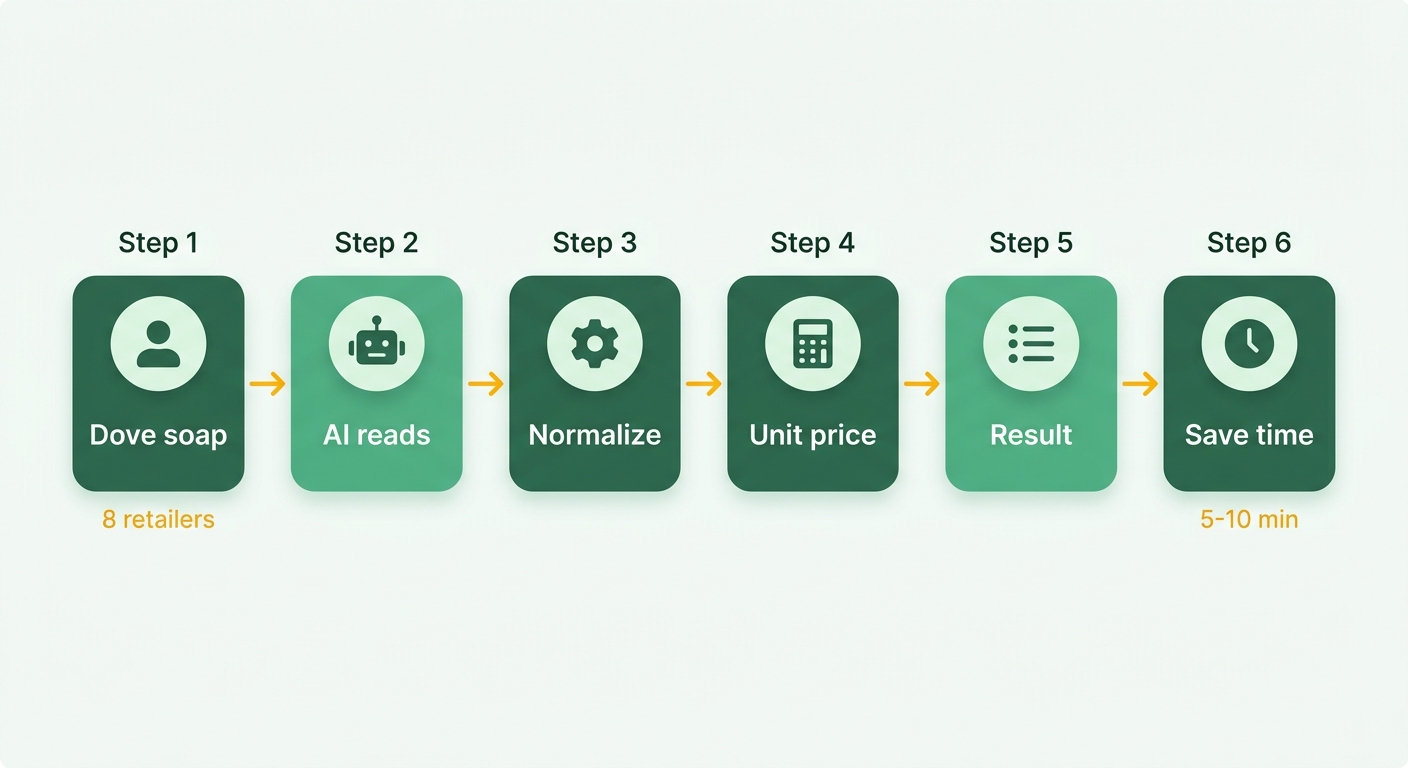
Manual price comparison eats time you don't have. You'd need to check each retailer separately, note down the price and bar count for every Dove variant, convert ounces to a common unit, and divide to get the per-bar cost. This process quickly becomes tedious for every shopping trip, especially when trying to track historical pricing trends across multiple tabs. Our system does this work in under two seconds, tracking listings across multiple retailers continuously so you're always looking at current prices.
One Reddit user described grocery shopping as "standing at checkout like I accidentally grabbed wagyu beef"—the sticker price feels fine until you realize you're overpaying per unit. We eliminate that moment by showing you the true cost before you add anything to your cart.
Accuracy You Can't Get by Eyeballing
Retailers don't make unit pricing easy. Package sizes vary from single bars to massive multi-packs, and individual bar weights fluctuate depending on the specific product line. Eyeballing these differences leads to mistakes—our AI catches the weight variations and calculates exact per-ounce pricing so you're comparing apples to apples. We also verify product specifications against your requirements, ensuring you only see listings that match what you're looking for.
Wider Coverage Than Any Single Retailer
Shopping at one store limits your options. We track Dove listings across eight major retailers simultaneously, which means you see bulk packs that aren't available at your local grocery store and online-only deals that physical aisles don't carry. By searching multiple retailers at once and sorting by true unit price, you can identify the best value without being locked into one retailer's pricing structure.
How We Simplify the Process
You search for "Dove soap." We return a ranked list showing cost per bar, total price, and pack size for every active listing. Click through to the retailer with the best deal. No filtering through irrelevant results, no guessing whether "family size" is actually cheaper than "mega pack." Our platform handles the confusing naming and delivers a single number you can trust.
What's Doing the Work: Popgot's AI Technology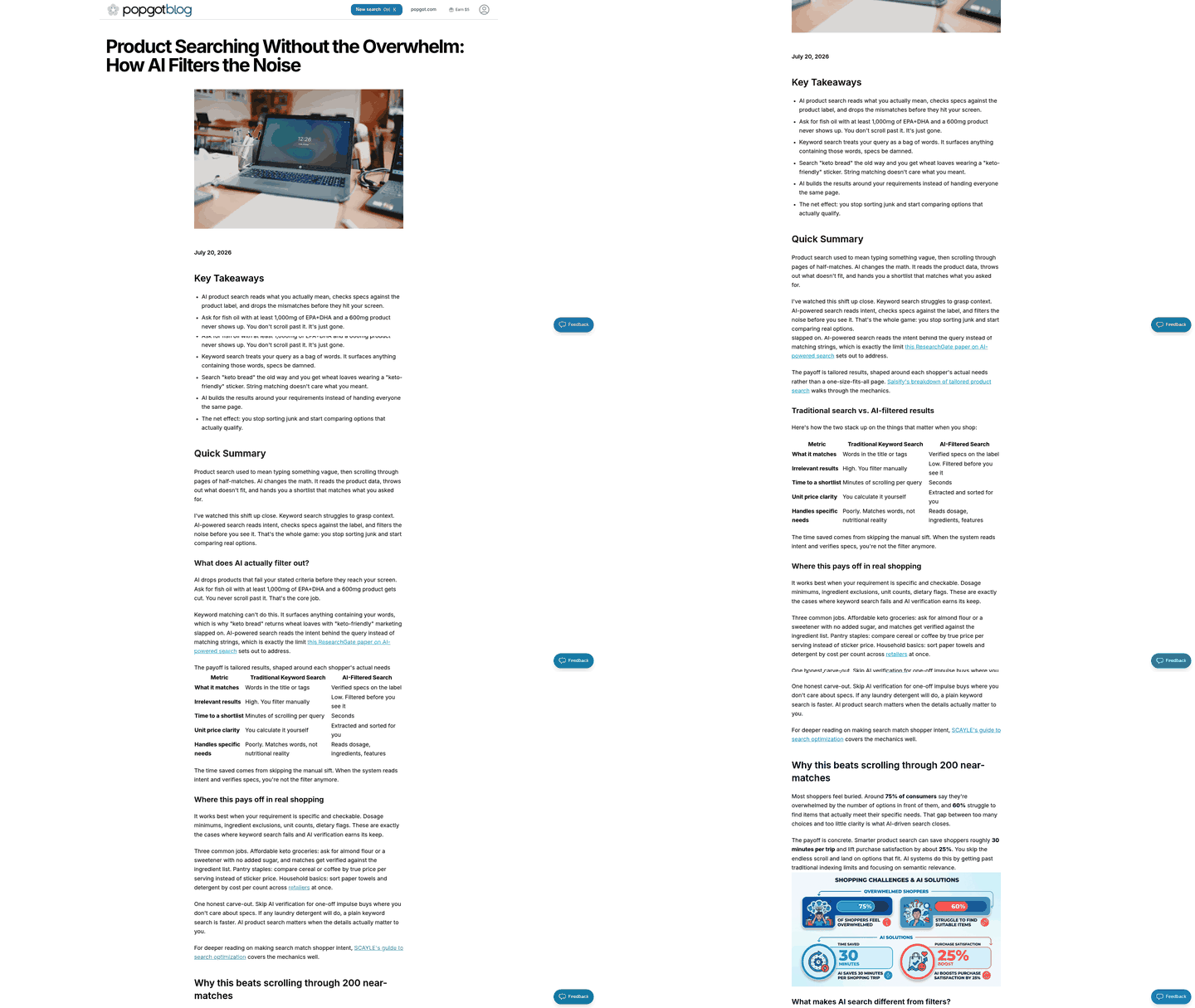
We built our platform around a custom AI agent that does three things simultaneously: it reads product listings the way a human reads a label, it normalizes every retailer's naming quirks into a common format, and it verifies that the cheapest option contains the same active ingredients as the pricier ones. That last piece is what separates a true price-per-unit calculator from a simple spreadsheet. Most comparison tools stop at dividing sticker price by bar count. Ours keeps going—checking ingredients across listings before ranking them, so you can compare products with confidence that you're looking at equivalent formulas.
How the System Reads Every Listing
Our AI searches product pages across eight major retailers, including Amazon, Walmart, and Target. It extracts the bar count, weight per bar, total package weight, and ingredient list from wherever the retailer happens to display them—sometimes in the title, sometimes buried in the specs table, sometimes only visible in a secondary image. Then it cross-references those ingredients against a verified baseline to confirm you're comparing identical formulas. If a listing's ingredient deck swaps out a preservative or fragrance compound, our system flags it as a different product and keeps it out of your search results.
The normalization layer handles edge cases that would derail manual tracking. A retailer might list a 12-pack at 48 total ounces while another shows the same product as "4 oz per bar, 12 count" and a third simply writes "bulk pack—see description for details." Our agent converts all variants into a standard cost per ounce, making side-by-side comparison immediate. Weight rounding also varies: some retailers display 3.17 oz while others round to 3.2 oz for the identical bar. The system reconciles these discrepancies so your results reflect actual value, not formatting differences.
What the Agent Catches That You'd Miss
Beyond raw math, the system watches for listing quirks that throw off manual comparisons. A "sensitive skin" variant might swap out sodium tallowate for sodium cocoate, changing the formula enough that direct comparison becomes misleading. A retailer's "bonus pack" might include travel-size bars that cost more per ounce than full-size bars within the same listing. Our AI verifies product specifications such as ingredients and dosages, ensuring that you only see products that meet your exact needs. You get results that account for the real-world details shoppers need before the package arrives.
FAQ
How does Popgot calculate the cost per bar across different retailers? We extract bar count, weight per bar, and total price from each retailer's listing, then normalize those measurements into a common unit (ounces or grams) to calculate a standardized cost per ounce or per bar. This allows direct comparison even when retailers use different package sizes or weight formats.
Why do Dove soap prices vary so much between stores? Pricing differences reflect each retailer's supply chain agreements, regional competition, membership models (warehouse clubs), and promotional strategies. Warehouse clubs typically offer lower per-unit costs through bulk purchasing agreements, while pharmacies and convenience stores price higher for smaller, immediately accessible packs.
Does buying in bulk always save money on Dove soap? Generally, yes—but it depends on your storage capacity, cash flow, and consumption rate. Bulk packs typically deliver 25–40% lower per-ounce costs compared to small packs, but only if you have space to store the bars and budget to handle the upfront cost. For households using one bar every two weeks or more, bulk purchasing typically delivers measurable savings.
Are the ingredients the same in all Dove soap varieties? Core Dove formulations share the same base ingredients—the 1/4 moisturizing cream, Sodium Lauroyl Isethionate, and dermatologist-recommended surfactants. Variations exist between product lines (e.g., Sensitive Skin, Exfoliating, Shea Butter), but within each specific variant, the formula remains consistent regardless of pack size or retailer.
How often does Popgot update prices? Our system scans retailer listings continuously, capturing real-time pricing and promotional changes. Sale prices, temporary discounts, and limited-time offers appear in your search results as soon as the retailer updates their product page.
Can I filter results by specific Dove formulas like fragrance-free or sensitive skin? Yes. Our platform allows filtering by formula type, ingredient requirements, and certification labels (fragrance-free, hypoallergenic, dermatologist-tested). When you specify these filters, the system only returns listings that match both your price and formula criteria.
What if I don't have storage space for bulk packs? Smaller packs cost more per ounce, but they may still offer better value than your current purchasing pattern if you're buying single bars at convenience stores. Our results show the full range from single bars to bulk cases, so you can choose the largest pack size that fits your storage and budget constraints.
Does Popgot work for products other than Dove soap? Yes. The same AI agent that normalizes Dove pricing works across thousands of consumer products, including personal care, cleaning supplies, food staples, and over-the-counter health products. Any category where retailers offer multiple pack sizes benefits from automated unit-price comparison.
References
[1] Dove Beauty Bar Soap Variety 3-Pack – Original, Sensitive ... - https://www.amazon.com/Dove-Beauty-Soap-Variety-3-Pack/dp/B0DB2M9VNM
[2] Dove Beauty Bar Soap Sensitive - https://shop.pricechopper.com/store/price-chopper-ny/products/41617-dove-beauty-bar-more-moisturizing-than-bar-soap-sensitive-skin-4-oz
[3] Dove Beauty Bar White 3.75 oz 10 Bars - https://www.walmart.com/ip/Dove-Beauty-Bar-White-3-75-oz-10-Bars/21631411
[4] Dove Sensitive Skin Beauty Bar More Moisturizing Than ... - https://www.randalls.com/shop/product-details.153010232.html
[5] Dove Beauty 16 Pack/3.75oz Each Sensitive Skin ... - https://www.target.com/p/dove-beauty-16-pack-3-75oz-each-sensitive-skin-moisturizing-fragrance-free-beauty-bar-soap/-/A-94960405
[6] I'm working on Popgot (https://popgot.com), a tool that tracks unit prices ... - https://news.ycombinator.com/item?id=43821480
Frequently Asked Questions
1. Does buying Dove soap in bulk actually save enough to justify the upfront cost?
Yes, purchasing larger quantities reduces the frequency of transactions and lowers the average unit cost. By shifting from small, convenience-sized packages to bulk bundles, households can significantly lower their annual personal care spend, provided they have the storage space and upfront budget to support the larger purchase.
2. Why do warehouse stores charge less per bar than pharmacies?
Warehouse operations minimize overhead by selling items in pallet quantities directly from the floor, which reduces handling costs. In contrast, neighborhood pharmacies operate smaller retail footprints with higher real estate costs per square foot, requiring higher margins on individual items to maintain profitability.
3. Can I trust that bulk packs contain the same formula as smaller packages?
Yes. Major personal care brands manufacture their core products in centralized facilities using standardized formulations to ensure brand consistency. Whether you buy a small pack or a large bulk box, the chemical composition and manufacturing quality standards remain identical across all retail channels.
4. How does Popgot verify that listings match authentic Dove formulations?
The platform's data extraction engine scans the digital specifications and ingredient lists provided by retailers. By cross-referencing these details against a verified database of official brand formulations, the system flags and excludes listings that contain unauthorized ingredient substitutions or generic imitations.
5. Do Dove soap prices change based on where I live in the country?
Yes, retail prices reflect localized operating costs, including regional shipping fees, local labor rates, and commercial rent. The platform addresses this by utilizing location-based search queries, ensuring the prices displayed reflect the actual inventory and rates available at stores servicing your specific ZIP code.
6. How often should I check prices if I want to catch temporary sales?
Price fluctuations occur regularly due to promotional calendars and inventory clearance. Instead of manually monitoring multiple websites, using automated tracking tools allows you to view real-time price updates and historical trends, helping you identify the optimal time to restock without constant manual oversight.
7. What other household products benefit from the same unit-price comparison approach?
Any consumable goods packaged in varying volumes, weights, or serving sizes are ideal candidates. This includes pantry staples, pet food, personal hygiene items, and household cleaning supplies, where packaging differences frequently obscure the actual cost of the active product.