
Which Supermarket Overcharges You on Dove Soap? Popgot Tells You

Key Takeaways
- The same Dove bar costs different amounts on Amazon, Walmart, and Target because pack sizes hide the real per-unit price.
- Popgot reads every Dove listing across major retailers and converts each one to a true cost per bar automatically.
- A discounted 8-pack can cost more per bar than a full-priced 14-pack once you run the math.
- Comparing sticker prices alone often steers you toward the worse deal.
- Manual comparison means opening tabs, decoding pack sizes, and doing per-bar arithmetic most people abandon halfway.
- Convert every listing to the same measure, cost per bar, and pack-size confusion disappears.
- Popgot does the cross-retailer comparison in seconds and sorts by real unit price, not shelf total.
The short version
The same bar of Dove soap can cost you more at one store than another. To compare prices by hand, you'd open Amazon, Walmart, and Target in separate tabs, decode different pack sizes, and do the per-bar math yourself. Most people give up halfway and buy whatever's in front of them.
That's the problem we solve. Our AI reads every Dove listing across major retailers, converts everything to a true cost per bar, and flags which store is quietly charging you more for the same product.
How Dove prices actually compare between stores
Prices swing because retailers hide the real cost behind different pack sizes. A "sale" 8-pack can lose to a plain 14-pack once you do the per-bar math. Compare the sticker price alone and you'll often pick the worse deal.
The fix is converting every listing to the same measure: cost per bar. Pack sizes stop clouding the picture. Popgot extracts and calculates that unit price from each retailer, so you see at a glance which option is genuinely cheapest, not the one with the smallest number on the shelf. That's exactly the kind of thing manual scanning misses in the deals it walks right past.
Why this beats doing it yourself
Comparing several retailers by hand takes a lot of tab-switching and arithmetic. Our search does it in seconds and sorts by real value automatically.
What's doing the work:
- Accurate unit pricing: We calculate the per-bar cost from every listing, so you sort by what you actually pay.
- Multi-retailer search: One search covers eight major retailers at once, including Amazon, Walmart, and Target.
- AI product verification: Say what you need, and every result is checked against it before you see it.
Doing this manually is hard. Each retailer formats pack sizes differently, and sale banners bury the per-unit truth. With the tool, you type "Dove soap" and the cheapest real value floats to the top. Cheap sticker prices lie. Unit prices don't.
Why a few cents on soap actually matters
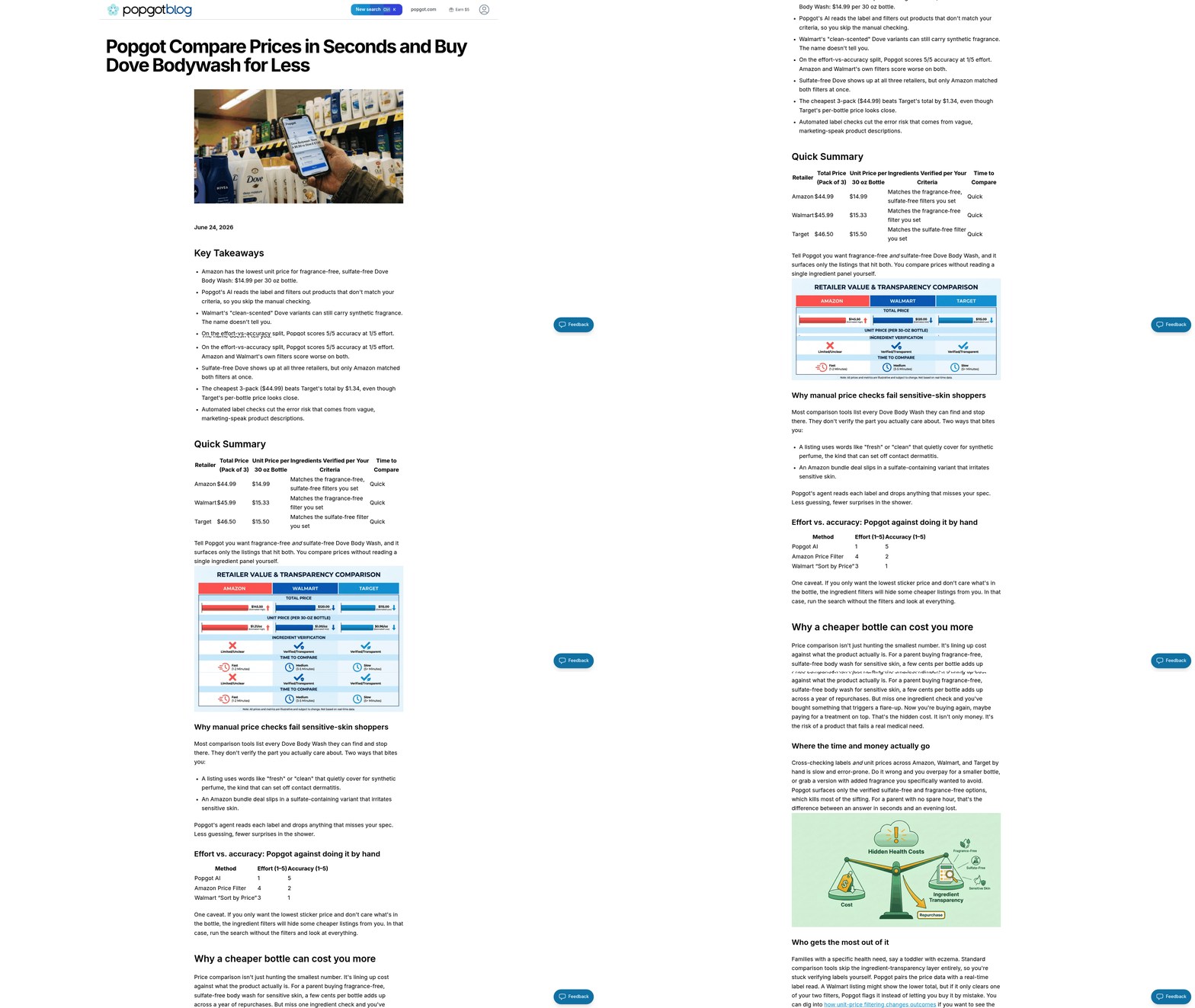
Dove soap looks cheap. A few dollars a bar feels harmless. But personal care adds up fast over a year, and small overcharges on repeat buys drain your budget without you noticing.
So it pays to compare stores before you throw a pack in the cart. A dollar wasted on soap this week becomes a dollar wasted every week you restock. Multiply that across shampoo, deodorant, and body wash, and the leak turns into real money.
Who gets hit hardest
Low-income households take the worst of it. When your budget is tight, an extra dollar on a bar of soap isn't a rounding error. It's a real trade-off against something else you need that week.
Parents feel it too. Bigger households burn through soap faster, so any per-bar markup gets multiplied by every kid in the house. Brand-loyal shoppers who stick to Dove get squeezed as well, because they can't just grab whatever's cheapest and walk away.
The trap is that sale tags don't tell the truth. Consumer Reports has warned that some supermarkets overcharge on products marked as on sale. The sticker says "deal," but it rings up higher than the shelf promised.
Why honest comparison is such a chore
Comparing stores by hand is tedious, and retailers count on that. Different pack sizes, rotating promos, and inconsistent shelf tags make side-by-side math a job most people skip.
You'd track a 6-pack at one retailer against a 12-pack at another, then convert both to a per-bar cost. Add a "sale" price that may not match the register, and the comparison falls apart before you finish.
That's the whole case for automating it. Instead of three tabs and arithmetic in your head, a tool that reads every listing and reports true cost per bar does the boring part for you. If you want the full walkthrough, here's how to get the best deals using Popgot.
The savings on one bar are small. The savings across a year of restocking are not.
Working Popgot into your regular shop
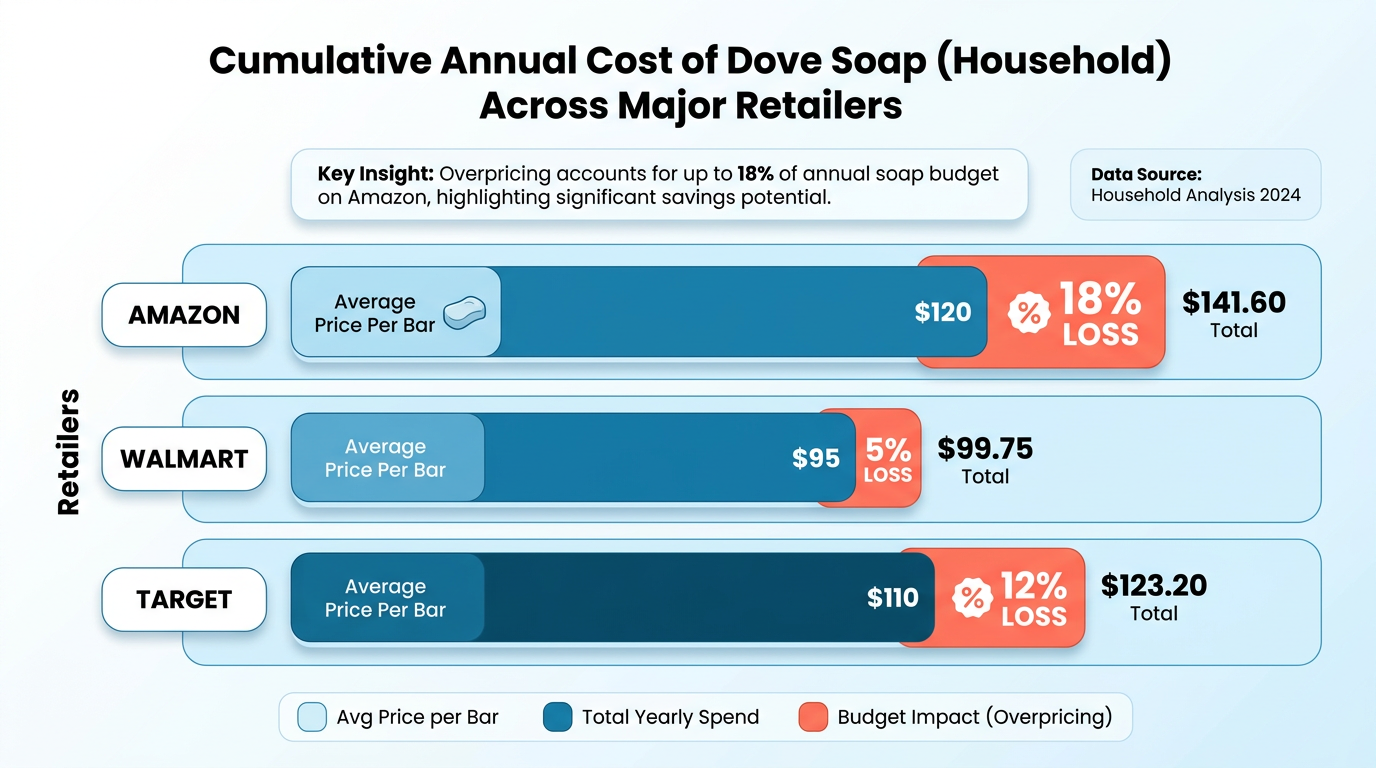
The fastest way to save on Dove soap is to check prices before you build your cart, not after. Add one step to your weekly routine: search the product on Popgot first, let the AI compare stores, then buy from whichever retailer wins on cost per bar. That single habit turns guesswork into a two-second decision.
Most people restock personal care on the same schedule. So bake the check into that rhythm. When soap, deodorant, or body wash hits your list, run each item through Popgot before you commit. No four tabs, no per-bar math, which is exactly the friction that makes shoppers give up and overpay.
The weekly flow
Build it into the list stage, not the checkout stage. Before you open any retailer, run your repeat buys through Popgot and note the cheapest. Then shop once, at the store that actually wins.
- Write your restock list. Group the repeat personal care items you buy on autopilot.
- Search each one on Popgot. Let the AI pull every listing and convert pack sizes to a real per-unit price.
- Buy from the winner. Order from whichever store shows the lowest cost per bar that week.
Prices shift, so the cheapest store this week may not be the cheapest next month. That's the whole point of checking every time instead of trusting one loyal retailer.
It also surfaces brands you'd skip
When the AI lines up listings side by side, you see options you'd normally scroll past. A comparable bar from a brand you've never tried might beat your usual Dove pack on price without dropping quality.
Over time that widens your choices instead of locking you into habit. Small, repeated checks compound into real savings across every restock.
Setting filters for ingredients and formula
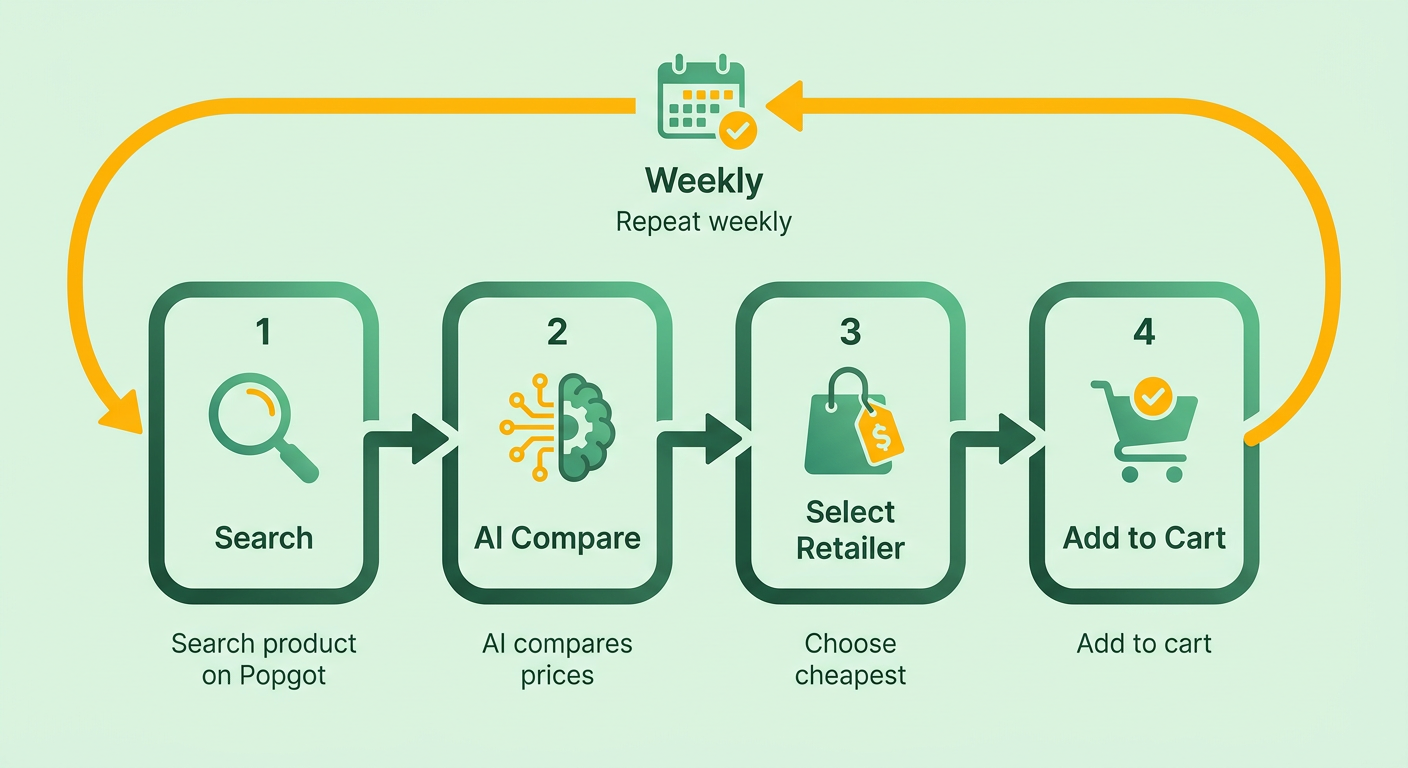
Not every Dove bar fits every shopper. Some people need fragrance-free. Others avoid certain oils or want a sensitive-skin formula. Custom filters let you set those requirements up front, so you only search bars that actually match your skin.
Here's how it works. You pick your ingredient preferences first, then let the AI pull matching listings across retailers. You never scroll past bars you can't use. And when you compare stores side by side, every option in the results already meets your criteria.
How to set ingredient filters
Custom filters are rules you set that tell the AI which product traits matter before it searches. Define them once, reuse them every restock.
Start by naming what you need. Say you want a fragrance-free Dove bar for sensitive skin. You flag "fragrance-free" as a requirement. The AI reads every Dove listing across major retailers and drops any bar with added fragrance.
You can stack filters too. Want fragrance-free and a specific pack size for the best cost per bar? Set both. The results show only bars that clear every rule, ranked by true per-bar price.
How filters and verification work together
Filters and verification run together. The filter narrows the field to bars matching your ingredient rules. The verification step then confirms each listing is the real product at the price shown, not a mismatched or stale listing.
That pairing matters for personal care. A cheap "Dove" listing means nothing if it's the wrong formula or an outdated price. Verification checks the product is what it claims before it lands in your ranked results.
A shopper who reacts to a common Dove fragrance sets a fragrance-free filter, runs the search, and gets three verified sensitive-skin bars across different stores. She picks the lowest per-bar option and skips the trial-and-error entirely.
Catching Dove overpricing across the big supermarkets
Overpricing hides in plain sight. A store slaps a "sale" tag on a Dove multipack, and you assume it's the best deal without checking. Markups often ride in on promotional signage that makes a standard price look like a limited-time discount. That applies directly to personal care items like Dove soap.
The fix is to compare on a true per-bar basis, not by trusting the sticker. Our AI pulls every Dove listing, verifies each product, and lines them up so you see the real cost side by side. When one retailer marks up the same bar, the flag shows up instantly.
How verification keeps comparisons honest
Product verification confirms two listings are the same Dove product before the AI compares their prices.
This matters because pack sizes and formulas differ across retailers. A 6-bar Sensitive Skin pack is not the same as a 6-bar Beauty Bar pack, even if the price looks similar. The AI matches the exact variant first, then does the math. So you never compare a fragrance-free bar against a regular one and reach a false conclusion.
Verification also catches sneaky repackaging. Some listings bundle two smaller packs and call it a "value" size. The AI unpacks that and reports the honest cost per bar.
How one search covers every store
Multi-retailer search runs one query across the big stores at once. You type "Dove soap," and the AI returns matched listings from every retailer it covers, already converted to cost per bar. No tabs, no manual math.
A gym owner restocking Dove Men+Care in bulk might see a loud discount banner at one outlet, while the search reveals a standard multi-pack at a competing warehouse club with a lower unit cost. Without the search, you'd never see the cheaper option. With it, the winner sits at the top. For a deeper breakdown of how this stacks up against manual checking, see Popgot vs traditional price comparison tools.
How the AI verifies each Dove listing
Product verification is the piece that makes every price check trustworthy. Before the AI ranks any Dove listing, it confirms two products are actually the same bar. Same formula, same size, same count. That step keeps the comparison honest.
The AI reads each listing's specs, not just its title. Bar weight, pack count, scent, formula variant. Then it normalizes everything to a single cost per bar so the numbers line up, even when one retailer buries the pack size in the fine print.
How it handles packaging differences
The AI matches products by their real specs, not their marketing labels. It treats a "value pack" and a "family size" as whatever they truly contain, then converts both to a per-bar figure.
One store lists a Dove Deep Moisture 6-pack of 4 oz bars. Another lists the same formula as a 5-pack with a promotional discount. The AI reads past the packaging spin, confirms both are the same Deep Moisture bar, and stacks them by true unit cost. You see which one actually wins.
This matters because retailers rename and rebundle constantly. A verified match means you're never comparing a moisturizing bar against a beauty bar just because they share a shelf. The formula check runs first, then the price math.
How verification connects to the search
Verification and multi-retailer search work as one loop. The search pulls every Dove listing across the big stores. Verification then filters that pool to confirmed matches before ranking.
The flow, in order:
- Search scans listings across retailers for your Dove query.
- Verify confirms each result is the same formula, size, and count.
- Rank sorts the verified matches by cost per bar, cheapest first.
That sequence is why the results come out clean. You don't wade through mismatched packs or guess at unit prices. The AI does the matching, and you buy the winner.
Step by step: finding the best Dove deal
Finding the best Dove soap deal takes three moves: search across retailers, filter for your bar, then rank by cost per bar. Popgot runs all three in one pass. You type the product once, and the AI pulls every matching listing so you compare without opening a single extra tab.
Here's the full walkthrough. Each step builds on the last, so you go from a blank search to a ranked list of real per-bar costs in under a minute.
Running the search
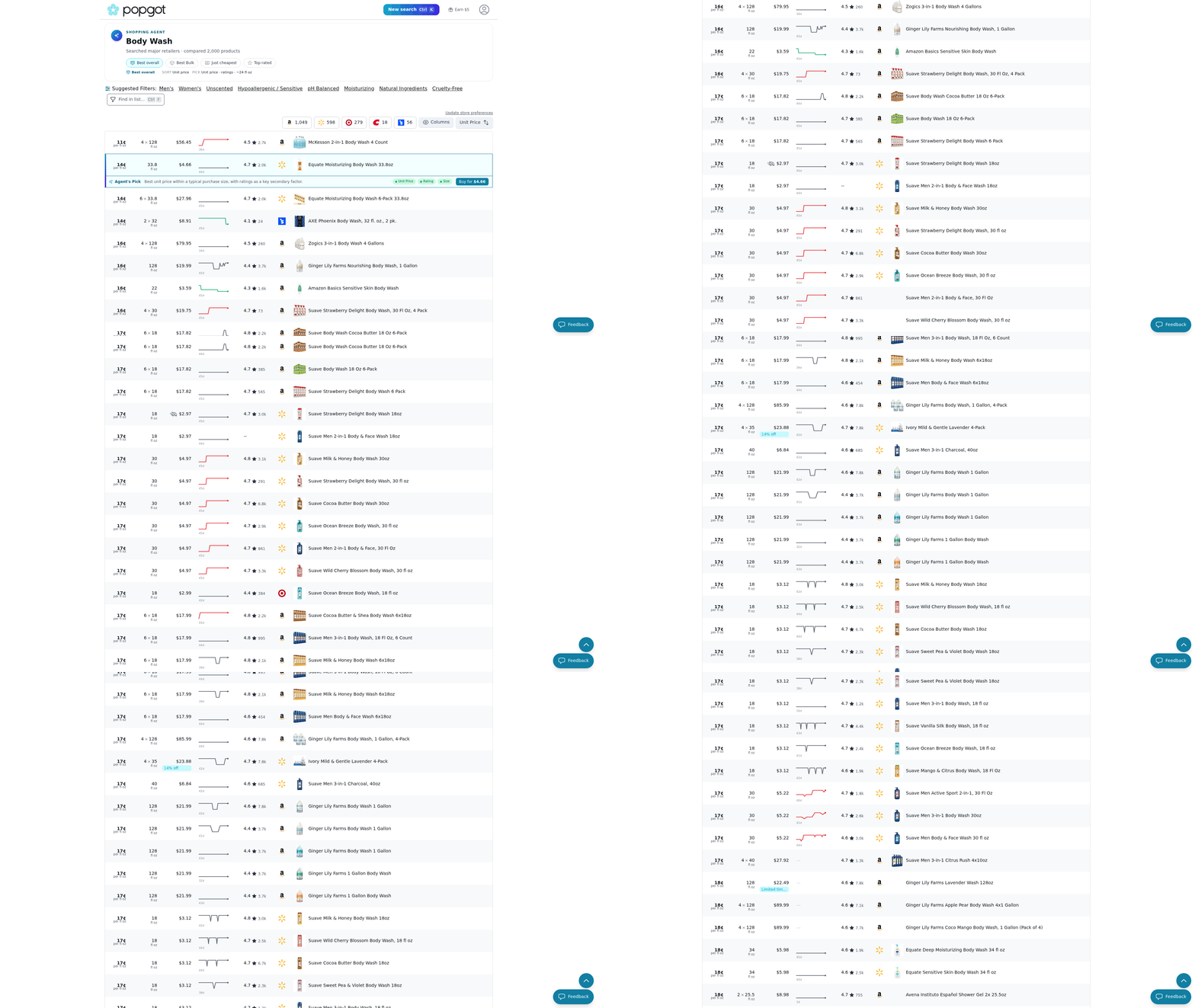
Type "Dove soap" into the search bar and hit go. The AI queries every major retailer at once and returns matching listings in a single view. You don't pick a store first. You let the results show you which stores carry the bar you want.
- Enter the product. Type the general name or a specific variant to narrow the field before results load.
- Set your filters. Add ingredient preferences up front, like fragrance-free or a moisturizing formula, so only matching bars appear.
- Read the cost per bar. Check the ranked column to see which listing wins after the AI normalizes every pack size.
- Buy from the winner. Pick the retailer at the top and check out.
Comparing unit prices across retailers
Sort the results by cost per bar, not by sticker price. That single toggle exposes markups that pack-size tricks hide. A "sale" multipack often drops below a plain larger pack once the AI does the per-bar math.
A guest house manager buying Dove Shea Butter bars might find a lower headline price on a 6-pack, but sorting by unit cost shows a 12-pack from another supplier cuts the cost per bar significantly. That one adjustment keeps every purchase based on real value.
What retailers actually hide in Dove pricing
Retailers hide markups behind packaging tricks, not obvious price hikes. The bar never changes, but the way it's sold does. A store bundles two bars into a "gift" pack, prints one price, and hopes you never break it down to cost per bar. Run the math and the trick falls apart.
Another common move: "buy one, get one half off" on a stack of Dove multipacks near the register. The base price gets nudged up first, so the "half off" second pack lands close to what a single pack costs elsewhere. Line that promotion up against a competitor's everyday price per gram, and the discount evaporates.
How the markup gets hidden
A hidden markup is extra profit baked into a listing through pack size, bar weight, or a fake "sale" tag rather than a higher sticker price.
A retailer might box Dove Pink Beauty Bars in a festive holiday design and price it above the standard white boxes on the next shelf. The soap inside is identical. The premium is purely for the cardboard. It's consumer psychology: attractive packaging or shelf placement distracts from the underlying unit cost. Personal care items like Dove sit right in that blind spot.
How the AI flags it
The AI strips away the packaging story and ranks every Dove listing by unit price. It reads bar weight, pack count, and formula from each listing's specs, not the marketing label. A padded "value" pack loses the moment its real per-bar number lands higher than a plain box.
A college student buying Dove Active Clean might see a promotional endcap screaming "special value," while the AI flags that a standard pack on a lower shelf has a better unit rate. Hard data over promotional displays, every time.
Comparing Dove unit prices on Amazon, Walmart, Target, and the rest
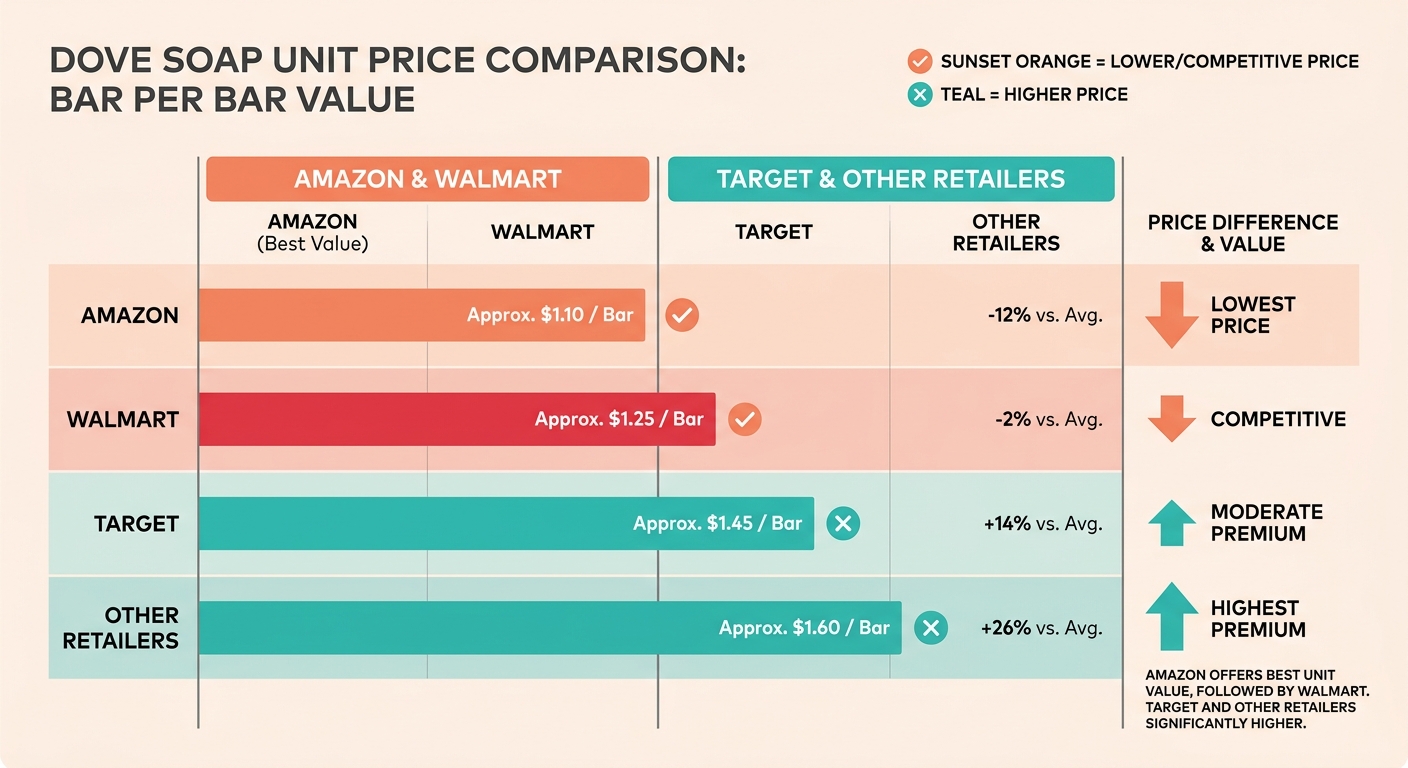
Retailers set their own pricing on personal care essentials, which is why the same soap runs different totals across platforms. To find the real deal, you need one number that cuts through the pack-size noise: the price of a single bar. That's the only figure that tells you which store is actually cheaper.
The lesson from side-by-side comparisons is simple: sticker prices deceive. A large multi-pack with a low headline number can still lose to a smaller pack once you account for how many bars you get and how much each one weighs. Shrinkflation makes it worse, trimming a few grams off each bar so the pack looks like a deal while quietly raising the true rate.
Watch for the small-pack trap. A listing that looks cheap up front often hides a reduced bar weight and a low count, pushing its real rate above bulkier options that carry a higher sticker.
How unit pricing sorts it out
Accurate unit pricing converts every Dove listing to a true per-bar rate so you rank stores on the same scale.
The AI pulls each listing's pack count and bar weight, then normalizes everything to one figure. You never do the division yourself. You just read the ranked results and buy from whoever lands at the bottom of the column.
This matters most on personal care, where pack sizes vary wildly and shrinkflation hides in a few missing grams. A gap of a few cents per bar feels tiny. Restock every three weeks and it stacks into real money over a year.
Using it to find the best Dove deal
Type "Dove soap" once and let the AI rank every listing. You skip the flashy front-runner and grab the option that actually costs the least per bar, saving a solid chunk off the priciest listing for the exact same soap. Let the tool handle the arithmetic and you lock in the lowest price on every restock.
References
[1] Some supermarkets are overcharging for products marked ' ... - https://www.youtube.com/watch?v=DV8d9Vwbrtc
Frequently Asked Questions
1. Does Popgot charge a fee or require a subscription to compare Dove soap prices?
Popgot's price comparison runs through its search tool where you type a product like "Dove soap" and receive ranked cost-per-bar results across eight retailers. Check the platform's current pricing page directly, since the article focuses on functionality rather than cost details for accessing comparisons.
2. How often do Dove soap prices change across retailers?
Retailers frequently adjust their pricing based on inventory levels and promotional calendars. A store that offers the best deal today might be undercut by a competitor next week, making regular checks essential for ongoing savings. Running a fresh search each shopping cycle catches new price swings automatically.
3. Can I compare Dove products other than bar soap, like body wash or deodorant?
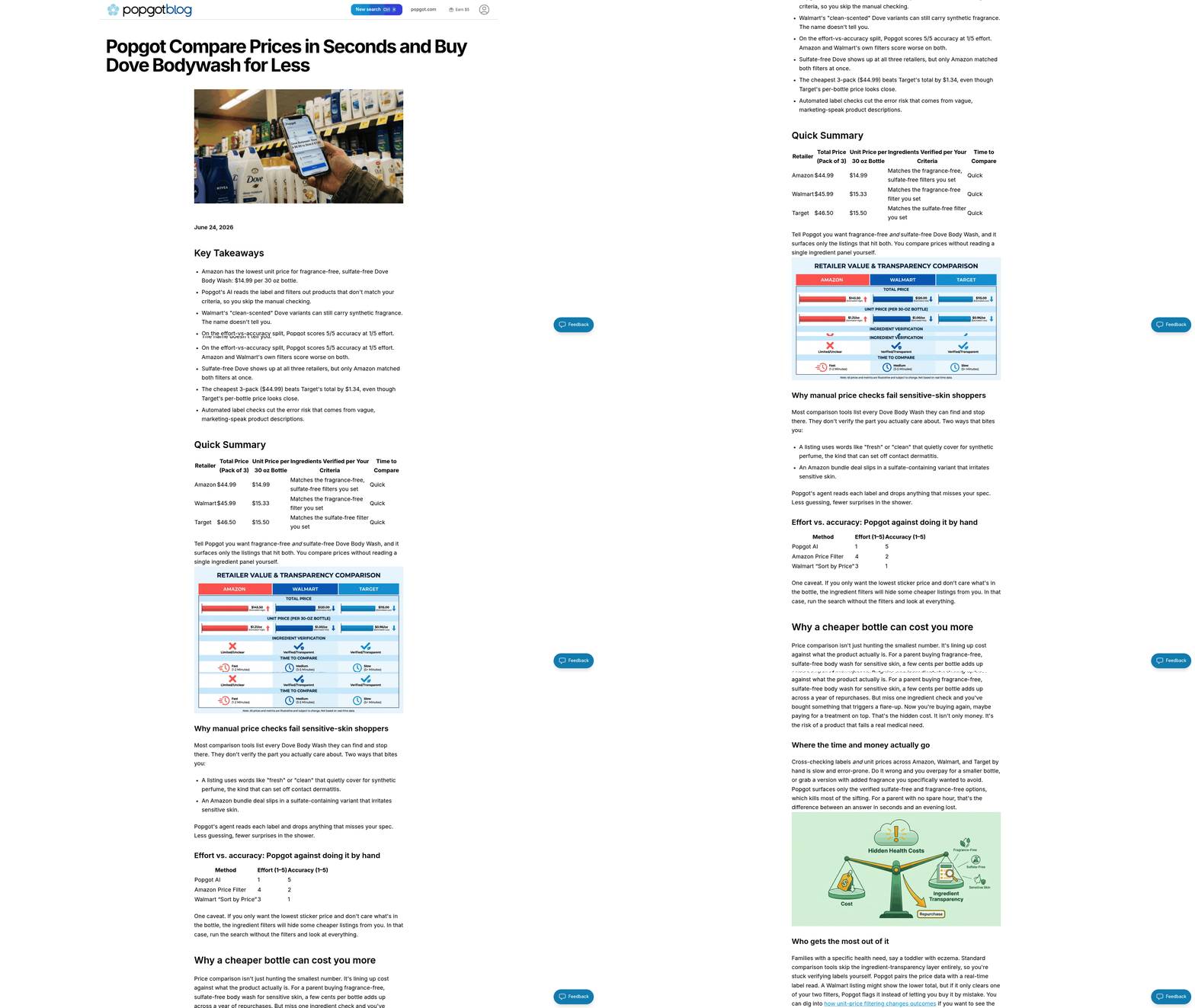
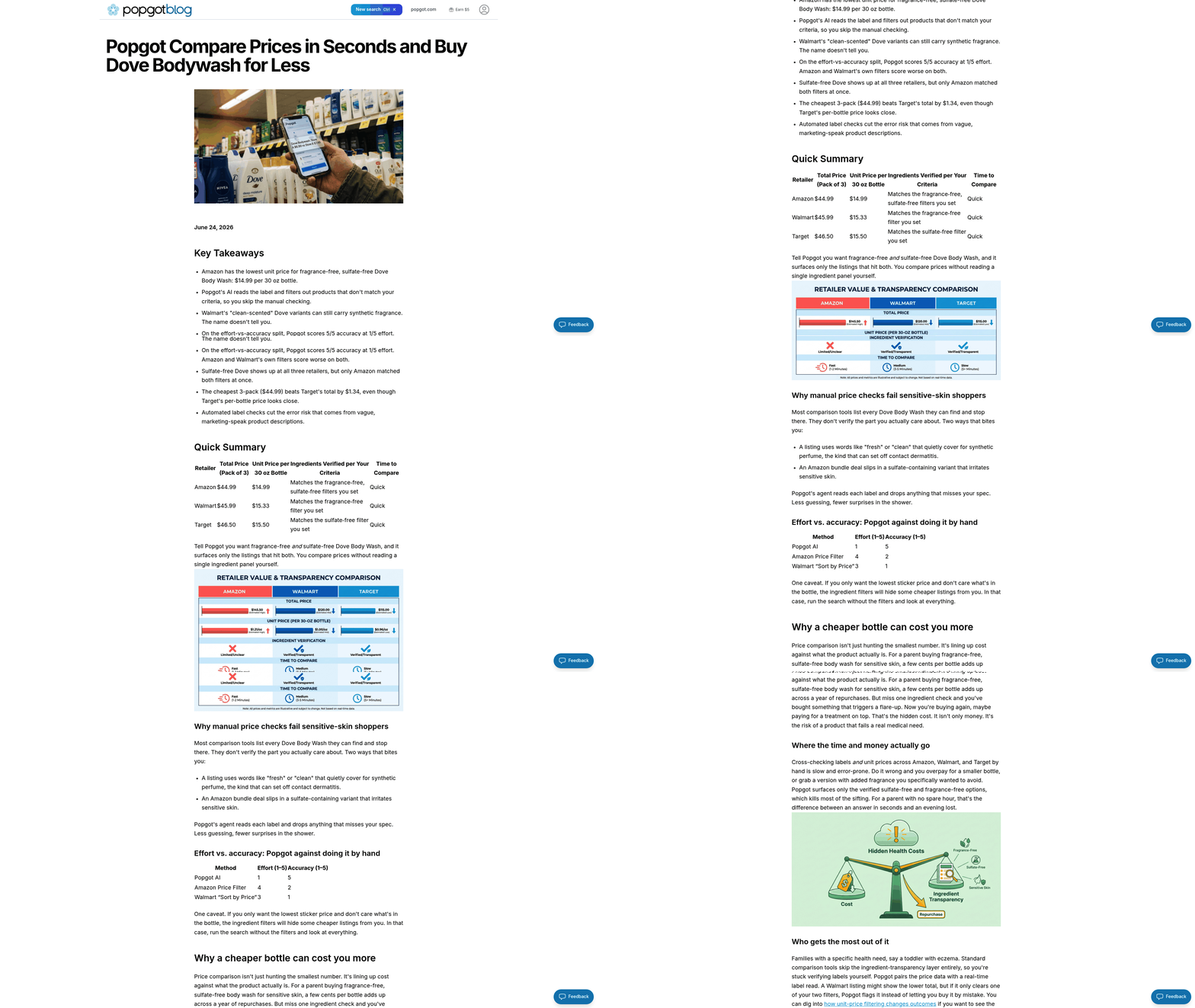
Popgot handles personal care items broadly, including body wash, shampoo, and deodorant, converting each to a true per-unit price. The Quick Summary references comparing Dove body wash per 30 oz bottle. Search any repeat personal care product the same way you would search "Dove soap" for accurate unit pricing.
4. What is shrinkflation and how does it affect Dove soap deals?
Shrinkflation trims a few grams off each bar so a pack looks like a deal while quietly raising the true per-gram rate. A cheap-looking small pack often hides reduced bar weight and low count. Popgot reads actual bar weight from listing specs, exposing these hidden rate increases automatically.
5. Will comparing prices online help if I prefer shopping in-store?
Online per-bar comparisons still guide in-store decisions by revealing which retailer consistently prices Dove lower and which packaging tricks to avoid. Independent consumer advocacy groups have frequently highlighted how in-store promotional tags can mislead shoppers. Knowing the true benchmark price beforehand helps you verify whether an in-store "special" is actually a bargain.
6. How does Popgot avoid comparing two different Dove formulas by mistake?
Product Verification confirms two listings share the same formula, size, and count before ranking them. The AI reads each listing's specs, including scent and variant, so a Sensitive Skin bar never gets compared against a Beauty Bar. This runs before the price math, keeping every comparison honest.
7. Is it worth switching retailers for just a few cents per bar of soap?
While a minor price difference seems negligible for a single purchase, those margins accumulate over dozens of shopping trips. When multiplied across multiple household essentials over twelve months, the total savings become substantial, especially for larger households that consume soap regularly.