
Edamame vs Black Soybeans: Which Keto Bean Costs Less Per Gram

Key Takeaways
- Black soybeans run about 1g net carbs per 1/2 cup. Edamame lands closer to 5g per 75g serving.
- Black soybeans edge out edamame on protein: ~12g per serving versus ~8g.
- Edamame brings 4g fiber per 75g serving, which helps with blood sugar and satiety.
- Price per gram swings by retailer and prep, but black soybeans are usually cheaper.
- If you're running strict keto, black soybeans win on the numbers.
- Edamame fits if you've got a little more carb room to spend.
- For anyone tracking protein per dollar, black soybeans are the better buy.
Why the bean you pick actually matters on keto
The gap between hitting your macros and quietly knocking yourself out of ketosis can come down to which bean lands in your cart. Edamame and black soybeans both deliver plant protein and fiber. But their carb counts and their price per gram aren't close, and that's the whole ballgame if you're watching both.
Beans have become a keto staple for good reason. They cover protein for muscle maintenance and fiber for the gut, which most low-carb eaters run short on. The catch is cost versus nutrition. To actually decide, you need real numbers, like per-gram pricing, not vibes.
The trade-off, in numbers
Here's the tension: edamame carries more net carbs but packs solid protein, while black soybeans stay low on carbs but can cost more depending on where you buy.
| Feature | Edamame (per 75g serving) | Black Soybeans (per 1/2 cup) |
|---|---|---|
| Total Carbs | 9g | ~4g |
| Net Carbs | 5g | ~1g |
| Fiber | 4g | Not specified |
| Protein | 8g | ~12g |
That 1g net carb figure is why black soybeans are the default for strict plans. Edamame works if your daily limit has some slack. Either way, the nutrition trade-off has to be weighed against per-gram cost, which shifts by retailer and how the beans are packaged.
Who these beans are actually for
Beans solve two recurring keto problems: not enough protein, not enough fiber. Athletes need the 8–12g of protein per serving to repair muscle. Anyone dealing with diabetes or metabolic syndrome gets the blood-sugar benefit of fiber. And for people skipping animal products, both are cheap, plant-based options.
The one warning: edamame demands stricter portioning. Those 5g net carbs add up fast if you're not measuring.
Tools like Popgot pull retailer-specific pricing so you can line up edamame against black soybeans on both cost and macros before you buy.
Protein Content Comparison
Both beans carry a respectable protein load, but the real value depends on price and how the macros balance out. Edamame runs ~11g protein per 100g. Black soybeans nudge ahead at ~13g. Both contain all nine essential amino acids, though they're light on methionine, which is standard for plant proteins.
Bioavailability is where it gets less flattering. Eggs or chicken absorb around 90% of their protein. These beans sit closer to 60–70%, partly thanks to anti-nutrients like phytates. Soaking or sprouting helps, but that's not always realistic when you're shopping on a budget and short on time.
| Feature | Edamame (100g) | Black Soybeans (100g) |
|---|---|---|
| Protein Content | 11g | 13g |
| Key Amino Acids | High in lysine | High in lysine |
| Bioavailability | ~65% | ~70% |
| Net Carbs | 3g | 4g |
Stack these against animal staples and the picture sharpens. A 100g chicken breast delivers 31g of protein at ~0g carbs, but runs $3–$5 at most stores. The beans cost less per gram, but the lower protein density means you're eating more volume to hit the same target. Which cuts into the savings, and cuts into your carb budget.
So the pick comes down to what you're optimizing. Edamame's slight cost edge makes it fine for bulk meals. Black soybeans work better for smaller, protein-dense snacks. For a proper cost-to-macro breakdown, Popgot's product attributes checklist helps compare these against nuts or eggs. Plant-based eaters should pair either bean with something like quinoa to close the amino acid gaps, and always double-check per-gram pricing at your own store.
Net Carbs and Fiber Breakdown
If you're counting carbs, this is the section that decides things. Edamame runs 5g net carbs per 75g serving (about 7g per 100g). Black soybeans drop to just 1g net carbs per 100g. That's a big gap, and it's why black soybeans are the strict-keto pick. Edamame's higher fiber is its consolation prize, and it's a real one for digestion.
What this does to your meal planning
A 100g serving of edamame gives you 9g carbs, minus 4g fiber, for 5g net. Black soybeans carry 10g carbs but 9g fiber, landing at 1g net. That fiber is mostly insoluble, which means it feeds gut bacteria and slows carb absorption, keeping blood sugar steadier. For context, almonds hit 10g net carbs per 100g, and spinach comes in at 1g.
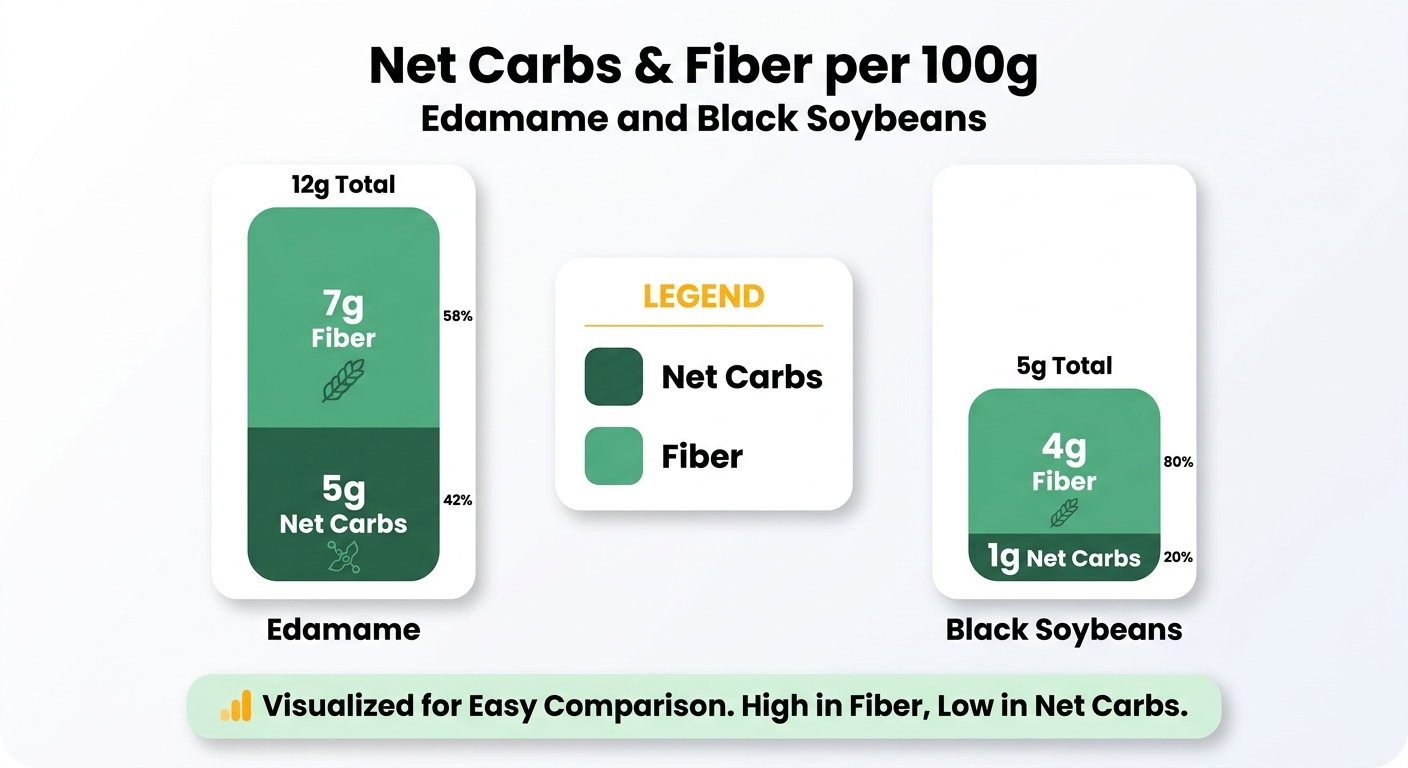
| Feature | Edamame (100g) | Black Soybeans (100g) | Almonds (100g) | Spinach (100g) |
|---|---|---|---|---|
| Net Carbs | 5g | 1g | 10g | 1g |
| Fiber | 4g | 9g | 12g | 2g |
| Protein | 11g | 13g | 21g | 3g |
Glycemic impact and staying full
Edamame's glycemic index is low (15), and black soybeans barely register. Both are fine for keto, though edamame's extra fiber may keep some people fuller. A 100g serving of black soybeans adds only 2g carbs to a meal, versus 14g for cooked black beans. That difference is exactly why regular black beans get shelved on strict plans. Trade-off for budget shoppers: you pay more per gram for edamame, but you gain protein and fiber.
Fiber earns its keep beyond the carb math. It feeds gut bacteria, fights the constipation that low-fiber keto is notorious for, and helps nutrient absorption. Against most legumes, black soybeans come out ahead, though they don't touch flaxseeds (38g fiber per 100g) on density alone.
For a fuller framework on evaluating keto foods, Popgot's Product Attributes Checklist covers it.
Price Per Gram Comparison
This is where black soybeans quietly pull ahead. Edamame usually runs $0.15 to $0.20 per gram dry. Black soybeans come in 20–30% lower, around $0.10 to $0.15. The gap gets wider once you factor in the net carb-to-protein ratio: black soybeans give you 13g protein per 100g at 1g net carbs, against edamame's 11g protein and 5g net carbs.
| Feature | Edamame (per gram) | Black Soybeans (per gram) |
|---|---|---|
| Price Range | $0.15–$0.20 | $0.10–$0.15 |
| Protein per $1 | ~55g | ~87g |
| Net Carbs per $1 | ~33g | ~7g |
How the beans stack up against other keto proteins
Put them next to chicken breast ($0.25–$0.30 per gram) or pasture-raised eggs ($0.18 per gram) and both beans start to look good. Ten dollars buys 670g of black soybeans (571g protein, 67g net carbs) or just 330g of chicken (99g protein, 0g carbs). On protein per dollar, that's black soybeans running roughly 5x more efficient than animal sources, which is a lot if you're cooking high-volume, low-carb.
Shopping keto without overpaying
A few things that actually move the needle:
- Buy in bulk at warehouse clubs, where black soybeans can drop to $0.08 per gram.
- Watch the sales cycles with tools like Popgot's product checklist, which flags bulk-bin discounts.
- Go store brand when you can. Private-label edamame often saves 15% over name brands.
Edamame's higher cost and carb load make it the harder budget case. Black soybeans are the cheaper macro booster, especially if you value protein density over fiber. Popgot's affordability guides can help match your goals to your grocery spend.
Keto Suitability Ranking
Black soybeans rank higher for keto than edamame, and it's not particularly close. Lower net carbs, better protein efficiency, cheaper per gram. Every one of those directly affects whether you can hit macros without blowing the budget.
| Feature | Black Soybeans | Edamame |
|---|---|---|
| Net Carbs (per 100g) | 1g | 5g |
| Protein (per 100g) | 13g | 11g |
| Price Range (per gram) | $0.10–$0.15 | $0.15–$0.20 |
| Keto Suitability | High (strict keto-friendly) | Moderate (requires portions) |
Where prep can trip you up
Black soybeans need almost nothing: soak, boil, done. Their low-carb edge survives intact. Edamame is more fiber-rich but tends to attract seasoning and sauces, and that's where hidden carbs sneak in. For strict keto, buy unsalted, dry-packaged black soybeans and skip the surprises.
The cost-to-macro math
Black soybeans give you 13g protein per $0.15 (about 87g per $1). Edamame delivers 11g for the same money. That's black soybeans running 27% more efficient for building keto meals on a budget. Edamame's extra fiber is a genuine digestive plus, but it comes at roughly 40% higher per-gram cost, which hurts for bulk buying.
If net carbs are your hard limit, black soybeans win outright. At 1g per 100g you can double a serving and still stay under threshold. Edamame's 5g per 100g means portion control, realistically around 150g max per meal, or you risk knocking yourself out of ketosis.
Use this to read labels and pick the bean that fits your goals and your budget.
Using Popgot for Keto Bean Shopping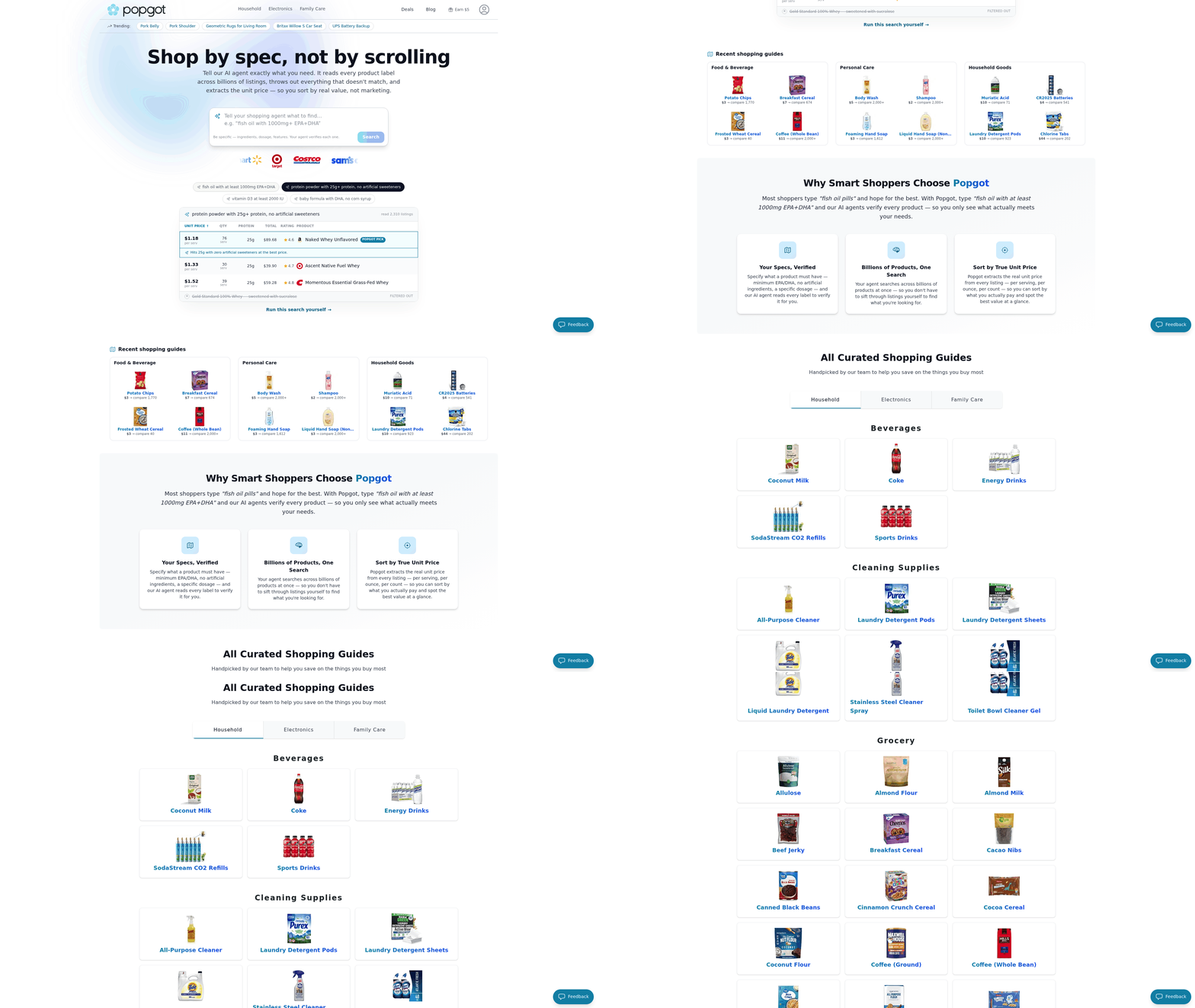
Popgot cuts down the busywork of comparing edamame and black soybeans by leaning on retailer-specific pricing and macro efficiency. Its product database is AI-verified to meet keto standards, so no hidden sugars or fillers slip through, and its multi-retailer search pulls prices from Amazon, Walmart, and local stores in real time. Instead of tabbing between sites and tracking numbers by hand, you compare price-per-gram and net carb-to-protein side by side.
Searching keto beans on Popgot
Type "edamame" or "black soybeans" into the search bar. Filter by keto suitability (a built-in tag for low-carb, high-protein items) and sort by price per gram to find the best deal. A 20-ounce bag of dry black soybeans at Walmart might run $3.50 ($0.12/gram), while a similar bag on Amazon could be $4.00 ($0.15/gram). The app also surfaces seasonal promotions, like a 15% discount on bulk organic edamame during sales.
Popgot vs. manual price checking
| Feature | Popgot | Generic Price Trackers |
|---|---|---|
| AI-verified keto tags | ✅ Yes (ensures accuracy) | ❌ No (requires user input) |
| Price-per-gram filter | ✅ Yes | ❌ No |
| Macro breakdown | ✅ Includes net carbs/protein | ❌ No |
| Multi-retailer search | ✅ Yes | ❌ No |
Save your regulars to the shopping list feature and the app pings you when prices drop or new keto-verified brands show up. By keeping cost and nutrition in one place, it turns the edamame-versus-black-soybeans call into something you can actually decide in a minute.
What I'd actually buy
For strict keto, black soybeans are the clear pick. Lower net carbs, better protein efficiency, cheaper. Per dollar you're getting ~87g of protein versus edamame's ~55g, while net carbs stay under 1g per 100g. Edamame still earns a spot, but only if you portion it. Stick to 75g servings (5g net carbs) and you're fine.
When edamame is the right call
Edamame wins when texture or fiber matters more than the last gram of carbs. It's sweeter, firmer, and better suited to salads and stir-fries, and the 4g fiber per 75g serving helps digestion. For bulk protein or a truly tight carb ceiling, though, black soybeans beat it.
| Feature | Black Soybeans | Edamame |
|---|---|---|
| Net Carbs (100g) | 1g | 5g |
| Protein per $1 | ~$87 | ~$55 |
| Price Range | $0.10–$0.15/gram | $0.15–$0.20/gram |
| Keto Suitability | High (strict keto) | Moderate (needs portions) |
The simple protocol: use Popgot to find black soybeans at the lowest price per gram, then rotate edamame in for variety when your macros allow. Soak and boil both to keep their keto edge. Budget and carb control? Black soybeans, no debate. Want more plant-protein variety? Edamame has a place.
Try both on your next run and let Popgot handle the label-reading so you can focus on what actually works for you.
References
[1] Is Edamame Keto-Friendly? - Healthline - https://www.healthline.com/nutrition/edamame-keto
Frequently Asked Questions
1. Which bean is better for strict keto diets with low carb allowances?
Black soybeans are the superior choice for strict keto plans because they contain only 1g of net carbs per 100g. This ultra-low carb profile allows you to enjoy larger, more satisfying portions without risking ketosis, whereas edamame requires much tighter portion control.
2. How does fiber content differ between edamame and black soybeans?
Edamame provides 4g of fiber per 75g serving, which is excellent for slowing down digestion and helping regulate blood sugar. Black soybeans offer a higher fiber density overall, making both options highly beneficial for gut health and satiety on a low-carb diet.
3. What’s the cost difference per gram for bulk purchases?
When purchasing in bulk, black soybeans generally offer a 20% to 30% savings over edamame. This price gap makes black soybeans a highly economical choice for meal prepping and high-volume keto cooking.
4. How do preparation methods affect keto suitability?
To keep both beans as keto-friendly as possible, stick to simple preparation methods like soaking and boiling. Be cautious with pre-packaged or restaurant-prepared edamame, as they are frequently tossed in sauces or seasonings that contain hidden sugars.
5. Can both beans be used in the same meal plan?
Absolutely. You can strategically rotate both into your weekly menu. For instance, use black soybeans as a low-carb base for chili or stews, and reserve edamame for fresh salads or stir-fries when you have more room in your daily carb limit.
6. Which bean supports muscle maintenance better?
With 13g of protein per 100g, black soybeans offer a slightly higher protein density than edamame. This makes them highly effective for athletes looking to hit their daily protein targets, though both beans provide a solid plant-based amino acid profile.
7. How does Popgot help compare these beans?
Popgot streamlines your grocery shopping by aggregating real-time pricing and nutritional data across multiple major retailers. It allows you to filter specifically by keto-friendly attributes, helping you find the absolute lowest price per gram for your preferred ingredients.