
Popgot Tutorial: How to Compare Prices Across Stores

Key Takeaways
- Popgot's multi-retailer search scans eight stores at once, Amazon, Walmart, Target, and Costco among them, in a single query.
- The platform only shows products that clear your saved ingredient and safety requirements, which takes the friction out of allergy-conscious buying.
- Real examples show unit-price gaps most tools miss, like paper towels at $0.50 versus $0.67 per roll.
- Set your ingredient preferences once and those filters stay saved for every future search.
- The AI reads product labels to verify specs from plain-language requests like "fish oil with at least 1000mg EPA+DHA."
- The biggest time sink in comparison shopping is re-checking that a cheaper option actually matches what you need.
- Grabbing the cheapest-looking item on the shelf often costs more per ounce and can fail both the price test and the ingredient test.
Quick Summary
Most grocery shoppers burn time comparing prices by hand and still miss better deals a store or two over. Parents managing food allergies carry double the load: reading ingredient lists while tracking unit prices across retailers. A recent Popgot tutorial shows how the platform pulls inventory from multiple stores and filters results down to products that actually meet your safety rules.
What This Tutorial Covers
This walkthrough shows you how to set up your dietary profile, then compare unit prices across the platform's supported retailers in one search. You'll learn to catch unit-price gaps that ordinary comparison tools miss, because those tools don't normalize packaging or verify product specs. The examples use everyday household goods to show what happens when package sizes vary, right down to pasta at $0.06/oz next to a name-brand markup at another chain.
Setup means creating your first product search with ingredient filters. After that, your profile sticks across sessions. Difficulty is low. You type what you need in plain language, say a specific nutrient threshold, and the AI reads labels to verify specs before showing results. No spreadsheet tracking. No copying prices off retailer sites by hand.
Key Features and Benefits
The core problem with comparison shopping is making sure a lower-priced alternative doesn't quietly give up quality or safety. Shoppers overpay all the time by picking items on the front-of-package price alone. For allergy-safe shopping, that impulse pick can fail both the price test and the ingredient test at once, and one of those failures matters a lot more than a few cents.
The tutorial walks through unit-price extraction across different package sizes so you're comparing apples to apples. A bulk pack at a warehouse club can look expensive up front, then turn out far cheaper per unit than a smaller pack from an online retailer. Ingredient verification runs automatically, so every result already meets your dietary filters before you lay eyes on it.
For parents juggling multiple allergens, one search replaces two chores: confirming safety and finding the lowest price. You set your allergen exclusions, then sort by cost per ounce knowing every option already passed. That shift heads off both safety mistakes and overpaying for compliant products you could've found cheaper somewhere else.
Why Comparing Prices with Popgot Matters
When you're managing food allergies for your family, the lowest sticker on the shelf can hide real costs or real risk. We built our comparison system to handle both at once. It filters by your ingredient requirements first, then ranks by true unit cost. So the lowest price you see already passed your safety rules before it ever showed up in results.
The math matters more than most shoppers think. Comparing unit prices across major chains turns up real savings, not because stores hide their pricing, but because packaging variation makes manual comparison nearly impossible. A 36-pack of granola bars at one store and a 15-pack at another leave you calculating cost per bar in your head in the aisle. Our system does that instantly across multiple store inventories, so you see precise per-unit costs without reaching for a calculator.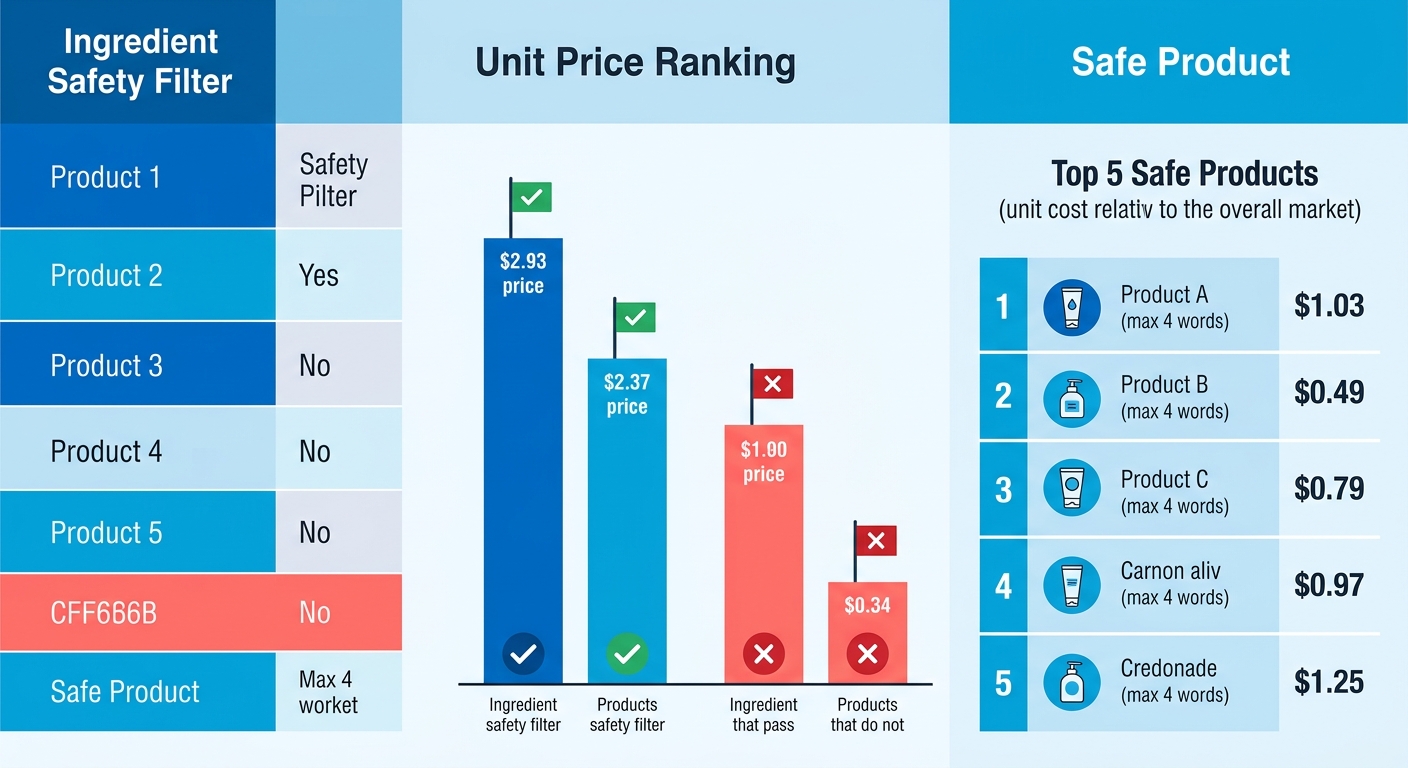
How Popgot Turns a Price Check Into a Safety Check
For families managing allergens, ordinary price tools fall short, because a low price means nothing if the product carries an unsafe ingredient. You'd still have to verify labels after finding the cheapest option. Two tasks, more time, more risk. We fold them into one step.
Our AI reads labels across billions of listings to verify specs before showing anything. Search for a snack, apply your exclusions, dairy-free, nut-free, gluten-free, and the system only surfaces products that meet those rules. Then it sorts by unit price. The cheapest result is both safe and economical, not one at the expense of the other.
Shoppers often find they've been paying more per ounce than they realized once they start tracking unit prices across stores. Pantry staples can swing a fair amount in cost per unit between retailers, and those differences compound across a full list. For allergy families, grabbing an unverified item in a rush can cost money and create a health hazard at the same time.
Who Gets the Most Out of Multi-Retailer Comparisons
Health-conscious shoppers and parents managing dietary restrictions get the most here. Buying fish oil with at least 1000mg EPA+DHA? The platform shows 1,847 listings filtered to that exact spec, sorted by cost per serving. The cheapest verified option lands at $0.34 per serving, a figure you'd never spot browsing store sites one by one, since each displays packaging differently and none normalize serving size.
Parents hunting allergen-safe school snacks hit decision fatigue when every product needs a label check. Research on comparison shopping agents shows that even when search costs are low, price dispersion sticks around thanks to selection bias and update delays. That dispersion is the opportunity. Persistent 2x–3x price gaps between stores for identical products mean someone leaves money on the table every time they shop a single retailer.
Plenty of shoppers pick convenience over exhaustive comparison. They'll pay extra to skip a second store or a fifth browser tab. We take that friction out by scanning multiple inventories at once against your saved requirements. You're not trading time for money. You get both.
The Real Cost of Shopping Without Unit-Price Intelligence
Academic studies confirm that consumers often need to check several comparison tools to land on the best purchase, because no single agent captures all the pricing. For everyday groceries, that's just not realistic. Nobody opens five apps to buy cereal.
Our approach flips it. Instead of asking you to do more, we automate the search and the unit-price math across major retailers. A family buying laundry detergent might find a 150-ounce bottle at one warehouse club for $0.11 per ounce while a 64-ounce bottle at a conventional grocery store runs $0.19 per ounce. Over a year, that per-ounce gap works out to $40–60 in extra spend on a single staple. Multiply it across cleaning supplies, pantry items, and personal care, and the annual cost of ignoring unit price runs into the hundreds.
For allergy families, the value isn't only financial. Verifying ingredient safety by hand across multiple retailers is error-prone. Shoppers keep telling us that pairing safety verification with cost optimization in one query ends the choice between being careful and being frugal. Both happen at once.
Reading Unit Prices and Cost Per Unit
A jar of pasta sauce at $3.99 for 24 ounces sits next to a $5.49 jar at 40 ounces, and the cheaper sticker feels like the obvious pick. Run the math and it flips: $0.17 per ounce on the small jar versus $0.14 on the large one. That gap piles up fast across a full cart, which is why the system calculates and shows unit prices automatically for every product you search.
Why Unit Price Beats the Shelf Tag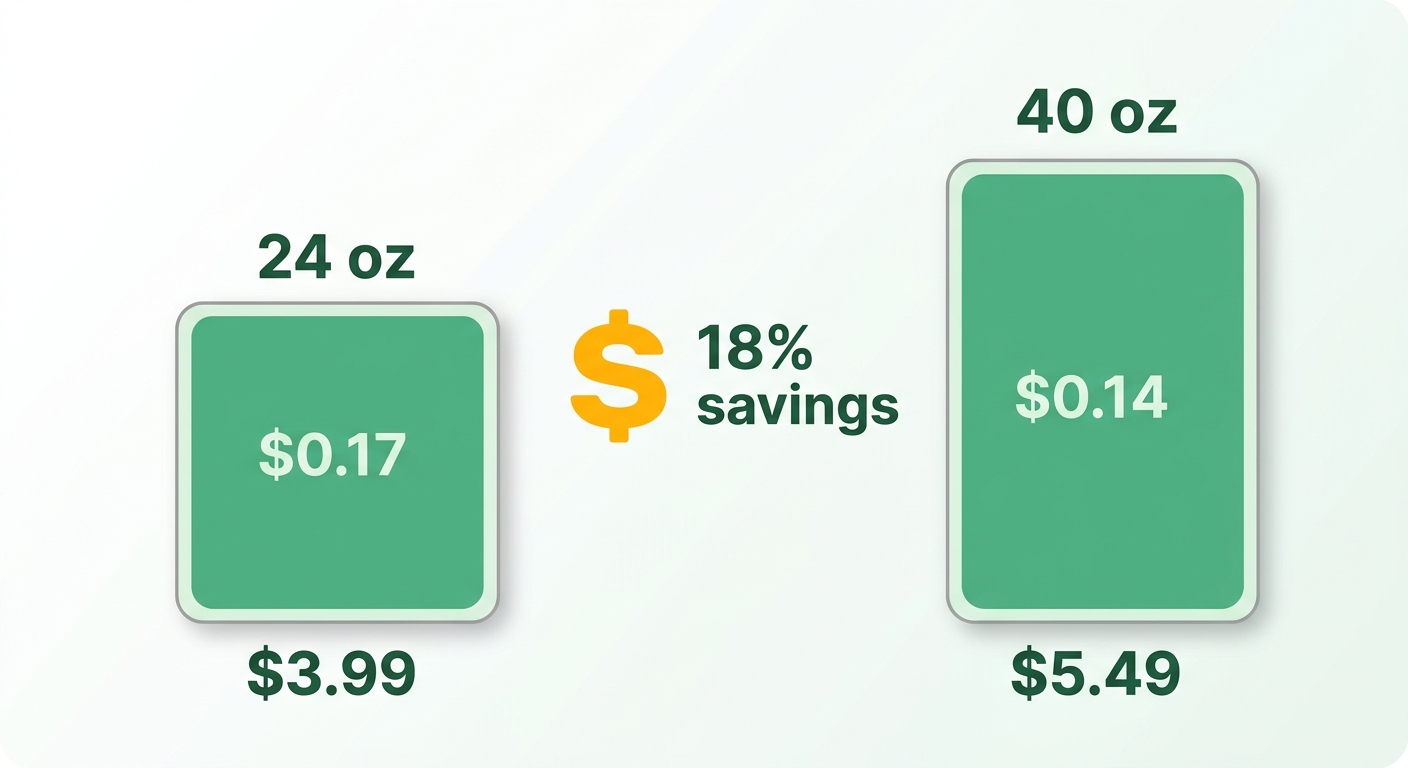
The shelf tag rarely tells the whole story. A family-size cereal box can cost twice as much as the standard box while delivering three times the servings. For parents managing food allergies, this kind of comparison gets trickier still, because you're filtering for safe ingredients first, then trying to compare pricing across different package sizes at different stores. The platform handles both in one search: it shows only products that pass your ingredient requirements, then ranks them by cost per ounce, sheet, or pound so the best value floats up.
We see this pattern constantly in user data. One search for allergen-safe hand soap returned results from $0.37 per ounce at one retailer to $1.15 at another, a 3x swing for functionally identical products. Without unit-price normalization, the mid-priced bottle on Amazon looks fine until you notice you're paying $0.74 more per ounce than the Walmart equivalent. Trivial on one bottle, sure. Repeat it across paper towels, shampoo, snacks, and detergent and it adds up when you prioritize unit price over shelf price.
How the System Calculates Unit Price Automatically
No calculator, no squinting at fine print. When you search in our Popgot tutorial, the platform reads the product description, pulls the package size, and divides price by quantity for a standardized cost per unit. A 12-roll pack of paper towels becomes price per sheet. A 64-ounce bottle of detergent becomes price per ounce. A 5-pound bag of rice becomes price per pound. All in the background, so you scan results and see which option gives you the most product per dollar.
The automation earns its keep because packaging variation makes manual comparison nearly impossible. One store sells a 24-count box of juice pouches. Another sells 18. A third sells 30. Figuring out which is cheapest per unit while also confirming each is allergen-free is exactly the friction that leads to impulse picks and abandoned carts. The AI reads every label, drops anything that fails your rules, then sorts what's left by unit price. Confident decision in seconds, not minutes.
When Total Cost Matters More Than Unit Price
Unit price isn't the last word on value. A 10-pound bag of oats at $0.08 per ounce beats a 2-pound bag at $0.12, but if you're feeding one person and the bulk size goes stale first, the "cheaper" option costs you more. For non-perishables like paper towels or detergent, the biggest unit-price winner usually makes sense. For fresh or specialty items with short shelf lives, the smaller package at a higher per-unit cost can be the smarter play.
Quality is another thing unit price won't show you. A $0.02-per-square-foot paper towel might absorb less and tear more than a $0.03 option, so you burn more sheets per task and the savings evaporate. One user noted that the gap between budget and premium brands can be real even when unit prices look close. For allergy-safe products, the bigger risk is mistaking a low unit price for a good deal when the product hides an allergen or filler. The label-reading step keeps you comparing viable, compliant options instead of risking an accidental exposure.
Curated Guides for the Stuff You Buy Every Month
If you're buying the same products month after month, allergy-safe snacks, household cleaners, personal care, you don't need to re-run the comparison each time. We offer curated shopping guides that track unit prices for frequently purchased essentials across our supported retailers. The guides update in real time, so when a price drops or a new retailer starts carrying a product, the list adjusts on its own. Bookmark a guide for your household's core items and check it before ordering to see if a better deal turned up since last time.
The guides also surface patterns you'd miss in one-off searches. Paper towels often hit their lowest per-sheet price during back-to-school promos, while detergent tends to see deeper discounts in January and February. Track items over time and you can line up bulk buys with seasonal drops. One parent in our community mentioned that pulling prices and dietary info from multiple retailers saved them time and money when hunting for products that met specific requirements.
Tracking Real-Time Prices and Sales
Shoppers spend real time checking prices at multiple stores, only to find a better deal somewhere they didn't look. It gets harder when you're also verifying ingredient lists. By the time you've ruled out products with a given allergen, it's easy to lose track of which store had the best per-ounce price. Our multi-store search handles both at once: it filters to products that pass your ingredient rules, then ranks those survivors by true unit cost across stores at the same time.
The platform pulls real-time pricing from major national chains and warehouse clubs, refreshing inventory counts and shelf prices continuously. Run a search and you're not looking at yesterday's flyer. You're seeing what each store charges right now for the exact spec you need. That kills the stale-data trap where a tool shows a deal that expired two days ago or lists a product the store no longer carries.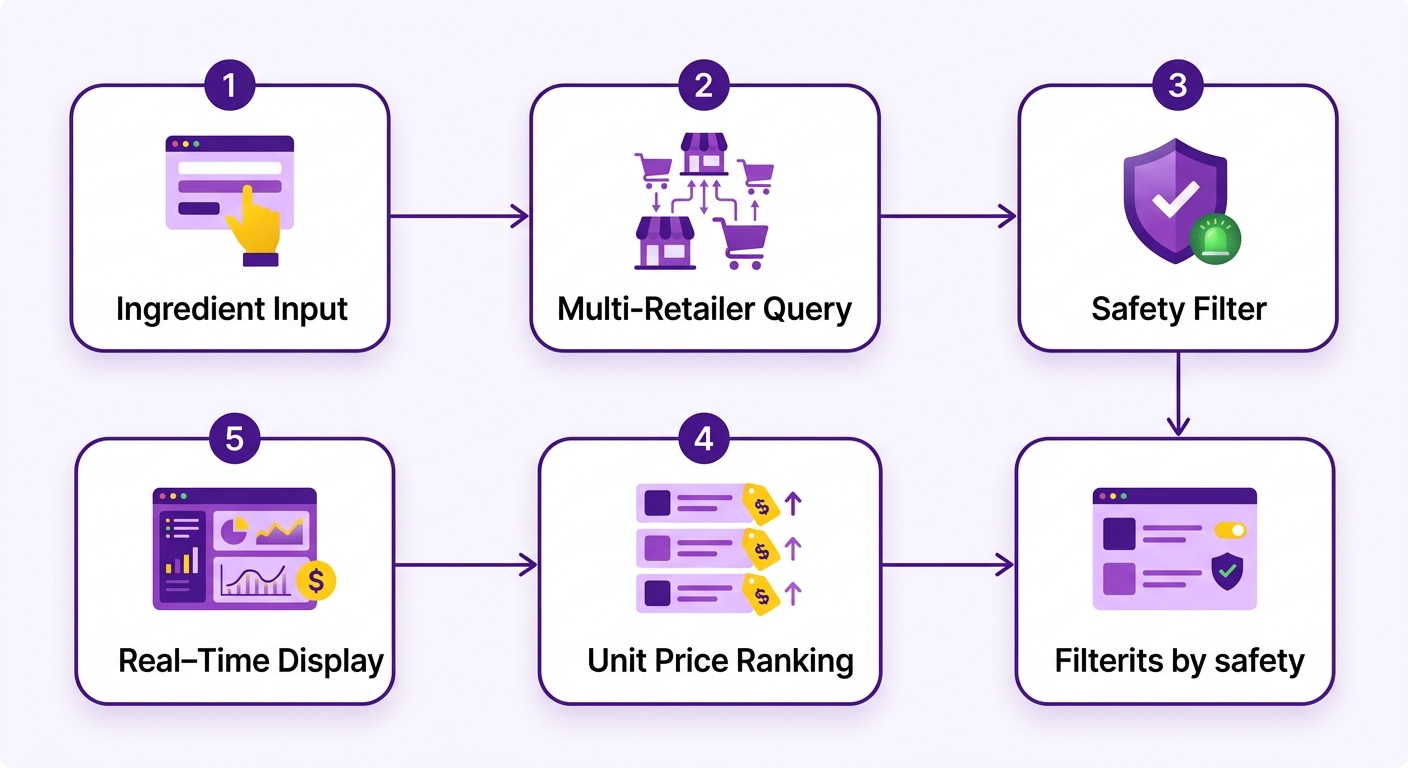
How Price Updates Work Behind the Scenes
We normalize packaging so different quantities of the same item line up. The AI reads every description to confirm the item matches your rules. Ask for gluten-free crackers under 2g sugar per serving and it won't surface a cracker at 2.5g, even if the unit price looks tempting. Only products that clear your safety gate show up, ranked cheapest to most expensive, per serving, or per count.
Price gaps across retailers can be wide. For families buying allergen-safe versions of everyday products, the spreads are often wider still, since specialty items get inconsistent distribution and stores price them independently. Comparing unit prices shows which store offers genuine value rather than just a lower sticker on a smaller package.
Setting Up Ingredient Filters to Track Safe Deals
Before you track prices, define your ingredient boundaries once. Name the allergens to exclude (dairy, eggs, peanuts, shellfish), the additives to avoid (artificial colors, high-fructose corn syrup), or the nutrients you're targeting (minimum protein per serving, maximum sodium). Our AI agent checks every product against those rules, so a search for "granola bars" returns only bars that fit. No manual label-reading.
That upfront filtering is what makes price tracking usable instead of overwhelming. Skip it and you'd stare at hundreds or thousands of protein powder listings, then spend real time weeding out the ones with unwanted ingredients or too little protein. With the filter on, you see only powders that hit your protein minimum with zero soy, ranked by cost per serving. The final pick is already compliant with what your family needs.
It also helps shoppers catch deals at warehouse clubs that looked pricier at first glance. Smaller packages often carry a premium the shelf tag doesn't advertise. On non-perishable staples alone, that can add up to meaningful monthly savings, before you count the time you'd otherwise spend driving between stores or the impulse buys you skip by shopping from a pre-verified list.
When Real-Time Tracking Earns Its Keep
Price volatility spikes around seasonal demand, back-to-school weeks, holiday baking, summer grilling. Allergen-free and specialty products can move noticeably week over week as retailers react to supply delays or promo cycles. Buying specialty flour or nut-free baking mixes during peak season? Checking prices regularly can turn up real per-ounce differences on the same product.
For staples you buy monthly, track prices over a two-week window to spot the low point in each store's cycle. Warehouse clubs rotate manufacturer rebates that can drop unit prices below even their standard bulk advantage, but those windows last days or weeks. Real-time data lets you catch the drops without calendar reminders or app-hopping. The system shows today's price and flags when something you've searched before falls below its previous low, so you know when to stock up.
Saving Time and Money with Popgot
Every week you run your list against packaging tricks built to hide the real cost. A 16-ounce jar sits beside a 24-ounce bottle, one listing price per ounce, the other per fluid ounce, and neither helps you spot the better deal in five seconds. Our eight-store search takes that math off your plate. It pulls real-time inventory from major retailers, verifies each result against your ingredient requirements, then ranks what's left.
The same AI that confirms a product is dairy-free or gluten-free also works out whether you're paying less per serving on staples you already buy. Users report that filtering for safe ingredients first, then sorting by unit price, showed them they'd been overpaying on routine purchases like pantry staples. The system catches when Costco's bulk peanut butter is $0.22 per ounce while the same brand at CVS runs $0.41. Knowing those spreads before you add to cart shows where your money goes furthest.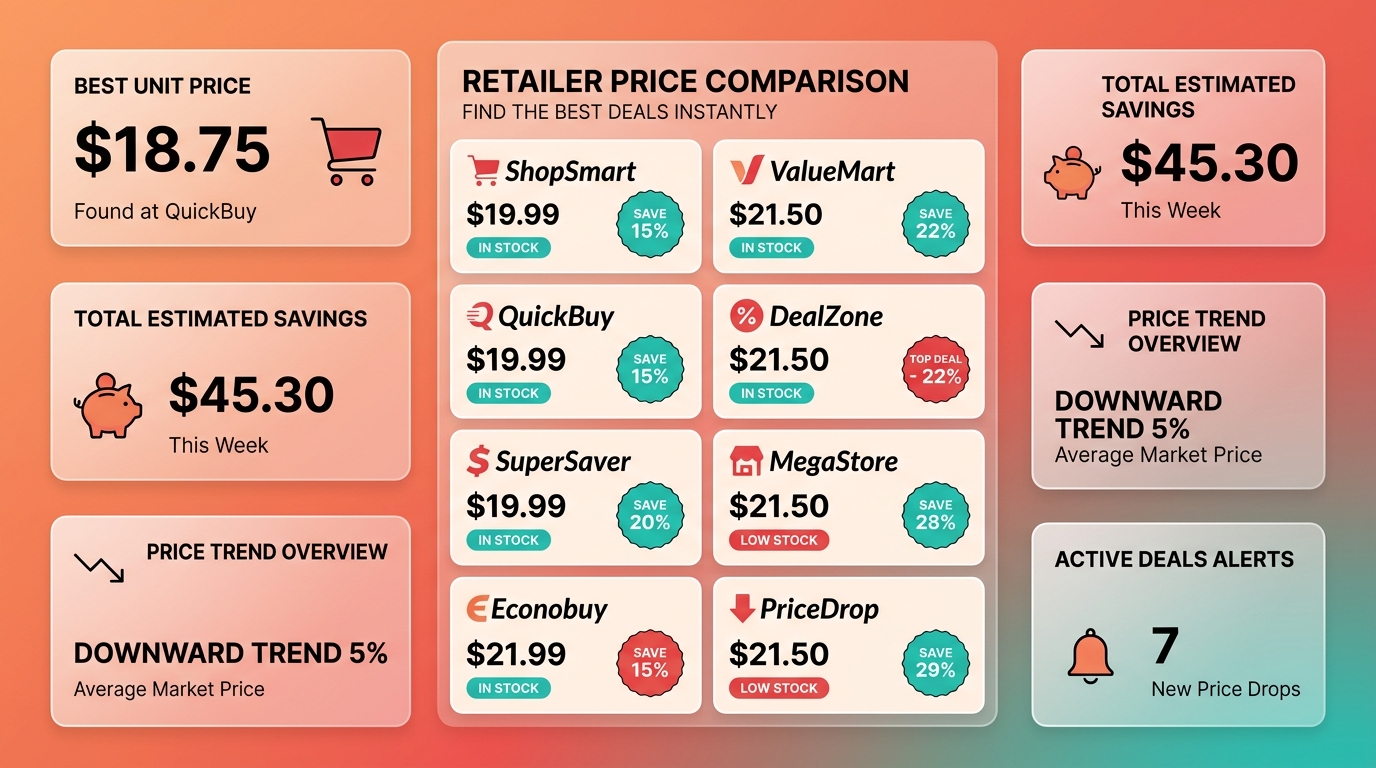
Set Ingredient Preferences Once, Save Time on Every Search
Decision fatigue compounds when you verify allergens and compare prices as separate steps. Set your profile once, no dairy, no soy, minimum protein per serving, whatever your family needs, and every result that appears has already passed those filters. The cheapest price you see is also the safest option for your household, not a tradeoff you re-litigate at checkout.
The time savings hit fastest on routine buys. Instead of reading six oat milk labels to confirm they're calcium-fortified and free of carrageenan, you specify that in your profile and the search returns only products that meet both. One user tracking their purchases found that moving three recurring items from Target to Amazon, almond milk, gluten-free crackers, and chia seeds, saved $18 a month while holding the same safety standards. You get convenience and safety together when the AI handles label-reading and price-ranking in one query.
The Price Gaps That Just Won't Close
Research on comparison shopping agents confirms that price differences persist even when search costs fall to near zero, kept alive by how consumers and retailers behave. That's exactly what you want to exploit. Personal care items, for instance, can show big swings between online marketplaces and physical discount stores, and the pattern repeats across categories because stores price the same SKU differently.
The tool doesn't erase dispersion. It surfaces the persistent gaps so you capture the savings. For specialty supplements, it highlights the cheapest verified option that meets your exact nutritional criteria, even when other retailers charge double for the same specs. Same story with protein powder at 25g+ protein, where packaging differences bury real spreads in per-serving cost. Stores won't suddenly align their prices, but the AI finds the low end of the spread while confirming every product meets your rules.
Skip this approach for one-off specialty items from niche brands. The tool shines on high-frequency staples, where small per-unit differences compound across dozens of purchases. For routine shopping, the referral program stacks on top, handing you rewards each time someone uses your link, effectively adding a discount to the unit-price savings you already banked.
References
[1] Popgot | Shop with AI that reads every label - https://popgot.com/
[2] Compare Food Prices Easily with Popgot - https://popgot.com/blog/compare-food-prices-easily-with-popgot
[3] I'm working on Popgot (https://popgot.com), a tool that tracks unit ... - https://news.ycombinator.com/item?id=43821480
[4] Popgot Scans 8 Stores for Deals While You Shop One Aisle - https://popgot.com/blog/popgot-scans-8-stores-for-deals-while-you-shop-one-aisle
[5] Popgot Blog | Unit Price Shopping Insights & Tips - https://popgot.com/blog
[6] Compare Grocery Prices Across 100+ Stores | GroceryChop - https://grocerychop.com/compare
[7] (PDF) Comparison Shopping Agents and Online Price Dispersion - https://www.researchgate.net/publication/262619425_Comparison_Shopping_Agents_and_Online_Price_Dispersion_A_Search_Cost_based_Explanation
Frequently Asked Questions
1. What stores does Popgot search when comparing prices?
Popgot scans a network of major national retailers and warehouse clubs in a single query. Rather than opening multiple browser tabs or apps, you run one search and see real-time pricing across all supported inventories, ranked by true unit cost after passing your ingredient filters.
2. Do I have to re-enter my allergy filters for every search?
No re-entry needed. Your dietary profile persists across sessions, applying your specified exclusions to every future product search. Each result you see has already passed your safety rules, so you never re-verify labels or reconfigure requirements between searches.
3. Is the cheapest per-unit option always the best choice?
Not always. For perishables, a bulk-size unit-price winner can go stale before you finish it, making the smaller package the smarter buy. Quality also matters: a lower-priced household paper product may absorb less or tear more easily, meaning you use more of it and the savings disappear.
4. How does Popgot handle products sold in different package sizes?
The platform reads each product description, extracts package size, and divides price by quantity to produce a standardized unit cost. This allows you to compare bulk packages against standard sizes accurately by normalizing the cost to a single common denominator.
5. Does Popgot work well for one-off specialty purchases?
Popgot delivers the most value on high-frequency household staples, where small per-unit differences compound across dozens of purchases. For one-off items from niche brands, the payoff is smaller since there's no repeat spending to accumulate savings across, so occasional buys benefit less.
6. How can real-time pricing help me time bulk purchases?
Real-time data flags when a product you've searched before drops below its previous low, so you stock up at the right moment. The system tracks promotional cycles and temporary discounts, catching them without requiring you to set calendar reminders.
7. What makes Popgot different from traditional price comparison tools?
Traditional tools separate finding a low price from verifying ingredients, forcing two manual steps and risking stale data. Popgot integrates these steps: it applies your dietary profile to the search results first, then ranks the compliant options by unit price using continuously refreshed data, so the cheapest result shown is both safe and economical.